

2.2: Expanding the Substitution Method - Trigonometric Substitution
- Page ID
- 128833

\( \newcommand{\vecs}[1]{\overset { \scriptstyle \rightharpoonup} {\mathbf{#1}} } \)
\( \newcommand{\vecd}[1]{\overset{-\!-\!\rightharpoonup}{\vphantom{a}\smash {#1}}} \)
\( \newcommand{\dsum}{\displaystyle\sum\limits} \)
\( \newcommand{\dint}{\displaystyle\int\limits} \)
\( \newcommand{\dlim}{\displaystyle\lim\limits} \)
\( \newcommand{\id}{\mathrm{id}}\) \( \newcommand{\Span}{\mathrm{span}}\)
( \newcommand{\kernel}{\mathrm{null}\,}\) \( \newcommand{\range}{\mathrm{range}\,}\)
\( \newcommand{\RealPart}{\mathrm{Re}}\) \( \newcommand{\ImaginaryPart}{\mathrm{Im}}\)
\( \newcommand{\Argument}{\mathrm{Arg}}\) \( \newcommand{\norm}[1]{\| #1 \|}\)
\( \newcommand{\inner}[2]{\langle #1, #2 \rangle}\)
\( \newcommand{\Span}{\mathrm{span}}\)
\( \newcommand{\id}{\mathrm{id}}\)
\( \newcommand{\Span}{\mathrm{span}}\)
\( \newcommand{\kernel}{\mathrm{null}\,}\)
\( \newcommand{\range}{\mathrm{range}\,}\)
\( \newcommand{\RealPart}{\mathrm{Re}}\)
\( \newcommand{\ImaginaryPart}{\mathrm{Im}}\)
\( \newcommand{\Argument}{\mathrm{Arg}}\)
\( \newcommand{\norm}[1]{\| #1 \|}\)
\( \newcommand{\inner}[2]{\langle #1, #2 \rangle}\)
\( \newcommand{\Span}{\mathrm{span}}\) \( \newcommand{\AA}{\unicode[.8,0]{x212B}}\)
\( \newcommand{\vectorA}[1]{\vec{#1}} % arrow\)
\( \newcommand{\vectorAt}[1]{\vec{\text{#1}}} % arrow\)
\( \newcommand{\vectorB}[1]{\overset { \scriptstyle \rightharpoonup} {\mathbf{#1}} } \)
\( \newcommand{\vectorC}[1]{\textbf{#1}} \)
\( \newcommand{\vectorD}[1]{\overrightarrow{#1}} \)
\( \newcommand{\vectorDt}[1]{\overrightarrow{\text{#1}}} \)
\( \newcommand{\vectE}[1]{\overset{-\!-\!\rightharpoonup}{\vphantom{a}\smash{\mathbf {#1}}}} \)
\( \newcommand{\vecs}[1]{\overset { \scriptstyle \rightharpoonup} {\mathbf{#1}} } \)
\(\newcommand{\longvect}{\overrightarrow}\)
\( \newcommand{\vecd}[1]{\overset{-\!-\!\rightharpoonup}{\vphantom{a}\smash {#1}}} \)
\(\newcommand{\avec}{\mathbf a}\) \(\newcommand{\bvec}{\mathbf b}\) \(\newcommand{\cvec}{\mathbf c}\) \(\newcommand{\dvec}{\mathbf d}\) \(\newcommand{\dtil}{\widetilde{\mathbf d}}\) \(\newcommand{\evec}{\mathbf e}\) \(\newcommand{\fvec}{\mathbf f}\) \(\newcommand{\nvec}{\mathbf n}\) \(\newcommand{\pvec}{\mathbf p}\) \(\newcommand{\qvec}{\mathbf q}\) \(\newcommand{\svec}{\mathbf s}\) \(\newcommand{\tvec}{\mathbf t}\) \(\newcommand{\uvec}{\mathbf u}\) \(\newcommand{\vvec}{\mathbf v}\) \(\newcommand{\wvec}{\mathbf w}\) \(\newcommand{\xvec}{\mathbf x}\) \(\newcommand{\yvec}{\mathbf y}\) \(\newcommand{\zvec}{\mathbf z}\) \(\newcommand{\rvec}{\mathbf r}\) \(\newcommand{\mvec}{\mathbf m}\) \(\newcommand{\zerovec}{\mathbf 0}\) \(\newcommand{\onevec}{\mathbf 1}\) \(\newcommand{\real}{\mathbb R}\) \(\newcommand{\twovec}[2]{\left[\begin{array}{r}#1 \\ #2 \end{array}\right]}\) \(\newcommand{\ctwovec}[2]{\left[\begin{array}{c}#1 \\ #2 \end{array}\right]}\) \(\newcommand{\threevec}[3]{\left[\begin{array}{r}#1 \\ #2 \\ #3 \end{array}\right]}\) \(\newcommand{\cthreevec}[3]{\left[\begin{array}{c}#1 \\ #2 \\ #3 \end{array}\right]}\) \(\newcommand{\fourvec}[4]{\left[\begin{array}{r}#1 \\ #2 \\ #3 \\ #4 \end{array}\right]}\) \(\newcommand{\cfourvec}[4]{\left[\begin{array}{c}#1 \\ #2 \\ #3 \\ #4 \end{array}\right]}\) \(\newcommand{\fivevec}[5]{\left[\begin{array}{r}#1 \\ #2 \\ #3 \\ #4 \\ #5 \\ \end{array}\right]}\) \(\newcommand{\cfivevec}[5]{\left[\begin{array}{c}#1 \\ #2 \\ #3 \\ #4 \\ #5 \\ \end{array}\right]}\) \(\newcommand{\mattwo}[4]{\left[\begin{array}{rr}#1 \amp #2 \\ #3 \amp #4 \\ \end{array}\right]}\) \(\newcommand{\laspan}[1]{\text{Span}\{#1\}}\) \(\newcommand{\bcal}{\cal B}\) \(\newcommand{\ccal}{\cal C}\) \(\newcommand{\scal}{\cal S}\) \(\newcommand{\wcal}{\cal W}\) \(\newcommand{\ecal}{\cal E}\) \(\newcommand{\coords}[2]{\left\{#1\right\}_{#2}}\) \(\newcommand{\gray}[1]{\color{gray}{#1}}\) \(\newcommand{\lgray}[1]{\color{lightgray}{#1}}\) \(\newcommand{\rank}{\operatorname{rank}}\) \(\newcommand{\row}{\text{Row}}\) \(\newcommand{\col}{\text{Col}}\) \(\renewcommand{\row}{\text{Row}}\) \(\newcommand{\nul}{\text{Nul}}\) \(\newcommand{\var}{\text{Var}}\) \(\newcommand{\corr}{\text{corr}}\) \(\newcommand{\len}[1]{\left|#1\right|}\) \(\newcommand{\bbar}{\overline{\bvec}}\) \(\newcommand{\bhat}{\widehat{\bvec}}\) \(\newcommand{\bperp}{\bvec^\perp}\) \(\newcommand{\xhat}{\widehat{\xvec}}\) \(\newcommand{\vhat}{\widehat{\vvec}}\) \(\newcommand{\uhat}{\widehat{\uvec}}\) \(\newcommand{\what}{\widehat{\wvec}}\) \(\newcommand{\Sighat}{\widehat{\Sigma}}\) \(\newcommand{\lt}{<}\) \(\newcommand{\gt}{>}\) \(\newcommand{\amp}{&}\) \(\definecolor{fillinmathshade}{gray}{0.9}\)
To succeed in this section, you'll need to use some skills from previous courses. While you should already know them, this is the first time they've been required. You can review these skills in CRC's Corequisite Codex. If you have a support class, it might cover some, but not all, of these topics.
The following is a list of learning objectives for this section.
|
.png?revision=1) To access the Hawk A.I. Tutor, you will need to be logged into your campus Gmail account. |
In this section, we explore integrals containing expressions of the form \(\sqrt{a^2−x^2}\), \(\sqrt{a^2+x^2}\), and \(\sqrt{x^2−a^2}\), where the values of \(a\) are positive. We have already encountered and evaluated integrals containing some expressions of this type, but many remain inaccessible. The trigonometric substitution technique is convenient when evaluating these integrals. This technique, which is a specific use of the Substitution Method, rewrites these integrals as trigonometric integrals.
Before diving into the instruction, it's best to recall the following identities from Trigonometry (all based on the Pythagorean Identity):
- \( \cos^2 \theta = 1 - \sin^2 \theta \),
- \( \sec^2 \theta = 1 + \tan^2 \theta \), and
- \( \tan^2 \theta = \sec^2 \theta - 1 \).
Note that the forms of these expressions match the radicands in
- \( \sqrt{a^2 - x^2} \) (where \( x = a \sin \theta \)),
- \( \sqrt{a^2 + x^2} \) (where \( x = a \tan \theta \)), and
- \( \sqrt{x^2 - a^2} \) (where \( x = a \sec \theta \)).
This observation will be compelling. It would be best to convince yourself that these forms are incredibly similar.
The final bit of "recall" we will need before developing the method of trigonometric substitution are the ranges of the inverse trigonometric functions. Specifically, we will need to remember, from Section 1.6 in the Differential Calculus textbook, the following range restrictions:\[ \begin{array}{ccccl}
\sin^{−1}(y) = \theta & \text{ if and only if } & \sin(\theta) = y & \text{ where } & \theta \in \left[−\dfrac{ \pi }{2}, \dfrac{ \pi }{2} \right] \\[6pt]
\tan^{−1}(y) = \theta & \text{ if and only if } & \tan(\theta) = y & \text{ where } & \theta \in \left(−\dfrac{ \pi }{2}, \dfrac{ \pi }{2} \right) \\[6pt]
\sec^{−1}(y) = \theta & \text{ if and only if } & \sec(\theta) = y & \text{ where } & \theta \in \left[0, \dfrac{\pi}{2} \right) \cup \left[ \pi, \dfrac{3 \pi}{2} \right). \\[6pt]
\end{array} \nonumber \]You should already be comfortable with the restrictions on \( \theta \) for both the arcsine and arctangent from your Trigonometry or Precalculus course; however, the following snippet from Section 1.6 in the Differential Calculus textbook should begin to justify our choice of range for the arcsecant.
Integrals Involving \(\sqrt{a^2−x^2}\)
Before developing a general strategy for integrals containing \(\sqrt{a^2−x^2}\), consider the integral \(\displaystyle \int \sqrt{9−x^2} \, dx.\) This integral cannot be evaluated using any of the techniques we have discussed so far. However, if we make the substitution \(x=3\sin \theta \), we have \(dx=3\cos \theta \, d \theta .\) After substituting into the integral, we have\[ \int \sqrt{9−x^2}\,dx= \int \sqrt{ 9−(3\sin \theta )^2}\cdot 3\cos \theta \,d \theta . \nonumber \]After simplifying, we have\[ \int \sqrt{ 9−x^2}\,dx= \int 9 \sqrt{1−\sin^2 \theta }\cdot\cos \theta \, d \theta . \nonumber \]Letting \(1−\sin^2 \theta =\cos^2 \theta ,\) we now have\[ \int \sqrt{ 9−x^2}\,dx= \int 9 \sqrt{\cos^2 \theta }\cos \theta \, d \theta . \nonumber \]Assuming that \(\cos \theta \geq 0\),1 we have\[ \int \sqrt{ 9−x^2}\,dx= \int 9\cos^2 \theta \, d \theta . \nonumber \]At this point, we can evaluate the integral using the techniques developed for integrating powers and products of trigonometric functions. Before completing this example, let's examine the general theory behind this idea.
To evaluate integrals involving \(\sqrt{a^2−x^2}\), we make the substitution \(x=a\sin \theta \) and \(dx=a\cos \theta \, d \theta \). To see that this makes sense, consider the following argument: The domain of \(\sqrt{a^2−x^2}\) is \([−a, a]\). Thus,\[−a \leq x \leq a. \label{sinedomain} \]Consequently,\[−1 \leq \dfrac{x}{a} \leq 1. \nonumber \]Since the range of \(\sin \theta\) over \(\left[−\frac{\pi}{2}, \frac{\pi}{2}\right]\) is \([−1,1]\), there is a unique angle \( \theta \) satisfying \(−\frac{\pi}{2} \leq \theta \leq \frac{\pi}{2}\) so that \(\sin \theta = \frac{x}{a}\), or equivalently, so that \(x=a\sin \theta \). If we substitute \(x=a\sin \theta \) into \(\sqrt{a^2−x^2}\), we get\[\begin{array}{rclcl}
\sqrt{a^2−x^2} & = & \sqrt{a^2−(a\sin \theta )^2} & \quad & \left( x=a\sin \theta \text{ where }−\dfrac{ \pi }{2} \leq \theta \leq \dfrac{ \pi }{2} \right) \\[6pt]
& = & \sqrt{a^2−a^2\sin^2 \theta } & & \\[6pt]
& = & \sqrt{a^2(1−\sin^2 \theta )} & \quad & \left( \text{factoring} \right) \\[6pt]
& = & \sqrt{a^2\cos^2 \theta } & \quad & \left( \text{Pythagorean Identity} \right) \\[6pt]
& = & |a\cos \theta | & \quad & \left( \sqrt{a^2 \cos^2 \theta} = |a \cos \theta| \right) \\[6pt]
\end{array} \nonumber \]Since \(\cos \theta \geq 0\) on \(−\frac{ \pi }{2} \leq \theta \leq \frac{ \pi }{2}\) and \(a \gt 0\), \(|a\cos \theta |=a\cos \theta\).
Therefore, by making the substitution \(x=a \sin \theta \), we can convert an integral involving a radical into an integral involving trigonometric functions, where we have the added benefit of not worrying about absolute values. From this point, we need to evaluate the integral. Once this is done, however, we must convert the solution to an expression involving \(x\). To do this, we begin by drawing a reference triangle for \( \theta \) (see Figure \( \PageIndex{1} \)).

Figure \(\PageIndex{1}\): A reference triangle can help express the trigonometric functions evaluated at \( \theta \) in terms of \(x\).
Since \( -\frac{\pi}{2} \leq \theta \leq \frac{\pi}{2} \), this reference triangle can only be drawn in quadrants I or IV. In either case,\[ \begin{array}{rcl}
\sin \theta & = & \dfrac{x}{a} \\[6pt]
\cos \theta & = & \dfrac{\sqrt{a^2 - x^2}}{a} \\[6pt]
\tan \theta & = & \dfrac{x}{\sqrt{a^2 - x^2}}. \\[6pt]
\end{array} \nonumber \]Hence, no matter what trigonometric function is in the result of our evaluated integral, we can rewrite it as a function of \( x \). Should \( \theta \) appear by itself, we use \( \theta =\sin^{−1}\left(\frac{x}{a}\right)\).2
The essential part of this discussion is summarized in the following problem-solving strategy.
- It is an excellent idea to make sure the integral cannot be evaluated easily in another way. For example, although this method can be applied to integrals of the form \[\int \dfrac{1}{\sqrt{a^2−x^2}}\, dx, \quad \int \dfrac{x}{\sqrt{a^2−x^2}}\, dx, \quad \text{and} \quad \int x\sqrt{a^2−x^2}\, dx,\nonumber \]they can each be integrated directly either by formula or by a simple \(u\)-substitution.
- Make the substitution \(x=a \sin \theta \) and \(dx =a\cos \theta \,d \theta .\) Note: This substitution yields \(\sqrt{a^2−x^2}=a\cos \theta .\)
- Simplify the expression.
- Evaluate the integral using techniques from the Section 2.1.
- Use a reference triangle to rewrite the result in terms of \(x\). You may also need to use some trigonometric identities and the relationship \( \theta =\sin^{−1}\left(\frac{x}{a}\right)\).
The following example demonstrates the application of this problem-solving strategy.
Evaluate\[ \int \sqrt{ 9−x^2} \, dx. \nonumber \]
- Solution
-
\( \boxed{\times} \) Direct Integration
\( \boxed{\times} \) Simple \( u \)-Substitution: Letting \( u = 9 - x^2 \) results in \( du = -2x \, dx \). I leave it to the reader to verify that this results in an uglier (and more difficult) integrand.
\( \boxed{\times} \) Radical Substitution: Letting \( u = \sqrt{9 - x^2} \) means \( u^2 = 9 - x^2 \). Therefore, \( 2u \, du = -2x \, dx \implies u \, du = - x \, dx\). Again, I leave it to the reader to verify that this results in an uglier (and more difficult) integrand.
\( \boxed{\checkmark} \) Trigonometric Substitution: We can try the trigonometric substitution \(x=3\sin \theta \) so that \(dx=3\cos \theta \, d \theta\). Since \(\sin \theta =\frac{x}{3}\), we can construct the reference triangle shown in Figure \( \PageIndex{2} \).
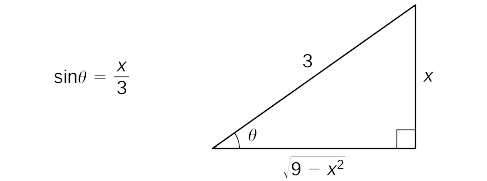
Figure \(\PageIndex{2}\)Thus,\[ \begin{array}{rclcl}
\displaystyle \int \sqrt{9−x^2}\,dx & = & \displaystyle \int \sqrt{ 9−(3\sin \theta )^2} \cdot 3\cos \theta \,d \theta & \quad & \left( x=3\sin \theta \implies dx=3\cos \theta \,d \theta \right) \\[6pt]
& = & \displaystyle \int \sqrt{ 9(1−\sin^2 \theta )}\cdot 3\cos \theta \, d \theta & & \\[6pt]
& = & \displaystyle \int \sqrt{ 9\cos^2 \theta }\cdot 3\cos \theta \, d \theta & \quad & \left( \text{Pythagorean Identity} \right) \\[6pt]
& = & \displaystyle \int 3|\cos \theta |3\cos \theta \, d \theta & \quad & \left( \sqrt{\blacksquare^2} = |\blacksquare| \right) \\[6pt]
& = & \displaystyle \int 9\cos^2 \theta \, d \theta & \quad & \left( -\dfrac{ \pi }{2} \leq \theta \leq \dfrac{ \pi }{2} \implies \cos \theta \geq 0 \implies |\cos \theta |=\cos \theta \right) \\[6pt]
& = & \displaystyle \int 9\left(\dfrac{1}{2}+\dfrac{1}{2}\cos(2 \theta )\right)\,d \theta & \quad & \left( \text{Power Reduction Identity} \right) \\[6pt]
& = & \dfrac{9}{2} \theta +\dfrac{9}{4}\sin(2 \theta )+C & & \\[6pt]
& = & \dfrac{9}{2} \theta +\dfrac{9}{4}(2\sin \theta \cos \theta )+C & \quad & \left( \text{Double-Angle Identity} \right) \\[6pt]
& = & \dfrac{9}{2}\sin^{−1}\left(\dfrac{x}{3}\right)+\dfrac{9}{2} \cdot \dfrac{x}{3} \cdot \dfrac{\sqrt{9−x^2}}{3}+C & \quad & \left( \text{resubstitute }\sin^{−1}\left(\dfrac{x}{3}\right)= \theta\text{ and use the reference triangle} \right) \\[6pt]
& = & \dfrac{9}{2}\sin^{−1}\left(\dfrac{x}{3}\right)+\dfrac{x\sqrt{9−x^2}}{2}+C & & \\[6pt]
\end{array} \nonumber \]
Example \( \PageIndex{1} \) showcases something that I tell my students repeatedly - mastery of Trigonometry is a requirement for your success in Calculus. If you need to brush up on lost Trigonometry skills, please see Section 1.6 of the Differential Calculus textbook for a single-section review of all basic material required from Trigonometry for survival in Calculus. More topics are required from your Trigonometry and Precalculus course than are shown in that section; however, those missing topics (e.g., polar coordinates and parametric equations) will be reviewed later.
Evaluate\[ \displaystyle \int \dfrac{\sqrt{4−\frac{25}{9} x^2}}{x} \, dx. \nonumber \]
- Solution
-
\( \boxed{\times} \) Direct Integration
\( \boxed{\times} \) Simple \( u \)-Substitution: Letting \( u = 4 - \frac{25}{9} x^2 \) results in \( du = -\frac{50}{9} x \, dx \). I leave it to the reader to verify that this results in \( -\frac{1}{2} \int \frac{\sqrt{u}}{4 - u} \, du \), which is no better than where we started.
\( \boxed{\times} \) Radical Substitution: For the same reasons that the simple \( u \)-substitution didn't work, a radical substitution is not viable either.
\( \boxed{\checkmark} \) Trigonometric Substitution: We want \( \frac{25}{9} x^2 = 4 \sin^2 \theta \), so we make the substitution \( \frac{5}{3} x = 2 \sin \theta \), which leads to \( \frac{5}{3} \, dx = 2 \cos \theta \, d \theta \). Solving this for \( dx \), we get \( dx = \frac{6}{5} \cos \theta \, d \theta \). We also need to rewrite the denominator in the integrand in terms of \( \theta \). Collecting everything in a nice group, we have the following:
- \( \frac{25}{9} x^2 = 4 \sin^2 \theta \)
- \( x = \frac{6}{5} \sin \theta \)
- \( dx = \frac{6}{5} \cos \theta \, d \theta \)
As in Example \( \PageIndex{1} \), we draw a reference triangle to help our conversions, and we get\[ \begin{array}{rclcl}
\displaystyle \int \dfrac{\sqrt{4− \frac{25}{9} x^2}}{x}\,dx & = & \displaystyle \int \dfrac{\sqrt{4− 4 \sin^2 \theta }}{\cancel{\dfrac{6}{5}} \sin \theta } \cdot \cancel{\dfrac{6}{5}} \cos \theta \, d \theta & & \\[6pt]
& = & \displaystyle \int \dfrac{2 \sqrt{\cos^2 \theta} \cdot \cos \theta }{\sin \theta }\,d \theta & \quad & \left( \text{Pythagorean Identity} \right) \\[6pt]
& = & \displaystyle \int \dfrac{2 |\cos \theta| \cdot \cos \theta }{\sin \theta }\,d \theta & \quad & \left( \sqrt{\blacksquare^2} = |\blacksquare| \right) \\[6pt]
& = & \displaystyle \int \dfrac{2 \cos^2 \theta }{\sin \theta }\,d \theta & & \\[6pt]
& = & \displaystyle \int \dfrac{2(1−\sin^2 \theta )}{\sin \theta }\,d \theta & & \left( \text{Pythagorean Identity} \right) \\[6pt]
& = & \displaystyle \int (2\csc \theta −2\sin \theta )\,d \theta & & \\[6pt]
& = & 2 \ln |\csc \theta −\cot \theta |+2\cos \theta +C & & \\[6pt]
& = & 2 \ln \left|\dfrac{6}{5x}−\dfrac{3 \sqrt{4−\dfrac{25}{9} x^2}}{5x}\right|+\sqrt{4− \dfrac{25}{9} x^2}+C & \quad & \left( \text{using the reference triangle} \right) \\[6pt]
& = & 2 \ln \left|\dfrac{6 − \sqrt{36 − 25 x^2}}{5x}\right|+\dfrac{1}{3} \sqrt{36 − 25 x^2}+C & & \\[6pt]
\end{array} \nonumber \]
In the next example, we see that we sometimes have a choice of methods.
Evaluate \( \displaystyle \int x^3\sqrt{1−x^2}dx\) two ways: first by using the substitution \(u=1−x^2\) and then by using a trigonometric substitution.
- Solution
-
Method 1
Let \(u=1−x^2\). Hence, \(x^2=1−u\). Thus, \(du=−2x\,dx\). In this case, the integral becomes\[ \begin{array}{rcl}
\displaystyle \int x^3\sqrt{1−x^2}\,dx & = & −\dfrac{1}{2} \displaystyle \int x^2\sqrt{1−x^2}(−2x\,dx) \\[6pt]
& = & −\dfrac{1}{2} \displaystyle \int (1−u)\sqrt{u}\,du \\[6pt]
& = & -\dfrac{1}{2} \displaystyle \int (u^{1/2}−u^{3/2})\,du \\[6pt]
& = & −\dfrac{1}{2}\left(\dfrac{2}{3}u^{3/2}−\dfrac{2}{5}u^{5/2}\right)+C \\[6pt]
& = & −\dfrac{1}{3}(1−x^2)^{3/2}+\dfrac{1}{5}(1−x^2)^{5/2}+C \\[6pt]
\end{array} \nonumber \]Method 2
Let \(x=\sin \theta \). In this case, \(dx=\cos \theta \, d \theta\). Using this substitution, we have\[ \begin{array}{rclcl}
\displaystyle \int x^3\sqrt{1−x^2}\,dx & = & \displaystyle \int \sin^3 \theta \cos^2 \theta \, d \theta & &\\[6pt]
& = & \displaystyle \int (1−\cos^2 \theta )\cos^2 \theta \sin \theta \, d \theta & & \\[6pt]
& = & \displaystyle \int (u^4−u^2)\,du & \quad & \left( u=\cos \theta \implies du=−\sin \theta \, d \theta \right) \\[6pt]
& = & \dfrac{1}{5}u^5−\dfrac{1}{3}u^3+C & & \\[6pt]
& = & \dfrac{1}{5}\cos^5 \theta −\dfrac{1}{3}\cos^3 \theta +C & & \\[6pt]
& = & \dfrac{1}{5}(1−x^2)^{5/2}−\dfrac{1}{3}(1−x^2)^{3/2}+C & \quad & \left( \text{using the reference triangle} \right) \\[6pt]
\end{array} \nonumber \]
Rewrite the integral \(\displaystyle \int \frac{x^3}{\sqrt{25−x^2}}\, dx\) using the appropriate trigonometric substitution (do not evaluate the integral).
- Answer
-
\(\displaystyle \int 125\sin^3 \theta \, d \theta \)
Integrating Expressions Involving \(\sqrt{a^2+x^2}\)
For integrals containing \(\sqrt{a^2+x^2}\), let's first consider the domain of this expression. Since \(\sqrt{a^2+x^2}\) is defined for all real values of \(x\), we restrict our choice to those trigonometric functions that have a range of all real numbers. Thus, we are restricted to selecting either \(x=a\tan \theta \) or \(x=a\cot \theta \). Either of these substitutions would work, but the standard substitution is \(x=a\tan \theta \) or, equivalently, \(\tan \theta = \frac{x}{a}\). With this substitution, we make the assumption that \(−\frac{\pi}{2} \lt \theta \lt \frac{\pi}{2}\), so that we also have \( \theta =\tan^{−1}\left( \frac{x}{a} \right)\). As before, let's derive the concept.
Since the range of \(\tan \theta\) over \(\left(−\frac{\pi}{2}, \frac{\pi}{2}\right)\) is \((−\infty,\infty)\), there is a unique angle \( \theta \) satisfying \(−\frac{\pi}{2} \lt \theta \lt \frac{\pi}{2}\) so that \(\tan \theta = \frac{x}{a}\), or equivalently, so that \(x=a\tan \theta \). If we substitute \(x=a\tan \theta \) into \(\sqrt{a^2 + x^2}\), we get\[\begin{array}{rclcl}
\sqrt{a^2 + x^2} & = & \sqrt{a^2 + (a \tan \theta )^2} & \quad & \left( x=a\tan \theta \text{ where }-\dfrac{ \pi }{2} \lt \theta \lt \dfrac{ \pi }{2} \right) \\[6pt]
& = & \sqrt{a^2 + a^2\tan^2 \theta } & & \\[6pt]
& = & \sqrt{a^2(1+\tan^2 \theta )} & \quad & \left( \text{factoring out }a^2 \right) \\[6pt]
& = & \sqrt{a^2\sec^2 \theta } & \quad & \left( \text{Pythagorean Identity} \right) \\[6pt]
& = & |a\sec \theta | & \quad & \left( \sqrt{\blacksquare^2} = |\blacksquare | \right) \\[6pt]
\end{array} \nonumber \]Since \(\sec \theta \geq 0\) on \(−\frac{ \pi }{2} \lt \theta \lt \frac{ \pi }{2}\) and \(a \gt 0\), \(|a\sec \theta |=a\sec \theta\).
We again arrive at the beautiful result that making the substitution \(x=a \tan \theta \) allows us to convert an integral involving a radical into an integral involving trigonometric functions, where we have the added benefit of not worrying about absolute values. To convert our solution back to an expression involving \(x\), we draw a reference triangle for \( \theta \) (see Figure \( \PageIndex{3} \)).
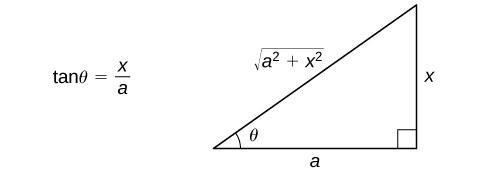
Figure \(\PageIndex{3}\): A reference triangle can be constructed to express the trigonometric functions evaluated at \( \theta \) in terms of \(x\).
Since \( -\frac{\pi}{2} \lt \theta \lt \frac{\pi}{2} \), this reference triangle can only be drawn in quadrants I or IV. In either case,\[ \begin{array}{rcl}
\sin \theta & = & \dfrac{x}{\sqrt{a^2 + x^2}} \\[6pt]
\cos \theta & = & \dfrac{a}{\sqrt{a^2 + x^2}} \\[6pt]
\tan \theta & = & \dfrac{x}{a}. \\[6pt]
\end{array} \nonumber \]Hence, no matter what trigonometric function is in the result of our evaluated integral, we can rewrite it as a function of \( x \). Should \( \theta \) appear by itself, we use \( \theta =\tan^{−1}\left(\frac{x}{a}\right)\). The procedure for using this substitution is outlined in the following problem-solving strategy.
- Check whether the integral can be evaluated easily using another method. In some cases, it is more convenient to use an alternative method.3
- Substitute \(x=a\tan \theta \) and \(dx=a\sec^2 \theta \, d \theta\). This substitution yields\[\sqrt{a^2+x^2}=\sqrt{a^2+(a\tan \theta )^2}=\sqrt{a^2(1+\tan^2 \theta )}=\sqrt{a^2sec^2 \theta }=|a\sec \theta |=a\sec \theta .\nonumber \]Since \(−\frac{ \pi }{2} \lt \theta \lt \frac{ \pi }{2}\) and \(\sec \theta \gt 0\) over this interval, \(|a\sec \theta |=a\sec \theta \).
- Simplify the expression.
- Evaluate the integral using techniques from the section on trigonometric integrals.
- Use the reference triangle from Figure \(\PageIndex{3}\) to rewrite the result in terms of \(x\). You may also need to use some trigonometric identities and the relationship \( \theta =\tan^{−1}\left(\frac{x}{a}\right)\).4,5
Evaluate \(\displaystyle \int \frac{dx}{\sqrt{1+x^2}}\) and check the solution by differentiating.
- Solution
-
\( \boxed{\times} \) Direct Integration*
\( \boxed{\times} \) Simple \( u \)-Substitution: Letting \( u = 1 + x^2 \) results in \( du = 2x \, dx \). I leave it to the reader to verify that this results in an uglier (and more difficult) integrand.
\( \boxed{\times} \) Radical Substitution: At this this point, you might have guessed that if the simple substitution doesn't work out nicely, nor will the related radical substitution.
\( \boxed{\checkmark} \) Trigonometric Substitution: Begin with the substitution \(x=\tan \theta \) and \(dx= \sec^2 \theta \, d \theta \). Since \(\tan \theta =x\), draw the reference triangle in Figure \(\PageIndex{4}\).
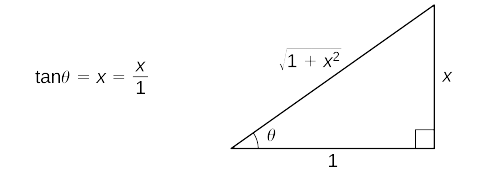
Figure \(\PageIndex{4}\)Thus,\[\begin{array}{rclcl}
\displaystyle \int \dfrac{dx}{\sqrt{1+x^2}} & = & \displaystyle \int \dfrac{\sec^2 \theta }{\sec \theta } \, d \theta & \quad & \left(x=\tan \theta \implies dx=\sec^2 \theta \, d \theta \implies \sqrt{1+x^2}=\sec \theta \right) \\[6pt]
& = & \displaystyle \int \sec \theta \, d \theta & & \\[6pt]
& = & \ln |\sec \theta +\tan \theta |+C & & \\[6pt]
& = & \ln |\sqrt{1+x^2}+x|+C & \left(\text{using the reference triangle} \right) \\[6pt]
\end{array} \nonumber \]To check the solution, differentiate:\[\dfrac{d}{dx}\left( \ln |\sqrt{1+x^2}+x|\right)=\dfrac{1}{\sqrt{1+x^2}+x} \cdot \left(\dfrac{x}{\sqrt{1+x^2}}+1\right) =\dfrac{1}{\sqrt{1+x^2}+x} \cdot \dfrac{x+\sqrt{1+x^2}}{\sqrt{1+x^2}}=\dfrac{1}{\sqrt{1+x^2}}. \nonumber \]Since \(\sqrt{1+x^2}+x \gt 0\) for all values of \(x\), we could rewrite \( \ln |\sqrt{1+x^2}+x|+C= \ln (\sqrt{1+x^2}+x)+C\), if desired.
* In Differential Calculus, you learned about the hyperbolic functions, their inverses, and the derivatives of both the base hyperbolic functions and their inverses. At the time, it was very likely that you were not required to memorize the derivatives of the inverse hyperbolic functions; however, if you happened to have stored those derivatives in your brain, then Example \( \PageIndex{4} \) could be much easier. Let's take a look at what I mean.
Use the substitution \(x = \sinh t \) to evaluate \(\displaystyle \int \frac{dx}{\sqrt{1+x^2}}.\)
- Solution
-
Because \(\sinh t \) has a range of all real numbers, and \(1+\sinh^2 t =\cosh^2 t \), we may use the substitution \(x=\sinh t \) to evaluate this integral. In this case, \(dx=\cosh t \,dt\), Consequently,\[\begin{array}{rclcl}
\displaystyle \int \dfrac{dx}{\sqrt{1+x^2}} & = & \displaystyle \int \dfrac{\cosh t }{\sqrt{1+\sinh^2 t }} \, dt & \quad & \left( x=\sinh t \implies dx=\cosh t \, dt \right) \\[6pt]
& = & \displaystyle \int \dfrac{\cosh t }{\sqrt{\cosh^2 t }} \, dt & \quad & \left( 1+\sinh^2 t =\cosh^2 t \right) \\[6pt]
& = & \displaystyle \int \dfrac{\cosh t }{|\cosh t |} \, dt & & \\[6pt]
& = & \displaystyle \int \dfrac{\cosh t }{\cosh t } \, dt & \quad & \left(\cosh t \gt 0 \text{ for all } t \implies |\cosh t |=\cosh t \right) \\[6pt]
& = & \displaystyle \int \, dt & & \\[6pt]
& = & t + C & & \\[6pt]
& = & \sinh^{-1} x + C & & \\[6pt]
\end{array} \nonumber \]
Example \( \PageIndex{5} \) deserves a couple comments. First, I did not use \( \theta \) as the argument for \( \sinh \) and \( \cosh \) because we traditionally reserve \( \theta \) for angles. The argument of the hyperbolic functions are not angles, so it's a bit safer to use a variable that does not invoke thoughts of angles. If you were unaware of this fact, please see Section 1.7 of the Differential Calculus textbook for a discussion that the arguments of the hyperbolic functions are neither angles nor arc lengths.
The second comment is a continuation of my comments before Example \( \PageIndex{5} \). Had we recalled that\[ \dfrac{d}{dt} \sinh^{-1} t = \dfrac{1}{\sqrt{1 + t^2}}, \nonumber \]we would have easily finished Example \( \PageIndex{5} \) in a single step; however, the answers to Examples \( \PageIndex{4} \) and \( \PageIndex{5} \) don't appear to match. To rectify this, we would need to recall that\[\sinh^{−1}x= \ln (x+\sqrt{x^2+1}). \nonumber \]
Rewrite \(\displaystyle \int x^3\sqrt{x^2+4} \, dx\) by using a substitution involving \(\tan \theta \).
- Answer
-
\[ \int 32\tan^3 \theta \sec^3 \theta \, d \theta \nonumber \]
Integrating Expressions Involving \(\sqrt{x^2−a^2}\)
The domain of the expression \(\sqrt{x^2−a^2}\) is \((− \infty ,−a] \cup [a, \infty )\). Thus, either \(x \le −a\) or \(x \ge a\). Hence, \(\frac{x}{a} \leq −1\) or \(\frac{x}{a} \geq 1\). Since these intervals correspond to the range of \(\sec \theta \) on the set \(\left[0,\frac{ \pi }{2} \right) \cup \left[\pi, \frac{3 \pi}{2} \right)\), it makes sense to use the substitution \(\sec \theta =\frac{x}{a}\) or, equivalently, \(x=a\sec \theta \), where \(0 \leq \theta \lt \frac{ \pi }{2}\) or \(\pi \leq \theta \lt \frac{3 \pi}{2} \). The corresponding substitution for \(dx\) is \(dx=a\sec \theta \tan \theta \, d \theta \). Again, we derive the process below.6
Since the range of \(\sec \theta\) over \(\left[0, \frac{\pi}{2}\right) \cup \left[ \pi, \frac{3 \pi}{2} \right) \) is \((-\infty, -1] \cup [1, \infty)\), there is a unique angle \( \theta \) satisfying \(0 \leq \theta \lt \frac{\pi}{2}\) or \( \pi \leq \theta \lt \frac{3 \pi}{2} \) so that \(\sec \theta = \frac{x}{a}\), or equivalently, so that \(x=a\sec \theta \). If we substitute \(x=a\sec \theta \) into \(\sqrt{x^2 - a^2}\), we get\[\begin{array}{rclcl}
\sqrt{x^2 - a^2} & = & \sqrt{(a \sec \theta )^2 - a^2} & \quad & \left( x=a\sec \theta \text{ where }0 \leq \theta \lt \dfrac{ \pi }{2} \text{ or } \pi \leq \theta \lt \dfrac{3 \pi}{2} \right) \\[6pt]
& = & \sqrt{a^2\sec^2 \theta - a^2} & & \\[6pt]
& = & \sqrt{a^2(\sec^2 \theta - 1 )} & \quad & \left( \text{factoring out }a^2 \right) \\[6pt]
& = & \sqrt{a^2\tan^2 \theta } & \quad & \left( \text{Pythagorean Identity} \right) \\[6pt]
& = & |a\tan \theta | & \quad & \left( \sqrt{\blacksquare^2} = |\blacksquare| \right) \\[6pt]
\end{array} \nonumber \]Since \(\tan \theta \geq 0\) on \(0 \leq \theta \lt \frac{ \pi }{2}\) and \( \pi \leq \theta \lt \frac{3 \pi}{2} \), and because \(a \gt 0\), \(|a\tan \theta |=a\tan \theta\).
Once more, by making the substitution \(x=a \sec \theta \), we can convert an integral involving a radical into an integral involving trigonometric functions, where we have the added benefit of not worrying about absolute values. To convert our solution back to an expression involving \(x\), we draw a reference triangle for \( \theta \) (see Figure \( \PageIndex{5} \) below).

Figure \(\PageIndex{5}\): Use the appropriate reference triangle to express the trigonometric functions evaluated at \( \theta \) in terms of \(x\).
Since \( \theta \in \left[ 0, \frac{\pi}{2} \right) \cup \left[\pi, \frac{3 \pi}{2} \right) \), this reference triangle can only be drawn in quadrants I or III.7 In either case,\[ \begin{array}{rcl}
\sin \theta & = & \dfrac{\sqrt{x^2 - a^2}}{x} \\[6pt]
\cos \theta & = & \dfrac{a}{x} \\[6pt]
\tan \theta & = & \dfrac{\sqrt{x^2 - a^2}}{a}. \\[6pt]
\end{array} \nonumber \]Hence, no matter what trigonometric function is in the result of our evaluated integral, we can rewrite it as a function of \( x \). Should \( \theta \) appear by itself, we use \( \theta =\sec^{−1}\left(\frac{x}{a}\right)\). The procedure for using this substitution is outlined in the following problem-solving strategy.
The procedure for using this substitution is outlined in the following problem-solving strategy.
- Check whether the integral cannot be evaluated using another method. If so, we may wish to consider applying an alternative technique.
- Substitute \(x=a\sec \theta \) and \(dx=a\sec \theta \tan \theta \, d \theta \). This substitution yields \[ \sqrt{x^2−a^2}=\sqrt{(a\sec \theta )^2−a^2}=\sqrt{a^2(\sec^2 \theta -1)}=\sqrt{a^2\tan^2 \theta }=|a\tan \theta | = a \tan \theta. \nonumber \]
- Simplify the expression.
- Evaluate the integral using techniques from the section on trigonometric integrals.
- Use the reference triangles from Figure \(\PageIndex{5}\) to rewrite the result in terms of \(x\).
- You may also need to use some trigonometric identities and the relationship \( \theta =\sec^{−1}\left(\frac{x}{a}\right)\).
Find the area of the region between the graph of \(f(x)= \frac{3\sqrt{x^2−25}}{x^4}\) and the x-axis over the interval \([5,10].\)
- Solution
-
First, we use graphing technology to obtain a graph of the region described in the problem, as shown in the following figure.
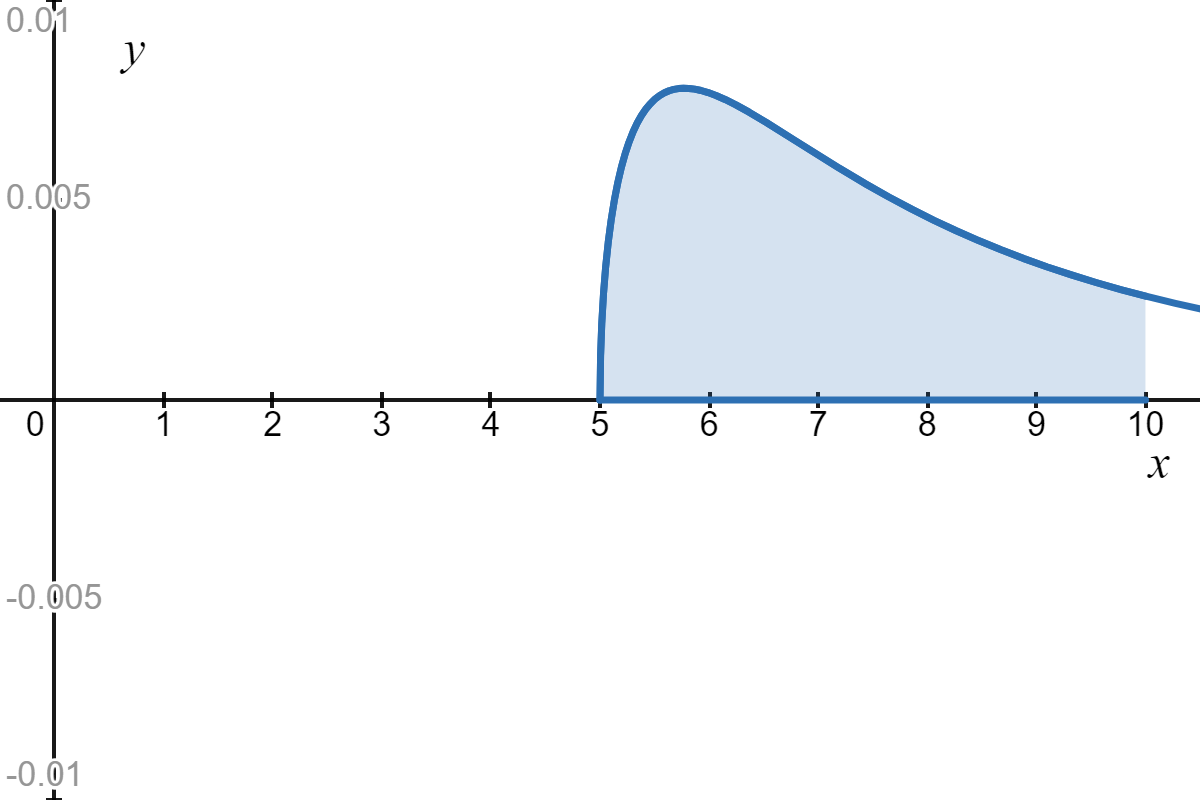
Figure \(\PageIndex{7}\)We can see that the area is \(A= \int_5^{10} \frac{\sqrt{x^2−25}}{x^4} \, dx\).
\( \boxed{\times} \) Direct Integration
\( \boxed{\times} \) Simple \( u \)-Substitution: Letting \( u = x^2 - 25 \) results in \( du = 2x \, dx \). I leave it to the reader to verify that this results in an uglier (and more difficult) integrand.
\( \boxed{\times} \) Radical Substitution
\( \boxed{\checkmark} \) Trigonometric Substitution: We can substitute \(x = 5 \sec \theta \) so that \(dx=5\sec \theta \tan \theta \, d \theta \). We must also change the limits of integration. If \(x=5\), then \(5=5\sec \theta \) and hence \( \theta =0\). If \(x=10\), then \( 10 = 5 \sec \theta \) and so \( \sec{\theta} = 2 \implies \theta = \frac{\pi}{3} \). After making these substitutions and simplifying, we have\[ \begin{array}{rclcl}
\text{Area} & = & \displaystyle \int_5^{10} \dfrac{\sqrt{x^2 − 25}}{x^4} \, dx & & \\[6pt]
& = & \displaystyle \int_0^{\pi/3} \dfrac{\sqrt{25 \sec^2{\theta} - 25}}{625 \sec^4{\theta}} \cdot 5 \sec{\theta} \tan{\theta} \, d \theta & & \\[6pt]
& = & \dfrac{5}{625} \displaystyle \int_0^{\pi/3} \dfrac{5 \sqrt{\sec^2{\theta} - 1} \cdot \tan{\theta}}{\sec^3{\theta}} \, d \theta & & \\[6pt]
& = & \dfrac{25}{625} \displaystyle \int_0^{\pi/3} \dfrac{\sqrt{\tan^2{\theta}} \cdot \tan{\theta}}{\sec^3{\theta}} \,d \theta & \quad & \left( \text{Pythagorean Identity} \right) \\[6pt]
& = & \dfrac{1}{25} \displaystyle \int_0^{\pi/3} \dfrac{\tan{\theta} \cdot \tan{\theta}}{\sec^3{\theta}} \,d \theta & & \\[6pt]
& = & \dfrac{1}{25} \displaystyle \int_0^{\pi/3} \dfrac{\tan^2{\theta}}{\sec^3{\theta}} \,d \theta & & \\[6pt]
& = & \dfrac{1}{25} \displaystyle \int_0^{\pi/3} \dfrac{\sin^2{\theta}/\cos^2{\theta}}{1/\cos^3{\theta}} \,d \theta & \quad & \left( \text{Ratio Identities} \right) \\[6pt]
& = & \dfrac{1}{25} \displaystyle \int_0^{\pi/3} \sin^2{\theta} \cos{\theta} \,d \theta & & \\[6pt]
& = & \dfrac{1}{25} \displaystyle \int_0^{\sqrt{3}/2} u^2 \,d u & \quad & \left( u = \sin{\theta} \implies du = \cos{\theta} \, d\theta \right) \\[6pt]
& = & \dfrac{1}{75} \left. u^3 \right|_0^{\sqrt{3}/2} & & \\[6pt]
& = & \dfrac{3^{3/2}}{600} & & \\[6pt]
& = & \dfrac{3 \cdot 3^{1/2}}{600} & & \\[6pt]
& = & \dfrac{3^{1/2}}{200} & & \\[6pt]
\end{array} \nonumber \]
Evaluate \[ \int \dfrac{dx}{\sqrt{x^2−4}}. \nonumber \]Assume that \(x \gt 2.\)
- Answer
-
\[ \ln \left|\dfrac{x}{2}+\dfrac{\sqrt{x^2−4}}{2}\right|+C \nonumber \]
Rewriting Integrals to Use Trigonometric Substitution
There are many situations in which a given integral seems too challenging to be evaluated using known techniques. In these (and, in fact, in all) cases, you should remember the Mathematical Mantra:
The following example illustrates how using the Mathematical Mantra can reduce a seemingly impossible problem into a more manageable one.
Evaluate the integral.\[ \int \dfrac{x^2}{\left(3 + 4x - 4x^2\right)^{3/2}} \, dx \nonumber \]
- Solution
-
\( \boxed{\times} \) Direct Integration: Since the integrand is not the derivative of an established, well-known function, we cannot directly integrate.
\( \boxed{\times} \) Simple \( u \)-Substitution:8 If we let \( u = 3 + 4x - 4x^2 \), then \( du = (4 - 8x) \, dx \). At this point, we are experienced enough to recognize that this substitution will lead nowhere.
\( \boxed{\times} \) Radical Substitution: Since a simple \( u \)-substitution will not work, a radical substitution is out of the question.
\( \boxed{\times} \) Trigonometric Substitution: As written, this does not look to have a sum or difference of squares, so it doesn't look to be a candidate for a trigonometric substitution.
Now that we have exhausted all our integration techniques learned up to this point, we should realize that there must be some manipulation of the integrand using our previously learned mathematics to help us out. There are, in fact, two previously learned topics in Mathematics that can help here - both from Algebra; however, I will only mention completing the square as the other topic will lead to an integral we do not yet have a way to evaluate.
Back in Algebra, we learned how to complete the square for quadratic functions. This idea is beneficial with the given integral.\[ 3 + 4x - 4x^2 = -4(x^2 - x) + 3 = -4\left( x^2 - x + \left( -\dfrac{1}{2} \right)^2 \right) + 3 + 4 \left( - \dfrac{1}{2} \right)^2 = -4 \left( x - \dfrac{1}{2} \right)^2 + 4 = 4 - 4 \left( x - \dfrac{1}{2} \right)^2. \nonumber \]Therefore,\[ \int \dfrac{x^2}{\left(3 + 4x - 4x^2\right)^{3/2}} \, dx = \int \dfrac{x^2}{\left(4 - 4 \left( x - \dfrac{1}{2} \right)^2\right)^{3/2}} \, dx = \dfrac{1}{8} \int \dfrac{x^2}{\left(1 - \left( x - \dfrac{1}{2} \right)^2\right)^{3/2}} \, dx. \nonumber \]The denominator of the integrand includes a difference of squares. This should encourage us to try a trigonometric substitution. The form is \( a^2 - x^2 \), which reminds us of the trigonometric identity \( 1 - \sin^2 \theta = \cos^2 \theta \). Hence, we want \( \left( x - \frac{1}{2} \right)^2 = a^2 \sin^2 \theta = \sin^2 \theta \), which gives \( x - \frac{1}{2} = \sin \theta \). Moreover, this gives \( dx = \cos \theta \, d \theta \). Finally, the numerator of the integrand has \( x^2 \), so it is necessary to determine \( x \) as a function of \( \theta \). Since \( x - \frac{1}{2} = \sin \theta \), \( x = \sin \theta + \frac{1}{2} \), and so \( x^2 = \left(\sin \theta + \frac{1}{2}\right)^2 \). Summarizing, we have
- \( \left( x - \frac{1}{2} \right)^2 = \sin^2 \theta \),
- \( dx = \cos \theta \, d \theta \), and
- \( x^2 = \left(\sin \theta + \frac{1}{2}\right)^2 \).
Moreover, drawing a reference triangle at this point is a good idea. Figure \( \PageIndex{8} \) shows our reference triangle.
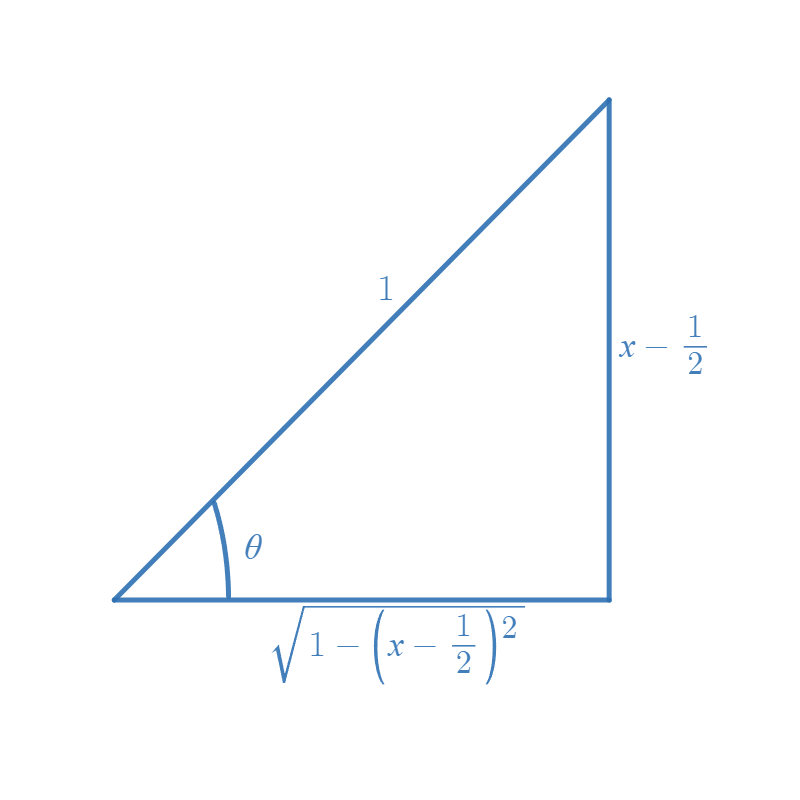
Figure \( \PageIndex{8} \): The reference triangle.Thus,\[ \begin{array}{rclcl}
\displaystyle \int \dfrac{x^2}{\left(3 + 4x - 4x^2\right)^{3/2}} \, dx & = & \dfrac{1}{8} \displaystyle \int \dfrac{x^2}{\left(1 - \left( x - \dfrac{1}{2} \right)^2\right)^{3/2}} \, dx & & \\[6pt]
& = & \dfrac{1}{8} \displaystyle \int \dfrac{\left(\sin \theta + \dfrac{1}{2}\right)^2}{\left( 1 - \sin^2 \theta \right)^{3/2}} \, \cos \theta \, d \theta & \quad & \left( \text{completing the square} \right)\\[6pt]
& = & \dfrac{1}{8} \displaystyle \int \dfrac{\left(\sin \theta + \dfrac{1}{2}\right)^2}{\left( \cos^2 \theta \right)^{3/2}} \, \cos \theta \, d \theta & \quad & \left( \text{Trigonometric substitutions} \right)\\[6pt]
& = & \dfrac{1}{8} \displaystyle \int \dfrac{\left(\sin \theta + \dfrac{1}{2}\right)^2}{\cos^3 \theta } \, \cos \theta \, d \theta & \quad & \left( \text{Pythagorean Identity} \right)\\[6pt]
& = & \dfrac{1}{8} \displaystyle \int \dfrac{\left(\sin \theta + \dfrac{1}{2}\right)^2}{\cos^2 \theta } \, d \theta & & \\[6pt]
& = & \dfrac{1}{8} \displaystyle \int \dfrac{\sin^2 \theta + \sin \theta + \dfrac{1}{4}}{\cos^2 \theta } \, d \theta & & \\[6pt]
& = & \dfrac{1}{8} \displaystyle \int \tan^2 \theta + \sec \theta \tan \theta + \dfrac{1}{4} \sec^2 \theta \, d \theta & & \\[6pt]
& = & \dfrac{1}{8} \displaystyle \int \sec^2 \theta - 1 + \sec \theta \tan \theta + \dfrac{1}{4} \sec^2 \theta \, d \theta & \quad & \left( \text{Pythagorean Identity} \right)\\[6pt]
& = & \dfrac{1}{8} \displaystyle \int - 1 + \sec \theta \tan \theta + \dfrac{5}{4} \sec^2 \theta \, d \theta & & \\[6pt]
& = & -\dfrac{1}{8} \theta + \dfrac{1}{8} \sec \theta + \dfrac{5}{32} \tan \theta + C & & \\[6pt]
& = & -\dfrac{1}{8} \sin^{-1}\left( x - \dfrac{1}{2} \right) + \dfrac{1}{8 \sqrt{1 - \left( x - \dfrac{1}{2} \right)^2}} + \dfrac{5\left( x - \dfrac{1}{2} \right)}{32 \sqrt{1 - \left( x - \dfrac{1}{2} \right)^2}} + C & \quad & \left( \text{using the reference triangle} \right)\\[6pt]
& = & -\dfrac{1}{8} \sin^{-1}\left( x - \dfrac{1}{2} \right) + \dfrac{4 + 5\left( x - \dfrac{1}{2} \right)}{32 \sqrt{1 - \left( x - \dfrac{1}{2} \right)^2}} + C & & \\[6pt]
& = & -\dfrac{1}{8} \sin^{-1}\left( x - \dfrac{1}{2} \right) + \dfrac{5x + \dfrac{3}{2}}{32 \sqrt{1 - \left( x - \dfrac{1}{2} \right)^2}} + C & & \\[6pt]
& = & -\dfrac{1}{8} \sin^{-1}\left( x - \dfrac{1}{2} \right) + \dfrac{10x + 3}{32 \sqrt{4 - 4\left( x - \dfrac{1}{2} \right)^2}} + C & & \\[6pt]
& = & -\dfrac{1}{8} \sin^{-1}\left( x - \dfrac{1}{2} \right) + \dfrac{10x + 3}{32 \sqrt{3 + 4x - 4x^2}} + C & & \\[6pt]
\end{array} \nonumber \]
Footnotes
1 We will justify this assumption momentarily.
2 After integrating the trigonometric integral as a function of \( \theta \), you sometimes have a term of the form \( k \theta \). If your original substitution was \( x = a \sin \theta \), then it is a fact that \( \theta = \arcsin \left( \frac{x}{a} \right) \). It is permissible to leave your final answer in this form if and only if \( \frac{x}{a} \) is not a special trigonometric ratio. That is if evaluating a definite integral where you end up with \( \arcsin\left( -\frac{1}{2} \right) \), you must use your prerequisite Trigonometry to simplify this to \( -\frac{\pi}{6} \).
3 The idea of constantly checking to see if something from the past will work first (i.e., a simple \( u \)-substitution) should not be new to you - especially if you took Differential Calculus using this text (well, the Calculus I version, at least). In that text, I continually referenced the Mathematical Mantra. The Mathematical Mantra boils down to doing mathematics in the order you learned mathematics - Arithmetic before Algebra, Algebra before Trigonometry, Trigonometry before Precalculus, Precalculus before Differential Calculus, and, in this case, Differential Calculus before Integral Calculus. In Differential Calculus, you learned about the Substitution Method. If you can evaluate an integral using the Substitution Method, then there is no need to get any fancier than that - don't jump to Trigonometric Substitutions or any other, more obscure technique if a good 'ol \( u \)-substitution does the job.
4 As was stated previously, if given a definite integral, then you are expected to be able to evaluate the arctangent at special ratios.
5 The reference triangle is based on the assumption that \(x \gt 0\); however, the trigonometric ratios produced from the reference triangle are the same as the ratios for which \(x \leq 0\).
6 Of the three processes we have developed, it is important to pay close attention to this one in particular. The reason behind the choice of restriction for the range from Section 1.6 in the Differential Calculus textbook of the arcsecant should become apparent.
7 Again, this is the distinct difference between the previous two derivations and this one. It is very important to note that we could have used the non-elegant range restriction of \( \theta \in \left[0 , \frac{\pi}{2} \right) \cup \left( \frac{\pi}{2}, \pi \right] \) for the arcsecant; however, doing so would result in a more complex derivation of this trigonometric substitution due to the sign of the tangent in quadrant II being negative - this would not allow for \( |a \tan \theta | = a \tan \theta \).
8 We have learned enough integration techniques at this point to realize that the Substitution Method is an "umbrella method" encapsulating at least two different "types" of substitution. The first was a simple \( u \)-substitution from our Differential Calculus course. We were introduced to the second in this section, trigonometric substitutions.