

1.2.2: Homework
- Page ID
- 128811

\( \newcommand{\vecs}[1]{\overset { \scriptstyle \rightharpoonup} {\mathbf{#1}} } \)
\( \newcommand{\vecd}[1]{\overset{-\!-\!\rightharpoonup}{\vphantom{a}\smash {#1}}} \)
\( \newcommand{\dsum}{\displaystyle\sum\limits} \)
\( \newcommand{\dint}{\displaystyle\int\limits} \)
\( \newcommand{\dlim}{\displaystyle\lim\limits} \)
\( \newcommand{\id}{\mathrm{id}}\) \( \newcommand{\Span}{\mathrm{span}}\)
( \newcommand{\kernel}{\mathrm{null}\,}\) \( \newcommand{\range}{\mathrm{range}\,}\)
\( \newcommand{\RealPart}{\mathrm{Re}}\) \( \newcommand{\ImaginaryPart}{\mathrm{Im}}\)
\( \newcommand{\Argument}{\mathrm{Arg}}\) \( \newcommand{\norm}[1]{\| #1 \|}\)
\( \newcommand{\inner}[2]{\langle #1, #2 \rangle}\)
\( \newcommand{\Span}{\mathrm{span}}\)
\( \newcommand{\id}{\mathrm{id}}\)
\( \newcommand{\Span}{\mathrm{span}}\)
\( \newcommand{\kernel}{\mathrm{null}\,}\)
\( \newcommand{\range}{\mathrm{range}\,}\)
\( \newcommand{\RealPart}{\mathrm{Re}}\)
\( \newcommand{\ImaginaryPart}{\mathrm{Im}}\)
\( \newcommand{\Argument}{\mathrm{Arg}}\)
\( \newcommand{\norm}[1]{\| #1 \|}\)
\( \newcommand{\inner}[2]{\langle #1, #2 \rangle}\)
\( \newcommand{\Span}{\mathrm{span}}\) \( \newcommand{\AA}{\unicode[.8,0]{x212B}}\)
\( \newcommand{\vectorA}[1]{\vec{#1}} % arrow\)
\( \newcommand{\vectorAt}[1]{\vec{\text{#1}}} % arrow\)
\( \newcommand{\vectorB}[1]{\overset { \scriptstyle \rightharpoonup} {\mathbf{#1}} } \)
\( \newcommand{\vectorC}[1]{\textbf{#1}} \)
\( \newcommand{\vectorD}[1]{\overrightarrow{#1}} \)
\( \newcommand{\vectorDt}[1]{\overrightarrow{\text{#1}}} \)
\( \newcommand{\vectE}[1]{\overset{-\!-\!\rightharpoonup}{\vphantom{a}\smash{\mathbf {#1}}}} \)
\( \newcommand{\vecs}[1]{\overset { \scriptstyle \rightharpoonup} {\mathbf{#1}} } \)
\(\newcommand{\longvect}{\overrightarrow}\)
\( \newcommand{\vecd}[1]{\overset{-\!-\!\rightharpoonup}{\vphantom{a}\smash {#1}}} \)
\(\newcommand{\avec}{\mathbf a}\) \(\newcommand{\bvec}{\mathbf b}\) \(\newcommand{\cvec}{\mathbf c}\) \(\newcommand{\dvec}{\mathbf d}\) \(\newcommand{\dtil}{\widetilde{\mathbf d}}\) \(\newcommand{\evec}{\mathbf e}\) \(\newcommand{\fvec}{\mathbf f}\) \(\newcommand{\nvec}{\mathbf n}\) \(\newcommand{\pvec}{\mathbf p}\) \(\newcommand{\qvec}{\mathbf q}\) \(\newcommand{\svec}{\mathbf s}\) \(\newcommand{\tvec}{\mathbf t}\) \(\newcommand{\uvec}{\mathbf u}\) \(\newcommand{\vvec}{\mathbf v}\) \(\newcommand{\wvec}{\mathbf w}\) \(\newcommand{\xvec}{\mathbf x}\) \(\newcommand{\yvec}{\mathbf y}\) \(\newcommand{\zvec}{\mathbf z}\) \(\newcommand{\rvec}{\mathbf r}\) \(\newcommand{\mvec}{\mathbf m}\) \(\newcommand{\zerovec}{\mathbf 0}\) \(\newcommand{\onevec}{\mathbf 1}\) \(\newcommand{\real}{\mathbb R}\) \(\newcommand{\twovec}[2]{\left[\begin{array}{r}#1 \\ #2 \end{array}\right]}\) \(\newcommand{\ctwovec}[2]{\left[\begin{array}{c}#1 \\ #2 \end{array}\right]}\) \(\newcommand{\threevec}[3]{\left[\begin{array}{r}#1 \\ #2 \\ #3 \end{array}\right]}\) \(\newcommand{\cthreevec}[3]{\left[\begin{array}{c}#1 \\ #2 \\ #3 \end{array}\right]}\) \(\newcommand{\fourvec}[4]{\left[\begin{array}{r}#1 \\ #2 \\ #3 \\ #4 \end{array}\right]}\) \(\newcommand{\cfourvec}[4]{\left[\begin{array}{c}#1 \\ #2 \\ #3 \\ #4 \end{array}\right]}\) \(\newcommand{\fivevec}[5]{\left[\begin{array}{r}#1 \\ #2 \\ #3 \\ #4 \\ #5 \\ \end{array}\right]}\) \(\newcommand{\cfivevec}[5]{\left[\begin{array}{c}#1 \\ #2 \\ #3 \\ #4 \\ #5 \\ \end{array}\right]}\) \(\newcommand{\mattwo}[4]{\left[\begin{array}{rr}#1 \amp #2 \\ #3 \amp #4 \\ \end{array}\right]}\) \(\newcommand{\laspan}[1]{\text{Span}\{#1\}}\) \(\newcommand{\bcal}{\cal B}\) \(\newcommand{\ccal}{\cal C}\) \(\newcommand{\scal}{\cal S}\) \(\newcommand{\wcal}{\cal W}\) \(\newcommand{\ecal}{\cal E}\) \(\newcommand{\coords}[2]{\left\{#1\right\}_{#2}}\) \(\newcommand{\gray}[1]{\color{gray}{#1}}\) \(\newcommand{\lgray}[1]{\color{lightgray}{#1}}\) \(\newcommand{\rank}{\operatorname{rank}}\) \(\newcommand{\row}{\text{Row}}\) \(\newcommand{\col}{\text{Col}}\) \(\renewcommand{\row}{\text{Row}}\) \(\newcommand{\nul}{\text{Nul}}\) \(\newcommand{\var}{\text{Var}}\) \(\newcommand{\corr}{\text{corr}}\) \(\newcommand{\len}[1]{\left|#1\right|}\) \(\newcommand{\bbar}{\overline{\bvec}}\) \(\newcommand{\bhat}{\widehat{\bvec}}\) \(\newcommand{\bperp}{\bvec^\perp}\) \(\newcommand{\xhat}{\widehat{\xvec}}\) \(\newcommand{\vhat}{\widehat{\vvec}}\) \(\newcommand{\uhat}{\widehat{\uvec}}\) \(\newcommand{\what}{\widehat{\wvec}}\) \(\newcommand{\Sighat}{\widehat{\Sigma}}\) \(\newcommand{\lt}{<}\) \(\newcommand{\gt}{>}\) \(\newcommand{\amp}{&}\) \(\definecolor{fillinmathshade}{gray}{0.9}\)Reading Questions
- What is the definition of a solid's cross-section?
- What is the general definite integral formula for the volume of a solid using the slicing method, where \(A(x)\) is the cross-sectional area at \(x\)?
- List the three steps in the problem-solving strategy for finding volumes by the slicing method.
- In Example 1.2.1, what geometric principle is used to find the side length \(s\) of the square cross-section in terms of its distance \(x\) from the apex of the pyramid?
- If the cross-sections of a solid are taken perpendicular to the y-axis, what variable must the area function and the integration be in terms of?
- According to the text, what is the mathematical definition of a cylinder? Does its base have to be a circle?
1) Derive the formula for the volume of a sphere using the slicing method.
2) Use the slicing method to derive the formula for the volume of a cone.
3) Use the slicing method to derive the formula for the volume of a tetrahedron with side length \(a.\)
Volumes by Slicing
For exercises 4 - 8, draw a typical slice and find the volume using the slicing method for the given volume.
4) A pyramid with height 6 units and square base of side 2 units, as pictured here.
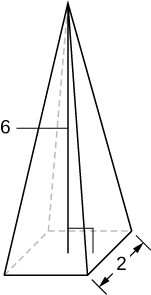
- Solution:
- Here the cross-sections are squares taken perpendicular to the \(y\)-axis.
We use the vertical cross-section of the pyramid through its center to obtain an equation relating \(x\) and \(y\).
Here this would be the equation, \( y = 6 - 6x \). Since we need the dimensions of the square at each \(y\)-level, we solve this equation for \(x\) to get, \(x = 1 - \tfrac{y}{6}\).
This is half the distance across the square cross-section at the \(y\)-level, so the side length of the square cross-section is, \(s = 2\left(1 - \tfrac{y}{6}\right).\)
Thus, we have the area of a cross-section is,
\(A(y) = \left[2\left(1 - \tfrac{y}{6}\right)\right]^2 = 4\left(1 - \tfrac{y}{6}\right)^2.\)
\(\begin{align*} \text{Then},\quad V &= \int_0^6 4\left(1 - \tfrac{y}{6}\right)^2 \, dy \\[5pt]
&= -24 \int_1^0 u^2 \, du, \quad \text{where} \, u = 1 - \tfrac{y}{6}, \, \text{so} \, du = -\tfrac{1}{6}\,dy, \quad \implies \quad -6\,du = dy \\[5pt]
&= 24 \int_0^1 u^2 \, du = 24\dfrac{u^3}{3}\bigg|_0^1 \\[5pt]
&= 8u^3\bigg|_0^1 \\[5pt]
&= 8\left( 1^3 - 0^3 \right) \quad= \quad 8\, \text{units}^3 \end{align*}\)
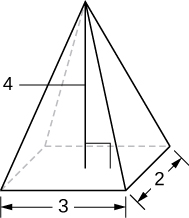
5) A pyramid with height 4 units and a rectangular base with length 2 units and width 3 units, as pictured here.
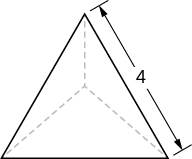
6) A tetrahedron with a base side of 4 units,as seen here.
- Answer
- \(V = \frac{32}{3\sqrt{2}} = \frac{16\sqrt{2}}{3}\) units3
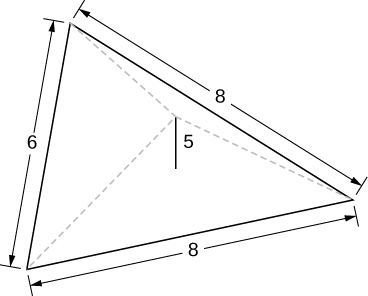
7) A pyramid with height 5 units, and an isosceles triangular base with lengths of 6 units and 8 units, as seen here.
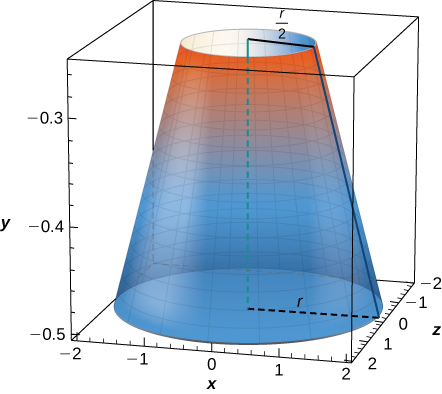
8) A cone of radius \( r\) and height \( h\) has a smaller cone of radius \( r/2\) and height \( h/2\) removed from the top, as seen here. The resulting solid is called a frustum.
- Answer
- \(V = \frac{7\pi}{12} hr^2\) units3
For exercises 9 - 14, draw an outline of the solid and find the volume using the slicing method.
9) The base is a circle of radius \( a\). The slices perpendicular to the base are squares.
10) The base is a triangle with vertices \( (0,0),(1,0),\) and \( (0,1)\). Slices perpendicular to the \(xy\)-plane are semicircles.
- Answer
-
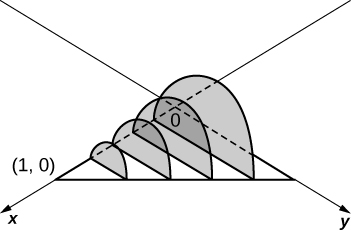
\( V = \int_0^1 \frac{\pi(1-x)^2}{8}\, dx \quad = \quad \frac{ \pi }{24}\) units3
11) The base is the region under the parabola \( y=1−x^2\) in the first quadrant. Slices perpendicular to the \(xy\)-plane are squares.
12) The base is the region under the parabola \( y=1−x^2\) and above the \(x\)-axis. Slices perpendicular to the \(y\)-axis are squares.
- Answer
-
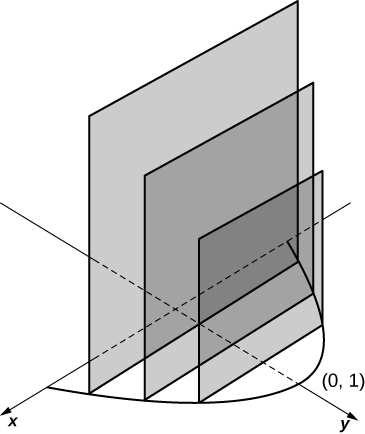
\( V = \int_0^1 4(1 - y)\,dy \quad = \quad 2\) units3
13) The base is the region enclosed by \( y=x^2\) and \( y=9.\) Slices perpendicular to the \(x\)-axis are right isosceles triangles.
14) The base is the area between \( y=x\) and \( y=x^2\). Slices perpendicular to the \(x\)-axis are semicircles.
- Answer
-
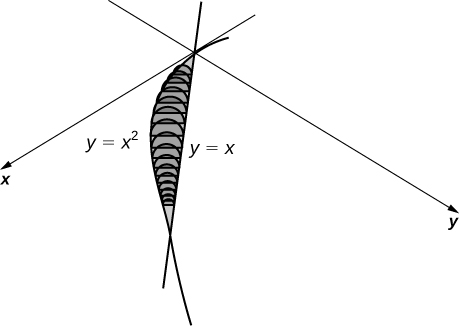
\( V = \int_0^1 \frac{\pi}{8}\left( x - x^2 \right)^2 \, dx \quad=\quad \frac{ \pi }{240}\) units3
For exercises 15 - 16, find the volume of the solid described.
15) The base is the region between \( y=x\) and \( y=x^2\). Slices perpendicular to the \(x\)-axis are semicircles.
16) The base is the region enclosed by the generic ellipse \( \dfrac{x^2}{a^2}+\dfrac{y^2}{b^2}=1.\) Slices perpendicular to the \(x\)-axis are semicircles.
- Answer
- \(V = \frac{2ab^2 \pi }{3}\) units3
Contributors
Gilbert Strang (MIT) and Edwin “Jed” Herman (Harvey Mudd) with many contributing authors. This content by OpenStax is licensed with a CC-BY-SA-NC 4.0 license. Download for free at http://cnx.org.