

2.4: Partial Fractions
- Page ID
- 128835

\( \newcommand{\vecs}[1]{\overset { \scriptstyle \rightharpoonup} {\mathbf{#1}} } \)
\( \newcommand{\vecd}[1]{\overset{-\!-\!\rightharpoonup}{\vphantom{a}\smash {#1}}} \)
\( \newcommand{\dsum}{\displaystyle\sum\limits} \)
\( \newcommand{\dint}{\displaystyle\int\limits} \)
\( \newcommand{\dlim}{\displaystyle\lim\limits} \)
\( \newcommand{\id}{\mathrm{id}}\) \( \newcommand{\Span}{\mathrm{span}}\)
( \newcommand{\kernel}{\mathrm{null}\,}\) \( \newcommand{\range}{\mathrm{range}\,}\)
\( \newcommand{\RealPart}{\mathrm{Re}}\) \( \newcommand{\ImaginaryPart}{\mathrm{Im}}\)
\( \newcommand{\Argument}{\mathrm{Arg}}\) \( \newcommand{\norm}[1]{\| #1 \|}\)
\( \newcommand{\inner}[2]{\langle #1, #2 \rangle}\)
\( \newcommand{\Span}{\mathrm{span}}\)
\( \newcommand{\id}{\mathrm{id}}\)
\( \newcommand{\Span}{\mathrm{span}}\)
\( \newcommand{\kernel}{\mathrm{null}\,}\)
\( \newcommand{\range}{\mathrm{range}\,}\)
\( \newcommand{\RealPart}{\mathrm{Re}}\)
\( \newcommand{\ImaginaryPart}{\mathrm{Im}}\)
\( \newcommand{\Argument}{\mathrm{Arg}}\)
\( \newcommand{\norm}[1]{\| #1 \|}\)
\( \newcommand{\inner}[2]{\langle #1, #2 \rangle}\)
\( \newcommand{\Span}{\mathrm{span}}\) \( \newcommand{\AA}{\unicode[.8,0]{x212B}}\)
\( \newcommand{\vectorA}[1]{\vec{#1}} % arrow\)
\( \newcommand{\vectorAt}[1]{\vec{\text{#1}}} % arrow\)
\( \newcommand{\vectorB}[1]{\overset { \scriptstyle \rightharpoonup} {\mathbf{#1}} } \)
\( \newcommand{\vectorC}[1]{\textbf{#1}} \)
\( \newcommand{\vectorD}[1]{\overrightarrow{#1}} \)
\( \newcommand{\vectorDt}[1]{\overrightarrow{\text{#1}}} \)
\( \newcommand{\vectE}[1]{\overset{-\!-\!\rightharpoonup}{\vphantom{a}\smash{\mathbf {#1}}}} \)
\( \newcommand{\vecs}[1]{\overset { \scriptstyle \rightharpoonup} {\mathbf{#1}} } \)
\(\newcommand{\longvect}{\overrightarrow}\)
\( \newcommand{\vecd}[1]{\overset{-\!-\!\rightharpoonup}{\vphantom{a}\smash {#1}}} \)
\(\newcommand{\avec}{\mathbf a}\) \(\newcommand{\bvec}{\mathbf b}\) \(\newcommand{\cvec}{\mathbf c}\) \(\newcommand{\dvec}{\mathbf d}\) \(\newcommand{\dtil}{\widetilde{\mathbf d}}\) \(\newcommand{\evec}{\mathbf e}\) \(\newcommand{\fvec}{\mathbf f}\) \(\newcommand{\nvec}{\mathbf n}\) \(\newcommand{\pvec}{\mathbf p}\) \(\newcommand{\qvec}{\mathbf q}\) \(\newcommand{\svec}{\mathbf s}\) \(\newcommand{\tvec}{\mathbf t}\) \(\newcommand{\uvec}{\mathbf u}\) \(\newcommand{\vvec}{\mathbf v}\) \(\newcommand{\wvec}{\mathbf w}\) \(\newcommand{\xvec}{\mathbf x}\) \(\newcommand{\yvec}{\mathbf y}\) \(\newcommand{\zvec}{\mathbf z}\) \(\newcommand{\rvec}{\mathbf r}\) \(\newcommand{\mvec}{\mathbf m}\) \(\newcommand{\zerovec}{\mathbf 0}\) \(\newcommand{\onevec}{\mathbf 1}\) \(\newcommand{\real}{\mathbb R}\) \(\newcommand{\twovec}[2]{\left[\begin{array}{r}#1 \\ #2 \end{array}\right]}\) \(\newcommand{\ctwovec}[2]{\left[\begin{array}{c}#1 \\ #2 \end{array}\right]}\) \(\newcommand{\threevec}[3]{\left[\begin{array}{r}#1 \\ #2 \\ #3 \end{array}\right]}\) \(\newcommand{\cthreevec}[3]{\left[\begin{array}{c}#1 \\ #2 \\ #3 \end{array}\right]}\) \(\newcommand{\fourvec}[4]{\left[\begin{array}{r}#1 \\ #2 \\ #3 \\ #4 \end{array}\right]}\) \(\newcommand{\cfourvec}[4]{\left[\begin{array}{c}#1 \\ #2 \\ #3 \\ #4 \end{array}\right]}\) \(\newcommand{\fivevec}[5]{\left[\begin{array}{r}#1 \\ #2 \\ #3 \\ #4 \\ #5 \\ \end{array}\right]}\) \(\newcommand{\cfivevec}[5]{\left[\begin{array}{c}#1 \\ #2 \\ #3 \\ #4 \\ #5 \\ \end{array}\right]}\) \(\newcommand{\mattwo}[4]{\left[\begin{array}{rr}#1 \amp #2 \\ #3 \amp #4 \\ \end{array}\right]}\) \(\newcommand{\laspan}[1]{\text{Span}\{#1\}}\) \(\newcommand{\bcal}{\cal B}\) \(\newcommand{\ccal}{\cal C}\) \(\newcommand{\scal}{\cal S}\) \(\newcommand{\wcal}{\cal W}\) \(\newcommand{\ecal}{\cal E}\) \(\newcommand{\coords}[2]{\left\{#1\right\}_{#2}}\) \(\newcommand{\gray}[1]{\color{gray}{#1}}\) \(\newcommand{\lgray}[1]{\color{lightgray}{#1}}\) \(\newcommand{\rank}{\operatorname{rank}}\) \(\newcommand{\row}{\text{Row}}\) \(\newcommand{\col}{\text{Col}}\) \(\renewcommand{\row}{\text{Row}}\) \(\newcommand{\nul}{\text{Nul}}\) \(\newcommand{\var}{\text{Var}}\) \(\newcommand{\corr}{\text{corr}}\) \(\newcommand{\len}[1]{\left|#1\right|}\) \(\newcommand{\bbar}{\overline{\bvec}}\) \(\newcommand{\bhat}{\widehat{\bvec}}\) \(\newcommand{\bperp}{\bvec^\perp}\) \(\newcommand{\xhat}{\widehat{\xvec}}\) \(\newcommand{\vhat}{\widehat{\vvec}}\) \(\newcommand{\uhat}{\widehat{\uvec}}\) \(\newcommand{\what}{\widehat{\wvec}}\) \(\newcommand{\Sighat}{\widehat{\Sigma}}\) \(\newcommand{\lt}{<}\) \(\newcommand{\gt}{>}\) \(\newcommand{\amp}{&}\) \(\definecolor{fillinmathshade}{gray}{0.9}\)
To succeed in this section, you'll need to use some skills from previous courses. While you should already know them, this is the first time they've been required. You can review these skills in CRC's Corequisite Codex. If you have a support class, it might cover some, but not all, of these topics.
The following is a list of learning objectives for this section.
|
.png?revision=1) To access the Hawk A.I. Tutor, you will need to be logged into your campus Gmail account. |
We have seen some techniques that allow us to integrate specific rational functions. For example, we know that\[ \int \dfrac{du}{u}=\ln |u|+C \nonumber \]and\[ \int \dfrac{du}{u^2+a^2}=\dfrac{1}{a}\tan^{−1} \left(\dfrac{u}{a}\right)+C.\nonumber \]However, we do not yet have a technique that allows us to tackle arbitrary quotients of this type. Thus, it is not immediately obvious how to go about evaluating\[ \int \dfrac{3x}{x^2−x−2}\, dx.\nonumber \]However, we know from material previously developed that\[ \int \left(\dfrac{1}{x+1}+\dfrac{2}{x−2}\right)\,dx=\ln |x+1|+2\ln |x−2|+C.\nonumber \]By getting a common denominator, we see that\[ \dfrac{1}{x+1}+\dfrac{2}{x−2}=\dfrac{3x}{x^2−x−2}.\nonumber \]Consequently,\[ \int \dfrac{3x}{x^2−x−2}\,dx=\int \left(\dfrac{1}{x+1}+\dfrac{2}{x−2}\right)\,dx.\nonumber \]In this section, we examine the method of Partial Fraction Decomposition, which allows us to decompose rational functions into sums of simpler, more easily integrated rational functions. Using this method, we can rewrite an expression such as:\[ \dfrac{3x}{x^2−x−2}\nonumber \]as an expression such as\[ \dfrac{1}{x+1}+\dfrac{2}{x−2}.\nonumber \]The key to the partial fraction decomposition method is anticipating the form that the decomposition of a rational function will take. As we shall see, this form is both predictable and highly dependent on the factorization of the denominator of the rational function. It is also imperative to keep in mind that partial fraction decomposition can be applied to a rational function \( \frac{P(x)}{Q(x)}\) only if \( \deg(P(x)) \lt \deg(Q(x))\). In the case when \( \deg(P(x)) \geq \deg(Q(x))\), we must first perform long division to rewrite the quotient \( \frac{P(x)}{Q(x)}\) in the form \( A(x)+\frac{R(x)}{Q(x)}\), where \( \deg(R(x)) \lt \deg(Q(x))\).1 We then do a partial fraction decomposition on \( \frac{R(x)}{Q(x)}\). The following example, although not requiring partial fraction decomposition, illustrates our approach to integrals of rational functions of the form \( \int \frac{P(x)}{Q(x)}\, dx\), where \( \deg(P(x)) \geq \deg(Q(x)).\)
Evaluate\[ \int \dfrac{x^2+3x+5}{x+1}\,dx. \nonumber \]
- Solution
-
Since \( \deg(x^2+3x+5) \geq \deg(x+1),\) we perform long division to obtain\[ \dfrac{x^2+3x+5}{x+1}=x+2+\dfrac{3}{x+1}. \nonumber \]Thus,\[ \int \dfrac{x^2+3x+5}{x+1}\,dx=\int \left(x+2+\dfrac{3}{x+1}\right)\,dx=\dfrac{1}{2}x^2+2x+3\ln |x+1|+C. \nonumber \]
Evaluate\[ \int \dfrac{x−3}{x+2}\,dx. \nonumber \]
- Answer
-
\[ x−5\ln |x+2|+C \nonumber \]
To integrate \(\displaystyle \int \frac{P(x)}{Q(x)}\,dx\), where \( \deg(P(x)) \lt \deg(Q(x))\), we must begin by factoring \( Q(x)\).
Nonrepeated Linear Factors
If \( Q(x)\) can be factored as \( (a_1x+b_1)(a_2x+b_2) \ldots (a_nx+b_n)\), where each linear factor is distinct, then it is possible to find constants \( A_1\), \(A_2\), \(\ldots\), \(A_n\) satisfying the following.2\[ \dfrac{P(x)}{Q(x)}=\dfrac{A_1}{a_1x+b_1}+\dfrac{A_2}{a_2x+b_2}+ \cdots +\dfrac{A_n}{a_nx+b_n}. \label{eq:7.4.1} \]In this next example, we see how to use partial fractions to integrate a rational function of this type.
Evaluate\[\int \dfrac{3x+2}{x^3−x^2−2x}\,dx. \nonumber \]
- Solution
-
Since \( \deg(3x+2) \lt \deg(x^3−x^2−2x)\), we begin by factoring the denominator of \( \frac{3x+2}{x^3−x^2−2x}\).
We can see that \( x^3−x^2−2x=x(x−2)(x+1)\). Thus, there are constants \(A\), \(B\), and \( C\) satisfying Equation \ref{eq:7.4.1} such that\[ \dfrac{3x+2}{x(x−2)(x+1)}=\dfrac{A}{x}+\dfrac{B}{x−2}+\dfrac{C}{x+1}. \nonumber \]We must now find these constants. To do so, we begin by multiplying both sides of this equation by the least common denominator: \( x(x - 2)(x + 1) \). Thus,\[ 3x+2=A(x−2)(x+1)+Bx(x+1)+Cx(x−2).\label{Ex2Numerator} \]There are two different strategies for finding the coefficients \(A\), \(B\), and \(C\). We refer to these as the method of equating coefficients and the method of strategic substitution.
Strategy One: Method of Equating Coefficients
Rewrite Equation \(\ref{Ex2Numerator}\) in the form\[ 3x+2=(A+B+C)x^2+(−A+B−2C)x+(−2A). \nonumber \]Equating coefficients produces the system of equations\[\begin{array}{rcl}
A+B+C & = & 0 \\
−A+B−2C & = & 3 \\
−2A & = & 2. \\
\end{array} \nonumber \]To solve this system, we first observe that \( −2A=2 \implies A=−1.\) Substituting this value into the first two equations gives us the system\[ \begin{array}{rcl}
B+C & = & 1 \\
B−2C & = & 2. \\
\end{array} \nonumber \]Multiplying the second equation by \( −1\) and adding the resulting equation to the first produces \( −3C=1,\) which in turn implies that \( C=−\frac{1}{3}\). Substituting this value into the equation \( B+C=1\) yields \( B=\frac{4}{3}\). Thus, solving these equations yields \( A=−1\), \(B=\frac{4}{3}\), and \( C=−\frac{1}{3}\).It is important to note that the system produced by this method is consistent if and only if we have set up the decomposition correctly. If the system is inconsistent, there is an error in our decomposition.
Strategy Two: Method of Strategic Substitution
The method of strategic substitution is also based on the assumption that we have set up the decomposition correctly. If the decomposition is set up correctly, then there must be values of \( A\), \(B\), and \( C\) that satisfy Equation \(\ref{Ex2Numerator}\) for all values of \( x\). This equation must be valid for any value of \(x\) we care to substitute into it. Therefore, by choosing values of \( x\) carefully and substituting them into the equation, we may find \( A\), \(B\), and \( C\) easily.
For example, if we substitute \( x=0\), the equation reduces to \( 2=A(−2)(1)\). Solving for \( A\) yields \( A=−1\). Next, by substituting \( x=2\), the equation reduces to \( 8=B(2)(3)\), or equivalently \( B= \frac{4}{3}\). Last, we substitute \( x=−1\) into the equation and obtain \( −1=C(−1)(−3).\) Solving, we have \( C=−\frac{1}{3}\).
It is important to remember that if we attempt to use this method with a decomposition that has not been set up correctly, we can still find values for the constants, but these constants are meaningless. If we opt to use the method of strategic substitution, then it is a good idea to check the result by recombining the terms algebraically.
Now that we have the values of \( A\), \(B\), and \( C\), we rewrite the original integral:\[ \int \dfrac{3x+2}{x^3−x^2−2x}\,dx=\int \left(−\dfrac{1}{x}+\dfrac{4}{3} \cdot \dfrac{1}{x−2}−\dfrac{1}{3} \cdot \dfrac{1}{x+1}\right)\,dx. \nonumber \]Evaluating the integral gives us\[ \int \dfrac{3x+2}{x^3−x^2−2x}\,dx=−\ln |x|+\dfrac{4}{3}\ln |x−2|−\dfrac{1}{3}\ln |x+1|+C. \nonumber \]
In the next example, we integrate a rational function in which the degree of the numerator is not less than the degree of the denominator.
Evaluate\[\int \dfrac{x^2+3x+1}{x^2−4}\,dx.\nonumber \]
- Solution
-
Since \( \deg(x^2+3x+1) \geq \deg(x^2−4)\), we must perform long division of polynomials. This results in\[ \dfrac{x^2+3x+1}{x^2−4}=1+\dfrac{3x+5}{x^2−4}. \nonumber \]Next, we perform partial fraction decomposition on \( \frac{3x+5}{x^2−4}=\frac{3x+5}{(x+2)(x−2)}\). We have\[ \dfrac{3x+5}{(x−2)(x+2)}=\dfrac{A}{x−2}+\dfrac{B}{x+2}. \nonumber \]Thus,\[ 3x+5=A(x+2)+B(x−2). \nonumber \]Solving for \( A\) and \( B\) using either method, we obtain \( A= \frac{11}{4}\) and \( B= \frac{1}{4}\).
Rewriting the original integral, we have\[ \int \dfrac{x^2+3x+1}{x^2−4}\,dx=\int \left(1+\dfrac{11}{4} \cdot \dfrac{1}{x−2}+\dfrac{1}{4} \cdot \dfrac{1}{x+2}\right)\,dx. \nonumber \]Evaluating the integral produces\[ \int \dfrac{x^2+3x+1}{x^2−4}\,dx=x+\dfrac{11}{4}\ln |x−2|+\dfrac{1}{4}\ln |x+2|+C. \nonumber \]
As we see in the following example, it may be possible to apply the technique of partial fraction decomposition to a nonrational function. To do so, we must first convert the nonrational function to a rational function through a substitution.
Evaluate\[ \int \dfrac{\cos x}{\sin^2x−\sin x}\,dx.\nonumber \]
- Solution
-
Let’s begin by letting \( u=\sin x\). Consequently, \( du=\cos x\,dx\). After making these substitutions, we have\[ \int \dfrac{\cos x}{\sin^2x−\sin x}\,dx=\int \dfrac{du}{u^2−u}=\int \dfrac{du}{u(u−1)}. \nonumber \]Applying partial fraction decomposition to \(\frac{1}{u(u−1)}\) gives \( \frac{1}{u(u−1)}=−\frac{1}{u}+\frac{1}{u−1}\).
Thus,\[ \int \dfrac{\cos x}{\sin^2x−\sin x}\,dx=−\ln |u|+\ln |u−1|+C=−\ln |\sin x|+\ln |\sin x−1|+C. \nonumber \]
Evaluate\[ \int \dfrac{x+1}{(x+3)(x−2)}\,dx.\nonumber \]
- Answer
-
\[ \dfrac{2}{5}\ln |x+3|+\dfrac{3}{5}\ln |x−2|+C \nonumber \]
Repeated Linear Factors
For some applications, we need to integrate rational expressions that have denominators with repeated linear factors - that is, rational functions with at least one factor of the form \( (ax+b)^n,\) where \( n\) is a positive integer greater than or equal to \( 2\). If the denominator contains the repeated linear factor \( (ax+b)^n\), then the decomposition must contain\[ \dfrac{A_1}{ax+b}+\dfrac{A_2}{(ax+b)^2}+ \cdots +\dfrac{A_n}{(ax+b)^n}. \label{eq:7.4.2} \]As we see in our next example, the basic technique for solving the coefficients is the same. Still, more algebra is required to determine the numerators of the partial fractions.
Evaluate\[ \int \dfrac{x−2}{(2x−1)^2(x−1)}\,dx.\nonumber \]
- Solution
-
We have \( \deg(x−2) \lt \deg((2x−1)^2(x−1))\), so we can proceed with the decomposition. Since \( (2x−1)^2\) is a repeated linear factor, include\[ \dfrac{A}{2x−1}+\dfrac{B}{(2x−1)^2} \nonumber \]in the decomposition in Equation \ref{eq:7.4.2}. Thus,\[ \dfrac{x−2}{(2x−1)^2(x−1)}=\dfrac{A}{2x−1}+\dfrac{B}{(2x−1)^2}+\dfrac{C}{x−1}. \nonumber \]After multiplying both sides by the least common denominator, we have\[ x−2=A(2x−1)(x−1)+B(x−1)+C(2x−1)^2. \label{Ex5Numerator} \]We then use the method of equating coefficients to find the values of \( A, B,\) and \( C\).\[ x−2=(2A+4C)x^2+(−3A+B−4C)x+(A−B+C). \nonumber \]Equating coefficients yields \( 2A+4C=0\), \(−3A+B−4C=1\), and \( A−B+C=−2\). Solving this system yields \( A=2\), \(B=3\), and \( C=−1\).
Alternatively, we can use the method of strategic substitution. In this case, substituting \( x=1\) and \( x= \frac{1}{2}\) into Equation \(\ref{Ex5Numerator}\) easily produces the values \( B=3\) and \( C=−1\). At this point, it may seem that we have run out of good choices for \( x\); however, since we already have values for \( B\) and \( C\), we can substitute these values and choose any value for \( x\) not previously used. The value \( x=0\) is a good option. In this case, we obtain the equation \( −2=A(−1)(−1)+3(−1)+(−1)(−1)^2\) or, equivalently, \( A=2.\)
Now that we have the values for \( A\), \(B\), and \( C\), we rewrite the original integral and evaluate it:\[ \begin{array}{rcl}
\displaystyle \int \dfrac{x−2}{(2x−1)^2(x−1)}\,dx & = & \displaystyle \int \left(\dfrac{2}{2x−1}+\dfrac{3}{(2x−1)^2}−\dfrac{1}{x−1}\right)\,dx \\[16pt]
& = & \ln |2x−1|−\dfrac{3}{2(2x−1)}−\ln |x−1|+C. \\[16pt]
\end{array}\nonumber \]
Set up the partial fraction decomposition for\[ \int \dfrac{x+2}{(x+3)^3(x−4)^2}\,dx. \nonumber \](Do not solve for the coefficients or complete the integration.)
- Answer
-
\[ \dfrac{x+2}{(x+3)^3(x−4)^2}=\dfrac{A}{x+3}+\dfrac{B}{(x+3)^2}+\dfrac{C}{(x+3)^3}+\dfrac{D}{(x−4)}+\dfrac{E}{(x−4)^2} \nonumber \]
The General Method
Now that we are beginning to understand how the partial fraction decomposition technique works let's outline the basic method in the following problem-solving strategy.
To decompose the rational function \( \frac{P(x)}{Q(x)}\), use the following steps:
- Make sure that \( \deg(P(x)) \lt \deg(Q(x))\). If not, perform a long division of polynomials.
- Factor \( Q(x)\) into the product of linear and irreducible quadratic factors.3
- Assuming that \( \deg(P(x)) \lt \deg(Q(x)\), the factors of \( Q(x)\) determine the form of the decomposition of \( \frac{P(x)}{Q(x)}\).
- If \( Q(x)\) can be factored as \( (a_1x+b_1)(a_2x+b_2) \ldots (a_nx+b_n)\), where each linear factor is distinct, then it is possible to find constants \( A_1, A_2,\ldots, A_n\) satisfying\[ \dfrac{P(x)}{Q(x)}=\dfrac{A_1}{a_1x+b_1}+\dfrac{A_2}{a_2x+b_2}+ \cdots +\dfrac{A_n}{a_nx+b_n}. \nonumber \]
- If \( Q(x)\) contains the repeated linear factor \( (ax+b)^n\), then the decomposition must contain\[ \dfrac{A_1}{ax+b}+\dfrac{A_2}{(ax+b)^2}+ \cdots +\dfrac{A_n}{(ax+b)^n}. \nonumber \]
- For each irreducible quadratic factor \( ax^2+bx+c\) that \( Q(x)\) contains, the decomposition must include\[ \dfrac{Ax+B}{ax^2+bx+c}. \nonumber \]
- For each repeated irreducible quadratic factor \( (ax^2+bx+c)^n,\) the decomposition must include\[ \dfrac{A_1x+B_1}{ax^2+bx+c}+\dfrac{A_2x+B_2}{(ax^2+bx+c)^2}+ \cdots +\dfrac{A_nx+B_n}{(ax^2+bx+c)^n}. \nonumber \]
- After determining the appropriate decomposition, solve for the constants.
- Last, rewrite the integral in its decomposed form and evaluate it using previously developed techniques or integration formulas.
Irreducible Quadratic Factors
Now, let's consider integrating a rational expression in which the denominator contains an irreducible quadratic factor. Recall that the quadratic \( ax^2+bx+c\) is irreducible if \( ax^2+bx+c=0\) has no real zeros - that is, if \( b^2−4ac \) (the discriminant) is less than \(0\).
Evaluate\[ \int \dfrac{2x−3}{x^3+x}\,dx.\nonumber \]
- Solution
-
Since \( \deg(2x−3) \lt \deg(x^3+x)\), factor the denominator and proceed with partial fraction decomposition. In this case, \( x^3+x=x(x^2+1)\) contains the irreducible quadratic factor \( x^2+1\). Therefore, we include \( \frac{Ax+B}{x^2+1}\) as part of the decomposition, along with \( \frac{C}{x}\) for the linear term \(x\). Thus, the decomposition has the form\[ \dfrac{2x−3}{x(x^2+1)}=\dfrac{Ax+B}{x^2+1}+\dfrac{C}{x}.\nonumber \]After multiplying both sides by the least common denominator, we obtain the equation\[ 2x−3=(Ax+B)x+C(x^2+1).\nonumber \]Solving for \( A\), \(B\), and \( C\), we get \( A=3\), \(B=2\), and \( C=−3\).
Thus,\[ \dfrac{2x−3}{x^3+x}=\dfrac{3x+2}{x^2+1}−\dfrac{3}{x}.\nonumber \]Substituting back into the integral, we obtain\[ \begin{array}{rcl}
\displaystyle \int \dfrac{2x−3}{x^3+x}\,dx & = & \displaystyle \int \left(\dfrac{3x+2}{x^2+1}−\dfrac{3}{x}\right)\,dx \\[16pt]
& = & 3 \displaystyle \int \dfrac{x}{x^2+1}\,dx + 2 \displaystyle \int \dfrac{1}{x^2+1}\,dx−3 \displaystyle \int \dfrac{1}{x}\,dx \\[16pt]
& = & \dfrac{3}{2}\ln ∣x^2+1∣+2 \tan^{−1}x−3\ln |x|+C. \\[16pt]
\end{array} \nonumber \]Note: We may rewrite \( \ln ∣x^2+1∣=\ln (x^2+1)\), if we wish to do so, since \( x^2+1 \gt 0\); however, this is not required.
Evaluate\[\int \dfrac{dx}{x^3−8}. \nonumber \]
- Solution
-
We can start by factoring \( x^3−8=(x−2)(x^2+2x+4)\). We see that the quadratic factor \( x^2+2x+4\) is irreducible since \( 2^2−4(1)(4) = −12 \lt 0\). Using the decomposition described in the problem-solving strategy, we get\[ \dfrac{1}{(x−2)(x^2+2x+4)}=\dfrac{A}{x−2}+\dfrac{Bx+C}{x^2+2x+4}. \nonumber \]Multiplying both sides by the LCD, we arrive at\[ 1=A(x^2+2x+4)+(Bx+C)(x−2). \nonumber \]Applying either method to find the constants, we get \( A=\frac{1}{12}\), \(B=−\frac{1}{12}\), and \( C=−\frac{1}{3}\).
Rewriting \( \displaystyle \int \frac{dx}{x^3−8}\), we have\[ \int \dfrac{\,dx}{x^3−8}=\dfrac{1}{12}\int \dfrac{1}{x−2}\,dx−\dfrac{1}{12}\int \dfrac{x+4}{x^2+2x+4}\,dx. \nonumber \]We can see that\[ \int \dfrac{1}{x−2}\,dx=\ln |x−2|+C,\nonumber \]but\[ \int \dfrac{x+4}{x^2+2x+4}\,dx \nonumber \]requires a bit more effort. Let's begin by completing the square on \( x^2+2x+4\) to obtain\[ x^2+2x+4=(x+1)^2+3. \nonumber \]By letting \( u=x+1\) and consequently \( du=\,dx,\) we see that\[ \begin{array}{rcl}
\displaystyle \int \dfrac{x+4}{x^2+2x+4}\,dx & = & \displaystyle \int \dfrac{x+4}{(x+1)^2+3}\,dx \\[16pt]
& = & \displaystyle \int \dfrac{u+3}{u^2+3}\,du \\[16pt]
& = & \displaystyle \int \dfrac{u}{u^2+3}\,du + \displaystyle \int \dfrac{3}{u^2+3}\, du \\[16pt]
& = & \dfrac{1}{2}\ln ∣u^2+3∣+\dfrac{3}{\sqrt{3}}\tan^{−1}\left(\dfrac{u}{\sqrt{3}}\right)+C \\[16pt]
& = & \dfrac{1}{2}\ln ∣x^2+2x+4∣+\sqrt{3}\tan^{−1}\left(\dfrac{x+1}{\sqrt{3}}\right)+C \\[16pt]
\end{array} \nonumber \]Substituting back into the original integral and simplifying gives\[ \int \dfrac{dx}{x^3−8}=\dfrac{1}{12}\ln |x−2|−\dfrac{1}{24}\ln |x^2+2x+4|−\dfrac{\sqrt{3}}{12}\tan^{−1}\left(\dfrac{x+1}{\sqrt{3}}\right)+C. \nonumber \]Here again, we can drop the absolute value if we wish to do so, since \( x^2+2x+4 \gt 0\) for all \( x\).
Find the volume of the solid of revolution obtained by revolving the region enclosed by the graph of \( f(x)=\frac{x^2}{(x^2+1)^2}\) and the \(x\)-axis over the interval \( [0,1]\) about the \(y\)-axis.
- Solution
-
Let's begin by sketching the region to be revolved (see Figure \(\PageIndex{1}\)). The sketch shows that the shell method is a good choice for solving this problem.
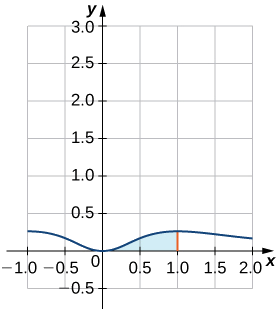
Figure \(\PageIndex{1}\): We can use the shell method to find the volume of revolution obtained by revolving the region shown about the \(y\)-axis.The volume is given by\[ V=2 \pi \int ^1_0 x \cdot \dfrac{x^2}{(x^2+1)^2}\,dx = 2 \pi \int ^1_0 \dfrac{x^3}{(x^2+1)^2}\,dx. \nonumber \]Since \( \deg((x^2+1)^2) = 4 \gt 3 = \deg(x^3)\), we can proceed with partial fraction decomposition. Note that \( (x^2+1)^2\) is a repeated irreducible quadratic. Using the decomposition described in the problem-solving strategy, we get\[ \dfrac{x^3}{(x^2+1)^2} = \dfrac{Ax+B}{x^2+1}+\dfrac{Cx+D}{(x^2+1)^2}. \nonumber \]Multiplying both sides by the LCD gives\[ x^3=(Ax+B)(x^2+1)+Cx+D. \nonumber \]Solving, we obtain \( A=1\), \(B=0\), \(C=−1\), and \( D=0\). Substituting back into the integral, we have\[ V=2 \pi \int _0^1\dfrac{x^3}{(x^2+1)^2}\,dx=2 \pi \int _0^1\left(\dfrac{x}{x^2+1}−\dfrac{x}{(x^2+1)^2}\right)\,dx=2 \pi \left(\dfrac{1}{2}\ln (x^2+1)+\dfrac{1}{2} \cdot \dfrac{1}{x^2+1}\right)\bigg|^1_0= \pi \left(\ln 2−\tfrac{1}{2}\right). \nonumber \]
Set up the partial fraction decomposition for\[ \int \dfrac{x^2+3x+1}{(x+2)(x−3)^2(x^2+4)^2}\,dx. \nonumber \]
- Answer
-
\[ \dfrac{x^2+3x+1}{(x+2)(x−3)^2(x^2+4)^2}=\dfrac{A}{x+2}+\dfrac{B}{x−3}+\dfrac{C}{(x−3)^2}+\dfrac{Dx+E}{x^2+4}+\dfrac{Fx+G}{(x^2+4)^2} \nonumber \]