

9.1: Introduction to the Laplace Transform
- Page ID
- 103539

\( \newcommand{\vecs}[1]{\overset { \scriptstyle \rightharpoonup} {\mathbf{#1}} } \)
\( \newcommand{\vecd}[1]{\overset{-\!-\!\rightharpoonup}{\vphantom{a}\smash {#1}}} \)
\( \newcommand{\dsum}{\displaystyle\sum\limits} \)
\( \newcommand{\dint}{\displaystyle\int\limits} \)
\( \newcommand{\dlim}{\displaystyle\lim\limits} \)
\( \newcommand{\id}{\mathrm{id}}\) \( \newcommand{\Span}{\mathrm{span}}\)
( \newcommand{\kernel}{\mathrm{null}\,}\) \( \newcommand{\range}{\mathrm{range}\,}\)
\( \newcommand{\RealPart}{\mathrm{Re}}\) \( \newcommand{\ImaginaryPart}{\mathrm{Im}}\)
\( \newcommand{\Argument}{\mathrm{Arg}}\) \( \newcommand{\norm}[1]{\| #1 \|}\)
\( \newcommand{\inner}[2]{\langle #1, #2 \rangle}\)
\( \newcommand{\Span}{\mathrm{span}}\)
\( \newcommand{\id}{\mathrm{id}}\)
\( \newcommand{\Span}{\mathrm{span}}\)
\( \newcommand{\kernel}{\mathrm{null}\,}\)
\( \newcommand{\range}{\mathrm{range}\,}\)
\( \newcommand{\RealPart}{\mathrm{Re}}\)
\( \newcommand{\ImaginaryPart}{\mathrm{Im}}\)
\( \newcommand{\Argument}{\mathrm{Arg}}\)
\( \newcommand{\norm}[1]{\| #1 \|}\)
\( \newcommand{\inner}[2]{\langle #1, #2 \rangle}\)
\( \newcommand{\Span}{\mathrm{span}}\) \( \newcommand{\AA}{\unicode[.8,0]{x212B}}\)
\( \newcommand{\vectorA}[1]{\vec{#1}} % arrow\)
\( \newcommand{\vectorAt}[1]{\vec{\text{#1}}} % arrow\)
\( \newcommand{\vectorB}[1]{\overset { \scriptstyle \rightharpoonup} {\mathbf{#1}} } \)
\( \newcommand{\vectorC}[1]{\textbf{#1}} \)
\( \newcommand{\vectorD}[1]{\overrightarrow{#1}} \)
\( \newcommand{\vectorDt}[1]{\overrightarrow{\text{#1}}} \)
\( \newcommand{\vectE}[1]{\overset{-\!-\!\rightharpoonup}{\vphantom{a}\smash{\mathbf {#1}}}} \)
\( \newcommand{\vecs}[1]{\overset { \scriptstyle \rightharpoonup} {\mathbf{#1}} } \)
\(\newcommand{\longvect}{\overrightarrow}\)
\( \newcommand{\vecd}[1]{\overset{-\!-\!\rightharpoonup}{\vphantom{a}\smash {#1}}} \)
\(\newcommand{\avec}{\mathbf a}\) \(\newcommand{\bvec}{\mathbf b}\) \(\newcommand{\cvec}{\mathbf c}\) \(\newcommand{\dvec}{\mathbf d}\) \(\newcommand{\dtil}{\widetilde{\mathbf d}}\) \(\newcommand{\evec}{\mathbf e}\) \(\newcommand{\fvec}{\mathbf f}\) \(\newcommand{\nvec}{\mathbf n}\) \(\newcommand{\pvec}{\mathbf p}\) \(\newcommand{\qvec}{\mathbf q}\) \(\newcommand{\svec}{\mathbf s}\) \(\newcommand{\tvec}{\mathbf t}\) \(\newcommand{\uvec}{\mathbf u}\) \(\newcommand{\vvec}{\mathbf v}\) \(\newcommand{\wvec}{\mathbf w}\) \(\newcommand{\xvec}{\mathbf x}\) \(\newcommand{\yvec}{\mathbf y}\) \(\newcommand{\zvec}{\mathbf z}\) \(\newcommand{\rvec}{\mathbf r}\) \(\newcommand{\mvec}{\mathbf m}\) \(\newcommand{\zerovec}{\mathbf 0}\) \(\newcommand{\onevec}{\mathbf 1}\) \(\newcommand{\real}{\mathbb R}\) \(\newcommand{\twovec}[2]{\left[\begin{array}{r}#1 \\ #2 \end{array}\right]}\) \(\newcommand{\ctwovec}[2]{\left[\begin{array}{c}#1 \\ #2 \end{array}\right]}\) \(\newcommand{\threevec}[3]{\left[\begin{array}{r}#1 \\ #2 \\ #3 \end{array}\right]}\) \(\newcommand{\cthreevec}[3]{\left[\begin{array}{c}#1 \\ #2 \\ #3 \end{array}\right]}\) \(\newcommand{\fourvec}[4]{\left[\begin{array}{r}#1 \\ #2 \\ #3 \\ #4 \end{array}\right]}\) \(\newcommand{\cfourvec}[4]{\left[\begin{array}{c}#1 \\ #2 \\ #3 \\ #4 \end{array}\right]}\) \(\newcommand{\fivevec}[5]{\left[\begin{array}{r}#1 \\ #2 \\ #3 \\ #4 \\ #5 \\ \end{array}\right]}\) \(\newcommand{\cfivevec}[5]{\left[\begin{array}{c}#1 \\ #2 \\ #3 \\ #4 \\ #5 \\ \end{array}\right]}\) \(\newcommand{\mattwo}[4]{\left[\begin{array}{rr}#1 \amp #2 \\ #3 \amp #4 \\ \end{array}\right]}\) \(\newcommand{\laspan}[1]{\text{Span}\{#1\}}\) \(\newcommand{\bcal}{\cal B}\) \(\newcommand{\ccal}{\cal C}\) \(\newcommand{\scal}{\cal S}\) \(\newcommand{\wcal}{\cal W}\) \(\newcommand{\ecal}{\cal E}\) \(\newcommand{\coords}[2]{\left\{#1\right\}_{#2}}\) \(\newcommand{\gray}[1]{\color{gray}{#1}}\) \(\newcommand{\lgray}[1]{\color{lightgray}{#1}}\) \(\newcommand{\rank}{\operatorname{rank}}\) \(\newcommand{\row}{\text{Row}}\) \(\newcommand{\col}{\text{Col}}\) \(\renewcommand{\row}{\text{Row}}\) \(\newcommand{\nul}{\text{Nul}}\) \(\newcommand{\var}{\text{Var}}\) \(\newcommand{\corr}{\text{corr}}\) \(\newcommand{\len}[1]{\left|#1\right|}\) \(\newcommand{\bbar}{\overline{\bvec}}\) \(\newcommand{\bhat}{\widehat{\bvec}}\) \(\newcommand{\bperp}{\bvec^\perp}\) \(\newcommand{\xhat}{\widehat{\xvec}}\) \(\newcommand{\vhat}{\widehat{\vvec}}\) \(\newcommand{\uhat}{\widehat{\uvec}}\) \(\newcommand{\what}{\widehat{\wvec}}\) \(\newcommand{\Sighat}{\widehat{\Sigma}}\) \(\newcommand{\lt}{<}\) \(\newcommand{\gt}{>}\) \(\newcommand{\amp}{&}\) \(\definecolor{fillinmathshade}{gray}{0.9}\)Definition of the Laplace Transform
To define the Laplace transform, we first recall the definition of an improper integral. If \(g\) is integrable over the interval \([a,T]\) for every \(T>a\), then the improper integral of \(g\) over \([a,\infty)\) is defined as
\[\label{eq:8.1.1} \int^\infty_a g(t)\,dt=\lim_{T\to\infty}\int^T_a g(t)\,dt.\]
We say that the improper integral converges if the limit in Equation \ref{eq:8.1.1} exists; otherwise, we say that the improper integral diverges or does not exist. We can now turn to the definition of the Laplace transform of a function \(f\).
Let \(f\) be defined for \(t\ge0\) and let \(s\) be a real number. Then the Laplace transform of \(f\) is the function \(F\) defined by
\[\label{eq:8.1.2} F(s)=\int_0^\infty e^{-st} f(t)\,dt,\]
for those values of \(s\) for which the improper integral converges.
It is important to keep in mind that the variable of integration in Equation \ref{eq:8.1.2} is \(t\), while \(s\) is a parameter independent of \(t\). We use \(t\) as the independent variable for \(f\) because in applications the Laplace transform is usually applied to functions of time.
The Laplace transform can be viewed as an operator \({\cal L}\) that transforms the function \(f=f(t)\) into the function \(F=F(s)\). Thus, Equation \ref{eq:8.1.2} can be expressed as
\[F(s)={\cal L}(f(t)).\nonumber \]
The functions \(f\) and \(F\) form a transform pair, which we’ll sometimes denote by
\[f(t)\leftrightarrow F(s).\nonumber\]
Computation of Some Simple Laplace Transforms
Find the Laplace transform of \(f(t)=1\).
Solution
From Equation \ref{eq:8.1.2} with \(f(t)=1\) and \(s\ne 0\),
\[F(s)=\int_0^\infty e^{-st}(1)dt=\lim_{T\to\infty}\int_0^T e^{-st}dt=\lim_{T\to\infty}\left(-{1\over s}e^{-st}\right)\Big|_0^T=\lim_{T\to\infty}{1-e^{-sT}\over s}=\left\{\begin{array}{rr} {1\over s}, & s>0,\\ \infty, & s<0. \end{array}\right.\nonumber\]
If \(s=0\) the integrand reduces to the constant \(1\), and
\[\int_0^\infty 1dt=\lim_{T\to\infty}\int_0^T 1\,dt= \lim_{T\to\infty}T=\infty.\nonumber\]
Therefore \(F(0)\) is undefined, and
\[F(s)=\int_0^\infty e^{-st}dt={1\over s},\quad s>0.\nonumber\]
This result can be written in operator notation as
\[{\cal L}(1)={1\over s},\quad s>0,\nonumber\]
or as the transform pair
\[1\leftrightarrow{1\over s},\quad s>0.\nonumber\]
Find the Laplace transform of \(f(t)=t\).
Solution
From Equation \ref{eq:8.1.2} with \(f(t)=t\) and \(s\ne 0\),
\[\begin{aligned}F(s)=\int_0^\infty e^{-st}(t)dt&=\lim_{T\to\infty}\int_0^T te^{-st}dt\\&=\lim_{T\to\infty}\left(-{te^{-st}\over s}\bigg|_0^T +{1\over s}\int_0^T e^{-st}dt\right)\\& =\lim_{T\to\infty}\left({-Te^{-sT}\over s}+0-{e^{-st}\over s^2}\bigg|_0^T\right)\\&=\lim_{T\to\infty}\left({-Te^{-sT}\over s}-{e^{-sT}\over s^2}+{1\over s^2}\right)\\&=\left\{\begin{array}{rr} {1\over s^2}, & s>0,\\ \infty, & s<0. \end{array}\right.\end{aligned}\nonumber\]
Note: \(\lim_{T\to\infty}{-Te^{-sT}\over s}\) was evaluated using L’Hôpital’s rule.
If \(s=0\), the integral becomes
\[\int_0^\infty t\,dt=\lim_{T\to\infty}\int_0^T tdt=\lim_{T\to\infty}\left({t^2\over2}\right)\bigg|_0^T=\lim_{T\to\infty}{T^2\over 2}=\infty.\nonumber\]
Therefore \(F(0)\) is undefined and
\[F(s)={1\over s^2},\quad s>0.\nonumber\]
This result can also be written as
\[{\cal L}(t)={1\over s^2},\quad s>0,\nonumber\]
or as the transform pair
\[t\leftrightarrow{1\over s^2},\quad s>0.\nonumber\]
Find the Laplace transform of \(f(t)=e^{at}\), where \(a\) is a constant.
Solution
From Equation \ref{eq:8.1.2} with \(f(t)=e^{at}\),
\[F(s)=\int_0^\infty e^{-st}e^{at}dt=\lim_{T\to\infty}\int_0^T e^{-(s-a)t}dt=\lim_{T\to\infty}\left(-{e^{-(s-a)t}\over s-a}\right)\bigg|_0^T =\lim_{T\to\infty}\left(-{e^{-(s-a)T}\over s-a}+{1\over s-a}\right)=\left\{\begin{array}{rr} {1\over s-a}, & s>a,\\ \infty, & s<a. \end{array}\right.\nonumber\]
If \(s=a\), the integral becomes
\[\int_0^\infty 1dt=\lim_{T\to\infty}\int_0^T 1\,dt= \lim_{T\to\infty}T=\infty.\nonumber\]
Therefore \(F(a)\) is undefined and
\[F(s)={1\over s-a},\quad s>a.\nonumber\]
This can also be written as
\[{\cal L}(e^{at})={1\over s-a},\quad s>a.\nonumber\]
or as the transform pair
\[e^{at}\leftrightarrow{1\over s-a},\quad s>a.\nonumber\]
Tables of Laplace Transforms
Extensive tables of Laplace transforms have been compiled and are commonly used in applications. The brief table of Laplace transforms that you need to know are listed here and will be adequate for our purposes.
Table \( \PageIndex{1}\)
| \( \displaystyle f(t)\) | \( \displaystyle F(s)\) | |
|---|---|---|
| 1 | \( \displaystyle 1\over s\) | \( \displaystyle (s > 0)\) |
| \( \displaystyle t^n\) | \( \displaystyle n!\over s^{n+1}\) | \( \displaystyle (s > 0)\) |
| \( \displaystyle e^{at}\) | \( \displaystyle 1 \over s-a\) | \( \displaystyle (s > a)\) |
| \( \displaystyle \cos \omega t\) | \( \displaystyle \frac{s}{s^{2}+\omega ^{2}}\) | \( \displaystyle (s > 0)\) |
| \( \displaystyle \sin \omega t\) | \( \displaystyle \omega \over s^2+\omega^2\) | \( \displaystyle (s > 0)\) |
| \( \displaystyle \cosh bt\) | \( \displaystyle s \over s^2-b^2\) | \( \displaystyle (s > |b|)\) |
| \( \displaystyle \sinh bt\) | \( \displaystyle b \over s^2-b^2\) | \( \displaystyle (s > |b|)\) |
Use the table of Laplace transforms to find \({\cal L}(\cosh 7t)\).
Solution
\[\cal L (\cosh 7t)={s\over s^2-49}.\nonumber\]
Linearity of the Laplace Transform
The next theorem presents an important property of the Laplace transform. If you have had linear algebra you should recognize that the Laplace transform is a linear transformation.
Suppose \({\cal L}(f_i)\) is defined for \(s>s_i,\) \(1\le i\le n).\) Let \(s_0\) be the largest of the numbers \(s_1\), \(s_{2},\) …,\(s_n,\) and let \(c_1\), \(c_2\),…, \(c_n\) be constants. Then
\[{\cal L}(c_1f_1+c_2f_2+\cdots+c_nf_n)=c_1{\cal L}(f_1)+c_2{\cal L}(f_2) +\cdots+c_n{\cal L}(f_n)\mbox{ for } s>s_0.\nonumber\]
- Proof
-
If \(s>s_0\) then
\[\begin{aligned} {\cal L}(c_1f_1+c_2f_2+\cdots+c_nf_n)&= \int_0^\infty e^{-st}\left(c_1f_1(t)+c_2f_2(t)+\cdots+c_nf_n(t)\right)\,dt\\ &= c_1\int_0^\infty e^{-st}f_1(t)\,dt+c_2\int_0^\infty e^{-st}f_2(t)\,dt+\cdots+c_n\int_0^\infty e^{-st}f_n(t)\,dt\\ &= c_1{\cal L}(f_1)+c_2{\cal L}(f_2)+\cdots+c_n{\cal L}(f_n).\end{aligned}\nonumber\]
Use Theorem 9.1.1 and the known Laplace transform
\[{\cal L}(e^{at})={1\over s-a} \nonumber\]
to prove that for \(b\ne0\),
\[{\cal L}(\cosh bt)={s\over s^2-b^2},\quad s>|b|.\nonumber\]
Solution
By definition,
\[\cosh bt={e^{bt}+e^{-bt}\over 2}. \nonumber\]
Therefore
\[\label{eq:8.1.9} \begin{array}{ccl} {\cal L}(\cosh bt)&=& {\cal L}\left( {1\over 2} e^{bt}+ {1\over 2}e^{-bt}\right)\\[4pt] &=& {1\over 2} {\cal L}(e^{bt}) + {1\over 2} {\cal L}(e^{-bt}) \qquad \hbox{(linearity property)}\\[4pt] &=& {1\over 2}\, {1\over s-b} + {1\over 2}\, {1\over s+b}, \end{array}\]
where the first transform on the right is defined for \(s>b\) and the second for \(s>-b\); hence, both are defined for \(s>|b|\). Simplifying the last expression in Equation \ref{eq:8.1.9} yields
\[{\cal L}(\cosh bt)={s\over s^2-b^2},\quad s>|b|.\nonumber\]
Existence of Laplace Transforms
Not every function has a Laplace transform. For example, it can be shown (Exercise 19) that
\[\int_0^\infty e^{-st}e^{t^2} dt=\infty\nonumber\]
for every real number \(s\). Hence, the function \(f(t)=e^{t^2}\) does not have a Laplace transform.
Our next objective is to establish conditions that ensure the existence of the Laplace transform of a function. We first review some relevant definitions from calculus.
Recall that a limit
\[\lim_{t\to t_0} f(t)\nonumber\]
exists if and only if the one-sided limits
\[\lim_{t\to t_0-}f(t)\quad \text{and} \quad \lim_{t\to t_0+}f(t)\nonumber\]
both exist and are equal; in this case,
\[\lim_{t\to t_0}f(t)=\lim_{t\to t_0-}f(t)=\lim_{t\to t_0+}f(t) .\nonumber\]
Recall also that \(f\) is continuous at a point \(t_0\) in an open interval \((a,b)\) if and only if
\[\lim_{t\to t_0}f(t)=f(t_0),\nonumber\]
which is equivalent to
\[\label{eq:8.1.12} \lim_{t\to t_0+}f(t)=\lim_{t\to t_0-}f(t)=f(t_0).\]
For simplicity, we define
\[f(t_0+)=\lim_{t\to t_0+}f(t)\quad\hbox{and }\quad f(t_0-)=\lim_{t\to t_0-}f(t),\nonumber\]
so Equation \ref{eq:8.1.12} can be expressed as
\[f(t_0+)=f(t_0-)=f(t_0).\nonumber\]
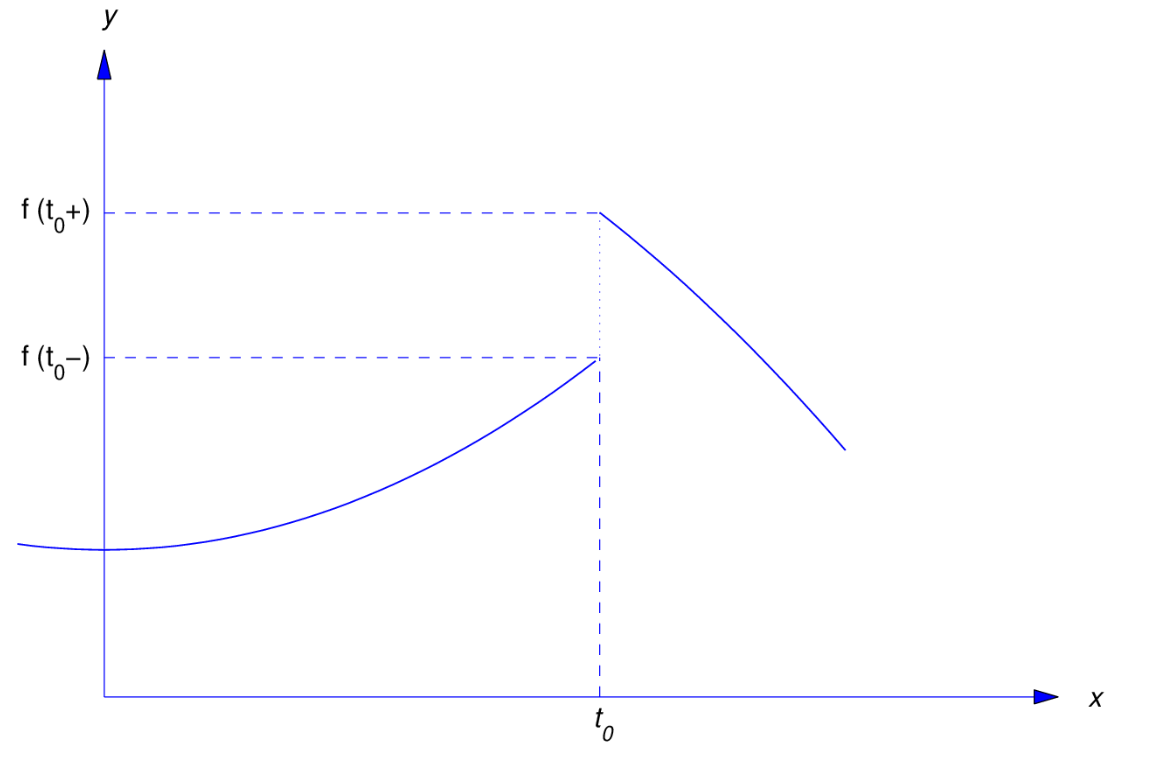
If \(f(t_0+)\) and \(f(t_0-)\) have finite but distinct values, we say that \(f\) has a jump discontinuity at \(t_0\), and
\[f(t_0+)-f(t_0-)\nonumber\]
is called the jump in \(f\) at \(t_0\) (Figure 9.1.1 ).
If \(f(t_0+)\) and \(f(t_0-)\) are finite and equal, but either \(f\) isn’t defined at \(t_0\) or it is defined but
\[f(t_0)\ne f(t_0+)=f(t_0-),\nonumber\]
we say that \(f\) has a removable discontinuity at \(t_0\) (Figure 9.1.2 ). This terminology is appropriate since a function \(f\) with a removable discontinuity at \(t_0\) can be made continuous at \(t_0\) by redefining
\[f(t_0)=f(t_0+)=f(t_0-).\nonumber\]

We know from calculus that a definite integral isn’t affected by changing the values of its integrand at isolated points. Therefore, redefining a function f to make it continuous at removable discontinuities does not change \(\cal{L}(f)\).
- A function \(f\) is said to be piecewise continuous on a finite closed interval \([0,T]\) if \(f(0+)\) and \(f(T-)\) are finite and \(f\) is continuous on the open interval \((0,T)\) except possibly at finitely many points, where \(f\) may have jump discontinuities or removable discontinuities.
- A function \(f\) is said to be piecewise continuous on the infinite interval \([0,\infty)\) if it is piecewise continuous on \([0,T]\) for every \(T>0\).
Figure 9.1.3 shows the graph of a typical piecewise continuous function.
It is shown in calculus that if a function is piecewise continuous on a finite closed interval then it is integrable on that interval. But if \(f\) is piecewise continuous on \([0,\infty)\), then so is \(e^{-st}f (t)\), and therefore
\[\int_0^T e^{-st}f(t)\,dt \nonumber\]

exists for every \(T>0\). However, piecewise continuity alone does not guarantee that the improper integral
\[\label{eq:8.1.13} \int_0^\infty e^{-st}f(t)\,dt=\lim_{T\to\infty}\int_0^T e^{-st}f(t)\, dt\]
converges for \(s\) in some interval \((s_0,\infty)\). For example, we noted earlier that Equation \ref{eq:8.1.13} diverges for all \(s\) if \(f(t)=e^{t^2}\). Stated informally, this occurs because \(e^{t^2}\) increases too rapidly as \(t\to\infty\). The next definition provides a constraint on the growth of a function that guarantees convergence of its Laplace transform for \(s\) in some interval \((s_0,\infty)\).
A function \(f\) is said to be of exponential order \(s_0\) if there are constants \(M\) and \(t_0\) such that
\[\label{eq:8.1.14} |f(t)|\le Me^{s_0t},\quad t\ge t_0.\]
In situations where the specific value of \(s_0\) is irrelevant we say simply that \(f\) is of exponential order.
The next theorem gives useful sufficient conditions for a function \(f\) to have a Laplace transform.
If \(f\) is piecewise continuous on \([0,\infty)\) and of exponential order \(s_0,\) then \({\cal L}(f)\) is defined for \(s>s_0\).
We emphasize that the conditions of Theorem 9.1.6 are sufficient, but not necessary, for \(f\) to have a Laplace transform. For example, Exercise 9.1.23 shows that \(f\) may have a Laplace transform even though \(f\) isn’t of exponential order
If \(f\) is bounded on some interval \([t_0,\infty)\), say
\[|f(t)|\le M,\quad t\ge t_0,\nonumber\]
then Equation \ref{eq:8.1.14} holds with \(s_0=0\), so \(f\) is of exponential order zero. Thus, for example, \(\sin\omega t\) and \(\cos \omega t\) are of exponential order zero, and Theorem 9.1.2 implies that \({\cal L}(\sin\omega t)\) and \({\cal L}(\cos \omega t)\) exist for \(s>0\).
It can be shown that if \(\lim_{t\to\infty}e^{-s_0t}f(t)\) exists and is finite then \(f\) is of exponential order \(s_0\). If \(\alpha\) is any real number and \(s_0>0\) then \(f(t)=t^\alpha\) is of exponential order \(s_0\), since
\[\lim_{t\to\infty}e^{-s_0t}t^\alpha=0,\nonumber\]
by L’Hôpital’s rule. If \(\alpha\ge 0\), \(f\) is also continuous on \([0,\infty)\). Therefore Theorem 9.1.2 imply that \({\cal L}(t^\alpha)\) exists for \(s\ge s_0\). However, since \(s_0\) is an arbitrary positive number, this really implies that \({\cal L}(t^\alpha)\) exists for all \(s>0\). This is consistent with the results of Example 9.1.2 .
Find the Laplace transform of the piecewise continuous function
\[f(t)=\left\{\begin{array}{cl} 1,&0\le t<1,\\ -3e^{-t},&t\ge 1.\end{array}\right.\nonumber\]
Solution
Since \(f\) is defined by different formulas on \([0,1)\) and \([1,\infty)\), we write
\[F(s)=\int_0^\infty e^{-st} f(t)\,dt =\int_0^1e^{-st}(1)\,dt+\int_1^\infty e^{-st}(-3e^{-t})\,dt.\nonumber\]
Since
\[\int_{0}^{1}e^{-st}dt = \left\{\begin{array}{cl} {\frac{1-e^{-s}}{s}}&{s\neq 0} \\ {1}&{s=0} \end{array} \right. \nonumber \]
and
\[\int_1^\infty e^{-st}(-3e^{-t})\,dt=-3\lim_{T\to\infty}\int_1^Te^{-(s+1)t}\,dt=-3\lim_{T\to\infty}\left(-{1\over s+1}e^{-(s+1)t}\right)\Big|_1^T=-3\lim_{T\to\infty}\left(-{1\over s+1}e^{-(s+1)T}+{1\over s+1}e^{-(s+1)}\right)=-{3e^{-(s+1)}\over s+1},\quad s>-1,\nonumber\]
it follows that
\[F(s) = \left\{\begin{array}{rl}{\frac{1-e^{-s}}{s}-3\frac{e^{-(s+1)}}{s+1}}&{s>-1, s\neq 0} \\ {1-\frac{3}{e}}&{s=0} \end{array} \right. \nonumber \]
This is consistent with Theorem 9.1.2 , since
\[|f(t)|\le 3e^{-t},\quad t\ge 1,\nonumber\]
and therefore \(f\) is of exponential order \(s_0=-1\).
We stated earlier that
\[\int_0^\infty e^{-st} e^{t^2} dt=\infty \nonumber\]
for all \(s\), so Theorem 9.1.2 implies that \(f(t)=e^{t^2}\) is not of exponential order, since
\[\lim_{t\to\infty} {e^{t^2}\over Me^{s_0t}}=\lim_{t\to\infty} {1\over M} e^{t^2-s_0t}=\infty, \nonumber\]
so
\[e^{t^2}>Me^{s_0t} \nonumber\]
for sufficiently large values of \(t\), for any choice of \(M\) and \(s_{0}\).