

6.A: Answers
- Page ID
- 212060

\( \newcommand{\vecs}[1]{\overset { \scriptstyle \rightharpoonup} {\mathbf{#1}} } \)
\( \newcommand{\vecd}[1]{\overset{-\!-\!\rightharpoonup}{\vphantom{a}\smash {#1}}} \)
\( \newcommand{\dsum}{\displaystyle\sum\limits} \)
\( \newcommand{\dint}{\displaystyle\int\limits} \)
\( \newcommand{\dlim}{\displaystyle\lim\limits} \)
\( \newcommand{\id}{\mathrm{id}}\) \( \newcommand{\Span}{\mathrm{span}}\)
( \newcommand{\kernel}{\mathrm{null}\,}\) \( \newcommand{\range}{\mathrm{range}\,}\)
\( \newcommand{\RealPart}{\mathrm{Re}}\) \( \newcommand{\ImaginaryPart}{\mathrm{Im}}\)
\( \newcommand{\Argument}{\mathrm{Arg}}\) \( \newcommand{\norm}[1]{\| #1 \|}\)
\( \newcommand{\inner}[2]{\langle #1, #2 \rangle}\)
\( \newcommand{\Span}{\mathrm{span}}\)
\( \newcommand{\id}{\mathrm{id}}\)
\( \newcommand{\Span}{\mathrm{span}}\)
\( \newcommand{\kernel}{\mathrm{null}\,}\)
\( \newcommand{\range}{\mathrm{range}\,}\)
\( \newcommand{\RealPart}{\mathrm{Re}}\)
\( \newcommand{\ImaginaryPart}{\mathrm{Im}}\)
\( \newcommand{\Argument}{\mathrm{Arg}}\)
\( \newcommand{\norm}[1]{\| #1 \|}\)
\( \newcommand{\inner}[2]{\langle #1, #2 \rangle}\)
\( \newcommand{\Span}{\mathrm{span}}\) \( \newcommand{\AA}{\unicode[.8,0]{x212B}}\)
\( \newcommand{\vectorA}[1]{\vec{#1}} % arrow\)
\( \newcommand{\vectorAt}[1]{\vec{\text{#1}}} % arrow\)
\( \newcommand{\vectorB}[1]{\overset { \scriptstyle \rightharpoonup} {\mathbf{#1}} } \)
\( \newcommand{\vectorC}[1]{\textbf{#1}} \)
\( \newcommand{\vectorD}[1]{\overrightarrow{#1}} \)
\( \newcommand{\vectorDt}[1]{\overrightarrow{\text{#1}}} \)
\( \newcommand{\vectE}[1]{\overset{-\!-\!\rightharpoonup}{\vphantom{a}\smash{\mathbf {#1}}}} \)
\( \newcommand{\vecs}[1]{\overset { \scriptstyle \rightharpoonup} {\mathbf{#1}} } \)
\(\newcommand{\longvect}{\overrightarrow}\)
\( \newcommand{\vecd}[1]{\overset{-\!-\!\rightharpoonup}{\vphantom{a}\smash {#1}}} \)
\(\newcommand{\avec}{\mathbf a}\) \(\newcommand{\bvec}{\mathbf b}\) \(\newcommand{\cvec}{\mathbf c}\) \(\newcommand{\dvec}{\mathbf d}\) \(\newcommand{\dtil}{\widetilde{\mathbf d}}\) \(\newcommand{\evec}{\mathbf e}\) \(\newcommand{\fvec}{\mathbf f}\) \(\newcommand{\nvec}{\mathbf n}\) \(\newcommand{\pvec}{\mathbf p}\) \(\newcommand{\qvec}{\mathbf q}\) \(\newcommand{\svec}{\mathbf s}\) \(\newcommand{\tvec}{\mathbf t}\) \(\newcommand{\uvec}{\mathbf u}\) \(\newcommand{\vvec}{\mathbf v}\) \(\newcommand{\wvec}{\mathbf w}\) \(\newcommand{\xvec}{\mathbf x}\) \(\newcommand{\yvec}{\mathbf y}\) \(\newcommand{\zvec}{\mathbf z}\) \(\newcommand{\rvec}{\mathbf r}\) \(\newcommand{\mvec}{\mathbf m}\) \(\newcommand{\zerovec}{\mathbf 0}\) \(\newcommand{\onevec}{\mathbf 1}\) \(\newcommand{\real}{\mathbb R}\) \(\newcommand{\twovec}[2]{\left[\begin{array}{r}#1 \\ #2 \end{array}\right]}\) \(\newcommand{\ctwovec}[2]{\left[\begin{array}{c}#1 \\ #2 \end{array}\right]}\) \(\newcommand{\threevec}[3]{\left[\begin{array}{r}#1 \\ #2 \\ #3 \end{array}\right]}\) \(\newcommand{\cthreevec}[3]{\left[\begin{array}{c}#1 \\ #2 \\ #3 \end{array}\right]}\) \(\newcommand{\fourvec}[4]{\left[\begin{array}{r}#1 \\ #2 \\ #3 \\ #4 \end{array}\right]}\) \(\newcommand{\cfourvec}[4]{\left[\begin{array}{c}#1 \\ #2 \\ #3 \\ #4 \end{array}\right]}\) \(\newcommand{\fivevec}[5]{\left[\begin{array}{r}#1 \\ #2 \\ #3 \\ #4 \\ #5 \\ \end{array}\right]}\) \(\newcommand{\cfivevec}[5]{\left[\begin{array}{c}#1 \\ #2 \\ #3 \\ #4 \\ #5 \\ \end{array}\right]}\) \(\newcommand{\mattwo}[4]{\left[\begin{array}{rr}#1 \amp #2 \\ #3 \amp #4 \\ \end{array}\right]}\) \(\newcommand{\laspan}[1]{\text{Span}\{#1\}}\) \(\newcommand{\bcal}{\cal B}\) \(\newcommand{\ccal}{\cal C}\) \(\newcommand{\scal}{\cal S}\) \(\newcommand{\wcal}{\cal W}\) \(\newcommand{\ecal}{\cal E}\) \(\newcommand{\coords}[2]{\left\{#1\right\}_{#2}}\) \(\newcommand{\gray}[1]{\color{gray}{#1}}\) \(\newcommand{\lgray}[1]{\color{lightgray}{#1}}\) \(\newcommand{\rank}{\operatorname{rank}}\) \(\newcommand{\row}{\text{Row}}\) \(\newcommand{\col}{\text{Col}}\) \(\renewcommand{\row}{\text{Row}}\) \(\newcommand{\nul}{\text{Nul}}\) \(\newcommand{\var}{\text{Var}}\) \(\newcommand{\corr}{\text{corr}}\) \(\newcommand{\len}[1]{\left|#1\right|}\) \(\newcommand{\bbar}{\overline{\bvec}}\) \(\newcommand{\bhat}{\widehat{\bvec}}\) \(\newcommand{\bperp}{\bvec^\perp}\) \(\newcommand{\xhat}{\widehat{\xvec}}\) \(\newcommand{\vhat}{\widehat{\vvec}}\) \(\newcommand{\uhat}{\widehat{\uvec}}\) \(\newcommand{\what}{\widehat{\wvec}}\) \(\newcommand{\Sighat}{\widehat{\Sigma}}\) \(\newcommand{\lt}{<}\) \(\newcommand{\gt}{>}\) \(\newcommand{\amp}{&}\) \(\definecolor{fillinmathshade}{gray}{0.9}\)Section 6.1
- \(y = e^{-3x}+2 \Rightarrow y' = -3e^{-3x}\) so \(y'+3y = \left(-3e^{-3x}\right)+3\left(e^{-3x}+2\right) = -3e^{-3x}+3e^{-3x}+6 = 6\)
- \(y=x^2+2x \Rightarrow y' = 2x+2 \Rightarrow y' = 2\) so \(y''-y'+y=2-\left(2x+2\right)+\left(x^2+2x\right) = 2-2x-2+x^2+2x = x^2\)
- \(y=7x^3-x^2 \Rightarrow y' = 21x^2-2x\) so \(xy'-3y=x\left(21x^2-2x\right)-3\left(7x^3-x^2\right) = 21x^3-2x^2-21x^3+3x^2=x^2\)
- \(y = \frac12 e^{x}+2e^{-x} \Rightarrow y' = \frac12 e^x - 2 e^{-x}\) so \(y'+y = \left(\frac12 e^x - 2 e^{-x}\right)+\left(\frac12 e^{x}+2e^{-x}\right) = e^x\)
- \(\displaystyle y = \left(7-x^2\right)^{\frac12} \Rightarrow y' = \frac12\left(7-x^2\right)^{-\frac12}\left(-2x\right) = \frac{-x}{\sqrt{7-x^2}} = -\frac{x}{y}\)
- \(y = 2x^3-3x+3 \Rightarrow y(1) = 2\cdot 1^3 - 3\cdot 1 + 3 = 2\) (OK) and \(y' = 6x^2-3\) (OK)
- \(y = \sin(2x)+1 \Rightarrow y(0)=\sin(0)+1=1\) (OK) and \(y'=2\cos(2x)\) (OK)
- \(y = 7e^{5x} \Rightarrow y(0) = 7e^{5\cdot 0} = 7\) (OK) and \(y' = 7e^{5x}\cdot 5 - 5y\) (OK)
- \(\displaystyle y = -\frac{4}{x} \Rightarrow y(1) = -\frac{4}{1} = -4\) (OK) and \(\displaystyle y' = \frac{4}{x^2}\) so \(\displaystyle x\cdot y' = x\left(\frac{4}{x^2}\right) = \frac{4}{x} = -y\)
- \(y = 5\ln(x)-2 \Rightarrow y(e) = 5\ln(e)-2 = 5-2=3\) (OK) and \(\displaystyle y' = 5\cdot\frac{1}{x}\) (OK)
- \(7 = y(3) = 3^2+C = 9 +C \Rightarrow C = -2\)
- \(5 = y(0) = Ce^{3\cdot 0} = C\cdot 1 \Rightarrow C = 5\)
- \(4 = y(0) =2\sin(3\cdot 0) + C = 0 + C \Rightarrow C = 4\)
- \(2 = y(e) = \ln(e) + C = 1 + C \Rightarrow C = 1\)
- \(\displaystyle 10 = y(2) =-\frac{C}{2} \Rightarrow C = -20\)
- \(\displaystyle y = \int\left[4x^2-x\right]\, dx = \frac43 x^3 - \frac12 x^2 + C\) so \(7 = y(1) = \frac43 - \frac12 + C \Rightarrow C = \frac{37}{6}\) and \(y = \frac43 x^3 - \frac12 x^2 + \frac{37}{6}\)
- \(\displaystyle y = \int \frac{3}{x}\, dx = 3\ln\left(\left|x\right|\right) + C\) so \(2 = y(1) = 3\ln(1) + C = 0 + C\) so \(C +2\) and \(y = 3\ln\left(\left|x\right|\right) + 2\)
- \(\displaystyle y = \int 6e^{2x} \, dx = 3e^{2x} + C\) so \(1 = y(0) = 3e^{2\cdot 0} + C = 3+C \Rightarrow C = -2\) and \(y = 3e^{2x} - 2\)
- \(\displaystyle y = \int x\cdot\sin\left(x^2\right)\, dx = -\frac12 \cos\left(x^2\right) + C\) so \(3 = y(0) = -\frac12 \cos(0)+C = -\frac12 + C \Rightarrow C = \frac72\) and \(\displaystyle y = -\frac12 \cos\left(x^2\right) + \frac72\)
- \(\displaystyle y' = \frac{1}{x}\left(6x^3-10x^2\right) = 6x^2-10x \Rightarrow y = \int\left[6x^2-10x\right]\, dx = 2x^3-5x^2+C\) so \(5 = y(2) = 2\cdot 2^3 - 5\cdot 2^2 + C = 16-20+C = -4 + C \Rightarrow C = 9\) and \(y = 2x^3-5x^2+9\)
- We know that \(f'(x)+5\cdot f(x) =0\) and \(g'(x)+5\cdot g(x) =0\), so: \(y = 3f(x) \Rightarrow y' = 3f'(x) \Rightarrow y'+5y=3f'(x) + 5\cdot 3f(x) = 3\left[f'(x) + 5 \cdot f(x)\right] = 3\cdot 0 = 0\)
\(y = 7g(x) \Rightarrow y' = 7g'(x) \Rightarrow y'+5y=7g'(x) + 5\cdot 7g(x) = 7\left[g'(x) + 5 \cdot g(x)\right] = 3\cdot 0\)
\(y = f(x)+g(x) \Rightarrow y' = f'(x)+g'(x) \Rightarrow y'+5\cdot y = \left[f'(x)+g'(x)\right] + 5\cdot\left[f(x)+g(x)\right] \Rightarrow y = f'(x) + g'(x) + 5f(x) + 5g(x) = \left[f'(x) + 5f(x)\right] + \left[g'(x) + 5g(x)\right] = 0+0 = 0\)
\(y = A\cdot f(x) + B\cdot g(x) \Rightarrow y' = A\cdot f'(x)+B \cdot g'(x) \Rightarrow y'+5\cdot y = \left[A\cdot f'(x)+B\cdot g'(x)\right] + 5\cdot\left[A\cdot f(x)+B\cdot g(x)\right] \Rightarrow y = Af'(x) + Bg'(x) + 5Af(x) + 5Bg(x) = A\left[f'(x) + 5f(x)\right] + B\left[g'(x) + 5g(x)\right] = A\cdot 0+B\cdot 0 = 0\) - \(y = \sin(x) + x \Rightarrow y' = \cos(x) + 1 \Rightarrow y'' = -\sin(x) \Rightarrow y''+y = \left[-\sin(x)\right]+\left[\sin(x) + x\right] = x\)
\(y = \cos(x) + x \Rightarrow y' = -\sin(x) + 1 \Rightarrow y'' = -\cos(x) \Rightarrow y''+y = \left[-\cos(x)\right]+\left[\cos(x) + x\right] = x\) (OK)
\(y = 3\left[\sin(x) + x\right] \Rightarrow y' = 3\cos(x) + 3 \Rightarrow y'' = -3\sin(x) \Rightarrow y''+y = -3\sin(x) +3\left[\sin(x) + x\right] = 3x\) (NO)
Similarly, \(y = \left[\sin(x) + x\right]+\left[\cos(x) + x\right] \Rightarrow y''+y =2x\) (NO) - \(y = \frac{A}{B}-C\cdot e^{-Bt} \Rightarrow \frac{dy}{dt} = 0 - C\left[-Be^{-Bt}\right] = BCe^{-Bt} \Rightarrow A-By = A - B \left[ \frac{A}{B}-C\cdot e^{-Bt}\right] = A - A +BCe^{-Bt} = BCe^{-Bt} = \frac{dy}{dt}\) (OK)
- \(I = \frac{E}{R}\left[1-\cdot e^{-\frac{Rt}{L}}\right] \Rightarrow \frac{dI}{dt} = \frac{E}{R}\left[0 - \left(-\frac{R}{L}\right)e^{-\frac{Rt}{L}}\right] = \frac{E}{R}e^{-\frac{Rt}{L}} \Rightarrow L\cdot\frac{dI}{dt} + R\cdot I = l\left[\frac{E}{R}e^{-\frac{Rt}{L}}\right] + r\cdot \frac{E}{R}\left[1-\cdot e^{-\frac{Rt}{L}}\right] = E\cdot e^{-\frac{Rt}{L}}+E\left[1-e^{-\frac{Rt}{L}}\right] = E\) (OK)
Section 6.2
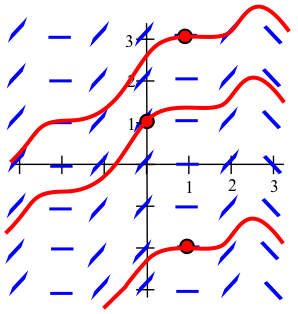
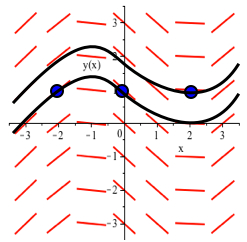

- All solutions appear to approach the horizontal line \(y=1\): for any solution \(y(x)\), \(\displaystyle \lim_{x \to \infty} \, y(x) = 1\).


-
- \(y = x^2-3x+C\)
- \(4 = y(1) = 1^2-3\cdot 1 + C \Rightarrow 4 = C- 2 \Rightarrow C = 6\) so \(y = x^2-3x+6\)
- \((-\infty, \infty)\)
-
- \(\Rightarrow y = e^x + \sin(x) + C\)
- \(7 = y(0) = 1+0 + C \Rightarrow C = 6\) so \(y = e^x+\sin(x)+6\)
- \((-\infty, \infty)\)
-
- \(\displaystyle y' = \frac{6}{2x+1} + \sqrt{x} \Rightarrow y = 3\ln\left(\left|2x+1\right|\right) + \frac23 x^{\frac32} + C\)
- \(4 = y(1) = 3\ln(3) + \frac23 + C \Rightarrow C = \frac{10}{3}-3\ln(3)\) so \(3\ln\left(\left|2x+1\right|\right) + \frac23 x^{\frac32} + \frac{10}{3}-3\ln(3)\)
- \((0, \infty)\)


Section 6.3
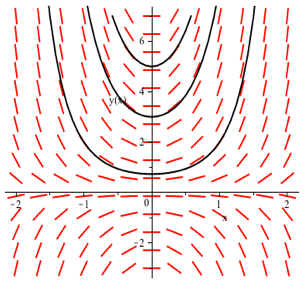
- If \(y \neq 0\), divide both sides by \(y\) to separate:\[\frac{1}{y}\cdot \frac{dy}{dx} = 2x \Rightarrow \frac{1}{y}\, dy = 2x \, dx\nonumber\]and then integrate both sides:\[\int \frac{1}{y}\, dy = \int 2x \, dx \Rightarrow \ln\left(\left|y\right|\right) = x^2 + C\nonumber\]then exponentiate both sides to solve for \(y\):\[e^{\ln\left(\left|y\right|\right)} = e^{x^2 + C} \Rightarrow \left|y\right| = e^C \cdot e^{x^2} \Rightarrow y = \pm e^C \cdot e^{x^2}\nonumber\]so \(\displaystyle y = A e^{x^2}\) is a solution for any \(A \neq 0\). But the constant function \(y(x) = 0\) is also a solution to \(y' = 2xy\) so the general solution is \(y = A e^{x^2}\) for any constant \(A\).
- Divide both sides of the ODE by \(1+x^2\) to separate, then integrate:\[\frac{dy}{dx} = \frac{3}{1+x^2} \Rightarrow y = 3\arctan(x) + C\nonumber\]
- Divide both sides by \(e^{y} \cdot \cos(x)\) to separate:\[\frac{1}{e^y} \cdot \frac{dy}{dx} = \frac{1}{\cos(x)} \Rightarrow e^{-y} \, dy = \sec(x) \, dx\nonumber\]and use Appendix I to assist with the integration: \begin{align*} \int e^{-y} \, dy &= \int \sec(x) \, dx\\ &\Rightarrow -e^{-y} = \ln\left(\left|\sec(x)+\tan(x)\right|\right) + C\end{align*} then solve for \(y\): \begin{align*}e^{-y} &= K-\ln\left(\left|\sec(x)+\tan(x)\right|\right) \Rightarrow \\ -y &= \ln\left( K-\ln\left(\left|\sec(x)+\tan(x)\right|\right)\right)\end{align*} so the general solution is:\[y = -\ln\left( K-\ln\left(\left|\sec(x)+\tan(x)\right|\right)\right)\nonumber\]
- Note that \(y = 0\) is a solution to \(y' = 4y\). If \(y \neq 0\), divide both sides of the ODE by \(y\) to separate:\[\frac{1}{y} \cdot \frac{dy}{dx} = 4 \Rightarrow \frac{1}{y}\, dy = 4\, dx\nonumber\]then integrate both sides:\[\int \frac{1}{y}\, dy = \int 4\, dx \Rightarrow \ln\left(\left|y\right|\right) = 4x + C\nonumber\]and solve for \(y\):\[e^{\ln\left(\left|y\right|\right)} = e^{4x + C} \Rightarrow \left|y\right| = e^C \cdot e^{4x} \Rightarrow y = \pm e^C \cdot e^{4x}\nonumber\]so \(y = A e^{4x}\) is a solution for any constant \(A \neq 0\) but \(y(x) = 0\) is also a solution, so the general solution is \(y(x) = Ae^{4x}\) for any constant \(A\).
- From Problem 3, we know that \(\displaystyle y = A e^{x^2}\), so using each initial condition: \begin{align*} 3 &= y(0) = A\cdot e^{0^2} = A \Rightarrow A = 3 \Rightarrow y = 3e^{x^2}\\ 5 &= y(0) = A\cdot e^{0^2} = A \Rightarrow A = 5 \Rightarrow y = 5e^{x^2}\\ 2 &= y(1) = A\cdot e \Rightarrow A = 2e^{-1} \Rightarrow y = 2e^{x^2-1} \end{align*}
- Mimic the solution to Problem 9 to arrive at the general solution: \(\displaystyle y = A e^{3x}\). Then use each initial condition: \begin{align*} 4 &= y(0) = A\cdot e^{3\cdot 0} = A \Rightarrow A = 4 \Rightarrow y = 4e^{3x}\\ 7 &= y(0) = A\cdot e^{3\cdot 0} = A \Rightarrow A = 7 \Rightarrow y = 7e^{3x}\\ 3 &= y(1) = A\cdot e^{3\cdot 1} = Ae^3 \Rightarrow A = 3e^{-3} \Rightarrow y = 3e^{3x-3} \end{align*}
- From Problem 10, we know \(\displaystyle y = 2+Ae^{-5x}\), so using each initial condition: \begin{align*} 5 &= y(0) = 2+A \cdot 1 \Rightarrow A = 3 \Rightarrow y = 2+3e^{-5x}\\ -3 &= y(0) = 2+A\cdot 1 \Rightarrow A = -5 \Rightarrow y = 2-5e^{-5x} \end{align*}
- From Problem 5, we know \(\displaystyle y = 3\arctan(x)+C\), so using each initial condition: \begin{align*} 4 &= y(1) = 3\cdot \frac{\pi}{4} + C \Rightarrow y = 3\arctan(x) + 4 - \frac{3\pi}{4}\\ 2 &= y(0) = 3\cdot 0 + C \Rightarrow y = 3\arctan(x)+2 \end{align*}
- No. Putting \(x = 0\) and \(y = 2\) into the ODE:\[0\cdot y'(0) = 2+3 \Rightarrow 0 = 5\nonumber\]which is a contradiction.
Section 6.4
- The population is 10,000 around 1966 and is 20,000 around 1978, so \(1978-1966 = 12\) years. The population grows from 15,000 around 1974 to 30,000 around 1985, so \(1985-1974 = 11\) years. The doubling time is approximately 12 years.
-
- If \(P(t)\) represents the population (in thousands) \(t\) years after 1990, then \(\displaystyle P(t) = 48e^{kt}\) for some constant \(k\). We also know that:\[64 = 48 e^{20k} \ \Rightarrow \ \frac43 = e^{20k} \ \Rightarrow \ k = \frac{1}{20}\ln\left(\frac43\right)\nonumber\]so that \(\displaystyle P(t) = 48\left(\frac43\right)^{\frac{t}{20}} \approx 48e^{0.01438t}\).
- \(\displaystyle P(30)= 48\left(\frac43\right)^{\frac{30}{20}} \approx 73.901\), so if the model holds, in 2020 the community's population will be approximately 74,000.
- Solving \(P(t)=100\) for \(t\): \begin{align*} &100 = 48\left(\frac43\right)^{\frac{t}{20}} \ \Rightarrow \ \frac{100}{48} = \left(\frac43\right)^{\frac{t}{20}} \\ &\Rightarrow \ \ln\left(\frac{25}{12}\right) = \frac{t}{20}\ln\left(\frac43\right) \ \Rightarrow t = \frac{20\ln\left(\frac{25}{12}\right)}{\ln\left(\frac43\right)} \end{align*} so about 51 years later (in 2041).
- \(\displaystyle \frac{\ln(2)}{k} = \frac{20\ln(2)}{\ln\left(\frac43\right)} \approx 48.19\) years
- If \(A(t)\) is the value of the investment \(t\) years later:\[A(t) = 5000(1.15)^t = 5000e^{t\cdot\ln(1.15)}\nonumber\]so the doubling time is \(\displaystyle \frac{\ln(2)}{\ln(1.15)} \approx 4.96\) years and the tripling time is \(\displaystyle \frac{\ln(3)}{\ln(1.15)} \approx 7.86\) years.
- In 1950 the population is approximately 5,000, so if \(P(t)\) represents the size of the population \(t\) years after 1950, then \(P(t) = 5000e^{kt}\) for some constant \(k\). If the doubling time is 12 years:\[\frac{\ln(2)}{k} = 12 \Rightarrow k = \frac{\ln(2)}{12} \Rightarrow P(t) = 5000e^{\frac{t}{12}\ln(2)}\nonumber\]so \(\displaystyle P(t) = 5000\left(2\right)^{\frac{t}{12}}\).
- \(\displaystyle k = \frac{\ln(2)}{50} \Rightarrow P(t) = P(0) e^{\frac{t}{50}\cdot\ln(2)} = P(0)\cdot 2^{\frac{t}{50}}\) so \(\displaystyle \frac{P(1)-P(0)}{P(0)} = 2^{\frac{1}{50} -1} \approx 0.014 = 1.4\%\)
- \(6(1.03)^t = 4(1.06)^t \Rightarrow t = \frac{\ln\left(\frac32\right)}{\ln\left(\frac{1.06}{1.03})\right)} \approx 14.12\) years
- After \(t\) months, you have \(S(t) = 8000e^{0.14\left(\frac{t}{12}\right)}\) snails before harvest.
- \(S(2) = 8000e^{0.14\left(\frac{2}{12}\right)} \approx 8,188\), so after harvest \(S = 6188\); \(S(4) = 6188e^{0.14\left(\frac{2}{12}\right)}\approx 6334\), so after harvest \(S = 4,334\); after third harvest, \(2436\) remain; after fourth harvest, \(494\) remain; after fifth harvest, no snails remain.
- No snails remain after the third harvest.
- The population growth is 188 snails after two months, so you can harvest 188 snails every two months and maintain a stable population (between 8,000 and 8,188).
- \(A(t) = A(0)e^{kt} = 10e^{kt}\) and \(A(14) = 2\)
- \(\displaystyle 2 = 10e^{14k} \Rightarrow k \approx -0.115 \Rightarrow A(t) = 10e^{–0.115t}\)
- \(\displaystyle \frac{-\ln(2)}{-0.115} \approx 6\) days
- \(\displaystyle 0.7 = 10e^{-0.115t} \Rightarrow t = \frac{\ln(0.7)}{-0.115} \approx 23\) days
-
- \(\displaystyle 143 = 187e^{2k} \Rightarrow k = \frac{\ln\left(\frac{143}{187}\right)}{2} \approx -0.134\), hence \(\displaystyle \frac{-\ln(2)}{k} \approx 5.17\) days
- \(\displaystyle 20 = 187e^{-0.134t} \Rightarrow t = \frac{\ln\left(\frac{20}{187}\right)}{-0.134} \approx 16.7\) days
- \(\displaystyle 3.5 = 8e^{6k} \Rightarrow k = \frac{\ln\left(\frac{3.5}{8}\right)}{6} \approx -0.138\), so \(A(t) = 8000e^{-0.138t}\) counts per minute after \(t\) days.
- Carbon-14 has a half-life of 5,700 years, so \(\displaystyle k = \frac{-\ln(2)}{5700} \approx -0.00012\), hence \(\displaystyle 0.975 = e^{-0.00012t} \Rightarrow t = \frac{\ln(0.975)}{-0.00012} \approx 211\) years, but Newton died in 1727, over 288 years ago, so the letter is a fake.
- \(\displaystyle k = \frac{-\ln(2)}{6} \approx -0.116\), so \(A(t) = 30e^{-0.116t}\) and \(\displaystyle A(t) \geq 10 \Rightarrow -0.116t \geq \ln\left(\frac{10}{30}\right) \Rightarrow t \leq \frac{-1.009}{-0.116} \approx 9.47\) hours. After about 9.5 hours, the concentration of medicine is no longer effective.
- \(\displaystyle k = \frac{-\ln(2)}{15} \approx -0.046\), so \(A(t) = 9e^{-0.046t}\), hence \(A(8) = 9e^{-0.046(8)} \approx 6.23\) mg, resulting in a “decay” of \(9 - 6.23 = 2.77\) mg during these 8 hours. Taking a 2.77 mg dose every 8 hours keeps level of the medicine in the safe and effective range over a long period of time.
- The half-life of iodine-131 is 8.07 days, hence \(\displaystyle k = \frac{-\ln(2)}{8.07} \approx -0.086\), thus \(A(t) = 5Se^{-0.086t}\). If \(S\) is highest safe level, \(\displaystyle S = 5Se^{-0.086t} \Rightarrow 0.2 = e^{-0.086t}\) so that \(\displaystyle t = \frac{\ln(0.2)}{-0.086} \approx 18.7\) days.
- For the population \(P(t)\), \(P(0) = 4\) and \(P(1) = (1.05)(4) = 4 e^{k(1)} \Rightarrow k = \ln(1.05) \approx 0.049\), so \(P(t) = 4e^{0.049t}\) (in millions). The size of the forest is \(F(t) = 10000000 - 300000t\) acres after \(t\) years (the entire forest will be gone in 33.3 years).
- \(\displaystyle \frac{100 - 3t}{40e^{0.049t}}\) acres per person
- \(\displaystyle \mbox{D}\left(\frac{100 - 3t}{40e^{0.049t}}\right) = \frac{-7.9 + 0.147t}{40e^{0.049t}}\)
- Solve \(\displaystyle \frac{100 - 3t}{40e^{0.049t}} = 1\) using technology to determine that \(t \approx 10.75\) years.
Section 6.5
- The temperature of the cheesecake \(t\) minutes later is given by:\[f(t) = 35+\left[165-35\right]e^{kt} = 35+130e^{kt}\nonumber\]Solving \(150=35+130e^{10k}\) for \(k\) yields:\[k = \frac{1}{10} \ln\left(\frac{115}{130}\right) \approx -0.01226\nonumber\]so that \(\displaystyle f(t) = 35+130e^{-0.01226t}\). Solving \(f(T) = 70\) for \(T\) then yields:\[70=35+130e^{-0.01226t} \Rightarrow T = -\frac{1}{0.01226}\ln\left(\frac{35}{130}\right)\nonumber\]so you will need to wait about 107 minutes.
-
- The temperature of the water \(t\) minutes later is given by:\[f(t) = 40+\left[200-40\right]e^{kt} = 40+160e^{kt}\nonumber\]Solving \(150=40+160e^{4k}\) for \(k\) yields:\[k = \frac{1}{4} \ln\left(\frac{110}{160}\right) \approx -0.09367\nonumber\]so that \(\displaystyle f(t) = 40+160e^{-0.09367t}\).
- Solving \(100=40+160e^{-0.09367T}\) for \(T\) yields:\[T = -\frac{1}{0.09367}\ln\left(\frac{60}{160}\right) \approx 10.5 \ \mbox{minutes}\nonumber\]
- \(\displaystyle -\frac{1}{0.09367}\ln\left(\frac{40}{160}\right) \approx 14.8\) minutes
- \(\approx 22.2\) minutes
- If \(A(t)\) represents the amount of salt in the tank \(t\) minutes later, then \(A(t)\) satisfies the IVP:\[\frac{dA}{dt} = - \frac{A}{100}\cdot 3, \quad A(0) = 50\nonumber\]Solving this separable ODE yields:\[\int \frac{1}{A}\, dA = \int -0.03\, dt \Rightarrow \ln(A) = -0.03t+C\nonumber\]The initial condition \(A(0) = 50\) tells us that \(\ln(50) = C\), so:\[\ln(A) = -0.03t+\ln(50) \Rightarrow A(t) = 50e^{-0.03t}\nonumber\]Hence \(A(60) = 50e^{-0.03(60)} \approx 8.26\) pounds.
- If \(A(t)\) represents the amount of salt in the tank \(t\) minutes later, then \(A(t)\) satisfies the IVP:\[\frac{dA}{dt} = - \frac{A}{100+t}\cdot 2, \quad A(0) = 50\nonumber\]Solving this separable ODE yields:\[\int \frac{1}{A}\, dA = \int -\frac{2}{100+t}\, dt\nonumber\]so that \(\displaystyle \ln(A) = \ln(100+t)^{-2}+C\). The initial condition \(A(0) = 50\) then tells us that:\[\ln(50) = -2\ln(100)+C \Rightarrow C = \ln(500000)\nonumber\]hence \(\displaystyle A(t) = \frac{500000}{\left(100+t\right)^2}\), so \(\displaystyle A(60) = \frac{500000}{160^2} \approx 19.53\) pounds.