

7.3: Trigonometric Substitution
- Page ID
- 186206

\( \newcommand{\vecs}[1]{\overset { \scriptstyle \rightharpoonup} {\mathbf{#1}} } \)
\( \newcommand{\vecd}[1]{\overset{-\!-\!\rightharpoonup}{\vphantom{a}\smash {#1}}} \)
\( \newcommand{\dsum}{\displaystyle\sum\limits} \)
\( \newcommand{\dint}{\displaystyle\int\limits} \)
\( \newcommand{\dlim}{\displaystyle\lim\limits} \)
\( \newcommand{\id}{\mathrm{id}}\) \( \newcommand{\Span}{\mathrm{span}}\)
( \newcommand{\kernel}{\mathrm{null}\,}\) \( \newcommand{\range}{\mathrm{range}\,}\)
\( \newcommand{\RealPart}{\mathrm{Re}}\) \( \newcommand{\ImaginaryPart}{\mathrm{Im}}\)
\( \newcommand{\Argument}{\mathrm{Arg}}\) \( \newcommand{\norm}[1]{\| #1 \|}\)
\( \newcommand{\inner}[2]{\langle #1, #2 \rangle}\)
\( \newcommand{\Span}{\mathrm{span}}\)
\( \newcommand{\id}{\mathrm{id}}\)
\( \newcommand{\Span}{\mathrm{span}}\)
\( \newcommand{\kernel}{\mathrm{null}\,}\)
\( \newcommand{\range}{\mathrm{range}\,}\)
\( \newcommand{\RealPart}{\mathrm{Re}}\)
\( \newcommand{\ImaginaryPart}{\mathrm{Im}}\)
\( \newcommand{\Argument}{\mathrm{Arg}}\)
\( \newcommand{\norm}[1]{\| #1 \|}\)
\( \newcommand{\inner}[2]{\langle #1, #2 \rangle}\)
\( \newcommand{\Span}{\mathrm{span}}\) \( \newcommand{\AA}{\unicode[.8,0]{x212B}}\)
\( \newcommand{\vectorA}[1]{\vec{#1}} % arrow\)
\( \newcommand{\vectorAt}[1]{\vec{\text{#1}}} % arrow\)
\( \newcommand{\vectorB}[1]{\overset { \scriptstyle \rightharpoonup} {\mathbf{#1}} } \)
\( \newcommand{\vectorC}[1]{\textbf{#1}} \)
\( \newcommand{\vectorD}[1]{\overrightarrow{#1}} \)
\( \newcommand{\vectorDt}[1]{\overrightarrow{\text{#1}}} \)
\( \newcommand{\vectE}[1]{\overset{-\!-\!\rightharpoonup}{\vphantom{a}\smash{\mathbf {#1}}}} \)
\( \newcommand{\vecs}[1]{\overset { \scriptstyle \rightharpoonup} {\mathbf{#1}} } \)
\(\newcommand{\longvect}{\overrightarrow}\)
\( \newcommand{\vecd}[1]{\overset{-\!-\!\rightharpoonup}{\vphantom{a}\smash {#1}}} \)
\(\newcommand{\ket}[1]{\left| #1 \right>}\)
\(\newcommand{\bra}[1]{\left< #1 \right|}\)
\(\newcommand{\braket}[2]{\left< #1 \vphantom{#2} \right| \left. #2 \vphantom{#1} \right>}\)
\(\newcommand{\braopket}[3]{\left< #1 \vphantom{#2}\vphantom{#3} \right| #2 \vphantom{#1}\vphantom{#3} \left| #3 \vphantom{#1}\vphantom{#2} \right>}\)
\(\newcommand{\qmvec}[1]{\mathbf{\vec{#1}}}\)
\(\newcommand{\op}[1]{\hat{\mathbf{#1}}}\)
\(\newcommand{\expect}[1]{\langle #1 \rangle}\)
\(\newcommand{\dfn}[1]{\emph{\textbf{#1}}}\)
- Solve integration problems involving the square root of a sum or difference of two squares.
In this section, we explore integrals containing expressions of the form \(\sqrt{a^2−x^2}\), \(\sqrt{a^2+x^2}\), and \(\sqrt{x^2−a^2}\), where the values of \(a\) are positive. We have already encountered and evaluated integrals containing some expressions of this type, but many still remain inaccessible. The technique of trigonometric substitution comes in very handy when evaluating these integrals. This technique uses substitution to rewrite these integrals as trigonometric integrals.
Integrals Involving \(\sqrt{a^2−x^2}\)
Before developing a general strategy for integrals containing \(\sqrt{a^2−x^2}\), consider the integral \(\displaystyle ∫ \sqrt{9−x^2}\,dx.\) This integral cannot be evaluated using any of the techniques we have discussed so far. However, if we make the substitution \(x=3\sin (θ)\), we have \(dx=3\cos (θ) \, dθ.\) After substituting into the integral, we have
\[ ∫\sqrt{9−x^2}\,dx=∫ \sqrt{ 9−\left(3\sin (θ)\right)^2}\cdot 3\cos (θ) \,dθ \nonumber \]
After simplifying, we have
\[ ∫\sqrt{ 9−x^2}\,dx=∫ 9 \sqrt{1−\sin^2(θ)}\cdot\cos (θ) \, dθ \nonumber \]
Letting \(1−\sin^2(θ)=\cos^2(θ),\) we now have
\[ ∫\sqrt{ 9−x^2}\,dx=∫ 9 \sqrt{\cos^2(θ)}\cos (θ) \, dθ \nonumber \]
Assuming that \(\cos (θ)≥0\), we have
\[ ∫ \sqrt{ 9−x^2}\,dx=∫ 9\cos^2(θ) \, dθ \nonumber \]
At this point, we can evaluate the integral using the techniques developed for integrating powers and products of trigonometric functions. Before completing this example, let’s take a look at the general theory behind this idea.
To evaluate integrals involving \(\sqrt{a^2−x^2}\), we make the substitution \(x=a\sin (θ)\) and \(dx=a\cos (θ)\). To see that this actually makes sense, consider the following argument: The domain of \(\sqrt{a^2−x^2}\) is \([−a,a]\). Thus,
\[−a≤x≤a \longleftrightarrow −1≤\dfrac{x}{a}≤1 \nonumber \]
Since the range of \(\sin (x)\) over \(\left[−\dfrac{\pi}{2},\dfrac{\pi}{2}\right]\) is \([−1,1]\), there is a unique angle \(θ\) satisfying \(−\dfrac{\pi}{2}≤θ≤\dfrac{\pi}{2}\) so that \(\sin (θ)=\dfrac{x}{a}\), or equivalently, so that \(x=a\sin (θ)\). If we substitute \(x=a\sin (θ)\) into \(\sqrt{a^2−x^2}\), we get
\[\begin{align*} \sqrt{a^2−x^2} &= \sqrt{a^2−\left(a\sin (θ)\right)^2} & & \text{Let }x=a\sin θ\text{ where }−\dfrac{π}{2}≤θ≤\dfrac{π}{2}.\\[4pt]
&=\sqrt{a^2−a^2\sin^2(θ)} & & \text{Factor out }a^2. \\[4pt]
&=\sqrt{a^2\left(1−\sin^2(θ)\right)} & & \text{Substitute }1−\sin^2(x)=\cos^2(x).\\[4pt]
&=\sqrt{a^2\cos^2(θ)} & & \text{Take the square root.}\\[4pt]
&=\left|a\cos (θ)\right| \\[4pt]
&=a\cos (θ) \end{align*}\]
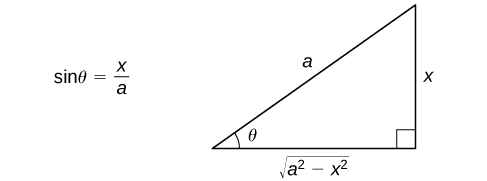
Since \(\cos (x)≥0\) on \(−\dfrac{π}{2}≤θ≤\dfrac{π}{2}\) and \(a>0, \left|a\cos (θ)\right|=a\cos (θ).\) We can see, from this discussion, that by making the substitution \(x=a\sin (θ)\), we are able to convert an integral involving a radical into an integral involving trigonometric functions. After we evaluate the integral, we can convert the solution back to an expression involving \(x\). To see how to do this, let’s begin by assuming that \(0<x<a\). In this case, \(0<θ<\dfrac{π}{2}\). Since \(\sin (θ)=\dfrac{x}{a}\), we can draw the reference triangle in Figure \(\PageIndex{1}\) to assist in expressing the values of \(\cos (θ), \, \tan (θ),\) and the remaining trigonometric functions in terms of \(x\). It can be shown that this triangle actually produces the correct values of the trigonometric functions evaluated at \(θ\) for all \(θ\) satisfying \(−\dfrac{π}{2}≤θ≤\dfrac{π}{2}\). It is useful to observe that the expression \(\sqrt{a^2−x^2}\) actually appears as the length of one side of the triangle. Last, should \(θ\) appear by itself, we use \(θ=\sin^{−1}\left(\dfrac{x}{a}\right).\)
The essential part of this discussion is summarized in the following problem-solving strategy.
- It is a good idea to make sure the integral cannot be evaluated easily in another way. For example, although this method can be applied to integrals of the form \(\displaystyle ∫\dfrac{1}{\sqrt{a^2−x^2}}\,dx\), \(\displaystyle ∫\dfrac{x}{\sqrt{a^2−x^2}}\,dx,\) and \(\displaystyle ∫x\sqrt{a^2−x^2}\,dx,\) they can each be integrated directly either by formula or by a simple \(u\)-substitution.
- Make the substitution \(x=a \sin (θ)\) and \(dx=a\cos (θ) \,dθ.\) Note: This substitution yields \(\sqrt{a^2−x^2}=a\cos (θ).\)
- Simplify the expression.
- Evaluate the integral using techniques from the section on trigonometric integrals.
- Use the reference triangle from Figure 1 and \(θ=\sin^{−1}\left(\dfrac{x}{a}\right) \)to rewrite the result in terms of \(x\).
The following example demonstrates the application of this problem-solving strategy.
Evaluate
\[ ∫\sqrt{ 9−x^2}\,dx \nonumber \]
Solution
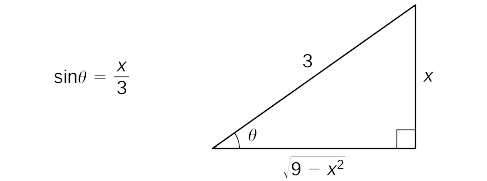
Begin by making the substitutions \(x=3\sin (θ)\) and \(dx=3\cos (θ) \, dθ.\) Since \(\sin (θ)=\dfrac{x}{3}\), we can construct the reference triangle shown in Figure 2.
Thus,
\[ \begin{align*} ∫\sqrt{9−x^2}\,dx&=∫\sqrt{ 9−\left(3\sin (θ)\right)^2}3\cos (θ)\,dθ \\[4pt]
&=∫\sqrt{ 9\left(1−\sin^2(θ)\right)}\cdot 3\cos (θ) \, dθ\\[4pt]
&=∫\sqrt{ 9\cos^2(θ)}\cdot 3\cos (θ) \, dθ\\[4pt]
&=∫ 3\left|\cos (θ)\right|3\cos (θ) \, dθ\\[4pt]
&=∫ 9\cos^2(θ) \, dθ\\[4pt]
&=∫ 9\left(\dfrac{1}{2}+\dfrac{1}{2}\cos(2θ)\right)\,dθ\\[4pt]
&=\dfrac{9}{2}θ+\dfrac{9}{4}\sin(2θ)+C \end{align*} \]
To replace the original variable \(x\), we can easily use \(\theta=\sin^{-1}\left(\dfrac{x}{3}\right)\) for the first term, but for the second, we need to use the reference triangle above. First, that means we use the double angle identity \( \sin(2\theta)=2\sin(\theta)\cos(\theta)\). Notice that \(\sin(\theta)=\dfrac{x}{3}\) and \(\cos(\theta)=\dfrac{\sqrt{9-x^2}}{3}\), so
\[\sin(2\theta)=2\cdot \dfrac{x}{3}\cdot \dfrac{\sqrt{9-x^2}}{3}=\dfrac{2x\sqrt{9-x^2}}{9} \nonumber \]
This gives us a final answer of:
\[ ∫\sqrt{9−x^2}\,dx=\boxed{\dfrac{9}{2}\sin^{−1}\left(\dfrac{x}{3}\right)+\dfrac{x\sqrt{9−x^2}}{2}+C} \nonumber \]
Evaluate
\[ ∫\dfrac{\sqrt{4−x^2}}{x}\,dx \nonumber \]
Solution
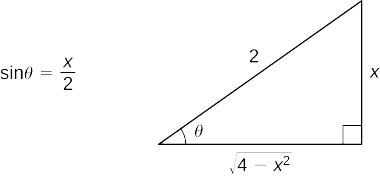
First make the substitutions \(x=2\sin (θ)\) and \(dx=2\cos (θ)\,dθ\). Since \(\sin (θ)=\dfrac{x}{2}\), we can construct the reference triangle shown in Figure \(\PageIndex{3}\).
Thus,
\[ \begin{align*} ∫\dfrac{\sqrt{4−x^2}}{x}\,dx& =∫\dfrac{\sqrt{4−\left(2\sin (θ)\right)^2}}{2\sin (θ)}2\cos (θ) \, dθ \\[4pt]
&=∫\dfrac{2\cos^2(θ)}{\sin (θ)}\,dθ \\[4pt]
&=∫\dfrac{2\left(1−\sin^2(θ)\right)}{\sin (θ)}\,dθ \\[4pt]
&=∫ \left(2\csc (θ)−2\sin (θ)\right)\,dθ\\[4pt]
&=2 \ln \big|\csc (θ)−\cot (θ)\big|+2\cos (θ)+C \\[4pt]
&=\boxed{2 \ln \left|\dfrac{2}{x}−\dfrac{\sqrt{4−x^2}}{x}\right|+\sqrt{4−x^2}+C}\end{align*} \]
In the next example, we see that we sometimes have a choice of methods.
Evaluate \(∫ x^3\sqrt{1−x^2}\,dx\) two ways: first by using the substitution \(u=1−x^2\) and then by using a trigonometric substitution.
Method 1
Let \(u=1−x^2\) and hence \(x^2=1−u\). Thus, \(du=−2x\,dx.\) In this case, the integral becomes
\[ \begin{align*} ∫ x^3\sqrt{1−x^2}\,dx& =−\dfrac{1}{2}∫ x^2\sqrt{1−x^2}\left(−2x\,dx\right) \\[4pt]
&=−\dfrac{1}{2}∫ (1−u)\sqrt{u}\,du \\[4pt]
&=−\dfrac{1}{2}∫\left(u^{\frac{1}{2}}−u^{\frac{3}{2}}\right)\,du \\[4pt]
&=−\dfrac{1}{2}\left(\dfrac{2}{3}u^{\frac{3}{2}}−\dfrac{2}{5}u^{\frac{5}{2}}\right)+C \\[4pt]
&=−\dfrac{1}{3}\left(1−x^2\right)^{\frac{3}{2}}+\dfrac{1}{5}\left(1−x^2\right)^{\frac{5}{2}}+C \end{align*} \]
Method 2
Let \(x=\sin (θ)\). In this case, \(dx=\cos (θ) \, dθ.\) Using this substitution, we have
\[ \begin{align*} ∫ x^3\sqrt{1−x^2}\,dx&=\int \left( \sin(\theta)\right)^3\sqrt{1-\sin^2(\theta)}\left(\cos(\theta)\,d\theta\right) \\[4pt]
&=∫ \sin^3(θ)\cos^2(θ) \, dθ \\[4pt]
&=∫ \left(1−\cos^2(θ)\right)\cos^2(θ)\sin (θ) \, dθ \\[4pt]
&=∫ \left(u^4−u^2\right)\,du \\[4pt]
&=\dfrac{1}{5}u^5−\dfrac{1}{3}u^3+C \\[4pt]
&=\dfrac{1}{5}\cos^5(θ)−\dfrac{1}{3}\cos^3(θ)+C \\[4pt]
&=−\dfrac{1}{3}\left(1−x^2\right)^{\frac{3}{2}}+\dfrac{1}{5}\left(1−x^2\right)^{\frac{5}{2}}+C \end{align*} \]
Rewrite the integral \(\displaystyle ∫\dfrac{x^3}{\sqrt{25−x^2}}\,dx\) using the appropriate trigonometric substitution (do not evaluate the integral).
- Hint
-
Substitute \(x=5\sin (θ)\) and \(dx=5\cos (θ )\, dθ.\)
- Answer
-
\(\displaystyle ∫ 125\sin^3(θ) \, dθ\)
Integrating Expressions Involving \(\sqrt{a^2+x^2}\)
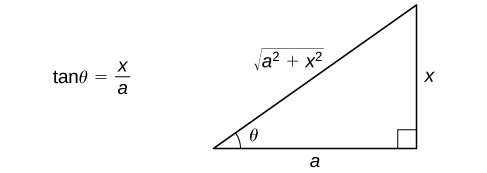
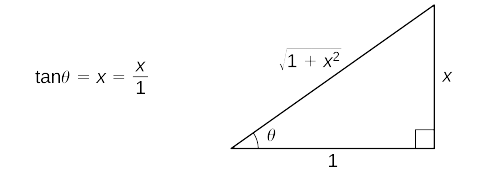
For integrals containing \(\sqrt{a^2+x^2}\),let’s first consider the domain of this expression. Since \(\sqrt{a^2+x^2}\) is defined for all real values of \(x\), we restrict our choice to those trigonometric functions that have a range of all real numbers. Thus, our choice is restricted to selecting either \(x=a\tan (θ)\) or \(x=a\cot (θ)\). Either of these substitutions would actually work, but the standard substitution is \(x=a\tan (θ)\) or, equivalently, \(\tan (θ)=\dfrac{x}{a}\). With this substitution, we make the assumption that \(−\dfrac{\pi}{2}<θ<\dfrac{\pi}{2}\), so that we also have \(θ=\tan^{−1}\left(\dfrac{x}{a}\right).\) The procedure for using this substitution is outlined in the following problem-solving strategy.
- Check to see whether the integral can be evaluated easily by using another method. In some cases, it is more convenient to use an alternative method.
- Substitute \(x=a\tan (θ)\) and \(dx=a\sec^2(θ) \, dθ.\) This substitution yields \(\sqrt{a^2+x^2}=a\sec (θ).\)
- Simplify the expression.
- Evaluate the integral using techniques from the section on trigonometric integrals.
- Use the reference triangle from Figure \(\PageIndex{4}\) and \(θ=\tan^{−1}\left(\dfrac{x}{a}\right)\) to rewrite the result in terms of \(x\).
Evaluate \(\displaystyle ∫\dfrac{dx}{\sqrt{1+x^2}}\) and check the solution by differentiating.
Solution
Begin with the substitution \(x=\tan (θ)\) and \(dx=\sec^2(θ)\,dθ\). Since \(\tan (θ)=x\), draw the reference triangle in Figure \(\PageIndex{5}\).
Thus,
\[ \begin{align*} ∫\dfrac{dx}{\sqrt{1+x^2}} &=∫\dfrac{\sec^2(θ)\,d\theta}{\sqrt{1+\tan^2(θ)}} \\[4pt]
&=∫\dfrac{\sec^2(θ)}{\sec (θ)}dθ \\[4pt]
&=∫ \sec (θ) \, dθ \\[4pt]
&= \ln \left|\sec (θ)+\tan (θ)\right|+C \\[4pt]
&= \boxed{\ln \left|\sqrt{1+x^2}+x\right|+C} \end{align*} \]
To check the solution, differentiate:
\(\dfrac{d}{dx}\Big( \ln \left|\sqrt{1+x^2}+x\right|\Big)=\dfrac{1}{\sqrt{1+x^2}+x}⋅\left(\dfrac{x}{\sqrt{1+x^2}}+1\right) =\dfrac{1}{\sqrt{1+x^2}+x}⋅\dfrac{x+\sqrt{1+x^2}}{\sqrt{1+x^2}}=\dfrac{1}{\sqrt{1+x^2}}\)
Since \(\sqrt{1+x^2}+x>0\) for all values of \(x\), we could rewrite \( \ln \left|\sqrt{1+x^2}+x\right|+C= \ln \left(\sqrt{1+x^2}+x\right)+C\), if desired.
Use the substitution \(x=\sinh (θ)\) to evaluate \(\displaystyle ∫\dfrac{dx}{\sqrt{1+x^2}}\)
Solution
Because \(\sinh (θ)\) has a range of all real numbers, and \(1+\sinh^2(θ)=\cosh^2(θ)\), we may also use the substitution \(x=\sinh (θ)\) to evaluate this integral. In this case, \(dx=\cosh (θ) \,dθ.\) Consequently,
\[\begin{align*} ∫\dfrac{dx}{\sqrt{1+x^2}}&=∫\dfrac{\cosh (θ)}{\sqrt{1+\sinh^2(θ)}}\,dθ \\[4pt]
&=∫\dfrac{\cosh (θ)}{\sqrt{\cosh^2(θ)}}\,dθ \\[4pt]
&=∫\dfrac{\cosh (θ)}{\left|\cosh (θ)\right|}\,dθ\\[4pt]
&=∫\dfrac{\cosh (θ)}{\cosh (θ)}\,dθ \\[4pt]
&=∫ 1\,dθ \\[4pt]
&=θ+C \\[4pt]
&=\boxed{\sinh^{−1}(x)+C} \end{align*}\]
Analysis
This answer looks quite different from the answer obtained using the substitution \(x=\tan (θ).\) But it is indeed equivalent, recall that:
\[\sinh^{−1}(x)= \ln \left(x+\sqrt{x^2+1}\right) \nonumber \]
We see that these two different methods produced equivalent solutions.
Evaluate the integral \(\displaystyle \int_0^{\frac{1}{2}} \sqrt{1+4x^2}\,dx\)
Solution
To evaluate this integral, use the substitution \(x=\dfrac{1}{2}\tan (θ)\) and \(dx=\dfrac{1}{2}\sec^2(θ) \, dθ\). We also need to change the limits of integration. If \(x=0\), then \(θ=0\) and if \(x=\dfrac{1}{2}\), then \(θ=\dfrac{π}{4}.\) Thus,
\[\begin{align*} ∫^{\frac{1}{2}}_0\sqrt{1+4x^2}dx&=∫^{\frac{\pi}{4}}_0\sqrt{1+\tan^2(θ)}\cdot \dfrac{1}{2}\sec^2(θ) \, dθ \\[4pt]
&=\dfrac{1}{2}∫^{\frac{\pi}{4}}_0\sec^3(θ) \, dθ \\[4pt]
&= \dfrac{1}{2}\left(\dfrac{1}{2}\sec (θ)\tan (θ)+ \dfrac{1}{2}\ln \left|\sec (θ)+\tan (θ)\right|\right)\bigg|^{\frac{\pi}{4}}_0 \\[4pt]
&= \boxed{\dfrac{1}{4}\left(\sqrt{2}+ \ln \left(\sqrt{2}+1\right)\right)} \end{align*} \]
Note that evaluating the integral \(\displaystyle \int \sec^3(\theta)\,d\theta\) was an example in the previous section.
Rewrite \(\displaystyle ∫ x^3\sqrt{x^2+4}\,dx\) by using a substitution involving \(\tan (θ)\).
- Hint
-
Use \(x=2\tan (θ)\) and \(dx=2\sec^2(θ) \, dθ.\)
- Answer
-
\[ ∫ 32\tan^3(θ)\sec^3(θ) \, dθ \nonumber \]
Integrating Expressions Involving \(\sqrt{x^2−a^2}\)
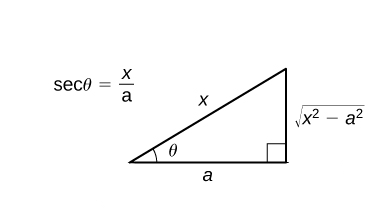
The domain of the expression \(\sqrt{x^2−a^2}\) is \((−∞,−a]∪[a,+∞)\). Thus, either \(x\le −a\) or \(x\ge a.\) Hence, \(\dfrac{x}{a}≤−1\) or \(\dfrac{x}{a}≥1\). Since these intervals correspond to the range of \(\sec (θ)\) on the set \(\left[0,\dfrac{π}{2}\right)∪\left[\pi, \dfrac{3π}{2}\right)\), it makes sense to use the substitution \(\sec (θ)=\dfrac{x}{a}\) or, equivalently, \(x=a\sec (θ)\), where \(0≤θ<\dfrac{π}{2}\) or \(\pi \le <\theta< \dfrac{3π}{2}\). The corresponding substitution for \(dx\) is \(dx=a\sec (θ)\tan (θ) \, dθ\). The procedure for using this substitution is outlined in the following problem-solving strategy.
- Check to see whether the integral cannot be evaluated using another method. If so, we may wish to consider applying an alternative technique.
- Substitute \(x=a\sec (θ)\) and \(dx=a\sec (θ)\tan (θ) \, dθ\). This substitution yields \( \sqrt{x^2−a^2}=a \tan (θ) \).
- Simplify the expression.
- Evaluate the integral using techniques from the section on trigonometric integrals.
- Use the reference triangles from Figure \(\PageIndex{6}\) and \(θ=\sec^{−1}\left(\dfrac{x}{a}\right)\) to rewrite the result in terms of \(x\).
Find the area of the region between the graph of \(f(x)=\sqrt{x^2−9}\) and the x-axis over the interval \([3,5].\)
Solution
First, sketch a rough graph of the region described in the problem, as shown in the following figure.
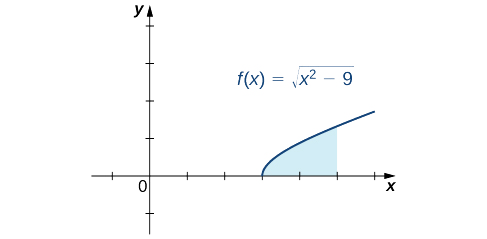
We can see that the area is \(A=∫^5_3\sqrt{x^2−9}dx\). To evaluate this definite integral, substitute \(x=3\sec (θ)\) and \(dx=3\sec (θ)\tan (θ) \, dθ\). We must also change the limits of integration. If \(x=3\), then \(3=3\sec (θ)\) and hence \(θ=0\). If \(x=5\), then \(θ=\sec^{−1}\left(\dfrac{5}{3}\right)\). After making these substitutions and simplifying, we have
\[ \begin{align*} \text{Area}&=∫^5_3\sqrt{x^2−9} \,dx \\[4pt]
&= ∫^{\sec^{−1}\left(\frac{5}{3}\right)}_0 9\tan^2(θ)\sec (θ) \, dθ\\[4pt]
&=∫^{\sec^{−1}\left(\frac{5}{3}\right)}_09\left(\sec^2(θ)−1\right)\sec (θ) \, dθ\\[4pt]
&=∫^{\sec^{−1}\left(\frac{5}{3}\right)}_09\left(\sec^3(θ)−\sec (θ)\right)\,dθ \\[4pt]
&=\dfrac{9}{2} \ln \left|\sec (θ)+\tan (θ)\right|+\dfrac{9}{2}\sec (θ)\tan (θ)−9 \ln \left|\sec (θ)+\tan (θ)\right|∣^{\sec^{−1}\left(\frac{5}{3}\right)}_0 \\[4pt]
&=\dfrac{9}{2}\sec (θ)\tan (θ)−\dfrac{9}{2} \ln \left|\sec (θ)+\tan (θ)\right|\bigg|_0^{\sec^{−1}\left(\frac{5}{3}\right)} \\[4pt]
&=\left(\dfrac{9}{2}⋅\dfrac{5}{3}⋅\dfrac{4}{3}−\dfrac{9}{2} \ln \left|\dfrac{5}{3}+\dfrac{4}{3}\right|\right)−\left(\dfrac{9}{2}⋅1⋅0−\dfrac{9}{2} \ln |1+0|\right) \\[4pt]
&=\boxed{10−\dfrac{9}{2} \ln (3)} \end{align*} \]
Evaluate \( \displaystyle ∫\dfrac{dx}{\sqrt{x^2−4}} \)
- Hint
-
Substitute \(x=2\sec (θ)\) and \(dx=2\sec (θ)\tan (θ) \, dθ.\)
- Answer
-
\[ \ln \left|\dfrac{x}{2}+\dfrac{\sqrt{x^2−4}}{2}\right|+C \nonumber \]
Key Concepts
- For integrals involving \(\sqrt{a^2−x^2}\), use the substitution \(x=a\sin (θ)\) and \(dx=a\cos (θ) \, dθ\)
- For integrals involving \(\sqrt{a^2+x^2}\), use the substitution \(x=a\tan (θ)\) and \(dx=a\sec^2(θ) \, dθ\)
- For integrals involving \(\sqrt{x^2−a^2}\), substitute \(x=a\sec (θ)\) and \(dx=a\sec (θ)\tan (θ) \,dθ\)
Glossary
- trigonometric substitution
- an integration technique that converts an algebraic integral containing expressions of the form \(\sqrt{a^2−x^2}\), \(\sqrt{a^2+x^2}\), or \(\sqrt{x^2−a^2}\) into a trigonometric integral