

8.1: Arc Length
- Page ID
- 186218

\( \newcommand{\vecs}[1]{\overset { \scriptstyle \rightharpoonup} {\mathbf{#1}} } \)
\( \newcommand{\vecd}[1]{\overset{-\!-\!\rightharpoonup}{\vphantom{a}\smash {#1}}} \)
\( \newcommand{\dsum}{\displaystyle\sum\limits} \)
\( \newcommand{\dint}{\displaystyle\int\limits} \)
\( \newcommand{\dlim}{\displaystyle\lim\limits} \)
\( \newcommand{\id}{\mathrm{id}}\) \( \newcommand{\Span}{\mathrm{span}}\)
( \newcommand{\kernel}{\mathrm{null}\,}\) \( \newcommand{\range}{\mathrm{range}\,}\)
\( \newcommand{\RealPart}{\mathrm{Re}}\) \( \newcommand{\ImaginaryPart}{\mathrm{Im}}\)
\( \newcommand{\Argument}{\mathrm{Arg}}\) \( \newcommand{\norm}[1]{\| #1 \|}\)
\( \newcommand{\inner}[2]{\langle #1, #2 \rangle}\)
\( \newcommand{\Span}{\mathrm{span}}\)
\( \newcommand{\id}{\mathrm{id}}\)
\( \newcommand{\Span}{\mathrm{span}}\)
\( \newcommand{\kernel}{\mathrm{null}\,}\)
\( \newcommand{\range}{\mathrm{range}\,}\)
\( \newcommand{\RealPart}{\mathrm{Re}}\)
\( \newcommand{\ImaginaryPart}{\mathrm{Im}}\)
\( \newcommand{\Argument}{\mathrm{Arg}}\)
\( \newcommand{\norm}[1]{\| #1 \|}\)
\( \newcommand{\inner}[2]{\langle #1, #2 \rangle}\)
\( \newcommand{\Span}{\mathrm{span}}\) \( \newcommand{\AA}{\unicode[.8,0]{x212B}}\)
\( \newcommand{\vectorA}[1]{\vec{#1}} % arrow\)
\( \newcommand{\vectorAt}[1]{\vec{\text{#1}}} % arrow\)
\( \newcommand{\vectorB}[1]{\overset { \scriptstyle \rightharpoonup} {\mathbf{#1}} } \)
\( \newcommand{\vectorC}[1]{\textbf{#1}} \)
\( \newcommand{\vectorD}[1]{\overrightarrow{#1}} \)
\( \newcommand{\vectorDt}[1]{\overrightarrow{\text{#1}}} \)
\( \newcommand{\vectE}[1]{\overset{-\!-\!\rightharpoonup}{\vphantom{a}\smash{\mathbf {#1}}}} \)
\( \newcommand{\vecs}[1]{\overset { \scriptstyle \rightharpoonup} {\mathbf{#1}} } \)
\(\newcommand{\longvect}{\overrightarrow}\)
\( \newcommand{\vecd}[1]{\overset{-\!-\!\rightharpoonup}{\vphantom{a}\smash {#1}}} \)
\(\newcommand{\ket}[1]{\left| #1 \right>}\)
\(\newcommand{\bra}[1]{\left< #1 \right|}\)
\(\newcommand{\braket}[2]{\left< #1 \vphantom{#2} \right| \left. #2 \vphantom{#1} \right>}\)
\(\newcommand{\braopket}[3]{\left< #1 \vphantom{#2}\vphantom{#3} \right| #2 \vphantom{#1}\vphantom{#3} \left| #3 \vphantom{#1}\vphantom{#2} \right>}\)
\(\newcommand{\qmvec}[1]{\mathbf{\vec{#1}}}\)
\(\newcommand{\op}[1]{\hat{\mathbf{#1}}}\)
\(\newcommand{\expect}[1]{\langle #1 \rangle}\)
\(\newcommand{\dfn}[1]{\emph{\textbf{#1}}}\)
- Find the length of a curve by setting up and evaluating a definite integral
Here is another geometric application of the integral: find the length of a portion of a curve. As usual, we need to think about how we might approximate the length, and turn the approximation into an integral.
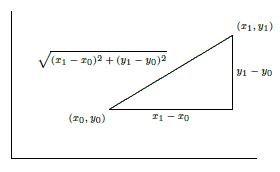
We already know how to compute one simple arc length, that of a line segment. If the endpoints are \( P_0(x_0,y_0)\) and \( P_1(x_1,y_1)\) then the length of the segment is the distance between the points, \( \sqrt{(x_1-x_0)^2+(y_1-y_0)^2}\), from the Pythagorean theorem, as illustrated in Figure \( \PageIndex{1}\).
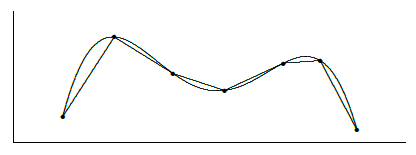
Now if the graph of \(f\) is "nice'' (say, differentiable) it appears that we can approximate the length of a portion of the curve with line segments, and that as the number of segments increases, and their lengths decrease, the sum of the lengths of the line segments will approach the true arc length; see Figure \( \PageIndex{2}\).
Now we need to write a formula for the sum of the lengths of the line segments, in a form that we know becomes an integral in the limit. So we suppose we have divided the interval \([a,b]\) into \(n\) subintervals as usual, each with length \(\Delta x =(b-a)/n\), and endpoints \( a=x_0\), \( x_1\), \( x_2\), …, \( x_n=b\). The length of a typical line segment, joining \( (x_i,f(x_i))\) to \( (x_{i+1},f(x_{i+1}))\), is \(\sqrt{(\Delta x )^2 +(f(x_{i+1})-f(x_i))^2}\). By the Mean Value Theorem, there is a number \( t_i\) in \( (x_i,x_{i+1})\) such that \( f'(t_i)\Delta x=f(x_{i+1})-f(x_i)\), so the length of the line segment can be written as
\[ \sqrt{\left(\Delta x\right)^2 + \left(f'(t_i)\cdot \Delta x\right)^2}= \sqrt{1+\left(f'(t_i)\right)^2}\,\Delta x \nonumber \]
The arc length is then
\[ \lim_{n\to\infty}\sum_{i=0}^{n-1} \sqrt{1+(f'(t_i))^2}\,\Delta x= \int_a^b \sqrt{1+\left(f'(x)\right)^2}\,dx \nonumber \]
Note that the sum looks a bit different than others we have encountered, because the approximation contains a \( t_i\) instead of an \( x_i\). In the past we have always used left endpoints (namely, \( x_i\)) to get a representative value of \(f\) on \( \left[x_i,x_{i+1}\right]\); now we are using a different point, but the principle is the same.
We summarize these findings in the Theorem below.
The length of a curve \(y=f(x)\) on the interval \(a\le x\le b\) is
\[L=\int_a^b \sqrt{1+\left(f'(x)\right)^2}\,dx \nonumber \]
Let \( f(x) = \sqrt{r^2-x^2}\), the upper half circle of radius \(r\). The length of this curve is half the circumference, namely \(\pi r\). Let's compute this with the arc length formula.
The derivative \(f'\) is \( -\dfrac{x}{\sqrt{r^2-x^2}}\) so the integral is
\[ \begin{align*} \text{Arc Length} &= \int_{-r}^r \sqrt{1+\left( -\dfrac{x}{\sqrt{r^2-x^2}}\right)^2}\,dx \\[4pt] &=\int_{-r}^r \sqrt{r^2\over r^2-x^2}\,dx\\[4pt] & = \int_{-r}^r \dfrac{r}{\sqrt{r^2-x^2}}\,dx \end{align*} \]
Notice that the integral is improper at both endpoints, as the function \( \dfrac{1}{\sqrt{r^2-x^2}}\) is undefined when \(x=\pm r\). So we need to compute
\[ \lim_{A\to -r^+}\int_A^0 \dfrac{r}{\sqrt{r^2-x^2}}\,dx + \lim_{B\to r^-}\int_0^B \dfrac{r}{\sqrt{r^2-x^2}}\,dx \nonumber \]
We can use the substitution \(u=\dfrac{x}{r}\) or the trigonometric substitution \(x=r\sin(\theta)\) to evaluate the antiderivative:
\[ \int \dfrac{r}{\sqrt{r^2-x^2}}\,dx = r\sin^{-1}\left(\dfrac{x}{r}\right)+C \nonumber \]
Therefore, the first improper integral becomes:
\[ \lim_{A\to-r^+} r\sin^{-1}\left(\dfrac{x}{r} \right)\bigg|_A^0 =\lim_{A\to-r^+} 0-r\sin^{-1}\left( \dfrac{A}{r}\right)=-r\sin^{-1}(-1)=\dfrac{r \pi}{2} \nonumber \]
Similarly, the second improper integral becomes:
\[ \lim_{B\to r^-} r\sin^{-1}\left(\dfrac{x}{r} \right)\bigg|_0^B =\lim_{B\to r^-} r\sin^{-1}\left( \dfrac{B}{r}\right)-0=r\sin^{-1}(1)=\dfrac{r \pi}{2} \nonumber \]
This gives our final answer, as expected from the circumference formula:
\[ \text{Arc Length} = \dfrac{r\pi}{2}+\dfrac{r \pi}{2} =\pi r \nonumber \]
Find the length of the curve \(y=x^2\) from \((0,0)\) to \(\left(\dfrac{1}{2},\dfrac{1}{4}\right)\)
Solution
The values of \(x\) range over the interval \(\left[0,\dfrac{1}{2}\right]\) and \(f'(x)= 2x\) so the integral is
\[ \begin{align*} \text{Arc Length} &= \int_0^{\frac{1}{2}} \sqrt{1+\left( 2x\right)^2}\,dx \\[4pt]
&=\int_0^{\frac{1}{2}} \sqrt{1+4x^2}\,dx\\[4pt]
& = \int_0^{\frac{\pi}{4}} \sqrt{1+\tan^2(\theta)}\left(\dfrac{1}{2}\sec^2(\theta)\,d\theta \right)\\[4pt]
& = \dfrac{1}{2} \int_0^{\frac{\pi}{4}} \sec^3(\theta)\,d\theta \\[4pt]
& = \dfrac{1}{2} \left( \dfrac{1}{2}\sec(\theta)\tan(\theta)+\dfrac{1}{2}\ln\big|\sec(\theta)+\tan(\theta)\big|\right) \bigg|_0^{\frac{\pi}{4}} \\[4pt]
& = \left(\dfrac{1}{4}\cdot \sqrt{2} \cdot 1 + \dfrac{1}{4}\ln \left| \sqrt{2}+1\right| \right) - \left(\dfrac{1}{4}\cdot 1\cdot 0 + \dfrac{1}{4}\ln \left| 1+0\right| \right) \\[4pt]
&= \boxed{\dfrac{1}{4}\left(\sqrt{2}+\ln\left(\sqrt{2}+1\right)\right)} \end{align*} \]
Find the length of the curve \(y=\dfrac{2}{3}x^{\frac{3}{2}} \) over the interval \([0,3]\)
- Answer
-
\(\dfrac{14}{3}\)
While this formula for the arc length is applicable to every continuous differentiable function, the resulting integral is not always simple (or possible) to evaluate.
Some functions, however, are built perfectly for this formula. These functions are ones which have a derivative if the form \(f'(x)=a(x)-\dfrac{1}{4a(x)}\), since:
\[\left(f'(x)\right)^2=\left( a(x)-\dfrac{1}{4a(x)}\right)^2=\left[a(x)\right]^2-\dfrac{1}{2}+\left[\dfrac{1}{4a(x)}\right]^2 \nonumber \]
In this case, it is easy to see that
\[1+\left(f'(x)\right)^2= \left[a(x)\right]^2+\dfrac{1}{2}+\left[\dfrac{1}{4a(x)}\right]^2=\left( a(x)+\dfrac{1}{4a(x)}\right)^2 \nonumber \]
Thus, we have a perfect square inside of the root, which makes integration signficantly easier.
Find the length of the curve \(y=x^2-\dfrac{1}{8}\ln(x)\) over the interval \(1\le x\le e\)
Solution
The values of \(x\) range over the interval \(\left[1,e\right]\) and \(f'(x)= 2x-\dfrac{1}{8x}\) so the integral is
\[ \begin{align*} \text{Arc Length} &= \int_1^e \sqrt{1+\left( 2x-\dfrac{1}{8x}\right)^2}\,dx \\[4pt]
&=\int_1^e \sqrt{1+\left(4x^2-\dfrac{1}{2}+\dfrac{1}{64x^2}\right)}\,dx\\[4pt]
&=\int_1^e \sqrt{4x^2+\dfrac{1}{2}+\dfrac{1}{64x^2}}\,dx\\[4pt]
&=\int_1^e \sqrt{\left(2x+\dfrac{1}{8x}\right)^2}\,dx\\[4pt]
&=\int_1^e 2x+\dfrac{1}{8x} \,dx\\[4pt]
&= \left(x^2+\dfrac{1}{8}\ln(x)\right)\bigg|_1^e \\[4pt]
& = \left(e^2+\dfrac{1}{8}\ln(e) \right) - \left(1^2+\dfrac{1}{8}\ln(1) \right) \\[4pt]
&= \boxed{e^2-\dfrac{7}{8}} \end{align*} \]
Find the length of the curve \(y=x^3+\dfrac{1}{12x} \) over the interval \([1,2]\)
- Answer
-
\(\dfrac{169}{24}\)
Key Equations
- Arc Length of \(y=f(x)\) over \([a,b]\)
\(\displaystyle L=∫^b_a \sqrt{1+\left(f'(x)\right)^2}\,dx\)
Glossary
- arc length
- the distance between two points along a curve