

3.1: Iterated Integrals and Area
- Page ID
- 191843

\( \newcommand{\vecs}[1]{\overset { \scriptstyle \rightharpoonup} {\mathbf{#1}} } \)
\( \newcommand{\vecd}[1]{\overset{-\!-\!\rightharpoonup}{\vphantom{a}\smash {#1}}} \)
\( \newcommand{\dsum}{\displaystyle\sum\limits} \)
\( \newcommand{\dint}{\displaystyle\int\limits} \)
\( \newcommand{\dlim}{\displaystyle\lim\limits} \)
\( \newcommand{\id}{\mathrm{id}}\) \( \newcommand{\Span}{\mathrm{span}}\)
( \newcommand{\kernel}{\mathrm{null}\,}\) \( \newcommand{\range}{\mathrm{range}\,}\)
\( \newcommand{\RealPart}{\mathrm{Re}}\) \( \newcommand{\ImaginaryPart}{\mathrm{Im}}\)
\( \newcommand{\Argument}{\mathrm{Arg}}\) \( \newcommand{\norm}[1]{\| #1 \|}\)
\( \newcommand{\inner}[2]{\langle #1, #2 \rangle}\)
\( \newcommand{\Span}{\mathrm{span}}\)
\( \newcommand{\id}{\mathrm{id}}\)
\( \newcommand{\Span}{\mathrm{span}}\)
\( \newcommand{\kernel}{\mathrm{null}\,}\)
\( \newcommand{\range}{\mathrm{range}\,}\)
\( \newcommand{\RealPart}{\mathrm{Re}}\)
\( \newcommand{\ImaginaryPart}{\mathrm{Im}}\)
\( \newcommand{\Argument}{\mathrm{Arg}}\)
\( \newcommand{\norm}[1]{\| #1 \|}\)
\( \newcommand{\inner}[2]{\langle #1, #2 \rangle}\)
\( \newcommand{\Span}{\mathrm{span}}\) \( \newcommand{\AA}{\unicode[.8,0]{x212B}}\)
\( \newcommand{\vectorA}[1]{\vec{#1}} % arrow\)
\( \newcommand{\vectorAt}[1]{\vec{\text{#1}}} % arrow\)
\( \newcommand{\vectorB}[1]{\overset { \scriptstyle \rightharpoonup} {\mathbf{#1}} } \)
\( \newcommand{\vectorC}[1]{\textbf{#1}} \)
\( \newcommand{\vectorD}[1]{\overrightarrow{#1}} \)
\( \newcommand{\vectorDt}[1]{\overrightarrow{\text{#1}}} \)
\( \newcommand{\vectE}[1]{\overset{-\!-\!\rightharpoonup}{\vphantom{a}\smash{\mathbf {#1}}}} \)
\( \newcommand{\vecs}[1]{\overset { \scriptstyle \rightharpoonup} {\mathbf{#1}} } \)
\(\newcommand{\longvect}{\overrightarrow}\)
\( \newcommand{\vecd}[1]{\overset{-\!-\!\rightharpoonup}{\vphantom{a}\smash {#1}}} \)
\(\newcommand{\avec}{\mathbf a}\) \(\newcommand{\bvec}{\mathbf b}\) \(\newcommand{\cvec}{\mathbf c}\) \(\newcommand{\dvec}{\mathbf d}\) \(\newcommand{\dtil}{\widetilde{\mathbf d}}\) \(\newcommand{\evec}{\mathbf e}\) \(\newcommand{\fvec}{\mathbf f}\) \(\newcommand{\nvec}{\mathbf n}\) \(\newcommand{\pvec}{\mathbf p}\) \(\newcommand{\qvec}{\mathbf q}\) \(\newcommand{\svec}{\mathbf s}\) \(\newcommand{\tvec}{\mathbf t}\) \(\newcommand{\uvec}{\mathbf u}\) \(\newcommand{\vvec}{\mathbf v}\) \(\newcommand{\wvec}{\mathbf w}\) \(\newcommand{\xvec}{\mathbf x}\) \(\newcommand{\yvec}{\mathbf y}\) \(\newcommand{\zvec}{\mathbf z}\) \(\newcommand{\rvec}{\mathbf r}\) \(\newcommand{\mvec}{\mathbf m}\) \(\newcommand{\zerovec}{\mathbf 0}\) \(\newcommand{\onevec}{\mathbf 1}\) \(\newcommand{\real}{\mathbb R}\) \(\newcommand{\twovec}[2]{\left[\begin{array}{r}#1 \\ #2 \end{array}\right]}\) \(\newcommand{\ctwovec}[2]{\left[\begin{array}{c}#1 \\ #2 \end{array}\right]}\) \(\newcommand{\threevec}[3]{\left[\begin{array}{r}#1 \\ #2 \\ #3 \end{array}\right]}\) \(\newcommand{\cthreevec}[3]{\left[\begin{array}{c}#1 \\ #2 \\ #3 \end{array}\right]}\) \(\newcommand{\fourvec}[4]{\left[\begin{array}{r}#1 \\ #2 \\ #3 \\ #4 \end{array}\right]}\) \(\newcommand{\cfourvec}[4]{\left[\begin{array}{c}#1 \\ #2 \\ #3 \\ #4 \end{array}\right]}\) \(\newcommand{\fivevec}[5]{\left[\begin{array}{r}#1 \\ #2 \\ #3 \\ #4 \\ #5 \\ \end{array}\right]}\) \(\newcommand{\cfivevec}[5]{\left[\begin{array}{c}#1 \\ #2 \\ #3 \\ #4 \\ #5 \\ \end{array}\right]}\) \(\newcommand{\mattwo}[4]{\left[\begin{array}{rr}#1 \amp #2 \\ #3 \amp #4 \\ \end{array}\right]}\) \(\newcommand{\laspan}[1]{\text{Span}\{#1\}}\) \(\newcommand{\bcal}{\cal B}\) \(\newcommand{\ccal}{\cal C}\) \(\newcommand{\scal}{\cal S}\) \(\newcommand{\wcal}{\cal W}\) \(\newcommand{\ecal}{\cal E}\) \(\newcommand{\coords}[2]{\left\{#1\right\}_{#2}}\) \(\newcommand{\gray}[1]{\color{gray}{#1}}\) \(\newcommand{\lgray}[1]{\color{lightgray}{#1}}\) \(\newcommand{\rank}{\operatorname{rank}}\) \(\newcommand{\row}{\text{Row}}\) \(\newcommand{\col}{\text{Col}}\) \(\renewcommand{\row}{\text{Row}}\) \(\newcommand{\nul}{\text{Nul}}\) \(\newcommand{\var}{\text{Var}}\) \(\newcommand{\corr}{\text{corr}}\) \(\newcommand{\len}[1]{\left|#1\right|}\) \(\newcommand{\bbar}{\overline{\bvec}}\) \(\newcommand{\bhat}{\widehat{\bvec}}\) \(\newcommand{\bperp}{\bvec^\perp}\) \(\newcommand{\xhat}{\widehat{\xvec}}\) \(\newcommand{\vhat}{\widehat{\vvec}}\) \(\newcommand{\uhat}{\widehat{\uvec}}\) \(\newcommand{\what}{\widehat{\wvec}}\) \(\newcommand{\Sighat}{\widehat{\Sigma}}\) \(\newcommand{\lt}{<}\) \(\newcommand{\gt}{>}\) \(\newcommand{\amp}{&}\) \(\definecolor{fillinmathshade}{gray}{0.9}\)In the previous chapter we found that we could differentiate functions of several variables with respect to one variable, while treating all the other variables as constants or coefficients. We have seen that one can integrate functions of several variables in a similar way. For instance, if we are told that \(f_x(x,y) = 2xy\), we can treat \(y\) as staying constant and integrate to obtain \(f(x,y)\):
\[ f(x,y) = \int f_x(x,y) \,dx= \int 2xy \,dx= x^2y + h(y) \nonumber \]
Here we see the constant of integration is a function \(h(y)\) which is "constant'' in the sense that it is something with a derivative of \(0\) with respect to \(x\). When doing a definite integral of one variable, we typically omit the constant. This is because it would cancel out when using the Fundamental Theorem of Calculus:
\[ \displaystyle{ \int_a^b f'(t)dt = \left[f(t)+C\right.\bigg|_a^b = \left( f(b)+C\right)-\left(f(a)+C\right)=f(b)-f(a)}\nonumber\]
The same is true when we solve definite integrals of more than one variable.
We can also integrate with respect to \(y\). In general,
\[\int_{h_1(y)}^{h_2(y)} f_x(x,y) \,dx = f(x,y)\Big|_{h_1(y)}^{h_2(y)} = f\big(h_2(y),y\big)-f\big(h_1(y),y\big), \text{ and } \int_{g_1(x)}^{g_2(x)} f_y(x,y) \,dy = f(x,y)\Big|_{g_1(x)}^{g_2(x)} = f\big(x,g_2(x)\big)-f\big(x,g_1(x)\big) \nonumber \]
Note that when integrating with respect to \(x\), the bounds are functions of \(y\) (of the form \(x=h_1(y)\) and \(x=h_2(y)\)) and the final result is also a function of \(y\). When integrating with respect to \(y\), the bounds are functions of \(x\) (of the form \(y=g_1(x)\) and \(y=g_2(x)\)) and the final result is a function of \(x\).
Evaluate the integral
(a) \(\displaystyle \int_1^{2y} 2xy \,dx\)
(b) \(\displaystyle \int_1^x\big(5x^3y^{-3}+6y^2\big) \,dy\)
Solution
(a) We treat \(y\) as a constant and use the Fundamental Theorem of Calculus:
\[ \int_1^{2y} 2xy \,dx = \left[ x^2y\right. \Big|_1^{2y}= (2y)^2y - (1)^2y = 4y^3-y \nonumber \]
(b) We treat \(x\) as a constant this time:
\[ \int_1^x \left(5x^3y^{-3}+6y^2\right) \,dy = \left[\dfrac{5x^3y^{-2}}{-2}+\dfrac{6y^3}{3}\right|_1^x = \left(-\dfrac{5}{2}x^3x^{-2}+2x^3\right) - \left(-\dfrac{5}{2}x^3+2\right) = \dfrac{9}{2}x^3-\dfrac{5}{2}x-2 \nonumber \]
Once we have integrated a function with respect to \(y\) and ended up with a function of \(x\), we can take the definite integral of this new function with respect to \(x\). This process is known as iterated integration, or multiple integration.
Evaluate \(\displaystyle \int_1^2\left(\int_1^x\big(30x^2y\big) \,dy\right) \,dx.\)
Solution
We follow a standard "order of operations'' and perform the operations inside parentheses first:
\[\begin{align*}
\int_1^2\left(\int_1^x (30x^2y ) \, dy\right) \,dx &= \int_1^2 \left(\left[ 15x^2y^2\right.\Bigg|_1^x\right) \,dx \\
&= \int_1^2 \left(15x^2(x)^2-15x^2(1)^2\right) \,dx \\
&= \int_1^2 \left(15x^4-15x^2 \right) \,dx \\
&= \left[3x^5-5x^3\right. \Big|_1^2\\
&= \left(3(2)^5-5(2)^3\right)-\left(3(1)^5-5(1)^3\right)=58
\end{align*}\]
The previous example showed how we could perform something called an iterated integral; we do not yet know why we would be interested in doing so nor what the result, such as the number \(58\), means. Before we investigate these questions, we offer some definitions.
Iterated integration is the process of repeatedly integrating the results of previous integrations. Integrating one integral is denoted as follows.
Let \(a\), \(b\), \(c\) and \(d\) be numbers and let \(g_1(x)\), \(g_2(x)\), \(h_1(y)\) and \(h_2(y)\) be functions of \(x\) and \(y\), respectively. Then:
- \(\displaystyle \int_c^d\int_{h_1(y)}^{h_2(y)} f(x,y) \,dx \,dy = \int_c^d\left(\int_{h_1(y)}^{h_2(y)} f(x,y) \,dx\right) \,dy\)
- \(\displaystyle \int_a^b\int_{g_1(x)}^{g_2(x)} f(x,y) \,dy \,dx = \int_a^b\left(\int_{g_1(x)}^{g_2(x)} f(x,y) \,dy\right) \,dx\)
Again make note of the bounds of these iterated integrals.
With \(\displaystyle \int_c^d\int_{h_1(y)}^{h_2(y)} f(x,y) \,dx \,dy\), \(x\) varies from \(h_1(y)\) to \(h_2(y)\), whereas \(y\) varies from \(c\) to \(d\). That is, the bounds of \(x\) are curves, the curves \(x=h_1(y)\) and \(x=h_2(y)\), whereas the bounds of \(y\) are constants, \(y=c\) and \(y=d\). It is useful to remember that when setting up and evaluating such iterated integrals, we integrate "from curve to curve, then from point to point.''
We now begin to investigate why we are interested in iterated integrals and what they mean.
If you consider the single integral of the constant function \(\textbf{1}\) on an interval, you easily get:
\[\text{length}([a,b])=\int_a^b \textbf{1}dx=\left[ x\right.\big|_a^b=b-a\nonumber\]Now consider the plane region \(R\) bounded by \(a\leq x\leq b\) and \(g_1(x)\leq y\leq g_2(x)\), shown below.
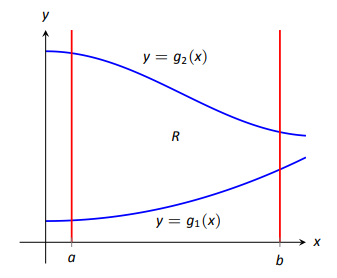
We learned in single variable calculus that the area of this region can be found via the integral:
\[\text{area}(R)=\int_a^b \big(g_2(x)-g_1(x)\big) \,dx \nonumber\]
We can view the expression \(\big(g_2(x)-g_1(x)\big) =\displaystyle{ \int_{g_1(x)}^{g_2(x)} \textbf{1} \,dy} \), meaning we can express the area of \(R\) as an iterated integral:
\[\text{area}(R) = \int_a^b \big(g_2(x)-g_1(x)\big) \,dx = \int_a^b\left(\int_{g_1(x)}^{g_2(x)} \textbf{1} \,dy\right) \,dx =\int_a^b\int_{g_1(x)}^{g_2(x)} \textbf{1} \,dy \,dx \nonumber \]
In short: the iterated integral with integrand \(1\) can be viewed as giving the area of a plane region \(R\) enclosed by the limits of integration.
A region \(R\) could also be defined by \(c\leq y\leq d\) and \(h_1(y)\leq x\leq h_2(y)\), as shown below.
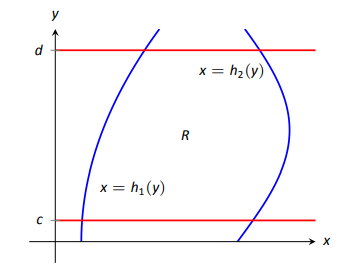
Using a process similar to that above, we have
\[\text{area}(R) = \int_c^d\int_{h_1(y)}^{h_2(y)} \textbf{1} \,dx \,dy \nonumber \]
We state this formally in a theorem.
- Let \(R\) be a plane region bounded by \(a\leq x\leq b\) and \(g_1(x)\leq y\leq g_2(x)\), where \(g_1\) and \(g_2\) are continuous functions on \([a,b]\). The area \(A\) of \(R\) is \[ \displaystyle A = \int_a^b\int_{g_1(x)}^{g_2(x)} 1\,dy \,dx \nonumber \]
- Let \(R\) be a plane region bounded by \(c\leq y\leq d\) and \(h_1(y)\leq x\leq h_2(y)\), where \(h_1\) and \(h_2\) are continuous functions on \([c,d]\). The area \(A\) of \(R\) is \[ \displaystyle A = \int_c^d\int_{h_1(y)}^{h_2(y)} 1 \,dx \,dy \nonumber \]
The following example will help us demonstrate this theorem.
Find the area of each region below by setting up and solving two iterated integrals ( \(dx\,dy\) and \(dy\,dx\) ):
(a) the rectangle with corners \((-1,1)\) and \((3,3)\)
(b) the triangle with vertices at \((1,1)\), \((3,1)\) and \((5,5)\)
(c) the region enclosed by \(y=2x\) and \(y=x^2\)
Solution
(a) The rectangle we want the area of looks like:
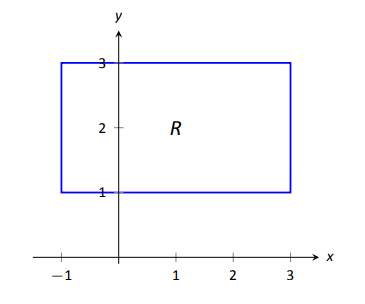
Multiple integration is obviously overkill in this situation, but we proceed to establish its use.
The region \(R\) is bounded by \(x=-1\), \(x=3\), \(y=1\) and \(y=3\). Choosing to integrate with respect to \(y\) first, we have
\[A = \int_{-1}^3\int_1^3 1 \,dy \,dx = \int_{-1}^3 \left( \left[y \right. \Big|_1^3\right) \,dx = \int_{-1}^3 2 \,dx = \left[ 2x\right. \Big|_{-1}^3=8\nonumber\]
We could also integrate with respect to \(x\) first, giving:
\[A = \int_1^3\int_{-1}^3 1 \,dx \,dy =\int_1^3 \left(\left[ x \right. \Big|_{-1}^3\right) \,dy = \int_1^3 4 \,dy = \left[ 4y\right. \Big|_1^3 = 8\nonumber\]
Clearly there are simpler ways to find this area, but it is nice to see that this method agrees with them.
(b) We sketch the triangle we want the area of:
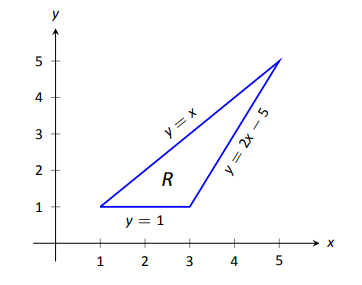
The triangle is bounded by the lines as shown in the figure. We will start by doing the iterated integral \(dxdy\), meaning we want to integrate \(x\) between two functions of \(y\). Since \(x\)-values increase from left to right, the leftmost curve, \(x=y\), is the lower bound and the rightmost curve, \(x=\dfrac{y+5}{2}\), is the upper bound. This holds for every possible \(y\) between the line \(y=1\) on the bottom, and the point of intersection where \(y=5\) at the top. Therefore the area is
\[A = \int_1^5\int_{y}^{\frac{y+5}2} \,dx \,dy = \int_1^5\left[ x \right. \Big|_y^{\frac{y+5}2} \,dy = \int_1^5 \left(-\dfrac{1}{2}y+\dfrac{5}{2}\right) \,dy = \left[-\dfrac{1}{4}y^2+\dfrac{5}{2}y\right|_1^5=4
\nonumber \]
We can also find the area by integrating with respect to \(dydx\). In this situation, we want \(y\) to be between two functions of \(x\). The values of \(y\) increase from low to high, so the "bottom" curve is piecewise defined: \(y_{bot}(x)=\left\{ \begin{array} {ll} 1 & x\le 3 \\ 2x-5 & x>3 \end{array}\right. \), and the "top" curve is simply the line \(y=x\). This holds for every possible \(x\) between the leftmost point in \(R\) (where \(x=1\)) and the rightmost point in \(R\) (where \(x=5\)):
\[ A = \int_1^3\int_{y_{bot}(x)}^x 1 \,dy \,dx=\int_1^3 \int_1^x 1\,dy\, dx+\int_3^5\int_{2x-5}^x1 \,dy \,dx \nonumber \\
= \int_1^3\left[ y\right. \Big|_1^x \,dx + \int_3^5\left[y\right. \Big|_{2x-5}^x \,dx= \int_1^3\big(x-1\big) \,dx + \int_3^5\big(-x+5\big) \,dx = 2 + 2=4
\nonumber \]
As expected, we get the same answer both ways.
(c) We sketch the region we want the area of:
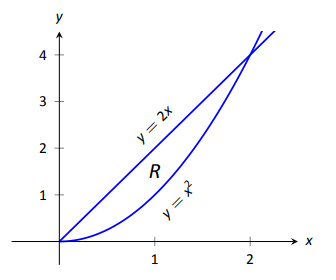
Once again we'll find the area of the region using both orders of integration.
Using \(\,dy \,dx\), we see that for each \(x\) between the leftmost point \(x=0\) and rightmost point \(x=2\), the values of \(y\) range from the bottom function \(y=x^2\) to the top function \(y=2x\). Therefore the area is given by:
\[\int_0^2\int_{x^2}^{2x}1 \,dy \,dx = \int_0^2(2x-x^2) \,dx = \left[ x^2-\dfrac{1}{3}x^3\right|_0^2 = \dfrac{4}{3} \nonumber \]
Using \(\,dx \,dy\), we see that for each \(y\) between the lowest point \(y=0\) and highest point \(y=4\), the values of \(x\) range from the left function \(x=\dfrac{y}{2}\) to the right function \(x=\sqrt{y}\). Therefore the area is given by:
\[\int_0^4\int_{\frac{y}{2}}^{\sqrt{y}} 1 \,dx \,dy = \int_0^4 \left(\sqrt{y}-\dfrac{y}{2} \right) \,dy = \left[\dfrac{2}{3} y^{\frac{3}{2} } - \dfrac{1}{4} y^2\right|_0^4 = \dfrac{4}{3} \nonumber \]
In each of the previous examples, we have been given a region \(R\) and found the bounds needed to find the area of \(R\) using both orders of integration. We integrated using both orders of integration to demonstrate their equality.
We now approach the skill of describing a region using both orders of integration from a different perspective. Instead of starting with a region and creating iterated integrals, we will start with an iterated integral and rewrite it in the other integration order. To do so, we'll need to understand the region over which we are integrating.
The simplest of all cases is when both integrals are bound by constants. The region described by these bounds is a rectangle, and so:
\[\int_a^b\int_c^d 1 \,dy \,dx = \int_c^d\int_a^b1 \,dx \,dy \nonumber \]
When the inner integral's bounds are not constants, it is generally very useful to sketch the bounds to determine what the region we are integrating over looks like. From the sketch we can then rewrite the integral with the other order of integration.
Rewrite the iterated integral \(\displaystyle \int_0^6\int_0^{\frac{x}{3} } 1 \,dy \,dx\) with the order of integration \(\,dx \,dy\).
Solution
We need to use the bounds of integration to determine the region we are integrating over.
The bounds tell us that for each fixed \(x\) between 0 and 6, the values of \(y\) are bounded by the curves \(y=0\) and \(y=\dfrac{x}{3}\).

We are integrating over the triangular domain between the lines \(y=0,x=0,\) and \(y=\dfrac{x}{3}\). Drawing these blue lines from side to side instead:

We can say that for each fixed \(y\) between 0 and 2, the values of \(x\) are bounded by the curves \(x=3y\) and \(x=6\). Thus, we can rewrite the integral as
\[ \displaystyle{ \int_0^2 \int_{3y}^6 1 \,dx \,dy=\int_0^2 \left[ x\right. \Big|_{3y}^6\,dy=\int_0^2 (6-3y)\,dy=\left[6y-\dfrac{3}{2}y^2\right|_0^2=6} \nonumber \]
This is exactly the area we would get by solving the original integral (or using the area of a triangle formula).
Change the order of integration of \(\displaystyle \int_1^4\int_{(y-2)^2}^{y}1 \,dx \,dy\)
Solution
We need to use the bounds of integration to determine the region we are integrating over.
The bounds tell us that for each fixed \(y\) between 1 and 4, the values of \(x\) are bounded by the curves \(x=(y-2)^2\) and \(x=y\).
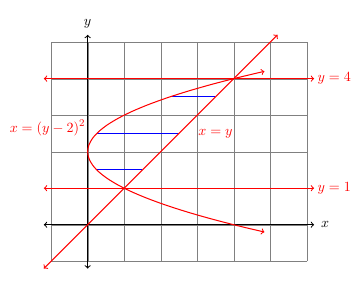
We are integrating over the domain between the curves \(x=(y-2)^2\) and \(x=y\). Drawing these blue lines from bottom to top instead:

We can see this region is described in two pieces. For each fixed \(x\) between 0 and 1, the values of \(x\) are bounded by the curves \(y=2-\sqrt{x}\) and \(y=2+\sqrt{x}\), then for each value of \(y\) between 1 and 4, the values of \(x\) are bounded by the curves \(y=x\) and \(y=2+\sqrt{x}\). Thus, we can rewrite the integral as
\[ \displaystyle{ \int_0^1 \int_{2-\sqrt{x}}^{2+\sqrt{x}} 1 \,dy \,dx+ \int_1^4 \int_{x}^{2+\sqrt{x}} 1 \,dy \,dx} \nonumber \]
The sum of these integrals evaluates to exactly the same number that \(\displaystyle \int_1^4\int_{(y-2)^2}^{y}1 \,dx \,dy\) does, which is \(\dfrac{9}{2}\).
This section has introduced a new concept, the iterated integral. We developed one application for iterated integration: area between curves. However, this is not new, for we already know how to find areas bounded by curves. The "real" goal of this section was not to learn a new way of computing area. Rather, our goal was to learn how to define a region in the plane using the bounds of an iterated integral.