Trapezoidal and Simpsons Rule
- Page ID
- 218545
\( \newcommand{\vecs}[1]{\overset { \scriptstyle \rightharpoonup} {\mathbf{#1}} } \)
\( \newcommand{\vecd}[1]{\overset{-\!-\!\rightharpoonup}{\vphantom{a}\smash {#1}}} \)
\( \newcommand{\dsum}{\displaystyle\sum\limits} \)
\( \newcommand{\dint}{\displaystyle\int\limits} \)
\( \newcommand{\dlim}{\displaystyle\lim\limits} \)
\( \newcommand{\id}{\mathrm{id}}\) \( \newcommand{\Span}{\mathrm{span}}\)
( \newcommand{\kernel}{\mathrm{null}\,}\) \( \newcommand{\range}{\mathrm{range}\,}\)
\( \newcommand{\RealPart}{\mathrm{Re}}\) \( \newcommand{\ImaginaryPart}{\mathrm{Im}}\)
\( \newcommand{\Argument}{\mathrm{Arg}}\) \( \newcommand{\norm}[1]{\| #1 \|}\)
\( \newcommand{\inner}[2]{\langle #1, #2 \rangle}\)
\( \newcommand{\Span}{\mathrm{span}}\)
\( \newcommand{\id}{\mathrm{id}}\)
\( \newcommand{\Span}{\mathrm{span}}\)
\( \newcommand{\kernel}{\mathrm{null}\,}\)
\( \newcommand{\range}{\mathrm{range}\,}\)
\( \newcommand{\RealPart}{\mathrm{Re}}\)
\( \newcommand{\ImaginaryPart}{\mathrm{Im}}\)
\( \newcommand{\Argument}{\mathrm{Arg}}\)
\( \newcommand{\norm}[1]{\| #1 \|}\)
\( \newcommand{\inner}[2]{\langle #1, #2 \rangle}\)
\( \newcommand{\Span}{\mathrm{span}}\) \( \newcommand{\AA}{\unicode[.8,0]{x212B}}\)
\( \newcommand{\vectorA}[1]{\vec{#1}} % arrow\)
\( \newcommand{\vectorAt}[1]{\vec{\text{#1}}} % arrow\)
\( \newcommand{\vectorB}[1]{\overset { \scriptstyle \rightharpoonup} {\mathbf{#1}} } \)
\( \newcommand{\vectorC}[1]{\textbf{#1}} \)
\( \newcommand{\vectorD}[1]{\overrightarrow{#1}} \)
\( \newcommand{\vectorDt}[1]{\overrightarrow{\text{#1}}} \)
\( \newcommand{\vectE}[1]{\overset{-\!-\!\rightharpoonup}{\vphantom{a}\smash{\mathbf {#1}}}} \)
\( \newcommand{\vecs}[1]{\overset { \scriptstyle \rightharpoonup} {\mathbf{#1}} } \)
\(\newcommand{\longvect}{\overrightarrow}\)
\( \newcommand{\vecd}[1]{\overset{-\!-\!\rightharpoonup}{\vphantom{a}\smash {#1}}} \)
\(\newcommand{\avec}{\mathbf a}\) \(\newcommand{\bvec}{\mathbf b}\) \(\newcommand{\cvec}{\mathbf c}\) \(\newcommand{\dvec}{\mathbf d}\) \(\newcommand{\dtil}{\widetilde{\mathbf d}}\) \(\newcommand{\evec}{\mathbf e}\) \(\newcommand{\fvec}{\mathbf f}\) \(\newcommand{\nvec}{\mathbf n}\) \(\newcommand{\pvec}{\mathbf p}\) \(\newcommand{\qvec}{\mathbf q}\) \(\newcommand{\svec}{\mathbf s}\) \(\newcommand{\tvec}{\mathbf t}\) \(\newcommand{\uvec}{\mathbf u}\) \(\newcommand{\vvec}{\mathbf v}\) \(\newcommand{\wvec}{\mathbf w}\) \(\newcommand{\xvec}{\mathbf x}\) \(\newcommand{\yvec}{\mathbf y}\) \(\newcommand{\zvec}{\mathbf z}\) \(\newcommand{\rvec}{\mathbf r}\) \(\newcommand{\mvec}{\mathbf m}\) \(\newcommand{\zerovec}{\mathbf 0}\) \(\newcommand{\onevec}{\mathbf 1}\) \(\newcommand{\real}{\mathbb R}\) \(\newcommand{\twovec}[2]{\left[\begin{array}{r}#1 \\ #2 \end{array}\right]}\) \(\newcommand{\ctwovec}[2]{\left[\begin{array}{c}#1 \\ #2 \end{array}\right]}\) \(\newcommand{\threevec}[3]{\left[\begin{array}{r}#1 \\ #2 \\ #3 \end{array}\right]}\) \(\newcommand{\cthreevec}[3]{\left[\begin{array}{c}#1 \\ #2 \\ #3 \end{array}\right]}\) \(\newcommand{\fourvec}[4]{\left[\begin{array}{r}#1 \\ #2 \\ #3 \\ #4 \end{array}\right]}\) \(\newcommand{\cfourvec}[4]{\left[\begin{array}{c}#1 \\ #2 \\ #3 \\ #4 \end{array}\right]}\) \(\newcommand{\fivevec}[5]{\left[\begin{array}{r}#1 \\ #2 \\ #3 \\ #4 \\ #5 \\ \end{array}\right]}\) \(\newcommand{\cfivevec}[5]{\left[\begin{array}{c}#1 \\ #2 \\ #3 \\ #4 \\ #5 \\ \end{array}\right]}\) \(\newcommand{\mattwo}[4]{\left[\begin{array}{rr}#1 \amp #2 \\ #3 \amp #4 \\ \end{array}\right]}\) \(\newcommand{\laspan}[1]{\text{Span}\{#1\}}\) \(\newcommand{\bcal}{\cal B}\) \(\newcommand{\ccal}{\cal C}\) \(\newcommand{\scal}{\cal S}\) \(\newcommand{\wcal}{\cal W}\) \(\newcommand{\ecal}{\cal E}\) \(\newcommand{\coords}[2]{\left\{#1\right\}_{#2}}\) \(\newcommand{\gray}[1]{\color{gray}{#1}}\) \(\newcommand{\lgray}[1]{\color{lightgray}{#1}}\) \(\newcommand{\rank}{\operatorname{rank}}\) \(\newcommand{\row}{\text{Row}}\) \(\newcommand{\col}{\text{Col}}\) \(\renewcommand{\row}{\text{Row}}\) \(\newcommand{\nul}{\text{Nul}}\) \(\newcommand{\var}{\text{Var}}\) \(\newcommand{\corr}{\text{corr}}\) \(\newcommand{\len}[1]{\left|#1\right|}\) \(\newcommand{\bbar}{\overline{\bvec}}\) \(\newcommand{\bhat}{\widehat{\bvec}}\) \(\newcommand{\bperp}{\bvec^\perp}\) \(\newcommand{\xhat}{\widehat{\xvec}}\) \(\newcommand{\vhat}{\widehat{\vvec}}\) \(\newcommand{\uhat}{\widehat{\uvec}}\) \(\newcommand{\what}{\widehat{\wvec}}\) \(\newcommand{\Sighat}{\widehat{\Sigma}}\) \(\newcommand{\lt}{<}\) \(\newcommand{\gt}{>}\) \(\newcommand{\amp}{&}\) \(\definecolor{fillinmathshade}{gray}{0.9}\)|
Numerical Integration
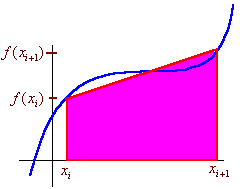
Trapezoidal Rule As we saw before, often we can not evaluate a definite integral because it is too difficult or because we do not have an algebraic expression for the integrand. We saw that the Midpoint estimate was one way to approximate a definite integral. In this section, we seek estimates that are likely to be more accurate. The Midpoint estimate involved using rectangles to approximate the region. Now we will play with other geometric shapes that can approximate the region. Our first investigation will involve trapezoids. The trapezoidal rule which geometrically calculates the area of the trapezoid with base on the x-axis and heights f(xi) and f(xi+1) The area of the trapezoid is
Example Use the Trapezoidal Approximation with n = 3 to approximate the integral \( \int_2^5 \frac{1}{1 + x^3} dx \)
Solution We have n = 3 a = 2 b = 5 So b - a 5 - 2 We set up a table beginning at a = 2 incrementing Dx = 1 and stopping at b = 5
Plug these numbers into the trapezoidal formula to get 1/2 [0.1111 + 2(0.0357) + 2(0.0154) + 0.0079)] = 0.1106 The true answer is closer to .0992. Hence the error in the approximation is Error = 0.1106 - 0.0992 = 0.0114
Simpson's Rule We have just seen that a trapezoid is a pretty good approximation to an integral. Might there be a better approximation? It turns out that using parabolas to approximate an integral is often better than using trapezoids. The use of parabolas to approximate an integral is called Simpson's Rule. We will not work out the details at how to arrive at the clean formula. We will instead just present the formula and leave it to more advanced courses to derive it.
Example \( \int_3^{27} \sqrt{1 + x^2} dx \) Using Simpson's Rule with n = 6.
Solution We have n = 6 a = 3 b = 27 so b - a Now create a table beginning with a = 3, incrementing by Dx = 4, and ending at 27.
= 361.09 It is a remarkable fact that the true answer is close to 361.091938. Simpson's estimate is very accurate indeed.
Error We keep mentioning how accurate the various estimates are. However, usually the exact answers are unavailable (if they were why would you need to use an approximation?) Our next goal is to find a bound for the error without knowing the true value of the integral. Once again formulas for this are available, but the derivations of the the formulas are beyond the scope of this course. The formulas are a bit messy, but with practice, their use can be mastered. Recall that the error is defined as the difference between the exact value and the calculated value.
Looking at these formulas, we should ask ourselves which approximation gives a more accurate result. Typically the work of approximating an integral is performed with a calculator or computer, where the values of n are very large. Since the error estimate for Simpson's Rule has an n4 in the denominator, while the error estimate for the Trapezoidal rule has an n2 in the denominator, Simpson's Rule will produce a more accurate estimate for large n.
Example ln(2) can be estimated by integrating \( \int_1^{2} f(x) dx \) If n = 1000, how accurate will each of the approximations be?
Solution We have n = 1000 a = 1 b = 2 Now calculate the derivatives f '(x) = -x -2 f ''(x) = 2x -3 f '''(x) = -6x -4 f ''''(x) = 24x -5 The absolute values of both f ''(x) and f ''''(x) are decreasing functions between x = 1 and x = 2, hence their maximums occur at the left most value of x, namely x = 1. We have |f ''(1)| = 2 and |f ''''(1)| = 24 Now we can plug the numbers into the error estimate formulas. We have (2 - 1)3 (2 - 1)5 It is clear the both estimates have very little error, however Simpson's has a much smaller error. You can find a nice demonstration of the approximation at http://math.furman.edu/~dcs/java/NumericalIntegration.html Back to the Techniques of Integration Page
|