Mathematics LibreTexts

Perimeter Area Volume and Circumference of Basic Shapes

  • Page ID
    221508
  • \( \newcommand{\vecs}[1]{\overset { \scriptstyle \rightharpoonup} {\mathbf{#1}} } \)

    \( \newcommand{\vecd}[1]{\overset{-\!-\!\rightharpoonup}{\vphantom{a}\smash {#1}}} \)

    \( \newcommand{\dsum}{\displaystyle\sum\limits} \)

    \( \newcommand{\dint}{\displaystyle\int\limits} \)

    \( \newcommand{\dlim}{\displaystyle\lim\limits} \)

    \( \newcommand{\id}{\mathrm{id}}\) \( \newcommand{\Span}{\mathrm{span}}\)

    ( \newcommand{\kernel}{\mathrm{null}\,}\) \( \newcommand{\range}{\mathrm{range}\,}\)

    \( \newcommand{\RealPart}{\mathrm{Re}}\) \( \newcommand{\ImaginaryPart}{\mathrm{Im}}\)

    \( \newcommand{\Argument}{\mathrm{Arg}}\) \( \newcommand{\norm}[1]{\| #1 \|}\)

    \( \newcommand{\inner}[2]{\langle #1, #2 \rangle}\)

    \( \newcommand{\Span}{\mathrm{span}}\)

    \( \newcommand{\id}{\mathrm{id}}\)

    \( \newcommand{\Span}{\mathrm{span}}\)

    \( \newcommand{\kernel}{\mathrm{null}\,}\)

    \( \newcommand{\range}{\mathrm{range}\,}\)

    \( \newcommand{\RealPart}{\mathrm{Re}}\)

    \( \newcommand{\ImaginaryPart}{\mathrm{Im}}\)

    \( \newcommand{\Argument}{\mathrm{Arg}}\)

    \( \newcommand{\norm}[1]{\| #1 \|}\)

    \( \newcommand{\inner}[2]{\langle #1, #2 \rangle}\)

    \( \newcommand{\Span}{\mathrm{span}}\) \( \newcommand{\AA}{\unicode[.8,0]{x212B}}\)

    \( \newcommand{\vectorA}[1]{\vec{#1}}      % arrow\)

    \( \newcommand{\vectorAt}[1]{\vec{\text{#1}}}      % arrow\)

    \( \newcommand{\vectorB}[1]{\overset { \scriptstyle \rightharpoonup} {\mathbf{#1}} } \)

    \( \newcommand{\vectorC}[1]{\textbf{#1}} \)

    \( \newcommand{\vectorD}[1]{\overrightarrow{#1}} \)

    \( \newcommand{\vectorDt}[1]{\overrightarrow{\text{#1}}} \)

    \( \newcommand{\vectE}[1]{\overset{-\!-\!\rightharpoonup}{\vphantom{a}\smash{\mathbf {#1}}}} \)

    \( \newcommand{\vecs}[1]{\overset { \scriptstyle \rightharpoonup} {\mathbf{#1}} } \)

    \(\newcommand{\longvect}{\overrightarrow}\)

    \( \newcommand{\vecd}[1]{\overset{-\!-\!\rightharpoonup}{\vphantom{a}\smash {#1}}} \)

    \(\newcommand{\avec}{\mathbf a}\) \(\newcommand{\bvec}{\mathbf b}\) \(\newcommand{\cvec}{\mathbf c}\) \(\newcommand{\dvec}{\mathbf d}\) \(\newcommand{\dtil}{\widetilde{\mathbf d}}\) \(\newcommand{\evec}{\mathbf e}\) \(\newcommand{\fvec}{\mathbf f}\) \(\newcommand{\nvec}{\mathbf n}\) \(\newcommand{\pvec}{\mathbf p}\) \(\newcommand{\qvec}{\mathbf q}\) \(\newcommand{\svec}{\mathbf s}\) \(\newcommand{\tvec}{\mathbf t}\) \(\newcommand{\uvec}{\mathbf u}\) \(\newcommand{\vvec}{\mathbf v}\) \(\newcommand{\wvec}{\mathbf w}\) \(\newcommand{\xvec}{\mathbf x}\) \(\newcommand{\yvec}{\mathbf y}\) \(\newcommand{\zvec}{\mathbf z}\) \(\newcommand{\rvec}{\mathbf r}\) \(\newcommand{\mvec}{\mathbf m}\) \(\newcommand{\zerovec}{\mathbf 0}\) \(\newcommand{\onevec}{\mathbf 1}\) \(\newcommand{\real}{\mathbb R}\) \(\newcommand{\twovec}[2]{\left[\begin{array}{r}#1 \\ #2 \end{array}\right]}\) \(\newcommand{\ctwovec}[2]{\left[\begin{array}{c}#1 \\ #2 \end{array}\right]}\) \(\newcommand{\threevec}[3]{\left[\begin{array}{r}#1 \\ #2 \\ #3 \end{array}\right]}\) \(\newcommand{\cthreevec}[3]{\left[\begin{array}{c}#1 \\ #2 \\ #3 \end{array}\right]}\) \(\newcommand{\fourvec}[4]{\left[\begin{array}{r}#1 \\ #2 \\ #3 \\ #4 \end{array}\right]}\) \(\newcommand{\cfourvec}[4]{\left[\begin{array}{c}#1 \\ #2 \\ #3 \\ #4 \end{array}\right]}\) \(\newcommand{\fivevec}[5]{\left[\begin{array}{r}#1 \\ #2 \\ #3 \\ #4 \\ #5 \\ \end{array}\right]}\) \(\newcommand{\cfivevec}[5]{\left[\begin{array}{c}#1 \\ #2 \\ #3 \\ #4 \\ #5 \\ \end{array}\right]}\) \(\newcommand{\mattwo}[4]{\left[\begin{array}{rr}#1 \amp #2 \\ #3 \amp #4 \\ \end{array}\right]}\) \(\newcommand{\laspan}[1]{\text{Span}\{#1\}}\) \(\newcommand{\bcal}{\cal B}\) \(\newcommand{\ccal}{\cal C}\) \(\newcommand{\scal}{\cal S}\) \(\newcommand{\wcal}{\cal W}\) \(\newcommand{\ecal}{\cal E}\) \(\newcommand{\coords}[2]{\left\{#1\right\}_{#2}}\) \(\newcommand{\gray}[1]{\color{gray}{#1}}\) \(\newcommand{\lgray}[1]{\color{lightgray}{#1}}\) \(\newcommand{\rank}{\operatorname{rank}}\) \(\newcommand{\row}{\text{Row}}\) \(\newcommand{\col}{\text{Col}}\) \(\renewcommand{\row}{\text{Row}}\) \(\newcommand{\nul}{\text{Nul}}\) \(\newcommand{\var}{\text{Var}}\) \(\newcommand{\corr}{\text{corr}}\) \(\newcommand{\len}[1]{\left|#1\right|}\) \(\newcommand{\bbar}{\overline{\bvec}}\) \(\newcommand{\bhat}{\widehat{\bvec}}\) \(\newcommand{\bperp}{\bvec^\perp}\) \(\newcommand{\xhat}{\widehat{\xvec}}\) \(\newcommand{\vhat}{\widehat{\vvec}}\) \(\newcommand{\uhat}{\widehat{\uvec}}\) \(\newcommand{\what}{\widehat{\wvec}}\) \(\newcommand{\Sighat}{\widehat{\Sigma}}\) \(\newcommand{\lt}{<}\) \(\newcommand{\gt}{>}\) \(\newcommand{\amp}{&}\) \(\definecolor{fillinmathshade}{gray}{0.9}\)

    Text to Supplement Lesson on Basic Area, Perimeter and Volume

    In this lesson, we will review area, perimeter and volume. In particular we will first look at the definitions of basic 2-dimensional shapes: rectangles, triangles and circles and how to compute the area and perimeter of that shape. Next we will work out a problem similar to the type you may expect to see on the CAHSEE. Finally we will review how to find the volume of a rectangular solid.


    1. Finding the Area and Perimeter of a Rectangle

    Definition: A polygon is a closed shape bounded only by straight lines. A rectangle is a 4-sided polygon in with all four of its angles are right angles.

    Example Rectangle:


    A rectangle with Area lxw where l is the 6 inch length and w is the 3 inch width

    To calculate the area of a rectangle multiply its length and width together. In the above example multiply 3 inches by 6 inches

              Area  =  (3 inches)(6 inches)

                       =  18 inches2

    When computing area our answer is always given in square units. This is because pictorially what we are doing when we calculate area is equivalent to dividing up the shape into equal unit squares and adding them up.


    Now try one by yourself.  If you want to see the answer, put your mouse on the yellow rectangle and the answer will appear.

    Exercise 1

    Find the area of the rectangle shown below

              A rectangle with width 10 cm and height 4 cm


    The perimeter of a polygon is equal to the distance all the way around the figure. So to calculate the perimeter of a square add twice the length and twice the width together.


    A rectangle, P = l+w+l+w, with l the 6 inch length and w the 3 inch width

    The perimeter of the above rectangle is

              Perimeter  =  12 inches + 6 inches

                              = 18 inches.

    On the CAHSEE you might be asked a question about a square. Remember that a square is a rectangle in which the length and width are the same length. In this case you only need to know one side length in order to calculate both the area and the perimeter of the square.


    Now try one by yourself.  If you want to see the answer, put your mouse on the yellow rectangle and the answer will appear.

    Exercise 2

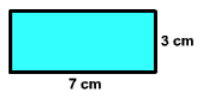
    Find the perimeter of the rectangle shown below

              A rectangle with width 7 cm and height 3 cm


    2. Finding the Area and Perimeter of a Triangle

    Definition: A polygon is a closed shape bounded only by straight lines. A triangle is a 3-sided polygon.

    Example Triangle:


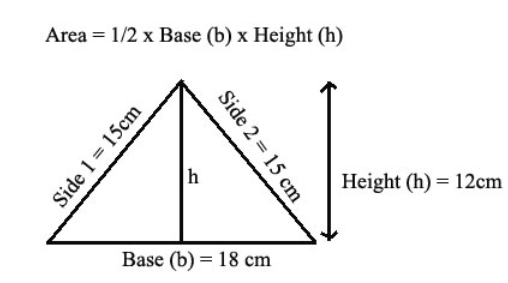
     triangle with base 18, the other two sides both 15, and the height 12.  Area = 1/2 times the base times the height

    To calculate the area of a triangle multiply its base times its height and divide by two. The triangle above has area

              Area  =  18 cm x 12 cm x (1/2)

                       = 108 cm2


    Now try one by yourself.  If you want to see the answer, put your mouse on the yellow rectangle and the answer will appear.

    Exercise 3

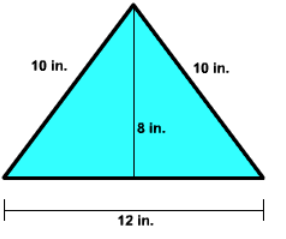
    Find the area of the area of the triangle shown below

               triangle with base 12, the other two sides both 10, and the height 8.


    The perimeter of a polygon is equal to the distance all the way around the figure. So to calculate the perimeter of a triangle add the lengths if its sides together.


    A triangle with sides 1 and 2 both 15cm and side 3 18 cm.  Perimeter = side1 + side2 + side3

    The perimeter of the above triangle is

              Perimeter  =  18 cm + 15 cm + 15 cm

                               = 48 cm


    Now try one by yourself.  If you want to see the answer, put your mouse on the yellow rectangle and the answer will appear.

    Exercise 4

    Find the perimeter of  the triangle from Exercise 3 (shown below)

              Triangle with base 12 in, other side lengths 10 and 10 in and height 8 in.


    You may see a triangle area problem on the CAHSEE in which you do not know the height of the triangle.


    A triangle has base 6 in and other two sides both 5 cm.  Find the height.

    These types of problems require that you know how to use the Pythagorean Theorem. This will be taught in a later lesson, but follow the link if you wish to look at that lesson now.


    3. Finding the Area and Circumference of a Circle

    Definition: A circle is the set of all points in a plane that are a fixed distance from a given point in the plane.

    This fixed distance is called the radius of the circle. The example circle below has radius = 25 mm

    Example Circle:


    Circle with radius 25 and diameter d

    This circle has a diameter of 50 mm. The diameter is the distance from any point on the circle, through its center, to a point on the opposite side of the circle. The radius of a circle is equal to half the diameter.

              Radius  =  1/2 Diameter


    The distance around the outside of a circle has a special name, it is called the Circumference and is denoted C.

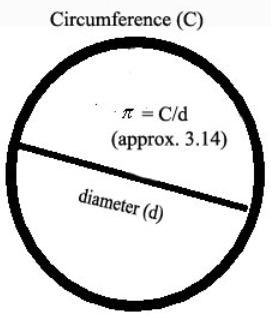
    Pi: There is a special number called pi that is equal to the ratio of circumference to diameter on any circle and is approximately equal to 3.14. We use this number when the calculating area and perimeter of a circle.  The symbol that we use for pi is p.  The illustration on the right uses this symbol.


    A circle with diameter d and Circumference C.  pi = C/d approximately 3.14

    To calculate the area of a circle multiply 3.14 times the radius, r, of the circle squared.

              Area of a Circle    3.14 r2

    which is the same thing as multiplying 3.14 by the radius and then again by the radius.
    The circle above has area

             Area  =  3.14 x 25 mm x 25 mm 

                      = 1962.5 mm2

    To calculate the circumference of the circle multiple 3.14 by its diameter. Notice this is the same thing as multiplying 3.14 by two times the radius of the circle.

    The circumference of the above circle is

              Circumference  =  3.14 x 50 mm

                                      = 157 mm


    Now try one by yourself.  If you want to see the answer, put your mouse on the yellow rectangle and the answer will appear.

    Exercise 5

    Find the area and circumference of the circle shown below.

              A circle with radius 3cm


    On the CAHSEE you might be given a question involving a circle in which you are given the diameter but not the radius. To calculate the radius just divide the diameter in half. For instance, you know that the diameter in the circle above is 50 mm, so the radius is half of that number: 25 mm.

    You may even get a tricky problem like the one below in which you are given the circumference but not the diameter or the radius. In this case you can compute the diameter (and therefore radius) by solving for d (the diameter) in the circumference formula.


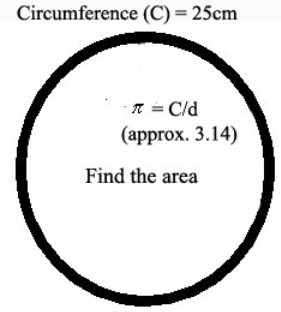
    Tricky Example: Find the area of the circle that has circumference 25 cm.


    Notice in this example that we haven't been given the radius or the diameter of the circle. What we have been given is that the circumference is 25cm. From the formula for circumference of a circle we can solve for d.

    C  =  3.14 x d

    d  =  C / 3.14

    d  =  25 cm / 3.14

    d  =  7.96 cm

    The radius is half the diameter, so

            r  =  7.96/2  =  3.98 cm

    or about 4 cm.  Now, we can find the area by using

               A = p r2

                  ≈  3.14 (42)

                  =  (3.14)(16)

                  =  50.24 cm2


    A circle with circumference C = 25cm, pi = C/d.  p approximately 3.14.  Find the area.


    Now try one by yourself.  If you want to see the answer, put your mouse on the yellow rectangle and the answer will appear.

    Exercise 6

    Find the area of the circle that has a circumference of 50 inches.


    4. Typical CAHSEE Type Question


    A circular flowerbed with radius 6 ft is inscribed within a grassy square region.

    a. Find the area of the entire square region.

         Area of square = length (l) x length (l)

    In this problem we are not given the length of the square but notice that the length of the radius of the flower bed is the same as one half the side length of the square. Multiplying the radius by two will give us length. So, area of square

              Area  =  12 ft x 12 ft

                       =  144 ft2

     circle with radius 6ft.


    b. Now find the perimeter of the grassy region and the flower bed so that we know how much material needs to be purchased to fence both.

              Perimeter of grassy region

                   = 4 x length (all the way around the square)

                   = 4 x 12 ft

                   = 48 ft

    Circumference of circular flowerbed

              Circumference 

                   =  3.14 x d

                   =  3.14 x 12 ft

                   =  37.7 ft

    Adding these two together gives us

          Total  =  Perimeter of Grassy Region + Circumference of Circular Flowerbed

                    =  85.7 ft.


    5. Finding the volume of a Rectangular Solid

    Definition: rectangular solid is a 3 dimensional object in which each of its 6 faces is a rectangle and adjacent faces are perpendicular. A rectangular solid has three dimensions, length, width and height.

    Example:


    rectangluar prism with length 3, width 5, height 2.  V = length(l) x width(w) x height (h)

    The rectangular solid above has length 3 inches, width 5 inches and height 2 inches.

    Definition: Volume is the amount of space occupied by a three-dimensional object, expressed in cubic units. To calculate the volume of a rectangular solid you multiple the area of its base times its height.

    So for the example above the volume is length times width (area of rectangle) times height. The volume of this rectangular solid is

              Volume = (3)(5)(2)  =  30 inches3


    Now try one by yourself.  If you want to see the answer, put your mouse on the yellow rectangle and the answer will appear.

    Exercise 7

    Find the volume of the rectangular solid shown below.

    rectangular solid with length 5 m, width 12 m, and height 4 m


    Perimeter Area Volume and Circumference of Basic Shapes is shared under a not declared license and was authored, remixed, and/or curated by LibreTexts.

    • Was this article helpful?