Mathematics LibreTexts

key

  • Page ID
    219471
  • \( \newcommand{\vecs}[1]{\overset { \scriptstyle \rightharpoonup} {\mathbf{#1}} } \)

    \( \newcommand{\vecd}[1]{\overset{-\!-\!\rightharpoonup}{\vphantom{a}\smash {#1}}} \)

    \( \newcommand{\dsum}{\displaystyle\sum\limits} \)

    \( \newcommand{\dint}{\displaystyle\int\limits} \)

    \( \newcommand{\dlim}{\displaystyle\lim\limits} \)

    \( \newcommand{\id}{\mathrm{id}}\) \( \newcommand{\Span}{\mathrm{span}}\)

    ( \newcommand{\kernel}{\mathrm{null}\,}\) \( \newcommand{\range}{\mathrm{range}\,}\)

    \( \newcommand{\RealPart}{\mathrm{Re}}\) \( \newcommand{\ImaginaryPart}{\mathrm{Im}}\)

    \( \newcommand{\Argument}{\mathrm{Arg}}\) \( \newcommand{\norm}[1]{\| #1 \|}\)

    \( \newcommand{\inner}[2]{\langle #1, #2 \rangle}\)

    \( \newcommand{\Span}{\mathrm{span}}\)

    \( \newcommand{\id}{\mathrm{id}}\)

    \( \newcommand{\Span}{\mathrm{span}}\)

    \( \newcommand{\kernel}{\mathrm{null}\,}\)

    \( \newcommand{\range}{\mathrm{range}\,}\)

    \( \newcommand{\RealPart}{\mathrm{Re}}\)

    \( \newcommand{\ImaginaryPart}{\mathrm{Im}}\)

    \( \newcommand{\Argument}{\mathrm{Arg}}\)

    \( \newcommand{\norm}[1]{\| #1 \|}\)

    \( \newcommand{\inner}[2]{\langle #1, #2 \rangle}\)

    \( \newcommand{\Span}{\mathrm{span}}\) \( \newcommand{\AA}{\unicode[.8,0]{x212B}}\)

    \( \newcommand{\vectorA}[1]{\vec{#1}}      % arrow\)

    \( \newcommand{\vectorAt}[1]{\vec{\text{#1}}}      % arrow\)

    \( \newcommand{\vectorB}[1]{\overset { \scriptstyle \rightharpoonup} {\mathbf{#1}} } \)

    \( \newcommand{\vectorC}[1]{\textbf{#1}} \)

    \( \newcommand{\vectorD}[1]{\overrightarrow{#1}} \)

    \( \newcommand{\vectorDt}[1]{\overrightarrow{\text{#1}}} \)

    \( \newcommand{\vectE}[1]{\overset{-\!-\!\rightharpoonup}{\vphantom{a}\smash{\mathbf {#1}}}} \)

    \( \newcommand{\vecs}[1]{\overset { \scriptstyle \rightharpoonup} {\mathbf{#1}} } \)

    \(\newcommand{\longvect}{\overrightarrow}\)

    \( \newcommand{\vecd}[1]{\overset{-\!-\!\rightharpoonup}{\vphantom{a}\smash {#1}}} \)

    \(\newcommand{\avec}{\mathbf a}\) \(\newcommand{\bvec}{\mathbf b}\) \(\newcommand{\cvec}{\mathbf c}\) \(\newcommand{\dvec}{\mathbf d}\) \(\newcommand{\dtil}{\widetilde{\mathbf d}}\) \(\newcommand{\evec}{\mathbf e}\) \(\newcommand{\fvec}{\mathbf f}\) \(\newcommand{\nvec}{\mathbf n}\) \(\newcommand{\pvec}{\mathbf p}\) \(\newcommand{\qvec}{\mathbf q}\) \(\newcommand{\svec}{\mathbf s}\) \(\newcommand{\tvec}{\mathbf t}\) \(\newcommand{\uvec}{\mathbf u}\) \(\newcommand{\vvec}{\mathbf v}\) \(\newcommand{\wvec}{\mathbf w}\) \(\newcommand{\xvec}{\mathbf x}\) \(\newcommand{\yvec}{\mathbf y}\) \(\newcommand{\zvec}{\mathbf z}\) \(\newcommand{\rvec}{\mathbf r}\) \(\newcommand{\mvec}{\mathbf m}\) \(\newcommand{\zerovec}{\mathbf 0}\) \(\newcommand{\onevec}{\mathbf 1}\) \(\newcommand{\real}{\mathbb R}\) \(\newcommand{\twovec}[2]{\left[\begin{array}{r}#1 \\ #2 \end{array}\right]}\) \(\newcommand{\ctwovec}[2]{\left[\begin{array}{c}#1 \\ #2 \end{array}\right]}\) \(\newcommand{\threevec}[3]{\left[\begin{array}{r}#1 \\ #2 \\ #3 \end{array}\right]}\) \(\newcommand{\cthreevec}[3]{\left[\begin{array}{c}#1 \\ #2 \\ #3 \end{array}\right]}\) \(\newcommand{\fourvec}[4]{\left[\begin{array}{r}#1 \\ #2 \\ #3 \\ #4 \end{array}\right]}\) \(\newcommand{\cfourvec}[4]{\left[\begin{array}{c}#1 \\ #2 \\ #3 \\ #4 \end{array}\right]}\) \(\newcommand{\fivevec}[5]{\left[\begin{array}{r}#1 \\ #2 \\ #3 \\ #4 \\ #5 \\ \end{array}\right]}\) \(\newcommand{\cfivevec}[5]{\left[\begin{array}{c}#1 \\ #2 \\ #3 \\ #4 \\ #5 \\ \end{array}\right]}\) \(\newcommand{\mattwo}[4]{\left[\begin{array}{rr}#1 \amp #2 \\ #3 \amp #4 \\ \end{array}\right]}\) \(\newcommand{\laspan}[1]{\text{Span}\{#1\}}\) \(\newcommand{\bcal}{\cal B}\) \(\newcommand{\ccal}{\cal C}\) \(\newcommand{\scal}{\cal S}\) \(\newcommand{\wcal}{\cal W}\) \(\newcommand{\ecal}{\cal E}\) \(\newcommand{\coords}[2]{\left\{#1\right\}_{#2}}\) \(\newcommand{\gray}[1]{\color{gray}{#1}}\) \(\newcommand{\lgray}[1]{\color{lightgray}{#1}}\) \(\newcommand{\rank}{\operatorname{rank}}\) \(\newcommand{\row}{\text{Row}}\) \(\newcommand{\col}{\text{Col}}\) \(\renewcommand{\row}{\text{Row}}\) \(\newcommand{\nul}{\text{Nul}}\) \(\newcommand{\var}{\text{Var}}\) \(\newcommand{\corr}{\text{corr}}\) \(\newcommand{\len}[1]{\left|#1\right|}\) \(\newcommand{\bbar}{\overline{\bvec}}\) \(\newcommand{\bhat}{\widehat{\bvec}}\) \(\newcommand{\bperp}{\bvec^\perp}\) \(\newcommand{\xhat}{\widehat{\xvec}}\) \(\newcommand{\vhat}{\widehat{\vvec}}\) \(\newcommand{\uhat}{\widehat{\uvec}}\) \(\newcommand{\what}{\widehat{\wvec}}\) \(\newcommand{\Sighat}{\widehat{\Sigma}}\) \(\newcommand{\lt}{<}\) \(\newcommand{\gt}{>}\) \(\newcommand{\amp}{&}\) \(\definecolor{fillinmathshade}{gray}{0.9}\)


    Name                                    


    MATH 105 PRACTICE MIDTERM II

    Please work out each of the given problems.  Credit will be based on the steps that you show towards the final answer.  Show your work.


    PROBLEM 1  (7 Points each)  Please answer the following true or false.  If false, explain why or provide a counter example.  If true, explain why.

    1. Let f(x) be differentiable on [0,1], then there is a positive c less than 1 such that
          f(1) = f(0) + f '(c)
      Solution

      True, by the mean value theorem, we have
                  
      f(1) - f(0)
                                        = f '(c)        
      for some c in [0,1].
                     1  -  0          

      and the result follows.

    2. Let f(x) be a differentiable function such that f '(c) = f ''(c) = 0 , then f has neither a relative maximum nor a relative minimum at x = c .
      Solution
      False.  The second derivative test only tells you that we do not know about max and min there.  For example, y = x4  has the above properties for c = 0 and has a minimum there.

    3.  If f ''(x) < 0 for all x between 0 and 1 and f(0) = 0  then f(1) < 0.
      Solution
      False, just because a function is concave down does not mean that it is decreasing.  For example, y = -(x - 1)2 + 1 is a counter example.

    4. If f(x) is a periodic differentiable function, that is f(x + p) = f(x)  for some p and all x, then f '(x) has an infinite number of roots.
      Solution
      True,  by Rolle's theorem, since f(kp) = f((k + 1)p), there is a c between kp and (k + 1)p, such that f '(c) = 0.  This gives a root for any integer k


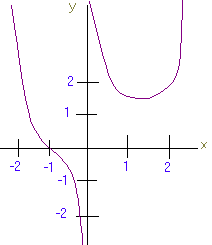
    PROBLEM 2  Consider the function (22 Points)

           \(  y = x^2 + \frac{1}{x}  \) 

    Without the use of the graphing capabilities of your graphing calculator, for the following two functions

    1. Determine the relative extrema if any.
      Solution
              f '(x) = 2x - 1/x2

      Which has a root at (1/2)1/3 hence the possible relative extrema is at
              
      ((1/2)1/3 , (1/2)2/3 +(1/2)-1/3)

              f ''(x) = 2 + 2/x3


      and

              
      f ''((1/2)1/3) = 2 + 2 > 0

      Hence there is a relative minimum there

    2. Determine where the function is increasing and decreasing.
      Solution
              We want to determine when the derivative is positive and when it is negative.  The critical points of f are

              
      (1/2)1/3     and     0

      For x < 0, 

              f '(x) = 2x - 1/x< 0        
      (plug in a test value such as x = -1) 

      For  0 < x < (1/2)1/3 

              f '(x) = 2x - 1/x< 0         
      (plug in a test value such as x = 0.1) 

      For   (1/2)1/3 < x

              f '(x) = 2x - 1/x2 > 0         
      (plug in a test value such as x = 5) 

      Hence the function is increasing for (1/2)1/3 < x and decreasing for  x < 0 and 0 < x < (1/2)1/3.

    3. Determine the inflection points if any.
      Solution
      We set the second derivative equal to zero:
              
              
      f ''(x) = 2 + 2/x3  =  0

              2x3 + 2  =  0

              x3  =  -1

              x = -1


      Now plug back into the original function to get the point

              
      (-1, 0 )

    4. Determine where the function is concave up and concave down.
      Solution
              We want to determine when the second derivative is positive and when it is negative.  The changes in sign can occur at 

              x = -1 or x = 0

      For x < -1, 

              f ''(x) = 2 + 2/x3 > 0        
      (plug in a test value such as x = -2) 

      For  -1 < x < 0 

              f ''(x) = 2 + 2/x3 < 0          
      (plug in a test value such as x = -0.5) 

      For   0 < x

              f ''(x) = 2 + 2/x3 > 0         
      (plug in a test value such as x = 5) 

      Hence the function is concave up for x < -1  and for 0 < x and concave down  for  -1 < x < 0.

    5. Find any horizontal asymptotes.
      Solution
      We find the horizontal asymptotes by taking the limit of f(x) as x approaches infinity.  But this limit goes to infinity, so there are no horizontal asymptotes.

    6. Find any vertical asymptotes.
      Solution
      We find the vertical asymptotes by setting the denominator equal to zero.  Hence the vertical asymptote occurs at x = 0.  Notice that by looking at the left and the right of the equation, we have a down-up behavior near the asymptote.

    7. Use the above to graph the function, labeling all important points and asymptotes.
      Solution

    Graph with vertical asymptote at the y-axis, decreasing for negative x values, inflection point at x=-1, decreasing from x=0 to x= 1.5, and then increasing past x = 1.5.

    PROBLEM 3  (20 Points) 

    As you are standing outside on a beautiful sunny late afternoon, you notice that your shadow is growing in length at a rate of 2 feet per hour.  If you are 6 feet tall, how fast is the angle of elevation of the sun decreasing when your shadow is 8 feet long?

              Solution
     

                       Triangle with horizontal side length s = 8, vertical side length 6, and hypotenuse h = 10 and angle theta

            We have

                    
    tan = 6/s

                    s  =  6cot q

                    ds/dt = -6csc2 q  dq/dt

                    2 = -6(10/6)2 dq/dt

                    dq/dt = -0.12 rad/sec


    PROBLEM 4   (20 Points Each)

    1. Suppose that

                  x2 + y + sin(xy) = 2

       Find the equation of the tangent line to this curve at the point (0,2).
      Solution
       

      Taking the derivative of both sides implicitly with respect to x, we get:

              2x + y' + (y + xy')cos(xy) = 0

              y' + 2cos(0) = 0

              y'  =  -2


      Now use the fact that the slope is -2 and the y-int is 2 to get

              
      y = -2x + 2

    2. Let
      \(  f(x) =  \frac{cos(x^2 + 1)}{1 - x}  \) 

      Find
      \(  \frac{df}{dx}  \) 

      Solution
              We use the quotient rule and the chain rule:

                  
      (1 - x)(2x)(-sin(x2 + 1)) - cos(x2 + 1)(-1)
                                                                                              
                                      (1 - x)2


                       (2x2 - 2x)sin(x2 + 1) + cos(x2 + 1)
                =                                                                                
                                                 (1 - x)2


    PROBLEM 5    (20 Points)

    Sketch the graph of a function with the following properties:

    • \(  \lim\limits_{x \to -\infty} f(x) = 1  \) 
    • \(  \lim\limits_{x \to \infty} f(x) = -1  \) 
    • \(  \lim\limits_{x \to -1^{-}} f(x) = -\infty  \) 
    •  \(  \lim\limits_{x \to -1^{+}} f(x) = \infty  \) 
    • f ''(x) > 0 only for     x < -3,     -1 < x < 2,     and     3 < x < 5
    • f '(x) > 0 only for      x < -2 and   x > 4
    • f '(-2) = f '(2) = f '(4) = 0
    • f ''(-3) = f ''(2) = f ''(3) = 0

      Solution


                    graph flat left goes up till -2 then drops to asymptote -1, drops on the right flat at 2 down until 4 then up and flat on right


    PROBLEM 6   (20 Points)

    You plan to build a rectangular office building of minimal cost with a with a wall down the middle to subdivide the building into two offices as shown in the picture.  The outer walls cost $500 per foot to construct and the divider wall costs $100 per foot to construct.  If the combined square footage of the two offices is to be 1,000 square feet, what dimensions should you make the building?


    Rectangle split into two rectangles, left and right

    Solution

    Let w be the width of the building and h be the length.  Then the square footage is

            1000 = wh

    or

            w = 1000/h

    and the cost is

            C = 500(2w + 2h) + 100h

            =  1000w + 1100h

            =  1,000,000/h + 1100h

    Taking a derivative and setting it equal to zero gives>

            C'(h) = -1,000,000/h2 + 1100  =  0

            -1,000,000 + 1100h2 = 0

            h2  =  10000/11

            h  =  30.15 feet

    So that

            w = 1000/h  =  1000/30.15  =  33.17

    The building should have dimensions 30.15 by 33.17


    key is shared under a not declared license and was authored, remixed, and/or curated by LibreTexts.

    • Was this article helpful?