Mathematics LibreTexts

Nonlinear Inequalities

  • Page ID
    221326
  • \( \newcommand{\vecs}[1]{\overset { \scriptstyle \rightharpoonup} {\mathbf{#1}} } \)

    \( \newcommand{\vecd}[1]{\overset{-\!-\!\rightharpoonup}{\vphantom{a}\smash {#1}}} \)

    \( \newcommand{\dsum}{\displaystyle\sum\limits} \)

    \( \newcommand{\dint}{\displaystyle\int\limits} \)

    \( \newcommand{\dlim}{\displaystyle\lim\limits} \)

    \( \newcommand{\id}{\mathrm{id}}\) \( \newcommand{\Span}{\mathrm{span}}\)

    ( \newcommand{\kernel}{\mathrm{null}\,}\) \( \newcommand{\range}{\mathrm{range}\,}\)

    \( \newcommand{\RealPart}{\mathrm{Re}}\) \( \newcommand{\ImaginaryPart}{\mathrm{Im}}\)

    \( \newcommand{\Argument}{\mathrm{Arg}}\) \( \newcommand{\norm}[1]{\| #1 \|}\)

    \( \newcommand{\inner}[2]{\langle #1, #2 \rangle}\)

    \( \newcommand{\Span}{\mathrm{span}}\)

    \( \newcommand{\id}{\mathrm{id}}\)

    \( \newcommand{\Span}{\mathrm{span}}\)

    \( \newcommand{\kernel}{\mathrm{null}\,}\)

    \( \newcommand{\range}{\mathrm{range}\,}\)

    \( \newcommand{\RealPart}{\mathrm{Re}}\)

    \( \newcommand{\ImaginaryPart}{\mathrm{Im}}\)

    \( \newcommand{\Argument}{\mathrm{Arg}}\)

    \( \newcommand{\norm}[1]{\| #1 \|}\)

    \( \newcommand{\inner}[2]{\langle #1, #2 \rangle}\)

    \( \newcommand{\Span}{\mathrm{span}}\) \( \newcommand{\AA}{\unicode[.8,0]{x212B}}\)

    \( \newcommand{\vectorA}[1]{\vec{#1}}      % arrow\)

    \( \newcommand{\vectorAt}[1]{\vec{\text{#1}}}      % arrow\)

    \( \newcommand{\vectorB}[1]{\overset { \scriptstyle \rightharpoonup} {\mathbf{#1}} } \)

    \( \newcommand{\vectorC}[1]{\textbf{#1}} \)

    \( \newcommand{\vectorD}[1]{\overrightarrow{#1}} \)

    \( \newcommand{\vectorDt}[1]{\overrightarrow{\text{#1}}} \)

    \( \newcommand{\vectE}[1]{\overset{-\!-\!\rightharpoonup}{\vphantom{a}\smash{\mathbf {#1}}}} \)

    \( \newcommand{\vecs}[1]{\overset { \scriptstyle \rightharpoonup} {\mathbf{#1}} } \)

    \(\newcommand{\longvect}{\overrightarrow}\)

    \( \newcommand{\vecd}[1]{\overset{-\!-\!\rightharpoonup}{\vphantom{a}\smash {#1}}} \)

    \(\newcommand{\avec}{\mathbf a}\) \(\newcommand{\bvec}{\mathbf b}\) \(\newcommand{\cvec}{\mathbf c}\) \(\newcommand{\dvec}{\mathbf d}\) \(\newcommand{\dtil}{\widetilde{\mathbf d}}\) \(\newcommand{\evec}{\mathbf e}\) \(\newcommand{\fvec}{\mathbf f}\) \(\newcommand{\nvec}{\mathbf n}\) \(\newcommand{\pvec}{\mathbf p}\) \(\newcommand{\qvec}{\mathbf q}\) \(\newcommand{\svec}{\mathbf s}\) \(\newcommand{\tvec}{\mathbf t}\) \(\newcommand{\uvec}{\mathbf u}\) \(\newcommand{\vvec}{\mathbf v}\) \(\newcommand{\wvec}{\mathbf w}\) \(\newcommand{\xvec}{\mathbf x}\) \(\newcommand{\yvec}{\mathbf y}\) \(\newcommand{\zvec}{\mathbf z}\) \(\newcommand{\rvec}{\mathbf r}\) \(\newcommand{\mvec}{\mathbf m}\) \(\newcommand{\zerovec}{\mathbf 0}\) \(\newcommand{\onevec}{\mathbf 1}\) \(\newcommand{\real}{\mathbb R}\) \(\newcommand{\twovec}[2]{\left[\begin{array}{r}#1 \\ #2 \end{array}\right]}\) \(\newcommand{\ctwovec}[2]{\left[\begin{array}{c}#1 \\ #2 \end{array}\right]}\) \(\newcommand{\threevec}[3]{\left[\begin{array}{r}#1 \\ #2 \\ #3 \end{array}\right]}\) \(\newcommand{\cthreevec}[3]{\left[\begin{array}{c}#1 \\ #2 \\ #3 \end{array}\right]}\) \(\newcommand{\fourvec}[4]{\left[\begin{array}{r}#1 \\ #2 \\ #3 \\ #4 \end{array}\right]}\) \(\newcommand{\cfourvec}[4]{\left[\begin{array}{c}#1 \\ #2 \\ #3 \\ #4 \end{array}\right]}\) \(\newcommand{\fivevec}[5]{\left[\begin{array}{r}#1 \\ #2 \\ #3 \\ #4 \\ #5 \\ \end{array}\right]}\) \(\newcommand{\cfivevec}[5]{\left[\begin{array}{c}#1 \\ #2 \\ #3 \\ #4 \\ #5 \\ \end{array}\right]}\) \(\newcommand{\mattwo}[4]{\left[\begin{array}{rr}#1 \amp #2 \\ #3 \amp #4 \\ \end{array}\right]}\) \(\newcommand{\laspan}[1]{\text{Span}\{#1\}}\) \(\newcommand{\bcal}{\cal B}\) \(\newcommand{\ccal}{\cal C}\) \(\newcommand{\scal}{\cal S}\) \(\newcommand{\wcal}{\cal W}\) \(\newcommand{\ecal}{\cal E}\) \(\newcommand{\coords}[2]{\left\{#1\right\}_{#2}}\) \(\newcommand{\gray}[1]{\color{gray}{#1}}\) \(\newcommand{\lgray}[1]{\color{lightgray}{#1}}\) \(\newcommand{\rank}{\operatorname{rank}}\) \(\newcommand{\row}{\text{Row}}\) \(\newcommand{\col}{\text{Col}}\) \(\renewcommand{\row}{\text{Row}}\) \(\newcommand{\nul}{\text{Nul}}\) \(\newcommand{\var}{\text{Var}}\) \(\newcommand{\corr}{\text{corr}}\) \(\newcommand{\len}[1]{\left|#1\right|}\) \(\newcommand{\bbar}{\overline{\bvec}}\) \(\newcommand{\bhat}{\widehat{\bvec}}\) \(\newcommand{\bperp}{\bvec^\perp}\) \(\newcommand{\xhat}{\widehat{\xvec}}\) \(\newcommand{\vhat}{\widehat{\vvec}}\) \(\newcommand{\uhat}{\widehat{\uvec}}\) \(\newcommand{\what}{\widehat{\wvec}}\) \(\newcommand{\Sighat}{\widehat{\Sigma}}\) \(\newcommand{\lt}{<}\) \(\newcommand{\gt}{>}\) \(\newcommand{\amp}{&}\) \(\definecolor{fillinmathshade}{gray}{0.9}\)

    Nonlinear Inequalities and the Pythagorean Theorem


    Quadratic Inequalities

    We will solve using the following steps


    1. Put everything on the left hand side so that we have for example Quad > 0.
       

    2. Factor and set equal to zero.
       

    3. Solve and place answers on a number line.  This will cut the number line into two or three regions.
       

    4. Pick a test value for each region and plug that test value into each of the factors.  Put plusses or minuses over the region depending on whether the test values test positive or negative.
       

    5. If the region has two plusses or two minuses the the region is positive.  If the region has one of each then the region is negative.
       

    6. If the inequality is "<" then include the negative regions.

      If the inequality is ">" then include the positive regions.


    7. If the inequality is a less (greater) than or equal to then include the endpoints with solid dot and the interval []

      If the inequality is a less (greater) than then do not include the endpoints by showing an open dot and the interval ()


    Example

    Solve 

            x2 + 3x  >  -2


    1. x2 + 3x + 2  >  0
       

    2. (x + 2)(x + 1)  =  0
       

    3. x = -2     or     x = -1      This cuts the number line into three regions.


      Number line with -2, -1.5, -1, -0.5, and 0 marked


    4.  For the left region we choose -5 and have that

              -5 + 2 < 0,      -5 + 1 < 0         (two negatives)


    5. For the middle region we choose -1.5 and have that

              -1.5 + 2 > 0,         -1.5 + 1 < 0     (one of each)

       For the left region we choose 0 and have that

      0 + 2 >0,         0+ 1 >0     (two positives)


        x+2 x+1 Total
      Left (-5)

      -

      -

      +

      Middle(-1.5)

      -

      +

      -

      Right(0)

      +

      +

      +


    6.  We see that the left and right regions are positive and the middle region is negative.
       

    7. Since the inequality is a greater then we have the solution:

      (- \(\infty\)  ,-2) U (-1,\(\infty\) )

            Number line with arrow from -2 to - infinity and arrow from -1 to infinity


    Exercise

    Solve

            x2 - 3  <  2x


    Rational Inequalities

    To solve rational inequalities, we can use the same technique that we used for quadratic inequalities with the following adjustments:


    1. After putting everything on the left hand side we put the left hand side over a common denominator.
       

    2. Instead of factoring and solving to find the cut points, we just set the numerator and denominator each equal to zero.
       

    3. The cut point that is determined from that denominator will never be included, thus will be bordered by a "(" and shown as an open dot.


    Example

              2x + 3   
                               <   2    
                x -1


    1.           2x + 3   
                                -   2    <   0   
                  x -1

                2x + 3           2(x - 1)
                                -                            <   0   
                  x -1                x - 1


                2x + 3 - 2x + 2   
                                                   <   0   
      Notice that - 2(x - 1)  =  -(2x - 2) = -2x + 2
                        x -1

                  5   
                                <   0   
                x -1


    2. Notice that the numerator is never zero and the denominator is zero only at x = 1.
       

    3. x = 1 cuts the number line into two regions.

      Number line with 1 marked and dots at 0 and 2
       

    4. For the left region, we choose 0 and see that

      5  >  0         and         0 - 1 < 0     (one of each)

      For the right region we choose 2 and see that

      5  >  0 and 2 - 1  >  0 (two positives)


        x-1 Total
      Left (0)

      -

      -

      Right(2)

      +

      +


    5. We see that the left region is negative and the right region is positive.
       

    6. Since the inequality is "<" we include that left region. 
       

    7. Although the inequality as an equality under it, the cut point comes from the denominator, therefore we do not include that cut point.  Hence the solution is

      (-\(\infty\) ,1)

      Number line with arrow from 1 to - infinity


    The Pythagorean Theorem

    The most important formula in mathematics is the Pythagorean theorem which states that for a right triangle, if a and b are the lengths of the legs (short sides) and c is the length of the hypotenuse (long side), then                                       Right triangle with side lengths a and b and hypothenuse length of c.

            a2 + b2 = c2


    Example

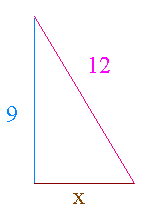
    Suppose the length of hypotenuse of a right triangle has length 12 and a leg has length 9.  Find the length of the other leg.

                                                    Right triangle with side lengths x and 9 and hypothenuse length of 12.

    Solution

    Let x be the length of the other leg, then

            x2 + 92  =  122  

    or 

            x2 + 81  =  144 

    or 

            x2  = 63 

    so that 

            x = \(\sqrt{63}\) 

    The length of the other leg is \(\sqrt{63}\) 


    Back to the Factoring Page


    Nonlinear Inequalities is shared under a not declared license and was authored, remixed, and/or curated by LibreTexts.

    • Was this article helpful?