

4.4E: Exercises for Section 4.4
( \newcommand{\kernel}{\mathrm{null}\,}\)
1) If
2) For the function
- Answer
- It is not a local maximum/minimum because
3) For the function
4) Is it possible for a point
- Answer
- No
5) Why do you need continuity for the first derivative test? Come up with an example.
6) Explain whether a concave-down function has to cross
- Answer
- False; for example,
7) Explain whether a polynomial of degree
In exercises 8 - 12, analyze the graphs of
8)
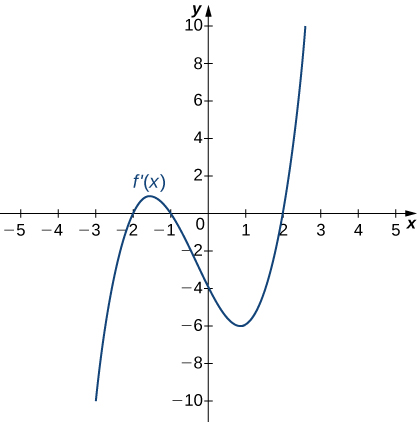
- Answer
- Increasing for
Decreasing for
9)
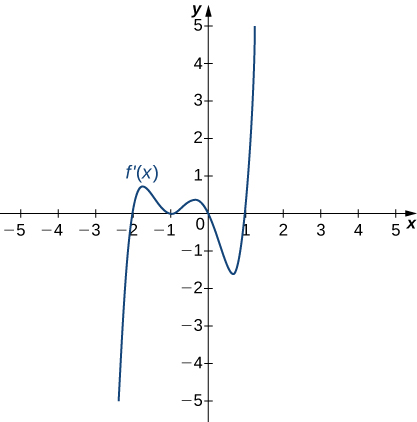
10)
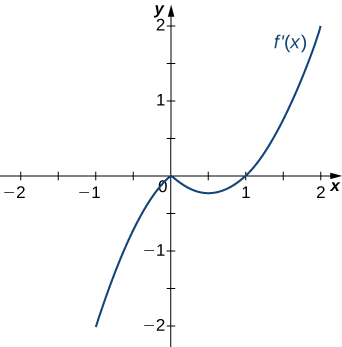
- Answer
- Decreasing for
Increasing for
11)
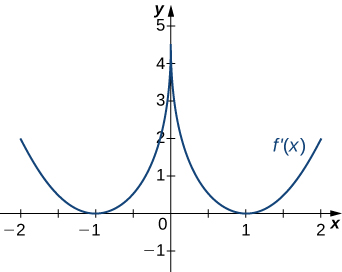
12)
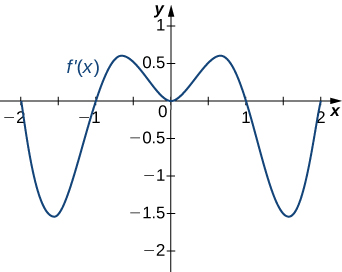
- Answer
- Decreasing for
Increasing for
In exercises 13 - 17, analyze the graphs of
a.
b. the minima and maxima are located.
13)
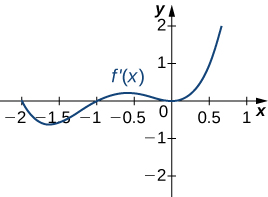
14)
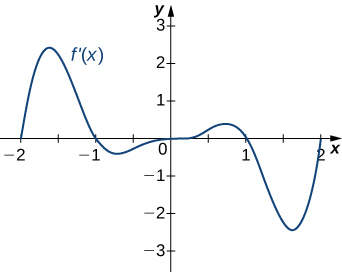
- Answer
- a. Increasing over
b. Maxima at
15)
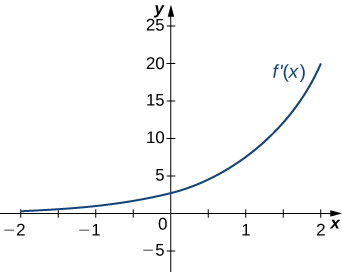
16)
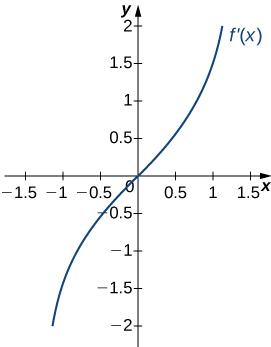
- Answer
- a. Increasing over
b. Minimum at
17)
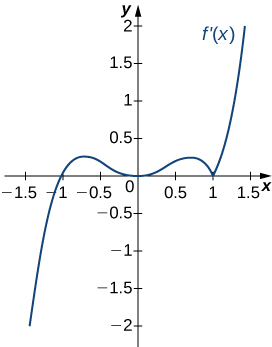
In exercises 18 - 22, analyze the graphs of
18)
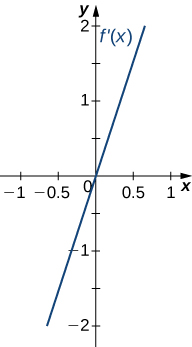
- Answer
- Concave up for all
No inflection points
19)
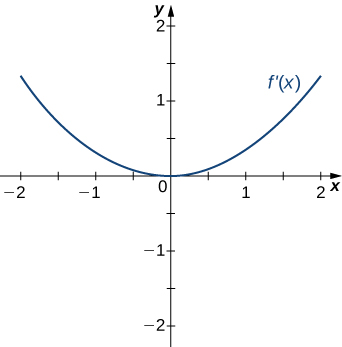
20)
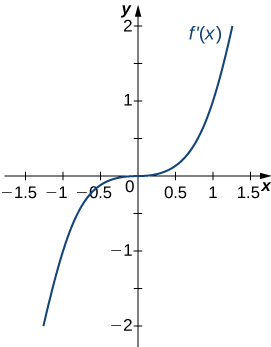
- Answer
- Concave up for all
No inflection points
21)
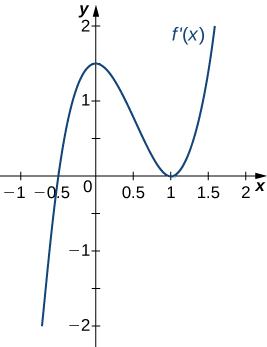
22)
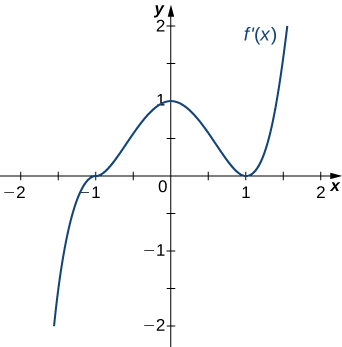
- Answer
- Concave up for
Concave down for
Inflection points at
For exercises 23 - 27, draw a graph that satisfies the given specifications for the domain
23)
24)
- Answer
- Answers will vary
25)
26) There is a local maximum at
- Answer
- Answers will vary
27) There are local maxima at
For the following exercises, determine
a. intervals where
b. local minima and maxima of
28)
- Answer
-
a. Increasing over
b. Local maximum at
29)
For exercise 30, determine
a. intervals where
b. the inflection points of
30)
- Answer
-
a. Concave up for
b. Inflection point at
For exercises 31 - 37, determine
a. intervals where
b. local minima and maxima of
c. intervals where
d. the inflection points of
31)
32)
- Answer
- a. Increasing over
b. Maximum at
c. Concave up for
d. Inflection point at
33)
34)
- Answer
- a. Increasing over
b. Maximum at
c. Concave down for
d. Inflection point at
35)
36)
- Answer
- a. Increasing over
b. Minimum at
c. Concave up for all
d. No inflection points
37)
For exercises 38 - 47, determine
a. intervals where
b. local minima and maxima of
c. intervals where
d. the inflection points of
38) [T]
- Answer
- a. Increases over
b. Minimum at
c. Concave up for
d. Inflection points at
39) [T]
40) [T]
- Answer
- a. Increasing for all
b. No local minimum or maximum
c. Concave up for
d. Inflection point at
41) [T]
42) [T]
- Answer
- a. Increasing for all
b. No local minima or maxima
c. Concave up for
d. No inflection points in domain
43) [T]
44)
- Answer
- a. Increasing over
b. Minimum at
c. Concave up for
d. Inflection points at
45)
46)
- Answer
- a. Increasing over
b. Minimum at
c. Concave up for
d. Inflection point at
47)
In exercises 48 - 52, interpret the sentences in terms of
48) The population is growing more slowly. Here
- Answer
49) A bike accelerates faster, but a car goes faster. Here
50) The airplane lands smoothly. Here
- Answer
51) Stock prices are at their peak. Here
52) The economy is picking up speed. Here
- Answer
For exercises 53 - 57, consider a third-degree polynomial
Determine whether the following statements are true or false. Justify your answer.
53)
54)
- Answer
- True, by the Mean Value Theorem
55) There is no absolute maximum at
56) If
- Answer
- True, examine derivative
57) If
