

5.1: Introduction to Rings
- Page ID
- 132508

\( \newcommand{\vecs}[1]{\overset { \scriptstyle \rightharpoonup} {\mathbf{#1}} } \)
\( \newcommand{\vecd}[1]{\overset{-\!-\!\rightharpoonup}{\vphantom{a}\smash {#1}}} \)
\( \newcommand{\dsum}{\displaystyle\sum\limits} \)
\( \newcommand{\dint}{\displaystyle\int\limits} \)
\( \newcommand{\dlim}{\displaystyle\lim\limits} \)
\( \newcommand{\id}{\mathrm{id}}\) \( \newcommand{\Span}{\mathrm{span}}\)
( \newcommand{\kernel}{\mathrm{null}\,}\) \( \newcommand{\range}{\mathrm{range}\,}\)
\( \newcommand{\RealPart}{\mathrm{Re}}\) \( \newcommand{\ImaginaryPart}{\mathrm{Im}}\)
\( \newcommand{\Argument}{\mathrm{Arg}}\) \( \newcommand{\norm}[1]{\| #1 \|}\)
\( \newcommand{\inner}[2]{\langle #1, #2 \rangle}\)
\( \newcommand{\Span}{\mathrm{span}}\)
\( \newcommand{\id}{\mathrm{id}}\)
\( \newcommand{\Span}{\mathrm{span}}\)
\( \newcommand{\kernel}{\mathrm{null}\,}\)
\( \newcommand{\range}{\mathrm{range}\,}\)
\( \newcommand{\RealPart}{\mathrm{Re}}\)
\( \newcommand{\ImaginaryPart}{\mathrm{Im}}\)
\( \newcommand{\Argument}{\mathrm{Arg}}\)
\( \newcommand{\norm}[1]{\| #1 \|}\)
\( \newcommand{\inner}[2]{\langle #1, #2 \rangle}\)
\( \newcommand{\Span}{\mathrm{span}}\) \( \newcommand{\AA}{\unicode[.8,0]{x212B}}\)
\( \newcommand{\vectorA}[1]{\vec{#1}} % arrow\)
\( \newcommand{\vectorAt}[1]{\vec{\text{#1}}} % arrow\)
\( \newcommand{\vectorB}[1]{\overset { \scriptstyle \rightharpoonup} {\mathbf{#1}} } \)
\( \newcommand{\vectorC}[1]{\textbf{#1}} \)
\( \newcommand{\vectorD}[1]{\overrightarrow{#1}} \)
\( \newcommand{\vectorDt}[1]{\overrightarrow{\text{#1}}} \)
\( \newcommand{\vectE}[1]{\overset{-\!-\!\rightharpoonup}{\vphantom{a}\smash{\mathbf {#1}}}} \)
\( \newcommand{\vecs}[1]{\overset { \scriptstyle \rightharpoonup} {\mathbf{#1}} } \)
\(\newcommand{\longvect}{\overrightarrow}\)
\( \newcommand{\vecd}[1]{\overset{-\!-\!\rightharpoonup}{\vphantom{a}\smash {#1}}} \)
\(\newcommand{\ket}[1]{\left| #1 \right>}\)
\(\newcommand{\bra}[1]{\left< #1 \right|}\)
\(\newcommand{\braket}[2]{\left< #1 \vphantom{#2} \right| \left. #2 \vphantom{#1} \right>}\)
\(\newcommand{\braopket}[3]{\left< #1 \vphantom{#2}\vphantom{#3} \right| #2 \vphantom{#1}\vphantom{#3} \left| #3 \vphantom{#1}\vphantom{#2} \right>}\)
\(\newcommand{\qmvec}[1]{\mathbf{\vec{#1}}}\)
\(\newcommand{\op}[1]{\hat{\mathbf{#1}}}\)
\(\newcommand{\expect}[1]{\langle #1 \rangle}\)
\(\newcommand{\dfn}[1]{\emph{\textbf{#1}}}\)
Recall that a group is a set with a binary operation; rings are algebraic structures similar to groups but with two operations instead of one.
A non-empty set \(R\) with two binary operations, addition and multiplication, denoted by \(+\) and \(\cdot\), is called a ring if:
-
\((R,+)\) is an abelian group .
-
\((R,\cdot)\) is semigroup: \(a \cdot b \in R, \;\forall a,b \in R\) (closed) and \(a \cdot (b \cdot c)=(a \cdot b) \cdot c, \; \forall a,b,c \in R\). (associative) \(R\) in this context is a ring.
-
Multiplication distributes over addition: \(a \cdot (b+c)=a \cdot b+a \cdot c\) and \((b+c)\cdot a=b \cdot a+c \cdot a\), \(\forall a,b,c \in R\). (Distributive property).
We call the additive identity \(0_R\) is zero. The additive inverse is called the negative element.
\(\{0\}\) is a ring called zero ring.
A ring need not have a multiplicative identity unless one is assumed or specified.
In this chapter, we will denote \(a \cdot b\) as \(ab\) (skipping the \(\cdot\) notation).
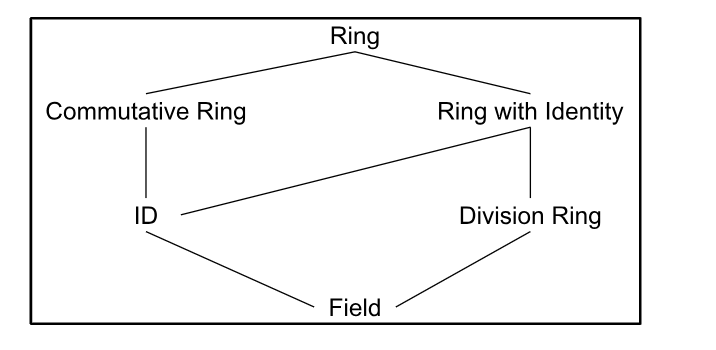
A ring \((R, +, \cdot)\) is called a commutative ring if \(ab=ba, \; \forall a,b \in R\).
A ring \((R, +, \cdot)\) has a unity(identity) \(1_R\ne 0_R \in R\) if \(a1_R=1_Ra=a, \; \forall a \in R\). Note that unity is always a unique, single element.
In this text, we will use \(1_R\) to denote the multiplicative identity (also denoted as \(e\)), not necessarily the additive identity \(0\).
An element \(a\in R\) is called a unit if there exists an \(b\in R\) such that \(ab=ba=1_R\).
- \((\mathbb{Z},+, \cdot)\) is a commutative ring with unity \(1\).
-
\((\mathbb{Z}_n,\bigoplus, \bigodot)\) (modulo n addition and multiplication) is a commutative ring with unity \(1\) and units \(U(n)\), since they must be all the elements relatively prime to n.
-
\((\mathbb{Z}_{[x]}, +, \cdot)\) where \(\mathbb{Z}_{[x]}\) is the set of all integer polynomials in variable \(x\), is a commutative ring with unity of \(1 \) and units of \(\pm 1\).
-
\((M_{22}(\mathbb{Z}), +, \cdot)\) is a ring, from the set of all \(2 \times 2\) matrices with integer entries, that has unity \(I\). It is a non-commutative ring. The units are the set of all invertible \(2 \times 2\) integer matrices. These are \(\{A \in M_{22}(\mathbb{Z} \mid det(A)=\pm1\}.\)
-
\((\mathbb{Q}, +, \cdot)\) is a field. It is a commutative ring with unity \(1\) and each \( a \in \mathbb{Q} \setminus \{0\}\) is a unit.
-
\((\mathbb{R}, +, \cdot)\) is a field. It is a commutative ring, and every non-zero element has an inverse.
-
\((\mathbb{C}, +, \cdot)\) is also a field, and inverses exist for all elements except 0.
-
A polynomial ring \(R[x]\) over a ring \(R\):
Let \(R\) be a ring. Then the polynomial ring over \(R\) in the indeterminate \(x\), denoted by \(R[x]|), is defined as the set of formal sums: \(
R[x] = \left\{ \sum_{i=0}^{n} a_i x^i = a_0 + a_1 x + a_2 x^2 + \dots + a_n x^n \;\middle|\; n \in \mathbb{N}_0,\; a_i \in R \text{ for all } 0 \le i \le n \right\}
\)
where:
1. \(a_i \in R\) is the coefficient of \(x^i\) (with \(a_0\) designated as the constant term),
2. \(n \in \{0, 1, 2, \dots\}\) represents a non-negative integer denoting the upper bound of non-zero terms,
3. If \(a_n \neq 0\), then \(n = \deg(p(x))\) is called the degree of the polynomial \(p(x)\).
The coefficient ring \(R\) can take various algebraic structures. Common choices for \(R\) include:
1.Number Systems: Integers (\(\mathbb{Z}\)), rational numbers (\(\mathbb{Q}\)), real numbers (\(\mathbb{R}\)), or complex numbers (\(\mathbb{C}\)).
2. Polynomial Extensions: The base ring \(R\) may itself be a polynomial ring (e.g., \(R = S[y]\)), giving rise to multivariate polynomial rings such as \(R[x] = S[y][x] \cong S[x, y]\).
Addition and multiplication in \(R[x]\) are induced directly from the addition and multiplication operations defined on the underlying base ring \(R\).
Polynomial Addition:
For two polynomials \(p(x) = \sum_{i=0}^n a_i x^i\) and \(q(x) = \sum_{i=0}^m b_i x^i\) (assuming \(n \ge m\) and setting \(b_i = 0\) for \(i > m\)):
\(
p(x) + q(x) = \sum_{i=0}^n (a_i + b_i) x^i
\)
Polynomial Multiplication:
The product is defined via the Cauchy product formula:
\(
p(x) \cdot q(x) = \sum_{k=0}^{n+m} c_k x^k, \quad \text{where } c_k = \sum_{i+j=k} a_i b_j = \sum_{i=0}^k a_i b_{k-i}
\)
Integral Domain (ID)
Recall: \((R,+,\cdot)\) is a non-empty set with closed binary operations.
\((R,+)\) is abelian.
\((R,\cdot)\) is a semigroup. Recall that this is a set with an associative operation and no identity.
\((R,+,\cdot)\) is distributive, has unity (aka identity) of \(1_R\), and unit of \(aa^{-1}=1_R=a^{-1}a\)
If \(ab=ba\), the ring is commutative under \(\cdot\).
A non-zero commutative ring with unity (aka identity \(1_R \ne 0_R\)), \(R\), is called an integral domain if for every \(a,b \in R\), \(ab=0\) implies \(a=0\) or \(b=0\).
Examples of non-integral domains:
1. In the ring \( \mathbb{Z}_6 \) (integers modulo 6), \( 2 \cdot 3 = 6 \equiv 0 \pmod{6} \), but neither 2 nor 3 is zero in \( \mathbb{Z}_6 \).
2. In the ring \((M_{22}(\mathbb{Z}), +, \cdot)\);
\(\begin{bmatrix} 1 & 0 \\0 & 0 \end{bmatrix} \begin{bmatrix} 0 & 0 \\0 & 1 \end{bmatrix}=\begin{bmatrix} 0 & 0 \\0 & 0 \end{bmatrix}\), but neither \(\begin{bmatrix} 1 & 0 \\0 & 0 \end{bmatrix}\) nor \( \begin{bmatrix} 0 & 0 \\0 & 1 \end{bmatrix}\) equal zero.
A division ring is a ring (R) with a unity \(1\) (aka identity) in which, for every non-zero \(a \in R\), there exists \(b \in R\) such that \(ab=1=ba\).
Examples of division rings:
\((\mathbb{Q},+,\cdot)\), \((\mathbb{R},+,\cdot)\), and \((\mathbb{C},+,\cdot)\), \( \mathbb{Z}_p \), where \(p\) is prime.
A field is a commutative division ring.
Examples of fields are: \((\mathbb{Q},+,\cdot)\), \((\mathbb{R},+,\cdot)\), \( \mathbb{Z}_p \), where \(p\) is prime,
and \((\mathbb{C},+,\cdot)\), with the later being algebraically closed.
A non-zero element \(a \in R\) is called a zero divisor if there exists a non-zero \(b \in R\) such that \(ab=0\).
If \(R\) is a noncommutative ring, then \(a\) is called a left zero divisor and \(b\) is called a right zero divisor.
\((\mathbb{Z},+,\cdot)\).
Since there are no zero divisors, it is an integral domain. It is a commutative ring. Not every non-zero element is a unit. Thus, it is not a field.
\((\mathbb{Z}_n,\oplus,\odot)\).
There are two cases.
This is a finite field if \(n\) is prime.
If \(n\) is not prime, then \(\mathbb {Z}/n\mathbb {Z}\) is not an integral domain, since it has zero divisors.
The set of all real-valued differentiable functions on \([a,b]\) is a commutative ring with a unit. This area of study is called differential algebra.
\(M_{22}(\mathbb{R},+,\cdot))\).
The addition is abelian. It is not commutative. It has an identity. It's not an integral domain.
This area of study is called matrix algebra.
Let 
\(1=\begin{bmatrix} 1 & 0 \\0 & 1 \end{bmatrix}, I= \begin{bmatrix} 0 & 1 \\-1 & 0 \end{bmatrix}, J= \begin{bmatrix} 0 & i \\i & 0 \end{bmatrix}, K= \begin{bmatrix} i & 0 \\0 & -i \end{bmatrix} \).
In other words, \(I^2=J^2=K^2=IJK=-1.\)
Define
\( \mathbb{H}= \{ a+bI+cJ+dK \mid a,b,c,d \in \mathbb{R} \}.\) Then \( \mathbb{H} \) is the ring of quaternions, which is a division ring but not a field.
* Discovered by Hamilton in 1843.
Let
\( \mathbb{H}= \left \{ \begin{bmatrix} a & b \\- \bar{b} & \bar{a} \end{bmatrix} \mid a, b \in \mathbb{C} \right\}.\)
Then \( \mathbb{H} \) is a division ring with matrix addition and multiplication, but not an integral domain.
Properties of Rings
 Let \(D\) be a non-zero commutative ring with identity. Then \(D\) is an integral domain if and only if \(ab=ac\) and \(a\ne 0\) implies \(b=c\; \forall a,b,c \in D\).
- Proof
-
Let \(D\) be an integral domain. Let \(a,b,c \in D\) such that \(ab=ac\) and \(a\ne 0\) . Then \(a(b-c)=0.\) Since \(D\) has no zero divisors and \(a\ne0\), \(b-c=0\). So \(b=c\).
Conversely, suppose cancellation holds. Let \(a,b \in D\) such that \(ab=0\). If \(a\ne0\), then \(ab=a0\), and cancellation gives \(b=0\). Thus there are no zero divisors.\(\square\)
Let \((R,+, \cdot)\) be a ring and \(a,b \in R\).
-
\(a0=0=0a\).
-
\(a(-b)=(-a)b=-ab\).
-
\((-a)(-b)=(ab)\).
- Answer
-
1. Let \( a \in R. \) Then \( 0 a=(0+0) a=0a+0a. \implies 0a+0=0a+0a.\) By cancellation law of \( + \), we get \( 0a=0. \) Similarly, we can show that \( a 0=0. \)
2. Let \( a, b \in R. \) Then \( ab+(-a)b=(a+(-a))b=0 b=0. \implies (-a)b=-(ab).\) Similarly, \( ab+a(-b)=a(b+(-b))=a 0=0. \implies a(-b)=-(ab).\)
Subring:
Let \((R,+,\cdot)\) be a ring.
Let \(S(\ne 0) \subseteq R\).
Then \(S\) is a subring of \(R\) if \((S,+,\cdot)\) is a ring with the same operations.
Let \((R,+,\cdot)\) be a ring.
\(S \subseteq R\) is a subring if and only if the following conditions are satisfied:
-
\(S \ne \{\}\). At least \(0\in S\).
-
\(a-b\in S\).
-
\(ab \in S, \; \forall a,b \in S\).
Let \((R,+,\cdot)\) be a ring then \(\{0\}\) and \(R\) are subrings of \(R\) and are called the trivial subrings of \(R\).
Let \((\mathbb{Q},+, \cdot)\) is a subring of \((\mathbb{R},+, \cdot)\) and \((\mathbb{R},+,\cdot)\) is a subring of \((\mathbb{C},+,\cdot)\).
\((\mathbb{Z}_6,\oplus, \odot)\) is a ring.
1. Let \( S=\{0, 3 \} \).
Clearly, \(S\) is non-empty.
Since \(0\oplus 3\), \(0 \oplus0\), and \(3 \oplus3\), \(a-b \in S\).
Since \(0\odot3\), \(0 \odot 0\), and \(3 \odot 3\), then \(ab \in S\) .
Thus \(S\) is a subring of \((\mathbb{Z}_6,\oplus, \odot)\).
2.
Let \( T =\{0, 2, 4 \} \).
Clearly, \(T\) is non-empty.
Since \(0 \oplus 0\), \(0 \oplus 2\), \(0 \oplus 4\), \(2 \oplus 2\),\(2 \oplus 4\) and \(4 \oplus 4\in T\) then \(a-b \in T\)
Since \(0 \odot 0\), \(0 \odot 2\), \(0 \odot 4\), \(2 \odot 2\), \(2 \odot 4\), and \(4 \odot 4 \in T\), then \(ab \in T\).
Thus \(T\) is a subring of \((\mathbb{Z}_6,\oplus, \odot)\).
Define \( \mathbb{Z}[i]=\{ m+ni|m.n \in \mathbb{Z}\}, \) where \( i^2=-1. \)
This is a ring called the Gaussian integers. The units of this ring are \( \pm1\) and \( \pm i\). Hence, the ring of Gaussian integers is not a field. This is a subring of \( (\mathbb{C},+,\cdot ). \)
Every finite integral domain is a field.
- Answer
-
Let \(D\) be a finite integral domain.
Let \(D^{*} = D \backslash \{0\}\).
We shall show that every element in \(D^*\) is a unit (i.e., \(aa^{-1}=e,\; \forall a \in D^*\)).
Let \(a\in D^*\).
Define \(\lambda_a : D^* \rightarrow D^*\) by \(\lambda_a(x)=ax, \; x\in D^*\).
We shall show that \(\lambda_a\) is injective.
Let \(x_1, x_2 \in D^*\) such that \(\lambda_a(x_1)=\lambda_a(x_2)\).
Consider \(ax_1=ax_2\).
Thus \(ax_1-ax_2=0\).
So \(a(x_1-x_2)=0\).
Since \(D\) is an integral domain, either \(a=0\) or \((x_1-x_2)\)=0\).\)
Since \(D^*\) excludes zero, \(a \ne 0\).
Thus \(x_1-x_2=0\).
Hence \(x_1=x_2\) and \(\lambda_a\) is injective.
Since \(D\) and \(D^*\) are finite, \(\lambda_a\) is surjective.
Since \(1 \in D^*, \; \exists x \in D^*\) such that \(\lambda_a(x)=1\).
Thus, \(a\) is a unit, and therefore, it is a field
Characteristic of a ring R
Let \(R \) be a ring with identity. Let \( r \in R \), then \( r+r=2r, r+r+r=3r, \cdots, r+ \cdots+ r =nr.\)
The characteristic of the ring \( R\) is the least positive integer \( n \) such that \( nr=0, \forall r \in R. \) If no such \( n \) exists, we say that the characteristic of ring \(R\) is \( 0. \)
Equivalently, for a ring with identity, if a least positive integer \(n\) satisfies \(n1_R=0_R\), then char\((R)=n.\)
If no positive integer satisfies this relation, char\((R)=0\).
-
\( ( \mathbb{Z}, + \cdot), ( \mathbb{Q}, + \cdot), ( \mathbb{R}, + \cdot), ( \mathbb{C}, + \cdot) \) are rings of characteristic \( 0. \)
-
\((\mathbb{Z}_6,\oplus, \odot)\) is a ring of characteristic \( 6. \)
-
Let \( R \) be ring with identity \( 1. \) If \( n \) is the least positive integer such that \( n1=0,\) then the characteristic of ring R is \( 0. \)
-
The characteristic of an integral domain is either prime or \( 0. \)