

Test 2A
- Page ID
- 142683
\( \newcommand{\vecs}[1]{\overset { \scriptstyle \rightharpoonup} {\mathbf{#1}} } \)
\( \newcommand{\vecd}[1]{\overset{-\!-\!\rightharpoonup}{\vphantom{a}\smash {#1}}} \)
\( \newcommand{\dsum}{\displaystyle\sum\limits} \)
\( \newcommand{\dint}{\displaystyle\int\limits} \)
\( \newcommand{\dlim}{\displaystyle\lim\limits} \)
\( \newcommand{\id}{\mathrm{id}}\) \( \newcommand{\Span}{\mathrm{span}}\)
( \newcommand{\kernel}{\mathrm{null}\,}\) \( \newcommand{\range}{\mathrm{range}\,}\)
\( \newcommand{\RealPart}{\mathrm{Re}}\) \( \newcommand{\ImaginaryPart}{\mathrm{Im}}\)
\( \newcommand{\Argument}{\mathrm{Arg}}\) \( \newcommand{\norm}[1]{\| #1 \|}\)
\( \newcommand{\inner}[2]{\langle #1, #2 \rangle}\)
\( \newcommand{\Span}{\mathrm{span}}\)
\( \newcommand{\id}{\mathrm{id}}\)
\( \newcommand{\Span}{\mathrm{span}}\)
\( \newcommand{\kernel}{\mathrm{null}\,}\)
\( \newcommand{\range}{\mathrm{range}\,}\)
\( \newcommand{\RealPart}{\mathrm{Re}}\)
\( \newcommand{\ImaginaryPart}{\mathrm{Im}}\)
\( \newcommand{\Argument}{\mathrm{Arg}}\)
\( \newcommand{\norm}[1]{\| #1 \|}\)
\( \newcommand{\inner}[2]{\langle #1, #2 \rangle}\)
\( \newcommand{\Span}{\mathrm{span}}\) \( \newcommand{\AA}{\unicode[.8,0]{x212B}}\)
\( \newcommand{\vectorA}[1]{\vec{#1}} % arrow\)
\( \newcommand{\vectorAt}[1]{\vec{\text{#1}}} % arrow\)
\( \newcommand{\vectorB}[1]{\overset { \scriptstyle \rightharpoonup} {\mathbf{#1}} } \)
\( \newcommand{\vectorC}[1]{\textbf{#1}} \)
\( \newcommand{\vectorD}[1]{\overrightarrow{#1}} \)
\( \newcommand{\vectorDt}[1]{\overrightarrow{\text{#1}}} \)
\( \newcommand{\vectE}[1]{\overset{-\!-\!\rightharpoonup}{\vphantom{a}\smash{\mathbf {#1}}}} \)
\( \newcommand{\vecs}[1]{\overset { \scriptstyle \rightharpoonup} {\mathbf{#1}} } \)
\(\newcommand{\longvect}{\overrightarrow}\)
\( \newcommand{\vecd}[1]{\overset{-\!-\!\rightharpoonup}{\vphantom{a}\smash {#1}}} \)
\(\newcommand{\avec}{\mathbf a}\) \(\newcommand{\bvec}{\mathbf b}\) \(\newcommand{\cvec}{\mathbf c}\) \(\newcommand{\dvec}{\mathbf d}\) \(\newcommand{\dtil}{\widetilde{\mathbf d}}\) \(\newcommand{\evec}{\mathbf e}\) \(\newcommand{\fvec}{\mathbf f}\) \(\newcommand{\nvec}{\mathbf n}\) \(\newcommand{\pvec}{\mathbf p}\) \(\newcommand{\qvec}{\mathbf q}\) \(\newcommand{\svec}{\mathbf s}\) \(\newcommand{\tvec}{\mathbf t}\) \(\newcommand{\uvec}{\mathbf u}\) \(\newcommand{\vvec}{\mathbf v}\) \(\newcommand{\wvec}{\mathbf w}\) \(\newcommand{\xvec}{\mathbf x}\) \(\newcommand{\yvec}{\mathbf y}\) \(\newcommand{\zvec}{\mathbf z}\) \(\newcommand{\rvec}{\mathbf r}\) \(\newcommand{\mvec}{\mathbf m}\) \(\newcommand{\zerovec}{\mathbf 0}\) \(\newcommand{\onevec}{\mathbf 1}\) \(\newcommand{\real}{\mathbb R}\) \(\newcommand{\twovec}[2]{\left[\begin{array}{r}#1 \\ #2 \end{array}\right]}\) \(\newcommand{\ctwovec}[2]{\left[\begin{array}{c}#1 \\ #2 \end{array}\right]}\) \(\newcommand{\threevec}[3]{\left[\begin{array}{r}#1 \\ #2 \\ #3 \end{array}\right]}\) \(\newcommand{\cthreevec}[3]{\left[\begin{array}{c}#1 \\ #2 \\ #3 \end{array}\right]}\) \(\newcommand{\fourvec}[4]{\left[\begin{array}{r}#1 \\ #2 \\ #3 \\ #4 \end{array}\right]}\) \(\newcommand{\cfourvec}[4]{\left[\begin{array}{c}#1 \\ #2 \\ #3 \\ #4 \end{array}\right]}\) \(\newcommand{\fivevec}[5]{\left[\begin{array}{r}#1 \\ #2 \\ #3 \\ #4 \\ #5 \\ \end{array}\right]}\) \(\newcommand{\cfivevec}[5]{\left[\begin{array}{c}#1 \\ #2 \\ #3 \\ #4 \\ #5 \\ \end{array}\right]}\) \(\newcommand{\mattwo}[4]{\left[\begin{array}{rr}#1 \amp #2 \\ #3 \amp #4 \\ \end{array}\right]}\) \(\newcommand{\laspan}[1]{\text{Span}\{#1\}}\) \(\newcommand{\bcal}{\cal B}\) \(\newcommand{\ccal}{\cal C}\) \(\newcommand{\scal}{\cal S}\) \(\newcommand{\wcal}{\cal W}\) \(\newcommand{\ecal}{\cal E}\) \(\newcommand{\coords}[2]{\left\{#1\right\}_{#2}}\) \(\newcommand{\gray}[1]{\color{gray}{#1}}\) \(\newcommand{\lgray}[1]{\color{lightgray}{#1}}\) \(\newcommand{\rank}{\operatorname{rank}}\) \(\newcommand{\row}{\text{Row}}\) \(\newcommand{\col}{\text{Col}}\) \(\renewcommand{\row}{\text{Row}}\) \(\newcommand{\nul}{\text{Nul}}\) \(\newcommand{\var}{\text{Var}}\) \(\newcommand{\corr}{\text{corr}}\) \(\newcommand{\len}[1]{\left|#1\right|}\) \(\newcommand{\bbar}{\overline{\bvec}}\) \(\newcommand{\bhat}{\widehat{\bvec}}\) \(\newcommand{\bperp}{\bvec^\perp}\) \(\newcommand{\xhat}{\widehat{\xvec}}\) \(\newcommand{\vhat}{\widehat{\vvec}}\) \(\newcommand{\uhat}{\widehat{\uvec}}\) \(\newcommand{\what}{\widehat{\wvec}}\) \(\newcommand{\Sighat}{\widehat{\Sigma}}\) \(\newcommand{\lt}{<}\) \(\newcommand{\gt}{>}\) \(\newcommand{\amp}{&}\) \(\definecolor{fillinmathshade}{gray}{0.9}\)These mock exams are provided to help you prepare for Term/Final tests. The best way to use these practice tests is to try the problems as if you were taking the test. Please don't look at the solution until you have attempted the question(s). Only reading through the answers or studying them, will typically not be helpful in preparing since it is too easy to convince yourself that you understand it.
Mock Exam (Test 2)
You can try timing yourself for 80 minutes.
Exercise \(\PageIndex{1}\): Absolute Extrema
A rectangular plot of land is to be fenced in using two kinds of fencing. Two opposite sides will use heavy-duty fencing selling for \(\$3\) a foot, while the remaining two sides will use standard fencing selling for \(\$2\) per foot. What are the dimensions of the rectangular plot of greatest area that can be fenced off at a cost of \(\$6000\)?
- Answer
-
\( 500 ft \times 750 ft\)
- Solution:
-
Let \( x \) and \( y \) be the length and the width of the rectangle fence. Suppose the length is the side cost \(\$3\) a foot, while the width is the side cost \(\$2\) a foot.
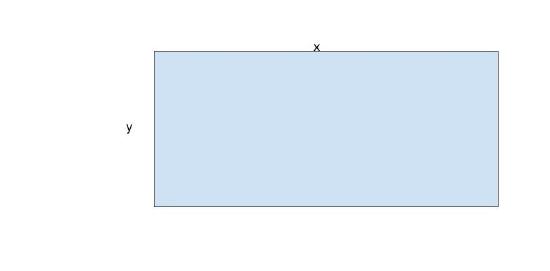
Then the cost to produce the fence is \( 6000= 6x+4y\). Thus \(3000=3x+2y\).
We need to maximize the area \(A = xy \).
Since \( 3000= 3x+2y\), \(y=\dfrac{3000-3x}{2}\).
Therefore \( A(x)=x \left(\dfrac{3000-3x}{2} \right)\). Further \(x \in [0,1000]\).
Since the domain is closed and bounded, we will compare the functional values between the endpoints and the critical points.
Critical points:
Since \( A=x \left(\dfrac{3000-3x}{2}\right)=\dfrac{3000x-3x^2}{2}\), \( A'=\dfrac{3000-6x}{2}\). Therefore \(x= 500\).
x A(x) 0 0 500 (500)(750) 1000 0 We earlier set \(y = \dfrac{3000-3x}{2}\); thus \(y = 750\). Thus, our rectangle will have two sides of length 500 and one side of length 750, with a total area of 375000 ft\(^2\).
Exercise \(\PageIndex{2}\): derivatives
Find the derivative \(\displaystyle{\frac{dy}{dx}}\) of the following functions/relations:
- \(y(x)=\displaystyle \frac{ln(x^2+1)}{x^2}\). Note that \(y(x)\) is \(y\) as a function of \(x\).
- \(\displaystyle{y=\sin^{-1}(x^3)}\).
- \(x^2y+xy+y^2=1\)
- \(y(x)= x^{\sin x}\)
- Answer
-
\( \displaystyle\frac{2}{x^2+x} -\displaystyle \frac{2 \ln(x^2+1)}{x^3}, \displaystyle\frac{3x^2}{\sqrt{1-x^6}}, \displaystyle\frac{-(2xy+y)}{x^2+x+2y}, x^{\sin x-1}(\sin(x)+x \ln(x) \cos(x))\).
- Solution:
-
1. \(\displaystyle \frac{dy}{dx}=\displaystyle \frac{\displaystyle \frac{(x^2)(2x)}{x^2+1}-(2x)ln(x^2+1) }{x^4},\) by quotient rule,
\(= \displaystyle \frac{2}{x(x^2+1)}-\displaystyle \frac{2ln(x^2+1)}{x^3},\)
\(= \displaystyle\frac{2}{x^3+x}- \displaystyle \frac{2 \ln(x^2+1)}{x^3}.\)
2, \(\displaystyle \frac{dy}{dx}=\displaystyle \frac {1} {\sqrt{(1-(x^3)^2)}} \frac{d}{dx} (x^3)= \displaystyle\frac{3x^2}{\sqrt{1-x^6}}\).
4. Let \(y=x^{\sin x}\).
Then \( ln(y)= ln \left(x^{\sin x} \right)\).
Which implies, \( ln(y)= \sin(x) ln \left(x\right)\).
Differentiate with respect to \(x\) both sides,
\( \displaystyle \frac{1}{y} \displaystyle \frac{dy}{dx}= \cos(x) \ln(x)+ \sin(x) \displaystyle \frac{1}{x}\),
\( \displaystyle \frac{dy}{dx}= y\left(\cos(x) \ln(x)+ \sin(x) \displaystyle \frac{1}{x} \right)\),
\( \displaystyle \frac{dy}{dx}= x^{\sin x}\left(\cos(x) \ln(x)+ \sin(x) \displaystyle \frac{1}{x} \right)\), Hence the result.
Exercise \(\PageIndex{3}\): Related rates
A spherical balloon is being inflated at a rate of \(2 m^3/min.\) Find how fast the surface area of the balloon is increasing when \(r=5m.\)
(The surface area of the sphere is \(4\pi r^2\) and the volume \(v=\displaystyle \frac{4}{3} \pi r^3,\) where \(r\) is the radius of the sphere.)
- Answer
-
\(\displaystyle\frac{4}{5} m^2/min\).
- Solution
-

Let \(r, S\) and \(V\) be radius, surface area and volume of the sphere at time \(t.\)
Given:
\(
\frac{dV}{dt} = 2 \, \text{m}^3/\text{min}
\)Question:
\(
\left. \frac{dS}{dt} \right|_{r = 5 \, \text{m}}
\)The volume \( V \) of a sphere is given by:
\(
V = \frac{4}{3} \pi r^3
\)The surface area \( S \) of a sphere is given by:
\(
S = 4 \pi r^2
\)The rate of change of volume with respect to time is given as:
\(
\frac{dV}{dt} = \left( \frac{4}{3} \pi \right) \left( 3r^2 \right) \frac{dr}{dt}
\)Given \( \frac{dV}{dt} = 2 \, \text{m}^3/\text{min} \), we have:
\(
2 = \left( \frac{4}{3} \pi \right) \left( 3r^2 \right) \frac{dr}{dt}
\)Solving for \( \frac{dr}{dt} \):
\(
\frac{dr}{dt} = \frac{2}{4 \pi r^2}=\frac{1}{2 \pi r^2}
\)Now, for the surface area:
\(
\frac{dS}{dt} = \left( 4 \pi \right) \left( 2r \right) \frac{dr}{dt}
\)Substitute \( \frac{dr}{dt} = \frac{1}{2 \pi r^2} \):
\(
\frac{dS}{dt} = \left( 4 \pi \right) \left( 2r \right) \left( \frac{1}{2 \pi r^2} \right)
\)Simplifying:
\(
\frac{dS}{dt} = \frac{4}{r}
\)Finally, evaluate at \( r = 5 \, \text{m} \):
\(
\left. \frac{dS}{dt} \right|_{r=5} = \frac{4}{5} \, \text{m}^2/\text{min}
\)Hence, the surface area of the balloon is increasing at a rate of \(\frac{4}{5} \, \text{m}^2/\text{min}\) when \(r=5m.\)
-
Exercise \(\PageIndex{4}\):
Consider the function \(f(x)=x^5 - 5x^4\).
- Find the intervals on which \(f\) is increasing.
- Find the intervals on which \(f\) is decreasing.
- Find the value of the relative minima(s)( if any) of the function.
- Find the value of the relative maxima(s)( if any) of the function.
- Find the open intervals on which \(f\) is concave up.
- Find the open intervals on which \(f\) is concave down.
- Find the \(x-\) coordinates of all inflection points.
- Answer
-
\((-\infty, 0)\cup (4, \infty), (0,4), x=4, x=0,(3,\infty), (-\infty,3). x=3\)
- Solution
-
\(f'(x) = \frac{d}{dx}(x^5 - 5x^4) = 5x^4 - 20x^3 = 5x^3(x-4)\)
Critical Points:
Set \(f'(x) = 0\): \(5x^3(x-4) = 0 \implies x = 0 \text{ or } x = 4.\)To determine intervals of increase/decrease: (You may use test points to decide the sign in each interval.)
\((-\infty,0)\) \((0,4)\) \((4,\infty)\) \(x^3\) \(-\) \(+\) \(+\) \((x-4)\) \(-\) \(-\) \(+\) Sign of \(f'\) \(+\) \(-\) \(+\) -
Hence, \(f\)
1. is increasing on \( (-\infty,0) \cup (4,\infty).\)
2. is decreasing on \((0,4)\).
3. has a a local maximum of \(0\) at \(x=0\).
4. has a a local miniimum of \(-256\) at \(x=4\).
For Concavity: Second Derivative
\(f''(x) = \frac{d}{dx}(5x^4 - 20x^3) = 20x^3 - 60x^2 = 20x^2(x-3)\).Now, \(f''(x) = 0\):
\(20x^2(x-3) = 0 \implies x = 0 \text{ or } x = 3\).(You may use test points to decide the sign in each interval.)
\((-infty,0)\) \((0,3)\) \((3, \infty)\) \(x^2\) \(+) \(+\) \(+\) \((x-3)\) \(-\) \(-\) \(+\) Sign of \(f''\) \(-\) \(-\) \(+\) Hence, \(f\) is concave down on \((-\infty, 3)\), concave up on \((3,\infty)\), and the \(x-\) coordinates of all inflection point is \(x=3\).
Verify that the hypotheses of the Mean Value Theorem are satisfied on the given interval and find all values of \(c\) in that interval that satisfy the conclusion of the theorem for \(f(x) = x^2-x \) on \([-3,5].\)
- Answer
-
\(c=1\)
- Solution:
-
Since \(f \) is a polynomial, it is continuous and differentiable everywhere. Therefore, \(f\) satisfies the hypotheses of the Mean Value Theorem, and there must exist at least one value \( c∈(-3,5) \) such that \(f'(c)\) is equal to the slope of the secant line connecting \((-3,f(-3))\) and \((5,f(5)). \)
To determine which value(s) of \(c\) are guaranteed, first calculate the derivative of \(f\). The derivative \(f′(x)= 2x-1\). The slope of the line connecting \((-3,f(-3))\) and \((5,f(5))\) is given by
\[\frac{f(5)−f(-3)}{5+3}=\frac{20−12}{8}=\frac{8}{8}=1.\]
We want to find \(c\) such that \(f′(c)=1\). That is, we want to find \(c\) such that
\[2c-1=1\]
Solving this equation for \(c\), we obtain \(c=1\).
Find the following limits:
- \(\displaystyle \lim_{x→0^+}x^2lnx\)
- \( \displaystyle \lim_{x→\pi}\dfrac{1+cosx}{sinx}\)
- \(\displaystyle \lim_{x\rightarrow 0 }\left(e^x + x\right)^{1/x}.\)
- Answer
-
\(0,0, e^2\)
- Solution
-
1. Since, \(\displaystyle \lim_{x→0^+}x^2lnx =(0)(-\infty), \) we rewrite the expression:
\(
x^2 \ln x = \frac{\ln x}{x^{-2}}.
\) As \(x \to 0^+\): \(\ln x \to -\infty,\) and \(x^{-2} \to +\infty,\), so we get the indeterminate form \(\dfrac{-\infty }{ \infty}\). Now, we can use L'Hopital's Rule.Differentiate top and bottom:
\(
\frac{d}{dx}(\ln x) = \frac{1}{x},
\qquad
\frac{d}{dx}(x^{-2}) = -2x^{-3}.
\)Apply L'Hopital:
\(\displaystyle
\lim_{x \to 0^+} \frac{\ln x}{x^{-2}}
= \displaystyle
\lim_{x \to 0^+}
\frac{\frac{1}{x}}{-2x^{-3}}
=\displaystyle
\lim_{x \to 0^+}
\frac{x^{-1}}{-2x^{-3}}=\displaystyle
\lim_{x \to 0^+} \frac{x^{-1}}{-2} x^{3}
= \lim_{x \to 0^+}
-\frac{1}{2} x^{2}.
= 0.
\)2. Since \( \displaystyle \lim_{x→π}\dfrac{1+cosx}{sinx}= \left[ \dfrac{0}{0}\right],\) by L'Hopital's Rule, \( \displaystyle \lim_{x→π}\frac{1+cosx}{sinx}= \displaystyle \lim_{x→\pi }\dfrac{-sin(x)}{cos(x)}= 0.\)
3. Let \(y = \left(e^x + x\right)^{1/x}.\) Then \(ln(y)= ln \left(\left(e^x + x\right)^{1/x}\right)= \dfrac{\ln(e^x + x)}{x}.\) Now,
\(\displaystyle lim_{x\rightarrow 0 }ln(y)= \displaystyle \lim_{x\rightarrow 0 }\dfrac{\ln(e^x + x)}{x}=\left[ \dfrac{0}{0}\right].\) By L'Hopital's Rule, \(\displaystyle lim_{x\rightarrow 0 }ln(y)= \displaystyle \lim_{x\rightarrow 0 }\dfrac{\left(\dfrac{e^x + 1}{\,e^x + x\,}\right)}{1}=\dfrac{1+1}{1+0}=2.\) Hence \(\displaystyle \lim_{x\rightarrow 0 }\left(e^x + x\right)^{1/x}=e^2.\)