

4.2: Algebraic Skills
- Page ID
- 203052

\( \newcommand{\vecs}[1]{\overset { \scriptstyle \rightharpoonup} {\mathbf{#1}} } \)
\( \newcommand{\vecd}[1]{\overset{-\!-\!\rightharpoonup}{\vphantom{a}\smash {#1}}} \)
\( \newcommand{\dsum}{\displaystyle\sum\limits} \)
\( \newcommand{\dint}{\displaystyle\int\limits} \)
\( \newcommand{\dlim}{\displaystyle\lim\limits} \)
\( \newcommand{\id}{\mathrm{id}}\) \( \newcommand{\Span}{\mathrm{span}}\)
( \newcommand{\kernel}{\mathrm{null}\,}\) \( \newcommand{\range}{\mathrm{range}\,}\)
\( \newcommand{\RealPart}{\mathrm{Re}}\) \( \newcommand{\ImaginaryPart}{\mathrm{Im}}\)
\( \newcommand{\Argument}{\mathrm{Arg}}\) \( \newcommand{\norm}[1]{\| #1 \|}\)
\( \newcommand{\inner}[2]{\langle #1, #2 \rangle}\)
\( \newcommand{\Span}{\mathrm{span}}\)
\( \newcommand{\id}{\mathrm{id}}\)
\( \newcommand{\Span}{\mathrm{span}}\)
\( \newcommand{\kernel}{\mathrm{null}\,}\)
\( \newcommand{\range}{\mathrm{range}\,}\)
\( \newcommand{\RealPart}{\mathrm{Re}}\)
\( \newcommand{\ImaginaryPart}{\mathrm{Im}}\)
\( \newcommand{\Argument}{\mathrm{Arg}}\)
\( \newcommand{\norm}[1]{\| #1 \|}\)
\( \newcommand{\inner}[2]{\langle #1, #2 \rangle}\)
\( \newcommand{\Span}{\mathrm{span}}\) \( \newcommand{\AA}{\unicode[.8,0]{x212B}}\)
\( \newcommand{\vectorA}[1]{\vec{#1}} % arrow\)
\( \newcommand{\vectorAt}[1]{\vec{\text{#1}}} % arrow\)
\( \newcommand{\vectorB}[1]{\overset { \scriptstyle \rightharpoonup} {\mathbf{#1}} } \)
\( \newcommand{\vectorC}[1]{\textbf{#1}} \)
\( \newcommand{\vectorD}[1]{\overrightarrow{#1}} \)
\( \newcommand{\vectorDt}[1]{\overrightarrow{\text{#1}}} \)
\( \newcommand{\vectE}[1]{\overset{-\!-\!\rightharpoonup}{\vphantom{a}\smash{\mathbf {#1}}}} \)
\( \newcommand{\vecs}[1]{\overset { \scriptstyle \rightharpoonup} {\mathbf{#1}} } \)
\(\newcommand{\longvect}{\overrightarrow}\)
\( \newcommand{\vecd}[1]{\overset{-\!-\!\rightharpoonup}{\vphantom{a}\smash {#1}}} \)
\(\newcommand{\ket}[1]{\left| #1 \right>}\)
\(\newcommand{\bra}[1]{\left< #1 \right|}\)
\(\newcommand{\braket}[2]{\left< #1 \vphantom{#2} \right| \left. #2 \vphantom{#1} \right>}\)
\(\newcommand{\braopket}[3]{\left< #1 \vphantom{#2}\vphantom{#3} \right| #2 \vphantom{#1}\vphantom{#3} \left| #3 \vphantom{#1}\vphantom{#2} \right>}\)
\(\newcommand{\qmvec}[1]{\mathbf{\vec{#1}}}\)
\(\newcommand{\op}[1]{\hat{\mathbf{#1}}}\)
\(\newcommand{\expect}[1]{\langle #1 \rangle}\)
\(\newcommand{\dfn}[1]{\emph{\textbf{#1}}}\)
Identify and Combining Like Terms
Algebraic expressions are made up of terms. A term is a constant, or the product of a constant and one or more variables.
A term is a constant or the product of a constant and one or more variables.
Examples of terms are \(7,\,y,\,5x^2,\,9a,\) and \(b^5\).
The constant that multiplies the variable is called the coefficient.
The coefficient of a term is the constant that multiplies the variable in a term.
Think of the coefficient as the number in front of the variable. The coefficient of the term \(3x\) is 3. When we write \(x\), the coefficient is 1, since \(x=1⋅x\).
Some terms share common traits. When two terms are constants or have the same variable and exponent, we say they are like terms.
Discussion:
Look at the following 6 terms. Which ones seem to have traits in common?
\[5x \quad 7 \quad n^2 \quad 4 \quad 3x \quad 9n^2\]
We say,
\(7\) and \(4\) are like terms.
\(5x\) and \(3x\) are like terms.
\(n^2\) and \(9n^2\) are like terms.
Terms that are either constants or have the same variables raised to the same powers are called like terms.
If there are like terms in an expression, you can simplify the expression by combining the like terms. We add the coefficients and keep the same variable.
\[\begin{array}{lc} \text{Simplify.} & 4x+7x+x \\ \text{Add the coefficients.} & 12x \end{array}\]
Simplify: \(2x^2+3x+7+x^2+4x+5\).
Solution
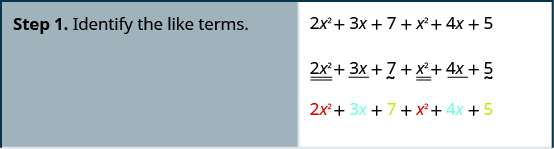
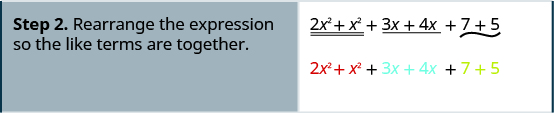

To combine like terms, you may follow the following steps:
- Identify the like terms.
- Rearrange the expression so the like terms are together.
- Add or subtract the coefficients and keep the same variable for each group of like terms.
Talking Mathematics: Words and Algebraic Expressions
When you have the mathematical expression \(a+b\), you can read and interpret the sum in different ways. For example, \(a\) plus \(b\), the sum of \(a\) and \(b\), \(a\) increased by \(b\), \(b\) more than \(a\), the total of \(a\) and \(b\), or \(b\) added to \(a\). The following table provides support on how to read different expressions, including addition, subtraction, multiplication, and division.
| Operation | In Words | Algebraic Expression |
|---|---|---|
| Addition | \(a\) plus \(b\) the sum of \(a\) and \(b\) \(a\) increased by \(b\) \(b\) more than \(a\) the total of \(a\) and \(b\) \(b\) added to \(a\) |
\(a+b\) |
| Subtraction | \(a\) minus \(b\) the difference of \(a\) and \(b\) \(a\) decreased by \(b\) \(b\) less than \(a\) \(b\) subtracted from \(a\) |
\(a−b\) |
| Multiplication | \(a\) times \(b\) the product of \(a\) and \(b\) twice \(a\) |
\(a·b,\,ab,\,a(b),\,(a)(b)\) \(2a\) |
| Division |
\(a\) divided by \(b\) the quotient of \(a\) and \(b\) the ratio of \(a\) and \(b\) \(b\) divided into \(a\) |
\(a÷b,\,a/b,\,\frac{a}{b},\,b \overline{\smash{)}a}\) |
Evaluate an Expression
In the last few examples, we simplified expressions using the order of operations. Now we’ll evaluate some expressions—again following the order of operations. To evaluate an expression means to find the value of the expression when the variable is replaced by a given number.
To evaluate an expression means to find the value of the expression when the variable is replaced by a given number.
To evaluate an expression, substitute that number for the variable in the expression and then simplify the expression.
Evaluate when \(x=4\): a. \(x^2\) b. \(3^x\) c. \(2x^2+3x+8\).
- Answer
-
a.
b.


Use definition of exponent. 
Simplify. 
c.


Use definition of exponent. 
Simplify. 



Follow the order of operations. .jpg?revision=1&size=bestfit&width=117&height=16)


Evaluate when \(x=3\), a. \(x^2\) b. \(4^x\) c. \(3x^2+4x+1\).
- Answer
-
a. 9
b. 64
c. 40
Evaluate when \(x=6\), a. \(x^3\) b. \(2^x\) c. \(6x^2−4x−7\).
- Answer
-
a. 216
b. 64
c. 185