

3.5: Piecewise-defined functions
- Page ID
- 238565

\( \newcommand{\vecs}[1]{\overset { \scriptstyle \rightharpoonup} {\mathbf{#1}} } \)
\( \newcommand{\vecd}[1]{\overset{-\!-\!\rightharpoonup}{\vphantom{a}\smash {#1}}} \)
\( \newcommand{\dsum}{\displaystyle\sum\limits} \)
\( \newcommand{\dint}{\displaystyle\int\limits} \)
\( \newcommand{\dlim}{\displaystyle\lim\limits} \)
\( \newcommand{\id}{\mathrm{id}}\) \( \newcommand{\Span}{\mathrm{span}}\)
( \newcommand{\kernel}{\mathrm{null}\,}\) \( \newcommand{\range}{\mathrm{range}\,}\)
\( \newcommand{\RealPart}{\mathrm{Re}}\) \( \newcommand{\ImaginaryPart}{\mathrm{Im}}\)
\( \newcommand{\Argument}{\mathrm{Arg}}\) \( \newcommand{\norm}[1]{\| #1 \|}\)
\( \newcommand{\inner}[2]{\langle #1, #2 \rangle}\)
\( \newcommand{\Span}{\mathrm{span}}\)
\( \newcommand{\id}{\mathrm{id}}\)
\( \newcommand{\Span}{\mathrm{span}}\)
\( \newcommand{\kernel}{\mathrm{null}\,}\)
\( \newcommand{\range}{\mathrm{range}\,}\)
\( \newcommand{\RealPart}{\mathrm{Re}}\)
\( \newcommand{\ImaginaryPart}{\mathrm{Im}}\)
\( \newcommand{\Argument}{\mathrm{Arg}}\)
\( \newcommand{\norm}[1]{\| #1 \|}\)
\( \newcommand{\inner}[2]{\langle #1, #2 \rangle}\)
\( \newcommand{\Span}{\mathrm{span}}\) \( \newcommand{\AA}{\unicode[.8,0]{x212B}}\)
\( \newcommand{\vectorA}[1]{\vec{#1}} % arrow\)
\( \newcommand{\vectorAt}[1]{\vec{\text{#1}}} % arrow\)
\( \newcommand{\vectorB}[1]{\overset { \scriptstyle \rightharpoonup} {\mathbf{#1}} } \)
\( \newcommand{\vectorC}[1]{\textbf{#1}} \)
\( \newcommand{\vectorD}[1]{\overrightarrow{#1}} \)
\( \newcommand{\vectorDt}[1]{\overrightarrow{\text{#1}}} \)
\( \newcommand{\vectE}[1]{\overset{-\!-\!\rightharpoonup}{\vphantom{a}\smash{\mathbf {#1}}}} \)
\( \newcommand{\vecs}[1]{\overset { \scriptstyle \rightharpoonup} {\mathbf{#1}} } \)
\(\newcommand{\longvect}{\overrightarrow}\)
\( \newcommand{\vecd}[1]{\overset{-\!-\!\rightharpoonup}{\vphantom{a}\smash {#1}}} \)
\(\newcommand{\ket}[1]{\left| #1 \right>}\)
\(\newcommand{\bra}[1]{\left< #1 \right|}\)
\(\newcommand{\braket}[2]{\left< #1 \vphantom{#2} \right| \left. #2 \vphantom{#1} \right>}\)
\(\newcommand{\braopket}[3]{\left< #1 \vphantom{#2}\vphantom{#3} \right| #2 \vphantom{#1}\vphantom{#3} \left| #3 \vphantom{#1}\vphantom{#2} \right>}\)
\(\newcommand{\qmvec}[1]{\mathbf{\vec{#1}}}\)
\(\newcommand{\op}[1]{\hat{\mathbf{#1}}}\)
\(\newcommand{\expect}[1]{\langle #1 \rangle}\)
\(\newcommand{\dfn}[1]{\emph{\textbf{#1}}}\)
1. A floor-refinishing company charges \(\$ 1.83\) per square foot to strip and refinish a tile floor for up to 1000 square feet. There is an additional charge of \$350 for toxic waste disposal for any job that includes more than 150 square feet of tile.
- Express the cost, \(y\), of refinishing a floor as a piecewise-defined function of the number of square feet, \(x\), to be refinished.
- Sketch a graph of the function. Give the domain and range.
2. The Ironman Triathlon is a race that consists of three parts: a 2.4-mile swim followed by a 112-mile bike race and then a 26.2 -mile marathon. A participant swims steadily at 2mph, cycles steadily at 20 mph, and then runs steadily at 9mph. Assuming that no time is lost during the transition from one stage to the next, write a piecewise-defined formula for the distance covered, \(d\), in miles, as a function of the elapsed time \(t\) in hours, from the beginning of the race. Draw a graph of the function.
3. Draw a graph of
\[f(x)= \begin{cases}x+1 & \text { for }-2 \leq x<0 \\ x-1 & \text { for } 0 \leq x<2 \\ x-3 & \text { for } 2 \leq x<4\end{cases} \notag\]
4. Write formulas for each of the following functions.
a.
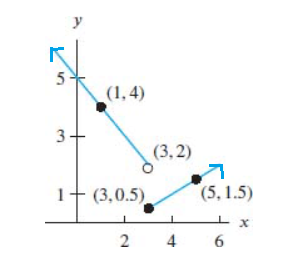
b.
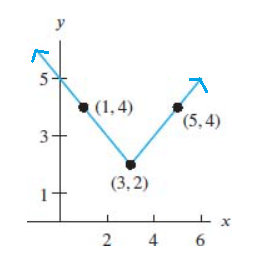
5. The function \(f\) is given by
\[f(x)= \begin{cases}3 x & \text { for }-1 \leq x \leq 1 \\ -x+4 & \text { for } 1<x \leq 5\end{cases} \notag\]
Use it to answer the following questions.
- Find \(f(0)\) and \(f(3)\).
- Find the domain and range of \(f(x)\).
- Sketch a graph of \(f(x)\) using Desmos.
6. Let \(f(x)=10|x-5|\).
- What are the domain and range of \(f(x)\) ?
- Find all values of \(x\) such that \(f(x)=20\).
7. Let \(f(x)=6|x+5|-7\)
- What are the domain and range of \(f(x)\) ?
- Find all values of \(x\) such that \(f(x)=11\).
8. Given that \(f(x)=\left|x^2-4\right|\), use the definition of absolute value to write a piecewise formula for \(f\). Sketch a graph of \(f\).