Mathematics LibreTexts

1.4.1: Exercises

  • Page ID
    214356
  • \( \newcommand{\vecs}[1]{\overset { \scriptstyle \rightharpoonup} {\mathbf{#1}} } \)

    \( \newcommand{\vecd}[1]{\overset{-\!-\!\rightharpoonup}{\vphantom{a}\smash {#1}}} \)

    \( \newcommand{\dsum}{\displaystyle\sum\limits} \)

    \( \newcommand{\dint}{\displaystyle\int\limits} \)

    \( \newcommand{\dlim}{\displaystyle\lim\limits} \)

    \( \newcommand{\id}{\mathrm{id}}\) \( \newcommand{\Span}{\mathrm{span}}\)

    ( \newcommand{\kernel}{\mathrm{null}\,}\) \( \newcommand{\range}{\mathrm{range}\,}\)

    \( \newcommand{\RealPart}{\mathrm{Re}}\) \( \newcommand{\ImaginaryPart}{\mathrm{Im}}\)

    \( \newcommand{\Argument}{\mathrm{Arg}}\) \( \newcommand{\norm}[1]{\| #1 \|}\)

    \( \newcommand{\inner}[2]{\langle #1, #2 \rangle}\)

    \( \newcommand{\Span}{\mathrm{span}}\)

    \( \newcommand{\id}{\mathrm{id}}\)

    \( \newcommand{\Span}{\mathrm{span}}\)

    \( \newcommand{\kernel}{\mathrm{null}\,}\)

    \( \newcommand{\range}{\mathrm{range}\,}\)

    \( \newcommand{\RealPart}{\mathrm{Re}}\)

    \( \newcommand{\ImaginaryPart}{\mathrm{Im}}\)

    \( \newcommand{\Argument}{\mathrm{Arg}}\)

    \( \newcommand{\norm}[1]{\| #1 \|}\)

    \( \newcommand{\inner}[2]{\langle #1, #2 \rangle}\)

    \( \newcommand{\Span}{\mathrm{span}}\) \( \newcommand{\AA}{\unicode[.8,0]{x212B}}\)

    \( \newcommand{\vectorA}[1]{\vec{#1}}      % arrow\)

    \( \newcommand{\vectorAt}[1]{\vec{\text{#1}}}      % arrow\)

    \( \newcommand{\vectorB}[1]{\overset { \scriptstyle \rightharpoonup} {\mathbf{#1}} } \)

    \( \newcommand{\vectorC}[1]{\textbf{#1}} \)

    \( \newcommand{\vectorD}[1]{\overrightarrow{#1}} \)

    \( \newcommand{\vectorDt}[1]{\overrightarrow{\text{#1}}} \)

    \( \newcommand{\vectE}[1]{\overset{-\!-\!\rightharpoonup}{\vphantom{a}\smash{\mathbf {#1}}}} \)

    \( \newcommand{\vecs}[1]{\overset { \scriptstyle \rightharpoonup} {\mathbf{#1}} } \)

    \(\newcommand{\longvect}{\overrightarrow}\)

    \( \newcommand{\vecd}[1]{\overset{-\!-\!\rightharpoonup}{\vphantom{a}\smash {#1}}} \)

    \(\newcommand{\avec}{\mathbf a}\) \(\newcommand{\bvec}{\mathbf b}\) \(\newcommand{\cvec}{\mathbf c}\) \(\newcommand{\dvec}{\mathbf d}\) \(\newcommand{\dtil}{\widetilde{\mathbf d}}\) \(\newcommand{\evec}{\mathbf e}\) \(\newcommand{\fvec}{\mathbf f}\) \(\newcommand{\nvec}{\mathbf n}\) \(\newcommand{\pvec}{\mathbf p}\) \(\newcommand{\qvec}{\mathbf q}\) \(\newcommand{\svec}{\mathbf s}\) \(\newcommand{\tvec}{\mathbf t}\) \(\newcommand{\uvec}{\mathbf u}\) \(\newcommand{\vvec}{\mathbf v}\) \(\newcommand{\wvec}{\mathbf w}\) \(\newcommand{\xvec}{\mathbf x}\) \(\newcommand{\yvec}{\mathbf y}\) \(\newcommand{\zvec}{\mathbf z}\) \(\newcommand{\rvec}{\mathbf r}\) \(\newcommand{\mvec}{\mathbf m}\) \(\newcommand{\zerovec}{\mathbf 0}\) \(\newcommand{\onevec}{\mathbf 1}\) \(\newcommand{\real}{\mathbb R}\) \(\newcommand{\twovec}[2]{\left[\begin{array}{r}#1 \\ #2 \end{array}\right]}\) \(\newcommand{\ctwovec}[2]{\left[\begin{array}{c}#1 \\ #2 \end{array}\right]}\) \(\newcommand{\threevec}[3]{\left[\begin{array}{r}#1 \\ #2 \\ #3 \end{array}\right]}\) \(\newcommand{\cthreevec}[3]{\left[\begin{array}{c}#1 \\ #2 \\ #3 \end{array}\right]}\) \(\newcommand{\fourvec}[4]{\left[\begin{array}{r}#1 \\ #2 \\ #3 \\ #4 \end{array}\right]}\) \(\newcommand{\cfourvec}[4]{\left[\begin{array}{c}#1 \\ #2 \\ #3 \\ #4 \end{array}\right]}\) \(\newcommand{\fivevec}[5]{\left[\begin{array}{r}#1 \\ #2 \\ #3 \\ #4 \\ #5 \\ \end{array}\right]}\) \(\newcommand{\cfivevec}[5]{\left[\begin{array}{c}#1 \\ #2 \\ #3 \\ #4 \\ #5 \\ \end{array}\right]}\) \(\newcommand{\mattwo}[4]{\left[\begin{array}{rr}#1 \amp #2 \\ #3 \amp #4 \\ \end{array}\right]}\) \(\newcommand{\laspan}[1]{\text{Span}\{#1\}}\) \(\newcommand{\bcal}{\cal B}\) \(\newcommand{\ccal}{\cal C}\) \(\newcommand{\scal}{\cal S}\) \(\newcommand{\wcal}{\cal W}\) \(\newcommand{\ecal}{\cal E}\) \(\newcommand{\coords}[2]{\left\{#1\right\}_{#2}}\) \(\newcommand{\gray}[1]{\color{gray}{#1}}\) \(\newcommand{\lgray}[1]{\color{lightgray}{#1}}\) \(\newcommand{\rank}{\operatorname{rank}}\) \(\newcommand{\row}{\text{Row}}\) \(\newcommand{\col}{\text{Col}}\) \(\renewcommand{\row}{\text{Row}}\) \(\newcommand{\nul}{\text{Nul}}\) \(\newcommand{\var}{\text{Var}}\) \(\newcommand{\corr}{\text{corr}}\) \(\newcommand{\len}[1]{\left|#1\right|}\) \(\newcommand{\bbar}{\overline{\bvec}}\) \(\newcommand{\bhat}{\widehat{\bvec}}\) \(\newcommand{\bperp}{\bvec^\perp}\) \(\newcommand{\xhat}{\widehat{\xvec}}\) \(\newcommand{\vhat}{\widehat{\vvec}}\) \(\newcommand{\uhat}{\widehat{\uvec}}\) \(\newcommand{\what}{\widehat{\wvec}}\) \(\newcommand{\Sighat}{\widehat{\Sigma}}\) \(\newcommand{\lt}{<}\) \(\newcommand{\gt}{>}\) \(\newcommand{\amp}{&}\) \(\definecolor{fillinmathshade}{gray}{0.9}\)

    For the following exercises, interpret each Venn diagram and describe the relationship between the sets, symbolically and in words.

    Exercise \(\PageIndex{1}\)

    A single-set Venn diagram is shaded. Outside the set, it is labeled as 'T equals Team sports.' Outside the Venn diagram, 'U equals Sports' is labeled.

    Exercise \(\PageIndex{2}\)

    A single-set Venn diagram is shaded. Outside the set, it is labeled as 'A equals Apples.' Outside the Venn diagram, 'U equals Fruit' is labeled.

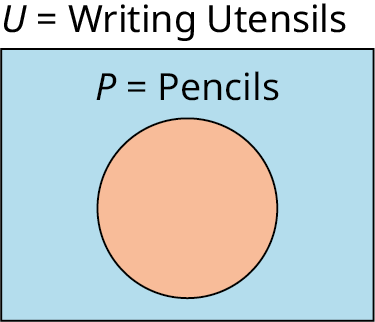
    Exercise \(\PageIndex{3}\)

    A single-set Venn diagram is shaded. Outside the set is labeled 'P equals Pencils.' Outside the Venn diagram, 'U equals Writing Utensils' is labeled.

    Exercise \(\PageIndex{4}\)

    A single-set Venn diagram is labeled 'B equals Board Games'. Outside the Venn diagram, it is labeled as 'U equals Games.'

    Exercise \(\PageIndex{5}\)

    A two-set Venn diagram not intersecting one another is given. Outside the Venn diagram, 'U equals Writing Utensils' is labeled.

    Exercise \(\PageIndex{6}\)

    A two-set Venn diagram not intersecting one another is given. Outside the Venn diagram, 'U equals Fruit' is labeled.

    Exercise \(\PageIndex{7}\)

    A two-set Venn diagram not intersecting one another is given. Outside the Venn diagram, it is labeled as 'U equals Writing Games.' The first set is labeled A equals Card games while the second set is labeled B equals Video Games.

    Exercise \(\PageIndex{8}\)

    A two-set Venn diagram not intersecting one another is given. Outside the Venn diagram, it is labeled as 'U equals Investments.' The first set is labeled A equals Stocks while the second set is labeled B equals Bonds.

    For the following exercises, create a Venn diagram to represent the relationships between the sets.

    Exercise \(\PageIndex{9}\)

    All birds have wings.

    Exercise \(\PageIndex{10}\)

    All cats are animals.

    Exercise \(\PageIndex{11}\)

    All almonds are nuts, and all pecans are nuts, but no almonds are pecans.

    Exercise \(\PageIndex{12}\)

    All rectangles are quadrilaterals, and all trapezoids are quadrilaterals, but no rectangles are trapezoids.

    Exercise \(\PageIndex{13}\)

    Lizards \(\subset\) Reptiles.

    Exercise \(\PageIndex{14}\)

    Ladybugs \(\subset\) Insects.

    Exercise \(\PageIndex{15}\)

    Ladybugs \(\subset\) Insects and Ants \(\subset\) Insects, but no Ants are Ladybugs.

    Exercise \(\PageIndex{16}\)

    Lizards \(\subset\) Reptiles and Snakes \(\subset\) Reptiles, but no Lizards are Snakes.

    Exercise \(\PageIndex{17}\)

    \(A\) and \(B\) are disjoint subsets of \(U\).

    Exercise \(\PageIndex{18}\)

    \(C\) and \(D\) are disjoint subsets of \(U\).

    Exercise \(\PageIndex{19}\)

    \(T\) is a subset of \(U\).

    Exercise \(\PageIndex{20}\)

    \(S\) is a subset of \(U\).

    Exercise \(\PageIndex{21}\)

    \(J=\) Jazz, \(M=\) Music, and \(J \subset M\).

    Exercise \(\PageIndex{22}\)

    \(R=\) Reggae, \(M=\) Music, and \(R \subset M\).

    Exercise \(\PageIndex{23}\)

    \(J=\) Jazz, \(R=\) Reggae, and \(M=\) Music are sets with the following relationships: \(J \subset M, R \subset M\), and \(R\) is disjoint from \(J\).

    Exercise \(\PageIndex{24}\)

    \(J=\) Jazz, \(B=\) Bebop, and \(M=\) Music are sets with the following relationships: \(J \subset M\) and \(B \subset J\).

    For the following exercises, the universal set is the set of single digit numbers, \(U=\{0,1,2,3,4,5,6,7,8,9\}\). Find the complement of each subset of \(U\).

    Exercise \(\PageIndex{25}\)

    \(A=\{6,7,8\}\)

    Exercise \(\PageIndex{26}\)

    \(A=\{0,2,4,6,8\}\)

    Exercise \(\PageIndex{27}\)

    \(A=\{ \}\)

    Exercise \(\PageIndex{28}\)

    \(A=\{0,1,4,6,8,9\}\)

    Exercise \(\PageIndex{29}\)

    \(A=\{0,1,2,3,4,5,6,7,8,9\}\)

    Exercise \(\PageIndex{30}\)

    \(A=\{0,1,3,4,5,6,7,9\}\)

    Exercise \(\PageIndex{31}\)

    \(A=\{1,2,3,4,5,6,7,8,9\}\)

    Exercise \(\PageIndex{32}\)

    \(A=\{0,3,6,9\}\)

    For the following exercises, the universal set is \(U=\) \{Bashful, Doc, Dopey, Grumpy, Happy, Sleepy, Sneezy\}. Find the complement of each subset of \(U\).

    Exercise \(\PageIndex{33}\)

    \(A=\{\) Happy, Bashful, Grumpy\}

    Exercise \(\PageIndex{34}\)

    \(A=\{\) Sleepy, Sneezy \(\}\)

    Exercise \(\PageIndex{35}\)

    \(A=\{\mathrm{Doc}\}\)

    Exercise \(\PageIndex{36}\)

    \(A=\{\) Doc, Dopey \(\}\)

    Exercise \(\PageIndex{37}\)

    \(A=\emptyset\)

    Exercise \(\PageIndex{38}\)

    \(A=\{\) Doc, Grumpy, Happy, Sleepy, Bashful, Sneezy, Dopey\}

    For the following exercises, the universal set is \(U=\mathbb{N}=\{1,2,3, \ldots\}\). Find the complement of each subset of \(U\).

    Exercise \(\PageIndex{39}\)

    \(A=\{1,2,3,4,5\}\)

    Exercise \(\PageIndex{40}\)

    \(A=\{1,3,5, \ldots\}\)

    Exercise \(\PageIndex{41}\)

    \(A=\{1\}\)

    Exercise \(\PageIndex{42}\)

    \(A=\{4,5,6, \ldots\}\)

    For the following exercises, use the Venn diagram to determine the members of the complement of set \(A, A^{\prime}\).

    A single-set Venn diagram is labeled 'A equals (2, 3, 4, 9).' Outside the Venn diagram, the union of the Venn diagram is marked 'U equals (0, 1, 2, 3, 4, 5, 6, 7, 8, 9).'

    Exercise \(\PageIndex{44}\)

    A single-set Venn diagram is labeled 'A equals (2, 3, 4, 9).' Outside the Venn diagram, the union of the Venn diagram is marked 'U equals (0, 1, 2, 3, 4, 5, 6, 7, 8, 9).'

    Exercise \(\PageIndex{45}\)

    A single-set Venn diagram is labeled A equals (n, e, t). Outside the Venn diagram, the union of the Venn diagram is marked 'U equals (l, i, s, t, e, n).'

    Exercise \(\PageIndex{46}\)

    A single-set Venn diagram is labeled 'A equals (l, i, n, e, s).' Outside the Venn diagram, the union of the Venn diagram is marked 'U equals (l, i, s, t, e, n).'


    1.4.1: Exercises is shared under a not declared license and was authored, remixed, and/or curated by LibreTexts.

    • Was this article helpful?