

7.3: Ratios and Proportions
- Page ID
- 186589
\( \newcommand{\vecs}[1]{\overset { \scriptstyle \rightharpoonup} {\mathbf{#1}} } \)
\( \newcommand{\vecd}[1]{\overset{-\!-\!\rightharpoonup}{\vphantom{a}\smash {#1}}} \)
\( \newcommand{\dsum}{\displaystyle\sum\limits} \)
\( \newcommand{\dint}{\displaystyle\int\limits} \)
\( \newcommand{\dlim}{\displaystyle\lim\limits} \)
\( \newcommand{\id}{\mathrm{id}}\) \( \newcommand{\Span}{\mathrm{span}}\)
( \newcommand{\kernel}{\mathrm{null}\,}\) \( \newcommand{\range}{\mathrm{range}\,}\)
\( \newcommand{\RealPart}{\mathrm{Re}}\) \( \newcommand{\ImaginaryPart}{\mathrm{Im}}\)
\( \newcommand{\Argument}{\mathrm{Arg}}\) \( \newcommand{\norm}[1]{\| #1 \|}\)
\( \newcommand{\inner}[2]{\langle #1, #2 \rangle}\)
\( \newcommand{\Span}{\mathrm{span}}\)
\( \newcommand{\id}{\mathrm{id}}\)
\( \newcommand{\Span}{\mathrm{span}}\)
\( \newcommand{\kernel}{\mathrm{null}\,}\)
\( \newcommand{\range}{\mathrm{range}\,}\)
\( \newcommand{\RealPart}{\mathrm{Re}}\)
\( \newcommand{\ImaginaryPart}{\mathrm{Im}}\)
\( \newcommand{\Argument}{\mathrm{Arg}}\)
\( \newcommand{\norm}[1]{\| #1 \|}\)
\( \newcommand{\inner}[2]{\langle #1, #2 \rangle}\)
\( \newcommand{\Span}{\mathrm{span}}\) \( \newcommand{\AA}{\unicode[.8,0]{x212B}}\)
\( \newcommand{\vectorA}[1]{\vec{#1}} % arrow\)
\( \newcommand{\vectorAt}[1]{\vec{\text{#1}}} % arrow\)
\( \newcommand{\vectorB}[1]{\overset { \scriptstyle \rightharpoonup} {\mathbf{#1}} } \)
\( \newcommand{\vectorC}[1]{\textbf{#1}} \)
\( \newcommand{\vectorD}[1]{\overrightarrow{#1}} \)
\( \newcommand{\vectorDt}[1]{\overrightarrow{\text{#1}}} \)
\( \newcommand{\vectE}[1]{\overset{-\!-\!\rightharpoonup}{\vphantom{a}\smash{\mathbf {#1}}}} \)
\( \newcommand{\vecs}[1]{\overset { \scriptstyle \rightharpoonup} {\mathbf{#1}} } \)
\(\newcommand{\longvect}{\overrightarrow}\)
\( \newcommand{\vecd}[1]{\overset{-\!-\!\rightharpoonup}{\vphantom{a}\smash {#1}}} \)
\(\newcommand{\avec}{\mathbf a}\) \(\newcommand{\bvec}{\mathbf b}\) \(\newcommand{\cvec}{\mathbf c}\) \(\newcommand{\dvec}{\mathbf d}\) \(\newcommand{\dtil}{\widetilde{\mathbf d}}\) \(\newcommand{\evec}{\mathbf e}\) \(\newcommand{\fvec}{\mathbf f}\) \(\newcommand{\nvec}{\mathbf n}\) \(\newcommand{\pvec}{\mathbf p}\) \(\newcommand{\qvec}{\mathbf q}\) \(\newcommand{\svec}{\mathbf s}\) \(\newcommand{\tvec}{\mathbf t}\) \(\newcommand{\uvec}{\mathbf u}\) \(\newcommand{\vvec}{\mathbf v}\) \(\newcommand{\wvec}{\mathbf w}\) \(\newcommand{\xvec}{\mathbf x}\) \(\newcommand{\yvec}{\mathbf y}\) \(\newcommand{\zvec}{\mathbf z}\) \(\newcommand{\rvec}{\mathbf r}\) \(\newcommand{\mvec}{\mathbf m}\) \(\newcommand{\zerovec}{\mathbf 0}\) \(\newcommand{\onevec}{\mathbf 1}\) \(\newcommand{\real}{\mathbb R}\) \(\newcommand{\twovec}[2]{\left[\begin{array}{r}#1 \\ #2 \end{array}\right]}\) \(\newcommand{\ctwovec}[2]{\left[\begin{array}{c}#1 \\ #2 \end{array}\right]}\) \(\newcommand{\threevec}[3]{\left[\begin{array}{r}#1 \\ #2 \\ #3 \end{array}\right]}\) \(\newcommand{\cthreevec}[3]{\left[\begin{array}{c}#1 \\ #2 \\ #3 \end{array}\right]}\) \(\newcommand{\fourvec}[4]{\left[\begin{array}{r}#1 \\ #2 \\ #3 \\ #4 \end{array}\right]}\) \(\newcommand{\cfourvec}[4]{\left[\begin{array}{c}#1 \\ #2 \\ #3 \\ #4 \end{array}\right]}\) \(\newcommand{\fivevec}[5]{\left[\begin{array}{r}#1 \\ #2 \\ #3 \\ #4 \\ #5 \\ \end{array}\right]}\) \(\newcommand{\cfivevec}[5]{\left[\begin{array}{c}#1 \\ #2 \\ #3 \\ #4 \\ #5 \\ \end{array}\right]}\) \(\newcommand{\mattwo}[4]{\left[\begin{array}{rr}#1 \amp #2 \\ #3 \amp #4 \\ \end{array}\right]}\) \(\newcommand{\laspan}[1]{\text{Span}\{#1\}}\) \(\newcommand{\bcal}{\cal B}\) \(\newcommand{\ccal}{\cal C}\) \(\newcommand{\scal}{\cal S}\) \(\newcommand{\wcal}{\cal W}\) \(\newcommand{\ecal}{\cal E}\) \(\newcommand{\coords}[2]{\left\{#1\right\}_{#2}}\) \(\newcommand{\gray}[1]{\color{gray}{#1}}\) \(\newcommand{\lgray}[1]{\color{lightgray}{#1}}\) \(\newcommand{\rank}{\operatorname{rank}}\) \(\newcommand{\row}{\text{Row}}\) \(\newcommand{\col}{\text{Col}}\) \(\renewcommand{\row}{\text{Row}}\) \(\newcommand{\nul}{\text{Nul}}\) \(\newcommand{\var}{\text{Var}}\) \(\newcommand{\corr}{\text{corr}}\) \(\newcommand{\len}[1]{\left|#1\right|}\) \(\newcommand{\bbar}{\overline{\bvec}}\) \(\newcommand{\bhat}{\widehat{\bvec}}\) \(\newcommand{\bperp}{\bvec^\perp}\) \(\newcommand{\xhat}{\widehat{\xvec}}\) \(\newcommand{\vhat}{\widehat{\vvec}}\) \(\newcommand{\uhat}{\widehat{\uvec}}\) \(\newcommand{\what}{\widehat{\wvec}}\) \(\newcommand{\Sighat}{\widehat{\Sigma}}\) \(\newcommand{\lt}{<}\) \(\newcommand{\gt}{>}\) \(\newcommand{\amp}{&}\) \(\definecolor{fillinmathshade}{gray}{0.9}\)The formal introduction and detailed study of ratios and proportional reasoning primarily occur later than the early elementary grades, specifically in middle school. However, early mathematics learning plays a crucial foundational role in preparing students for later understanding of ratios (CDE, 2013).
Ratios and proportions are essential concepts in the middle school mathematics curriculum, offering a powerful way to understand relationships between quantities. In everyday life, ratios appear all around us. For instance, a community might have 2 parks for every 5000 residents. In a classroom, the student-to-laptop ratio might be 3 to 2, meaning there are three students for every two laptops available. Further, Learning about ratios and proportions develops relational reasoning and thinking, the ability to compare two quantities and recognize invariant relationships. This form of mathematical thinking is foundational for advanced topics like rates of change, which are central to calculus.
Ratios
A ratio is a comparison of two quantities using division. Some ratios show a part-to-part relationship. For example, the ratio of left-handed students to right-handed students in a class could be 1 to 4. Other ratios represent part-to-whole or whole-to-part relationships. If there are 10 students who have dogs in the class of 25, then the ratio of students who have a dog (part) to all students (whole) is 10 to 25. Conversely, the ratio of all students (whole) to those who have a dog (part) would be 25 to 10. We will also see that this ratio can be stated as 2 to 5 or 5 to 2.
A ratio is the quotient of two numerical quantities or two quantities with the same physical units written as an ordered pair of numbers.
There are a number of equivalent ways of expressing ratios, three of which we will use in this text: fraction notation, “to” notation, and “colon” notation.
- 3/4 is a ratio, read as “the ratio of 3 to 4.”
- 3 to 4 is a ratio, read as “the ratio of 3 to 4.”
- 3:4 is a ratio, read as “the ratio of 3 to 4.”
- In general, a/b, a to b, or a:b.
NOTE: Unlike fractions, there are instances of ratios in which b could be zero.
Express each of the following ratios as a fraction reduced to lowest terms: a) 36 to 24, and b) 0.12 : 0.18.
- Answer
-
a) To express the ratio “36 to 24” as a fraction, place 36 over 24 and reduce.
\[ \begin{aligned} \frac{36}{24} = \frac{3 \cdot \textcolor{red}{12}}{2 \cdot \textcolor{red}{12}} ~ & \textcolor{red}{ \text{ Factor.}} \\ = \frac{3 \cdot \cancel{ \textcolor{red}{12}}}{2 \cdot \cancel{ \textcolor{red}{12}}} ~ & \textcolor{red}{ \text{ Cancel common factor.}} \\ = \frac{3}{2} \end{aligned}\nonumber \]
Thus, the ratio 36 to 24 equals 3/2.(b) To express the ratio “0.12:0.18” as a fraction, place 0.12 over 0.18 and reduce.
\[ \begin{aligned} \frac{0.12}{0.18} = \frac{(0.18) \textcolor{red}{(100)}}{(0.18) \textcolor{red}{(100)}} ~ & \textcolor{red}{ \text{ Multiply numerator and denominator by 100.}} \\ = \frac{12}{18} ~ & \textcolor{red}{ \text{ Move each decimal 2 places right.}} \\ = \frac{2 \cdot \textcolor{red}{6}}{3 \cdot \textcolor{red}{6}} ~ & \textcolor{red}{ \text{ Factor.}} \\ = \frac{2 \cdot \cancel{ \textcolor{red}{6}}}{3 \cdot \cancel{ \textcolor{red}{6}}} ~ & \textcolor{red}{ \text{Cancel.}} \\ \frac{2}{3} \end{aligned}\nonumber \]
Thus, the ratio 0.12:0.18 equals 2/3.
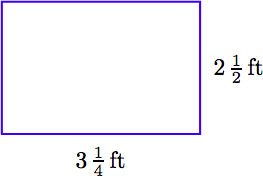
For the rectangle that follows, express the ratio of length to width as a fraction reduced to lowest terms.
- Answer
-
The ratio length to width can be expressed as a fraction and reduced as follows.
\[ \begin{aligned} \frac{ \text{length}}{ \text{width}} = \frac{3 \frac{1}{4} \text{ ft}}{2 \frac{1}{2} \text{ ft}} ~ & \textcolor{red}{ \text{ Length to width as a fraction.}} \\ = \frac{3 \frac{1}{4} \cancel{ \text{ ft}}}{2 \frac{1}{2} \cancel{ \text{ ft}}} ~ & \textcolor{red}{ \text{ Cancel common units.}} \\ = \frac{ \frac{13}{4}}{ \frac{5}{2}} ~ & \textcolor{red}{ \text{ Mixed to improper fractions.}} \end{aligned}\nonumber \]
Invert and multiply, factor, and cancel common factors.
\[ \begin{aligned} = \frac{13}{4} \cdot \frac{2}{5} ~ & \textcolor{red}{ \text{ Invert and multiply.}} \\ = \frac{26}{20} ~ & \textcolor{red}{ \text{ Multiply numerators and denominators.}} \\ = \frac{13 \cdot \textcolor{red}{2}}{10 \cdot \textcolor{red}{2}} ~ & \textcolor{red}{ \text{ Factor numerator and denominator.}} \\ = \frac{13 \cdot \cancel{ \textcolor{red}{2}}}{10 \cdot \cancel{ \textcolor{red}{2}}} ~ & \textcolor{red}{ \text{ Cancel common factors.}} \\ = \frac{13}{10} \end{aligned}\nonumber \]
Hence, the ratio length to width is 13/10.
Rates
We now introduce the concept of rate, a special type of ratio.
A rate is a quotient of two measurements with different units.
An automobile travels 224 miles on 12 gallons of gasoline. Express the ratio distance traveled to gas consumption as a fraction reduced to lowest terms. Write a short sentence explaining the physical significance of your solution. Include units in your description.
- Answer
-
Place miles traveled over gallons of gasoline consumed and reduce.
\[ \begin{aligned} \frac{224 \text{ mi}}{12 \text{ gal}} = \frac{56 \cdot \textcolor{red}{4} \text{ mi}}{3 \cdot \textcolor{red}{4} \text{ gal}} ~ & \textcolor{red}{ \text{ Factor.}} \\ = \frac{56 \cdot \cancel{ \textcolor{red}{4}} \text{ mi}}{3 \cdot \cancel{ \textcolor{red}{4}} \text{ gal}} ~ & \textcolor{red}{ \text{ Cancel common factor.}} \\ = \frac{56 \text{ mi}}{3 \text{ gal}} \end{aligned}\nonumber \]
Thus, the rate is 56 miles to 3 gallons of gasoline. In plain-speak, this means that the automobile travels 56 miles on 3 gallons of gasoline.
Unit Rates
When making comparisons, it is helpful to have a rate in a form where the denominator is 1. Such rates are given a special name.
A unit rate is a rate whose denominator is 1.
a) Herman drives 120 miles in 4 hours. Find his average rate of speed.
b) Aditya works 8.5 hours and receives $95 for his efforts. What is his hourly salary rate?
- Answer
-
a)
Place the distance traveled over the time it takes to drive that distance.
\[ \begin{aligned} \frac{120 \text{ miles}}{4 \text{ hours}} = \frac{30 \text{ miles}}{1 \text{ hour}} ~ & \textcolor{red}{ \text{ Divide: } 120/4 = 30.} \\ = 30 \text{ miles/hour} \end{aligned}\nonumber \]
Hence, Herman’s average rate of speed is 30 miles per hour.
b)
Let’s place money earned over hours worked to get the following rate:
\[ \frac{95 \text{ dollars}}{8.5 \text{ hours}}\nonumber \]
We will get a much better idea of Aditya’s salary rate if we express the rate with a denominator of 1. To do so, divide.
\[ \begin{aligned} \frac{95 \text{ dollars}}{8.5 \text{ hours}} = \frac{11.18 \text{ dollars}}{1 \text{ hour}} ~ & \textcolor{red}{ \text{ Divide: } 95/8.5 \approx 11.18.} \\ = 11.18 \text{ dollars/hour.} \end{aligned}\nonumber \]
That is, his salary rate is 11.18 dollars per hour.
For any proportion of the form where its cross products are equal.
One automobile travels 422 miles on 15 gallons of gasoline. A second automobile travels 354 miles on 13 gallons of gasoline. Which automobile gets the better gas mileage?
- Answer
-
Decimal division (rounded to the nearest tenth) reveals the better gas mileage.
In the case of the first automobile, we get the following rate:
\[ \frac{422 \text{ mi}}{15 \text{gal}}\nonumber \]
In the case of the second autombile, we get the following rate:
\[ \frac{354 \text{ mi}}{13 \text{ gal}}\nonumber \]
In the case of the first automobile, the mileage rate is 28.1 mi/1 gal, which can be read “28.1 miles per gallon.” In the case of the second automobile, the mileage rate is 27.2 mi/1 gal, which can be read “27.2 miles per gallon.” Therefore, the first automobile gets the better gas mileage.
Use the Definition of Proportion
When two ratios or rates are equal, the equation relating them is called a proportion.
A proportion is an equation of the form where
The proportion states two ratios or rates are equal. The proportion is read is to as is to
The equation is a proportion because the two fractions are equal. The proportion is read is to as is to If we compare quantities with units, we have to be sure we are comparing them in the right order.
To determine if a proportion is true, we find the cross products of each proportion. To find the cross products, we multiply each denominator with the opposite numerator (diagonally across the equal sign). The results are called a cross product because of the cross formed. If, and only if, the given proportion is true, that is, the two sides are equal, then the cross products of a proportion will be equal.
Determine whether each relationship is a proportion:
a) 4:9 and 12:28
b) $1.50 for 6 ounces is equivalent to $2.25 for 9 ounces.
- Answer
-
a) To determine if the equation is a proportion, we find the cross products. If they are equal, the equation is a proportion.
28 ⋅ 4 = 112, 9 ⋅ 12 = 108
Since the cross products are not equal, 28 · 4 ≠ 9 · 12 , 28 · 4 ≠ 9 · 12 , the relatiobship is not a proportion.
b) \(\dfrac{$}{ounces}\) = \(\dfrac{$}{ounces}\), \(\dfrac{1.50}{6}\) = \(\dfrac{2.25}{9}\)
9 ⋅ 1.50 = 6 ⋅ 2.25, $1.50 for 6 ounces is equivalent to $2.25 for 9 ounces.
The strategy for solving applications that we have used earlier in this chapter, also works for proportions, since proportions are equations. When we set up the proportion, we must make sure the units are correct—the units in the numerators match and the units in the denominators match.
Josiah went to Mexico for spring break and changed $325 dollars into Mexican pesos. At that time, the exchange rate had $1 U.S. is equal to 12.54 Mexican pesos. How many Mexican pesos did he get for his trip?
Answer
| Identify what you are asked to find. | How many Mexican pesos did Josiah get? |
| Choose a variable to represent it. | Let number of pesos. |
| Write a sentence that gives the information to find it. | If $1 U.S. is equal to 12.54 Mexican pesos, then $325 is how many pesos? |
| Translate into a proportion. | |
| Substitute given values. | |
| The variable is in the denominator, so find the cross products and set them equal. | |
| Simplify. | |
| Check if the answer is reasonable. | |
| Yes, $100 would be $1,254 pesos. $325 is a little more than 3 times this amount. | |
| Write a complete sentence. | Josiah has 4075.5 pesos for his spring break trip. |
In a scale drawing, 0.5 centimeter represents 35 miles.
a. How many miles will 4 centimeters represent?
b. How many centimeters will represent 420 miles?
- Answer
-
a) \(
\frac{0.5}{35} = \frac{4}{x}. \text{ Solving, we obtain } x = \frac{35 \cdot 4}{0.5}, \text{ or } x = 280.
\)b) \(
\frac{0.5}{35} = \frac{y}{420}, \text{ or } \frac{0.5 \times 420}{35} = y. \text{ Therefore, } y = \frac{210}{35} = 6 \text{ centimeters}.
\)NOTE: We could have been solved mentally by using a technique called scaling up/scaling down, that is, by multiplying/dividing each number in a ratio by the same number.
\(
\begin{aligned}
0.5 \text{ centimeter} : 35 \text{ miles} &= 1 \text{ centimeter} : 70 \text{ miles} \\
&= 2 \text{ centimeters} : 140 \text{ miles} \\
&= 4 \text{ centimeters} : 280 \text{ miles}.
\end{aligned}
\)See if you can do part b) using this technique.
Scaling is when one quantity changes in a consistent ratio with another. For fun, they some problems below.
Wonder, Play, Grow
Solve the following problem in as many different ways as possible. Compare and contrast your methods with those of your peers.
Lena has a new smoothie recipe that uses a 117-ounce container of almond milk every 6.5 weeks. If she keeps making smoothies at the same rate, how many ounces of almond milk will she need for a full year?
Advanced Connections
Proportional reasoning prepares you to understand rates of change, such as velocity (change in distance over time) or slope of a function. In calculus, these ideas are formalized with derivatives. For instance, the concept of unit rate — "miles per hour" — becomes the instantaneous rate of change in calculus. Even related rates problems in calculus (e.g., how fast a shadow lengthens as someone walks) are grounded in the ability to set up ratios and proportions between changing quantities. Understanding ratios and proportions isn't just about solving everyday problems — it's about developing the habits of mind that support mathematical modeling and reasoning about change. These skills are foundational as you move toward algebra, functions, and eventually calculus, where the relationships between changing quantities are central.