

1.3: Multiplying and Dividing Whole Numbers
- Page ID
- 137899

\( \newcommand{\vecs}[1]{\overset { \scriptstyle \rightharpoonup} {\mathbf{#1}} } \)
\( \newcommand{\vecd}[1]{\overset{-\!-\!\rightharpoonup}{\vphantom{a}\smash {#1}}} \)
\( \newcommand{\dsum}{\displaystyle\sum\limits} \)
\( \newcommand{\dint}{\displaystyle\int\limits} \)
\( \newcommand{\dlim}{\displaystyle\lim\limits} \)
\( \newcommand{\id}{\mathrm{id}}\) \( \newcommand{\Span}{\mathrm{span}}\)
( \newcommand{\kernel}{\mathrm{null}\,}\) \( \newcommand{\range}{\mathrm{range}\,}\)
\( \newcommand{\RealPart}{\mathrm{Re}}\) \( \newcommand{\ImaginaryPart}{\mathrm{Im}}\)
\( \newcommand{\Argument}{\mathrm{Arg}}\) \( \newcommand{\norm}[1]{\| #1 \|}\)
\( \newcommand{\inner}[2]{\langle #1, #2 \rangle}\)
\( \newcommand{\Span}{\mathrm{span}}\)
\( \newcommand{\id}{\mathrm{id}}\)
\( \newcommand{\Span}{\mathrm{span}}\)
\( \newcommand{\kernel}{\mathrm{null}\,}\)
\( \newcommand{\range}{\mathrm{range}\,}\)
\( \newcommand{\RealPart}{\mathrm{Re}}\)
\( \newcommand{\ImaginaryPart}{\mathrm{Im}}\)
\( \newcommand{\Argument}{\mathrm{Arg}}\)
\( \newcommand{\norm}[1]{\| #1 \|}\)
\( \newcommand{\inner}[2]{\langle #1, #2 \rangle}\)
\( \newcommand{\Span}{\mathrm{span}}\) \( \newcommand{\AA}{\unicode[.8,0]{x212B}}\)
\( \newcommand{\vectorA}[1]{\vec{#1}} % arrow\)
\( \newcommand{\vectorAt}[1]{\vec{\text{#1}}} % arrow\)
\( \newcommand{\vectorB}[1]{\overset { \scriptstyle \rightharpoonup} {\mathbf{#1}} } \)
\( \newcommand{\vectorC}[1]{\textbf{#1}} \)
\( \newcommand{\vectorD}[1]{\overrightarrow{#1}} \)
\( \newcommand{\vectorDt}[1]{\overrightarrow{\text{#1}}} \)
\( \newcommand{\vectE}[1]{\overset{-\!-\!\rightharpoonup}{\vphantom{a}\smash{\mathbf {#1}}}} \)
\( \newcommand{\vecs}[1]{\overset { \scriptstyle \rightharpoonup} {\mathbf{#1}} } \)
\(\newcommand{\longvect}{\overrightarrow}\)
\( \newcommand{\vecd}[1]{\overset{-\!-\!\rightharpoonup}{\vphantom{a}\smash {#1}}} \)
\(\newcommand{\avec}{\mathbf a}\) \(\newcommand{\bvec}{\mathbf b}\) \(\newcommand{\cvec}{\mathbf c}\) \(\newcommand{\dvec}{\mathbf d}\) \(\newcommand{\dtil}{\widetilde{\mathbf d}}\) \(\newcommand{\evec}{\mathbf e}\) \(\newcommand{\fvec}{\mathbf f}\) \(\newcommand{\nvec}{\mathbf n}\) \(\newcommand{\pvec}{\mathbf p}\) \(\newcommand{\qvec}{\mathbf q}\) \(\newcommand{\svec}{\mathbf s}\) \(\newcommand{\tvec}{\mathbf t}\) \(\newcommand{\uvec}{\mathbf u}\) \(\newcommand{\vvec}{\mathbf v}\) \(\newcommand{\wvec}{\mathbf w}\) \(\newcommand{\xvec}{\mathbf x}\) \(\newcommand{\yvec}{\mathbf y}\) \(\newcommand{\zvec}{\mathbf z}\) \(\newcommand{\rvec}{\mathbf r}\) \(\newcommand{\mvec}{\mathbf m}\) \(\newcommand{\zerovec}{\mathbf 0}\) \(\newcommand{\onevec}{\mathbf 1}\) \(\newcommand{\real}{\mathbb R}\) \(\newcommand{\twovec}[2]{\left[\begin{array}{r}#1 \\ #2 \end{array}\right]}\) \(\newcommand{\ctwovec}[2]{\left[\begin{array}{c}#1 \\ #2 \end{array}\right]}\) \(\newcommand{\threevec}[3]{\left[\begin{array}{r}#1 \\ #2 \\ #3 \end{array}\right]}\) \(\newcommand{\cthreevec}[3]{\left[\begin{array}{c}#1 \\ #2 \\ #3 \end{array}\right]}\) \(\newcommand{\fourvec}[4]{\left[\begin{array}{r}#1 \\ #2 \\ #3 \\ #4 \end{array}\right]}\) \(\newcommand{\cfourvec}[4]{\left[\begin{array}{c}#1 \\ #2 \\ #3 \\ #4 \end{array}\right]}\) \(\newcommand{\fivevec}[5]{\left[\begin{array}{r}#1 \\ #2 \\ #3 \\ #4 \\ #5 \\ \end{array}\right]}\) \(\newcommand{\cfivevec}[5]{\left[\begin{array}{c}#1 \\ #2 \\ #3 \\ #4 \\ #5 \\ \end{array}\right]}\) \(\newcommand{\mattwo}[4]{\left[\begin{array}{rr}#1 \amp #2 \\ #3 \amp #4 \\ \end{array}\right]}\) \(\newcommand{\laspan}[1]{\text{Span}\{#1\}}\) \(\newcommand{\bcal}{\cal B}\) \(\newcommand{\ccal}{\cal C}\) \(\newcommand{\scal}{\cal S}\) \(\newcommand{\wcal}{\cal W}\) \(\newcommand{\ecal}{\cal E}\) \(\newcommand{\coords}[2]{\left\{#1\right\}_{#2}}\) \(\newcommand{\gray}[1]{\color{gray}{#1}}\) \(\newcommand{\lgray}[1]{\color{lightgray}{#1}}\) \(\newcommand{\rank}{\operatorname{rank}}\) \(\newcommand{\row}{\text{Row}}\) \(\newcommand{\col}{\text{Col}}\) \(\renewcommand{\row}{\text{Row}}\) \(\newcommand{\nul}{\text{Nul}}\) \(\newcommand{\var}{\text{Var}}\) \(\newcommand{\corr}{\text{corr}}\) \(\newcommand{\len}[1]{\left|#1\right|}\) \(\newcommand{\bbar}{\overline{\bvec}}\) \(\newcommand{\bhat}{\widehat{\bvec}}\) \(\newcommand{\bperp}{\bvec^\perp}\) \(\newcommand{\xhat}{\widehat{\xvec}}\) \(\newcommand{\vhat}{\widehat{\vvec}}\) \(\newcommand{\uhat}{\widehat{\uvec}}\) \(\newcommand{\what}{\widehat{\wvec}}\) \(\newcommand{\Sighat}{\widehat{\Sigma}}\) \(\newcommand{\lt}{<}\) \(\newcommand{\gt}{>}\) \(\newcommand{\amp}{&}\) \(\definecolor{fillinmathshade}{gray}{0.9}\)We begin this section by discussing multiplication of whole numbers. The first order of business is to introduce the various symbols used to indicate multiplication of two whole numbers.
Mathematical symbols that indicate multiplication
| Symbol | Example | |
|---|---|---|
| × | times symbol | 3 × 4 |
| · | dot | 3 · 4 |
| ( ) | parentheses | (3)(4) or 3(4) of (3)4 |
Products and Factors
In the expression \(3 · 4\), the whole numbers 3 and 4 are called the factors and \(3 · 4\) is called the product.
The key to understanding multiplication is held in the following statement.
Multiplication is equivalent to repeated addition.
Suppose, for example, that we would like to evaluate the product \(3 ·4\). Because multiplication is equivalent to repeated addition, \(3 · 4\) is equivalent to adding three fours. That is,
\[ 3 \cdot 4=\underbrace{4+4+4}_{\text { three fours }} \nonumber\]
Thus, \(3 · 4 = 12\). You can visualize the product \(3 · 4\) as the sum of three fours on a number line, as shown in Figure 1.6.

Like addition, the order of the factors does not matter.
\[ 4 \cdot 3=\underbrace{3+3+3+3}_{\text { four threes }} \nonumber\]
Thus, \(4 · 3 = 12\). Consider the visualization of \(4 · 3\) in Figure 1.7.

The evidence in Figure 1.6 and Figure 1.7 show us that multiplication is commutative. That is,
\[3 · 4=4 · 3 \nonumber\]
Commutative Property of Multiplication
If a and b are any whole numbers, then
\[a · b = b · a. \nonumber\]
The Multiplicative Identity
In Figure 1.8(a), note that five ones equals 5; that is, \(5 · 1 = 5\). On the other hand, in Figure 1.8(b), we see that one five equals five; that is, 1 · 5 = 5.
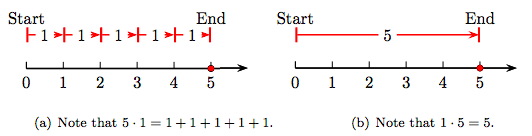
Because multiplying a whole number by 1 equals that identical number, the whole number 1 is called the multiplicative identity.
The Multiplicative Identity Property
If \(a\) is any whole number, then
a · 1 = a and 1 · a = a.
Multiplication by Zero
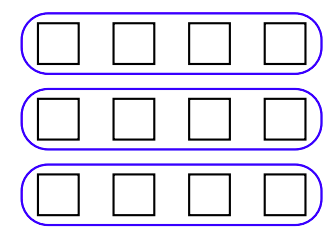
Because \(3 · 4 = 4 + 4 + 4\), we can say that the product \(3 · 4\) represents “3 sets of 4,” as depicted in Figure 1.9, where three groups of four boxes are each enveloped in an oval.
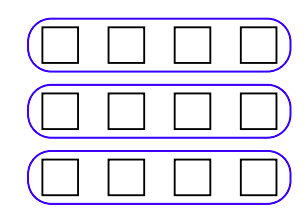
Therefore, \(0 · 4\) would mean zero sets of four. Of course, zero sets of four is zero.
Multiplication by Zero.
If a represents any whole number, then
\(a · 0 = 0\) and \(0 · a = 0\).
The Associative Property of Multiplication
Like addition, multiplication of whole numbers is associative. Indeed,
\[\begin{align*} 2 · (3 · 4) &= 2 · 12 \\[4pt] &= 24 \end{align*}\]
and
\[\begin{align*} (2 · 3) · 4 &=6 · 4 \\[4pt] &= 24. \end{align*}\]
The Associative Property of Multiplication.
If a, b, and c are any whole numbers, then
\[a · (b · c)=(a · b) · c. \nonumber\]
Multiplying Larger Whole Numbers
Much like addition and subtraction of large whole numbers, we will also need to multiply large whole numbers. Again, we hope the algorithm is familiar from previous coursework.
Example 1
Simplify: \(35 · 127\).
Solution
Align the numbers vertically. The order of multiplication does not matter, but we’ll put the larger of the two numbers on top of the smaller number. The first step is to multiply 5 times 127. Again, we proceed from right to left. So, 5 times 7 is 35. We write the 5, then carry the 3 to the tens column. Next, 5 times 2 is 10. Add the carry digit 3 to get 13. Write the 3 and carry the 1 to the hundreds column. Finally, 5 times 1 is 5. Add the carry digit to get 6.
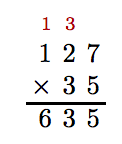
The next step is to multiply 3 times 127. However, because 3 is in the tens place, its value is 30, so we actually multiply 30 times 126. This is the same as multiplying 127 by 3 and placing a 0 at the end of the result.
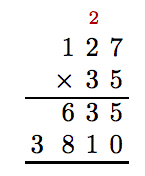
After adding the 0, 3 times 7 is 21. We write the 1 and carry the 2 above the 2 in the tens column. Then, 3 times 2 is 6. Add the carry digit 2 to get 8. Finally, 3 times 1 is 1.
All that is left to do is to add the results.
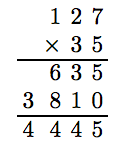
Thus, 35 · 127 = 4, 445.
Alternate Format
It does not hurt to omit the trailing zero in the second step of the multiplication, where we multiply 3 times 127. The result would look like this:
In this format, the zero is understood, so it is not necessary to have it physically present. The idea is that with each multiplication by a new digit, we indent the product one space from the right.
Exercise
Simplify: 56 · 335
- Answer
-
18,760
Division of Whole Numbers
We now turn to the topic of division of whole numbers. We first introduce the various symbols used to indicate division of whole numbers.
Mathematical Symbols that Indicate Division
| Symbol | Example | |
|---|---|---|
| ÷ | division symbol | 12 ÷ 4 |
| - | fraction bar | \(\frac{12}{4}\) |
| \(\longdiv{-}\) | division bar | \(4 \longdiv{12}\) |
Note that each of the following say the same thing; that is, “12 divided by 4 is 3.”
\(12 \div 4=3 \quad \text { or } \quad \frac{12}{4}=3 \quad \text { or } \quad 4 \sqrt{12}\)
Quotients, Dividends, and Divisors
In the statement
\(\frac{3}{4 ) 12}\)
the whole number 12 is called the dividend, the whole number 4 is called the divisor, and the whole number 3 is called the quotient. Note that this division bar notation is equivalent to
\(12 \div 4=3 \quad \text { and } \quad \frac{12}{4}=3.\)
The expression a/b means “a divided by b,” but this construct is also called a fraction.
Definition: Fraction
The expression
\( \frac{a}{b}\)
is called a fraction. The number \(a\) on top is called the numerator of the fraction; the number \(b\) on the bottom is called the denominator of the fraction.
The key to understanding division of whole numbers is contained in the following statement.
Division is equivalent to repeated subtraction.
Suppose for example, that we would like to divide the whole number 12 by the whole number 4. This is equivalent to asking the question “how many fours can we subtract from 12?” This can be visualized in a number line diagram, such as the one in Figure 1.10.

In Figure 1.10, note that we if we subtract three fours from twelve, the result is zero. In symbols,
\( 12-\underbrace{4-4-4}_{\text { three fours }}=0.\)
Equivalently, we can also ask “How many groups of four are there in 12,” and arrange our work as shown in Figure 1.11, where we can see that in an array of twelve objects, we can circle three groups of four ; i.e., 12 ÷ 4 = 3.
In Figure 1.10 and Figure 1.11, note that the division (repeated subtraction) leaves no remainder. This is not always the case.
Example 2.
Divide 7 by 3.
Solution
In Figure 1.12, we can see that we can subtract two threes from seven, leaving a remainder of one.
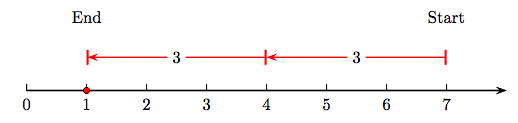
Alternatively, in an array of seven objects, we can circle two groups of three, leaving a remainder of one.
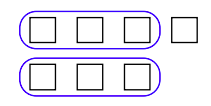
Both Figure 1.12 and Figure1.13 show that there are two groups of three in seven, with one left over. We say “Seven divided by three is two, with a remainder of one.
Exercise
Use both the number line approach and the array of boxes approach to divide 12 by 5.
Division is not Commutative
When dividing whole numbers, the order matters. For example
12 ÷ 4 = 3,
but 4 ÷ 12 is not even a whole number. Thus, if a and b are whole numbers, then a ÷ b does not have to be the same as b ÷ a.
Division is not Associative
When you divide three numbers, the order in which they are grouped will usually affect the answer. For example,
(48 ÷ 8) ÷ 2=6 ÷ 2
= 3,
but
48 ÷ (8 ÷ 2) = 48 ÷ 4
= 12.
Thus, if a, b, and c are whole numbers, (a ÷ b) ÷ c does not have to be the same as a ÷ (b ÷ c).
Division by Zero is Undefined
Suppose that we are asked to divide six by zero; that is, we are asked to calculate 6 ÷ 0. In Figure 1.14, we have an array of six objects.
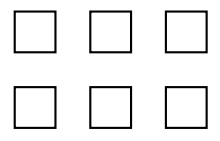
Now, to divide six by zero, we must answer the question “How many groups of zero can we circle in Figure 1.14?” Some thought will provide the answer: This is a meaningless request! It makes absolutely no sense to ask how many groups of zero can be circled in the array of six objects in Figure 1.14.
Division by Zero
Division by zero is undefined. Each of the expressions
\(6 \div 0 \quad \text { and } \quad \frac{6}{0} \quad \text { and } \quad 0 ) \overline{6}\)
is undefined.
On the other hand, it make sense to ask “What is zero divided by six?” If we create an array of zero objects, then ask how many groups of six we can circle, the answer is “zero groups of six.” That is, zero divided by six is zero.
\( 0 \div 6=0 \quad \text { and } \quad \frac{0}{6}=0 \quad \text { and } \quad 6 \frac{0}{0}\)
Dividing Larger Whole Numbers
We’ll now provide a quick review of division of larger whole numbers, using an algorithm that is commonly called long division. This is not meant to be a thorough discussion, but a cursory one. We’re counting on the fact that our readers have encountered this algorithm in previous courses and are familiar with the process.
Example 3
Simplify: 575/23.
Solution
We begin by estimating how many times 23 will divide into 57, guessing 1. We put the 1 in the quotient above the 7, multiply 1 times 23, place the answer underneath 57, then subtract.
\(\begin{array}{c}{23 ) \frac{1}{575}} \\ {\frac{23}{34}}\end{array}\)
Because the remainder is larger than the divisor, our estimate is too small. We try again with an estimate of 2.
\(\begin{array}{r}{2} \\ {2 3 \longdiv { 5 7 5 }} \\ {\frac{46}{11}}\end{array}\)
That’s the algorithm. Divide, multiply, then subtract. You may continue only when the remainder is smaller than the divisor.
To continue, bring down the 5, estimate that 115 divided by 23 is 5, then multiply 5 times the divisor and subtract.
\(\begin{array}{c}{25} \\ {2 3 \longdiv { 5 7 5 }} \\ {\frac{46}{115}} \\ {\frac{115}{0}}\end{array}\)
Because the remainder is zero, 575/23 = 25.
Exercise
Divide 980/35
- Answer
-
28
Exercises
State the property of multiplication depicted by the given identity.
1. 8 · (5 · 6) = (8 · 5) · 6
2. 6 · 2=2 · 6
3. 21 · 1 = 21
Multiply the given numbers.
4. 78 · 3
5. 128 · 30
6. 291 · 47
Simplify the given expression. If the answer doesn’t exist or is undefined, write “undefined”.
7. 0 ÷ 5
8. 24 ÷ 0
Divide the given numbers.
9. \(\frac{8075}{85}\)
10. \(\frac{18048}{32}\)
Answers
1. Associative property of multiplication
2. Commutative property of multiplication
3. Multiplicative identity property
4. 234
5. 3840
6. 13677
7. 0
8. Undefined
9. 95
10. 564