

10.3: Gamma Function
- Page ID
- 8331

\( \newcommand{\vecs}[1]{\overset { \scriptstyle \rightharpoonup} {\mathbf{#1}} } \)
\( \newcommand{\vecd}[1]{\overset{-\!-\!\rightharpoonup}{\vphantom{a}\smash {#1}}} \)
\( \newcommand{\dsum}{\displaystyle\sum\limits} \)
\( \newcommand{\dint}{\displaystyle\int\limits} \)
\( \newcommand{\dlim}{\displaystyle\lim\limits} \)
\( \newcommand{\id}{\mathrm{id}}\) \( \newcommand{\Span}{\mathrm{span}}\)
( \newcommand{\kernel}{\mathrm{null}\,}\) \( \newcommand{\range}{\mathrm{range}\,}\)
\( \newcommand{\RealPart}{\mathrm{Re}}\) \( \newcommand{\ImaginaryPart}{\mathrm{Im}}\)
\( \newcommand{\Argument}{\mathrm{Arg}}\) \( \newcommand{\norm}[1]{\| #1 \|}\)
\( \newcommand{\inner}[2]{\langle #1, #2 \rangle}\)
\( \newcommand{\Span}{\mathrm{span}}\)
\( \newcommand{\id}{\mathrm{id}}\)
\( \newcommand{\Span}{\mathrm{span}}\)
\( \newcommand{\kernel}{\mathrm{null}\,}\)
\( \newcommand{\range}{\mathrm{range}\,}\)
\( \newcommand{\RealPart}{\mathrm{Re}}\)
\( \newcommand{\ImaginaryPart}{\mathrm{Im}}\)
\( \newcommand{\Argument}{\mathrm{Arg}}\)
\( \newcommand{\norm}[1]{\| #1 \|}\)
\( \newcommand{\inner}[2]{\langle #1, #2 \rangle}\)
\( \newcommand{\Span}{\mathrm{span}}\) \( \newcommand{\AA}{\unicode[.8,0]{x212B}}\)
\( \newcommand{\vectorA}[1]{\vec{#1}} % arrow\)
\( \newcommand{\vectorAt}[1]{\vec{\text{#1}}} % arrow\)
\( \newcommand{\vectorB}[1]{\overset { \scriptstyle \rightharpoonup} {\mathbf{#1}} } \)
\( \newcommand{\vectorC}[1]{\textbf{#1}} \)
\( \newcommand{\vectorD}[1]{\overrightarrow{#1}} \)
\( \newcommand{\vectorDt}[1]{\overrightarrow{\text{#1}}} \)
\( \newcommand{\vectE}[1]{\overset{-\!-\!\rightharpoonup}{\vphantom{a}\smash{\mathbf {#1}}}} \)
\( \newcommand{\vecs}[1]{\overset { \scriptstyle \rightharpoonup} {\mathbf{#1}} } \)
\(\newcommand{\longvect}{\overrightarrow}\)
\( \newcommand{\vecd}[1]{\overset{-\!-\!\rightharpoonup}{\vphantom{a}\smash {#1}}} \)
\(\newcommand{\avec}{\mathbf a}\) \(\newcommand{\bvec}{\mathbf b}\) \(\newcommand{\cvec}{\mathbf c}\) \(\newcommand{\dvec}{\mathbf d}\) \(\newcommand{\dtil}{\widetilde{\mathbf d}}\) \(\newcommand{\evec}{\mathbf e}\) \(\newcommand{\fvec}{\mathbf f}\) \(\newcommand{\nvec}{\mathbf n}\) \(\newcommand{\pvec}{\mathbf p}\) \(\newcommand{\qvec}{\mathbf q}\) \(\newcommand{\svec}{\mathbf s}\) \(\newcommand{\tvec}{\mathbf t}\) \(\newcommand{\uvec}{\mathbf u}\) \(\newcommand{\vvec}{\mathbf v}\) \(\newcommand{\wvec}{\mathbf w}\) \(\newcommand{\xvec}{\mathbf x}\) \(\newcommand{\yvec}{\mathbf y}\) \(\newcommand{\zvec}{\mathbf z}\) \(\newcommand{\rvec}{\mathbf r}\) \(\newcommand{\mvec}{\mathbf m}\) \(\newcommand{\zerovec}{\mathbf 0}\) \(\newcommand{\onevec}{\mathbf 1}\) \(\newcommand{\real}{\mathbb R}\) \(\newcommand{\twovec}[2]{\left[\begin{array}{r}#1 \\ #2 \end{array}\right]}\) \(\newcommand{\ctwovec}[2]{\left[\begin{array}{c}#1 \\ #2 \end{array}\right]}\) \(\newcommand{\threevec}[3]{\left[\begin{array}{r}#1 \\ #2 \\ #3 \end{array}\right]}\) \(\newcommand{\cthreevec}[3]{\left[\begin{array}{c}#1 \\ #2 \\ #3 \end{array}\right]}\) \(\newcommand{\fourvec}[4]{\left[\begin{array}{r}#1 \\ #2 \\ #3 \\ #4 \end{array}\right]}\) \(\newcommand{\cfourvec}[4]{\left[\begin{array}{c}#1 \\ #2 \\ #3 \\ #4 \end{array}\right]}\) \(\newcommand{\fivevec}[5]{\left[\begin{array}{r}#1 \\ #2 \\ #3 \\ #4 \\ #5 \\ \end{array}\right]}\) \(\newcommand{\cfivevec}[5]{\left[\begin{array}{c}#1 \\ #2 \\ #3 \\ #4 \\ #5 \\ \end{array}\right]}\) \(\newcommand{\mattwo}[4]{\left[\begin{array}{rr}#1 \amp #2 \\ #3 \amp #4 \\ \end{array}\right]}\) \(\newcommand{\laspan}[1]{\text{Span}\{#1\}}\) \(\newcommand{\bcal}{\cal B}\) \(\newcommand{\ccal}{\cal C}\) \(\newcommand{\scal}{\cal S}\) \(\newcommand{\wcal}{\cal W}\) \(\newcommand{\ecal}{\cal E}\) \(\newcommand{\coords}[2]{\left\{#1\right\}_{#2}}\) \(\newcommand{\gray}[1]{\color{gray}{#1}}\) \(\newcommand{\lgray}[1]{\color{lightgray}{#1}}\) \(\newcommand{\rank}{\operatorname{rank}}\) \(\newcommand{\row}{\text{Row}}\) \(\newcommand{\col}{\text{Col}}\) \(\renewcommand{\row}{\text{Row}}\) \(\newcommand{\nul}{\text{Nul}}\) \(\newcommand{\var}{\text{Var}}\) \(\newcommand{\corr}{\text{corr}}\) \(\newcommand{\len}[1]{\left|#1\right|}\) \(\newcommand{\bbar}{\overline{\bvec}}\) \(\newcommand{\bhat}{\widehat{\bvec}}\) \(\newcommand{\bperp}{\bvec^\perp}\) \(\newcommand{\xhat}{\widehat{\xvec}}\) \(\newcommand{\vhat}{\widehat{\vvec}}\) \(\newcommand{\uhat}{\widehat{\uvec}}\) \(\newcommand{\what}{\widehat{\wvec}}\) \(\newcommand{\Sighat}{\widehat{\Sigma}}\) \(\newcommand{\lt}{<}\) \(\newcommand{\gt}{>}\) \(\newcommand{\amp}{&}\) \(\definecolor{fillinmathshade}{gray}{0.9}\)For \(\nu\) not an integer the recursion relation for the Bessel function generates something very similar to factorials. These quantities are most easily expressed in something called a Gamma-function, defined as
\[\Gamma(\nu) = \int_0^\infty e^{-t}t^{\nu-1} dt,\;\;\;\nu>0. \nonumber \]
Some special properties of \(\Gamma\) function now follow immediately:
\[\begin{aligned} \Gamma(1) & = & \int_0^\infty e^{-t}dt = \left.-e^{-1}\right|^\infty_0 =1-e^{-\infty}=1\nonumber\\ \Gamma(\nu) & = & \int_0^\infty e^{-t} t^{\nu-1} dt = -\int_0^\infty \frac{de^{-t}}{dt} t^{\nu-1} dt\nonumber\\ &=& \left.- e^{-t} t^{\nu-1} \right|^\infty_0 +(\nu-1) \int_0^\infty e^{-t} t^{\nu-2} dt \end{aligned} \nonumber \]
The first term is zero, and we obtain \[\Gamma(\nu) = (\nu-1)\Gamma(\nu-1) \nonumber \]
From this we conclude that
\[\Gamma(2)=1\cdot1=1,\;\Gamma(3)=2\cdot1\cdot1=2,\; \Gamma(4)=3\cdot2\cdot1\cdot1=2,\;\Gamma(n) = (n-1)!. \nonumber \]
Thus for integer argument the \(\Gamma\) function is nothing but a factorial, but it also defined for other arguments. This is the sense in which \(\Gamma\) generalises the factorial to non-integer arguments. One should realize that once one knows the \(\Gamma\) function between the values of its argument of, say, 1 and 2, one can evaluate any value of the \(\Gamma\) function through recursion. Given that \(\Gamma(1.65) = 0.9001168163\) we find
\[\Gamma(3.65) = 2.65\times1.65\times0.9001168163 = 3.935760779 . \nonumber \]
Evaluate \(\Gamma(3)\), \(\Gamma(11)\), \(\Gamma(2.65)\).
- Answer
-
\(2!=2\), \(10!=3628800\), \(1.65\times0.9001168163=1.485192746\).
We also would like to determine the \(\Gamma\) function for \(\nu<1\). One can invert the recursion relation to read \[\Gamma(\nu-1) = \frac{\Gamma(\nu)}{\nu-1}, \nonumber \] \(\Gamma(0.7) = \Gamma(1.7)/0.7=0.909/0.7=1.30\).
What is \(\Gamma(\nu)\) for \(\nu<0\)? Let us repeat the recursion derived above and find \[\Gamma(-1.3) = \frac{\Gamma(-0.3)}{-1.3} = \frac{\Gamma(0.7)}{-1.3\times -0.3} = \frac{\Gamma(1.7)}{0.7\times-0.3\times -1.3}=3.33\;. \nonumber \] This works for any value of the argument that is not an integer. If the argument is integer we get into problems. Look at \(\Gamma(0)\). For small positive \(\epsilon\) \[\Gamma(\pm\epsilon)= \frac{\Gamma(1\pm\epsilon)}{\pm\epsilon} =\pm \frac{1}{\epsilon}\rightarrow \pm \infty. \nonumber \] Thus \(\Gamma(n)\) is not defined for \(n\leq0\). This can be easily seen in the graph of the \(\Gamma\) function, Fig. \(\PageIndex{1}\).
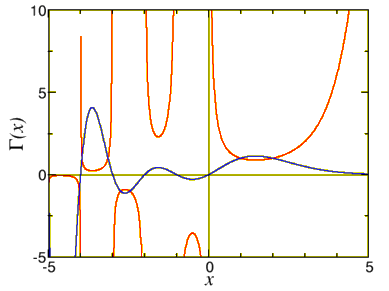
Figure \(\PageIndex{1}\): A graph of the \(\Gamma\) function (solid line). The inverse \(1/\Gamma\) is also included (dashed line). Note that this last function is not discontinuous.
Finally, in physical problems one often uses \(\Gamma(1/2)\), \[\Gamma(\frac{1}{2}) = \int_0^\infty e^{-t}t^{-1/2} dt = 2\int_0^\infty e^{-t}dt^{1/2} = 2\int_0^\infty e^{-x^2}dx. \nonumber \] This can be evaluated by a very smart trick, we first evaluate \(\Gamma(1/2)^2\) using polar coordinates \[\begin{aligned} \Gamma(\frac{1}{2})^2 &=& 4 \int_0^\infty e^{-x^2}dx\int_0^\infty e^{-y^2}dy \nonumber\\ &=& 4 \int_0^\infty \int_0^{\pi/2} e^{-\rho^2}\rho d\rho d\phi = \pi.\end{aligned} \nonumber \] (See the discussion of polar coordinates in Sec. 7.1.) We thus find \[\Gamma(1/2)=\sqrt{\pi},\;\;\Gamma(3/2)=\frac{1}{2}\sqrt{\pi},\;\;{\rm etc.} \nonumber \]