

2.6.E: Exercises
- Page ID
- 219870

\( \newcommand{\vecs}[1]{\overset { \scriptstyle \rightharpoonup} {\mathbf{#1}} } \)
\( \newcommand{\vecd}[1]{\overset{-\!-\!\rightharpoonup}{\vphantom{a}\smash {#1}}} \)
\( \newcommand{\dsum}{\displaystyle\sum\limits} \)
\( \newcommand{\dint}{\displaystyle\int\limits} \)
\( \newcommand{\dlim}{\displaystyle\lim\limits} \)
\( \newcommand{\id}{\mathrm{id}}\) \( \newcommand{\Span}{\mathrm{span}}\)
( \newcommand{\kernel}{\mathrm{null}\,}\) \( \newcommand{\range}{\mathrm{range}\,}\)
\( \newcommand{\RealPart}{\mathrm{Re}}\) \( \newcommand{\ImaginaryPart}{\mathrm{Im}}\)
\( \newcommand{\Argument}{\mathrm{Arg}}\) \( \newcommand{\norm}[1]{\| #1 \|}\)
\( \newcommand{\inner}[2]{\langle #1, #2 \rangle}\)
\( \newcommand{\Span}{\mathrm{span}}\)
\( \newcommand{\id}{\mathrm{id}}\)
\( \newcommand{\Span}{\mathrm{span}}\)
\( \newcommand{\kernel}{\mathrm{null}\,}\)
\( \newcommand{\range}{\mathrm{range}\,}\)
\( \newcommand{\RealPart}{\mathrm{Re}}\)
\( \newcommand{\ImaginaryPart}{\mathrm{Im}}\)
\( \newcommand{\Argument}{\mathrm{Arg}}\)
\( \newcommand{\norm}[1]{\| #1 \|}\)
\( \newcommand{\inner}[2]{\langle #1, #2 \rangle}\)
\( \newcommand{\Span}{\mathrm{span}}\) \( \newcommand{\AA}{\unicode[.8,0]{x212B}}\)
\( \newcommand{\vectorA}[1]{\vec{#1}} % arrow\)
\( \newcommand{\vectorAt}[1]{\vec{\text{#1}}} % arrow\)
\( \newcommand{\vectorB}[1]{\overset { \scriptstyle \rightharpoonup} {\mathbf{#1}} } \)
\( \newcommand{\vectorC}[1]{\textbf{#1}} \)
\( \newcommand{\vectorD}[1]{\overrightarrow{#1}} \)
\( \newcommand{\vectorDt}[1]{\overrightarrow{\text{#1}}} \)
\( \newcommand{\vectE}[1]{\overset{-\!-\!\rightharpoonup}{\vphantom{a}\smash{\mathbf {#1}}}} \)
\( \newcommand{\vecs}[1]{\overset { \scriptstyle \rightharpoonup} {\mathbf{#1}} } \)
\(\newcommand{\longvect}{\overrightarrow}\)
\( \newcommand{\vecd}[1]{\overset{-\!-\!\rightharpoonup}{\vphantom{a}\smash {#1}}} \)
\(\newcommand{\ket}[1]{\left| #1 \right>}\)
\(\newcommand{\bra}[1]{\left< #1 \right|}\)
\(\newcommand{\braket}[2]{\left< #1 \vphantom{#2} \right| \left. #2 \vphantom{#1} \right>}\)
\(\newcommand{\braopket}[3]{\left< #1 \vphantom{#2}\vphantom{#3} \right| #2 \vphantom{#1}\vphantom{#3} \left| #3 \vphantom{#1}\vphantom{#2} \right>}\)
\(\newcommand{\qmvec}[1]{\mathbf{\vec{#1}}}\)
\(\newcommand{\op}[1]{\hat{\mathbf{#1}}}\)
\(\newcommand{\expect}[1]{\langle #1 \rangle}\)
\(\newcommand{\dfn}[1]{\emph{\textbf{#1}}}\)
2.6 Exercises
The graph of \(y = f(x)\) is shown.
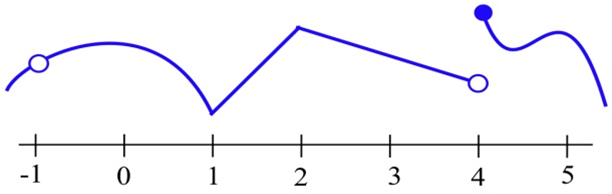
(a) At which integers is \(f\) continuous?
(b) At which integers is \(f\) differentiable?
The graph of \(y = g(x)\) is shown.
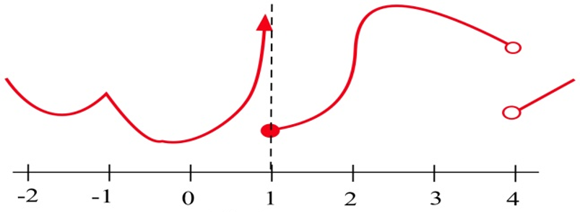
(a) At which integers is \(g\) continuous?
(b) At which integers is \(g\) differentiable?
Problems 3 and 4 refer to the values given in this table:
| \(x\) | \(f(x)\) | \(g(x)\) | \(f'(x)\) | \(g'(x)\) | \((f \circ g)(x)\) | \((f \circ g)' (x)\) |
| -2 | 2 | -1 | 1 | 1 | ||
| -1 | 1 | 2 | 0 | 2 | ||
| 0 | -2 | 1 | 2 | -1 | ||
| 1 | 0 | -2 | -1 | 2 | ||
| 2 | 1 | 0 | 1 | -1 |
3. Use the table of values to determine \(( f \circ g )(x)\) and \(( f \circ g )' (x)\) at \(x =\) 1 and 2.
4. Use the table of values to determine \(( f \circ g )(x)\) and \(( f \circ g )' (x)\) at \(x =\) –2, –1 and 0.
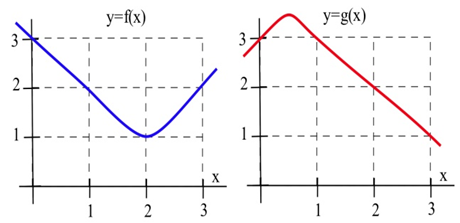
5. Use the graphs to estimate the values of \(g(x)\), \(\bf g '(x)\), \((f \circ g)(x)\), \(\mathbf{f '(} g(x) \mathbf{)}\), and \(\mathbf{( f \circ g ) '(} x \mathbf{)}\) at \(x = 1\).
6. Use the graphs to estimate the values of \(g(x)\), \(\bf g '(x)\), \((f \circ g)(x)\), \(\mathbf{f '(} g(x) \mathbf{)}\), and \(\mathbf{( f \circ g ) '(} x \mathbf{)}\) for \(x = 2\).
In problems 7 – 12, find the derivative of each function.
| 7. \(f(x) = (2x – 8)^5\) | 8. \(f(x) = (6x – x^2)^{10}\) | 9. \(f(x) = x \cdot (3x + 7)^5\) |
| 10. \(f(x) = (2x + 3)^6 \cdot (x – 2)^4\) | 11. \(f(x) = \sqrt{x^2 + 6x - 1}\) | 12. \(f(x) = \frac{x-5}{(x+3)^4}\) |
If \(f\) is a differentiable function,
(a) how are the graphs of \(y = f(x)\) and \(y = f(x) + k\) related?
(b) how are the derivatives of \(f(x)\) and \(f(x) + k\) related?