

2.10.E: Exercises
- Page ID
- 219709

\( \newcommand{\vecs}[1]{\overset { \scriptstyle \rightharpoonup} {\mathbf{#1}} } \)
\( \newcommand{\vecd}[1]{\overset{-\!-\!\rightharpoonup}{\vphantom{a}\smash {#1}}} \)
\( \newcommand{\dsum}{\displaystyle\sum\limits} \)
\( \newcommand{\dint}{\displaystyle\int\limits} \)
\( \newcommand{\dlim}{\displaystyle\lim\limits} \)
\( \newcommand{\id}{\mathrm{id}}\) \( \newcommand{\Span}{\mathrm{span}}\)
( \newcommand{\kernel}{\mathrm{null}\,}\) \( \newcommand{\range}{\mathrm{range}\,}\)
\( \newcommand{\RealPart}{\mathrm{Re}}\) \( \newcommand{\ImaginaryPart}{\mathrm{Im}}\)
\( \newcommand{\Argument}{\mathrm{Arg}}\) \( \newcommand{\norm}[1]{\| #1 \|}\)
\( \newcommand{\inner}[2]{\langle #1, #2 \rangle}\)
\( \newcommand{\Span}{\mathrm{span}}\)
\( \newcommand{\id}{\mathrm{id}}\)
\( \newcommand{\Span}{\mathrm{span}}\)
\( \newcommand{\kernel}{\mathrm{null}\,}\)
\( \newcommand{\range}{\mathrm{range}\,}\)
\( \newcommand{\RealPart}{\mathrm{Re}}\)
\( \newcommand{\ImaginaryPart}{\mathrm{Im}}\)
\( \newcommand{\Argument}{\mathrm{Arg}}\)
\( \newcommand{\norm}[1]{\| #1 \|}\)
\( \newcommand{\inner}[2]{\langle #1, #2 \rangle}\)
\( \newcommand{\Span}{\mathrm{span}}\) \( \newcommand{\AA}{\unicode[.8,0]{x212B}}\)
\( \newcommand{\vectorA}[1]{\vec{#1}} % arrow\)
\( \newcommand{\vectorAt}[1]{\vec{\text{#1}}} % arrow\)
\( \newcommand{\vectorB}[1]{\overset { \scriptstyle \rightharpoonup} {\mathbf{#1}} } \)
\( \newcommand{\vectorC}[1]{\textbf{#1}} \)
\( \newcommand{\vectorD}[1]{\overrightarrow{#1}} \)
\( \newcommand{\vectorDt}[1]{\overrightarrow{\text{#1}}} \)
\( \newcommand{\vectE}[1]{\overset{-\!-\!\rightharpoonup}{\vphantom{a}\smash{\mathbf {#1}}}} \)
\( \newcommand{\vecs}[1]{\overset { \scriptstyle \rightharpoonup} {\mathbf{#1}} } \)
\(\newcommand{\longvect}{\overrightarrow}\)
\( \newcommand{\vecd}[1]{\overset{-\!-\!\rightharpoonup}{\vphantom{a}\smash {#1}}} \)
\(\newcommand{\ket}[1]{\left| #1 \right>}\)
\(\newcommand{\bra}[1]{\left< #1 \right|}\)
\(\newcommand{\braket}[2]{\left< #1 \vphantom{#2} \right| \left. #2 \vphantom{#1} \right>}\)
\(\newcommand{\braopket}[3]{\left< #1 \vphantom{#2}\vphantom{#3} \right| #2 \vphantom{#1}\vphantom{#3} \left| #3 \vphantom{#1}\vphantom{#2} \right>}\)
\(\newcommand{\qmvec}[1]{\mathbf{\vec{#1}}}\)
\(\newcommand{\op}[1]{\hat{\mathbf{#1}}}\)
\(\newcommand{\expect}[1]{\langle #1 \rangle}\)
\(\newcommand{\dfn}[1]{\emph{\textbf{#1}}}\)
2.10 Exercises
(a) You have 200 feet of fencing available to construct a rectangular pen with a fence divider down the middle (see below). What dimensions of the pen enclose the largest total area?
(b) If you need 2 dividers, what dimensions of the pen enclose the largest area?
(c) What are the dimensions in parts (a) and (b) if one edge of the pen borders on a river and does not require any fencing?

You have 120 feet of fencing to construct a pen with 4 equal sized stalls. If the pen is rectangular and shaped like the one below, what are the dimensions of the pen of largest area and what is that area?
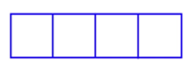
Suppose you decide to fence the rectangular garden in the corner of your yard. Then two sides of the garden are bounded by the yard fence which is already there, so you only need to use the 80 feet of fencing to enclose the other two sides. What are the dimensions of the new garden of largest area? What are the dimensions of the rectangular garden of largest area in the corner of the yard if you have \(F\) feet of new fencing available?
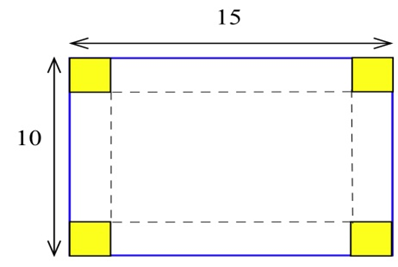
(a) You have a 10 inch by 15 inch piece of tin which you plan to form into a box (without a top) by cutting a square from each corner and folding up the sides. How much should you cut from each corner so the resulting box has the greatest volume?
(b) If the piece of tin is \(A\) inches by \(B\) inches, how much should you cut from each corner so the resulting box has the greatest volume?
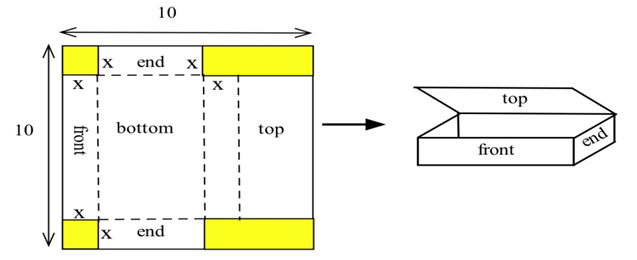
You have a 10 inch by 10 inch piece of cardboard which you plan to cut and fold as shown to form a box with a top. Find the dimensions of the box which has the largest volume.
(a) You have been asked to bid on the construction of a square-bottomed box with no top which will hold 100 cubic inches of water. If the bottom and sides are made from the same material, what are the dimensions of the box which uses the least material? (Assume that no material is wasted.)
(b) Suppose the box in part (a) uses different materials for the bottom and the sides. If the bottom material costs 5¢ per square inch and the side material costs 3¢ per square inch, what are the dimensions of the least expensive box which will hold 100 cubic inches of water?
(a) Determine the dimensions of the least expensive cylindrical can which will hold 100 cubic inches if the materials cost 2¢, 5¢ and 3¢ respectively for the top, bottom and sides.
(b) How do the dimensions of the least expensive can change if the bottom material costs more than 5¢ per square inch?
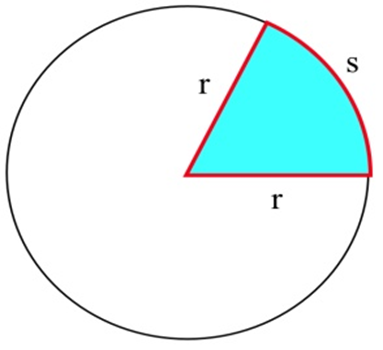
You have 100 feet of fencing to build a pen in the shape of a circular sector, the "pie slice" shown. The area of such a sector is \((rs)/2\). What value of \(r\) maximizes the enclosed area?
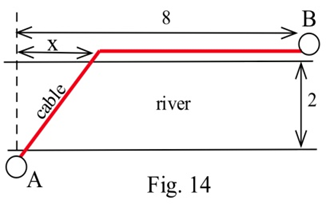
(a) You have been asked to determine the least expensive route for a telephone cable which connects Andersonville with Beantown. If it costs $5000 per mile to lay the cable on land and $8000 per mile to lay the cable across the river and the cost of the cable is negligible, find the least expensive route.
(b) What is the least expensive route if the cable costs $7000 per mile plus the cost to lay it.
You have been asked to determine where a water works should be built along a river between Chesterville and Denton to minimize the total cost of the pipe to the towns.
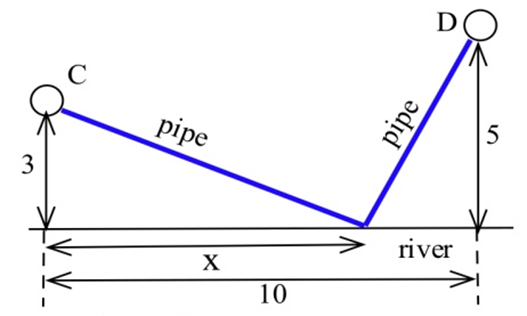
(a) Assume that the same size (and cost) pipe is used to each town. (This part can be done quickly without using calculus.)
(b) Assume that the pipe to Chesterville costs $3000 per mile and to Denton it costs $7000 per mile.
U.S. postal regulations state that the sum of the length and girth (distance around) of a package must be no more than 108 inches.
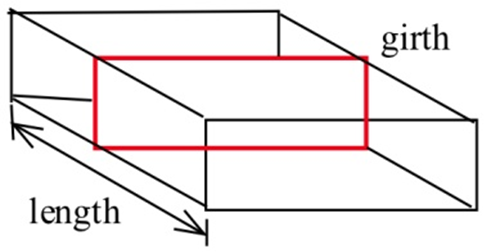
(a) Find the dimensions of the acceptable box with a square end which has the largest volume.
(b) Find the dimensions of the acceptable box which has the largest volume if its end is a rectangle twice as long as it is width.
(c) Find the dimensions of the acceptable box with a circular end which has the largest volume.
D. Simonton claims that the "productivity levels" of people in different fields can be described as a function of their "career age" \(t\) by \(p(t) = e^{–at} – e^{ –bt}\) where \(a\) and \(b\) are constants which depend on the field of work, and career age is approximately 20 less than the actual age of the individual.
(a) Based on this model, at what ages do mathematicians \((a=.03, b=.05)\), geologists \((a=.02, b=.04)\), and historians \((a=.02, b=.03)\) reach their maximum productivity?
(b) Simonton says "With a little calculus we can show that the curve \(( p(t) )\) maximizes at \(t = \frac{1}{b-a} \ln(\frac{b}{a})\)." Use calculus to show that Simonton is correct.
Note: Models of this type have uses for describing the behavior of groups, but it is dangerous and usually invalid to apply group descriptions or comparisons to individuals in the group.
(Scientific Genius, by Dean Simonton, Cambridge University Press, 1988, pp. 69 – 73)
You own a small airplane which holds a maximum of 20 passengers. It costs you $100 per flight from St. Thomas to St. Croix for gas and wages plus an additional $6 per passenger for the extra gas required by the extra weight. The charge per passenger is $30 each if 10 people charter your plane (10 is the minimum number you will fly), and this charge is reduced by $1 per passenger for each passenger over 10 who goes (that is, if 11 go they each pay $29, if 12 go they each pay $28, etc.). What number of passengers on a flight will maximize your profits?
In the planning of a coffee shop, we estimate that if there is seating for between 40 and 80 people, the daily profit will be $50 per seat. However, if the seating capacity is more than 80 places, the daily profit per seat will be decreased by $1 for each additional seat over 80. What should the seating capacity be in order to maximize the coffee shop’s total profit?
In the planning of a taco restaurant, we estimate that if there is seating for between 10 and 40 people, the daily profit will be $10 per seat. However, if the seating capacity is more than 40 places, the daily profit per seat will be decreased by $0.20 per seat. What should the seating capacity be in order to maximize the taco restaurant’s total profit?
The total cost in dollars for Alicia to make \(q\) oven mitts is given by \(C(q) = 64+1.5q+.01q^2\).
(a) What is the fixed cost?
(b) Find a function that gives the marginal cost.
(c) Find a function that gives the average cost.
(d) Find the quantity that minimizes the average cost.
(e) Confirm that the average cost and marginal cost are equal at your answer to part (d).
Shaki makes and sells backpack danglies. The total cost in dollars for Shaki to make \(q\) danglies is given by \(C(q) = 75+2q+.015q^2\). Find the quantity that minimizes Shaki’s average cost for making danglies.