

17.2: Angles
- Page ID
- 195954

\( \newcommand{\vecs}[1]{\overset { \scriptstyle \rightharpoonup} {\mathbf{#1}} } \)
\( \newcommand{\vecd}[1]{\overset{-\!-\!\rightharpoonup}{\vphantom{a}\smash {#1}}} \)
\( \newcommand{\dsum}{\displaystyle\sum\limits} \)
\( \newcommand{\dint}{\displaystyle\int\limits} \)
\( \newcommand{\dlim}{\displaystyle\lim\limits} \)
\( \newcommand{\id}{\mathrm{id}}\) \( \newcommand{\Span}{\mathrm{span}}\)
( \newcommand{\kernel}{\mathrm{null}\,}\) \( \newcommand{\range}{\mathrm{range}\,}\)
\( \newcommand{\RealPart}{\mathrm{Re}}\) \( \newcommand{\ImaginaryPart}{\mathrm{Im}}\)
\( \newcommand{\Argument}{\mathrm{Arg}}\) \( \newcommand{\norm}[1]{\| #1 \|}\)
\( \newcommand{\inner}[2]{\langle #1, #2 \rangle}\)
\( \newcommand{\Span}{\mathrm{span}}\)
\( \newcommand{\id}{\mathrm{id}}\)
\( \newcommand{\Span}{\mathrm{span}}\)
\( \newcommand{\kernel}{\mathrm{null}\,}\)
\( \newcommand{\range}{\mathrm{range}\,}\)
\( \newcommand{\RealPart}{\mathrm{Re}}\)
\( \newcommand{\ImaginaryPart}{\mathrm{Im}}\)
\( \newcommand{\Argument}{\mathrm{Arg}}\)
\( \newcommand{\norm}[1]{\| #1 \|}\)
\( \newcommand{\inner}[2]{\langle #1, #2 \rangle}\)
\( \newcommand{\Span}{\mathrm{span}}\) \( \newcommand{\AA}{\unicode[.8,0]{x212B}}\)
\( \newcommand{\vectorA}[1]{\vec{#1}} % arrow\)
\( \newcommand{\vectorAt}[1]{\vec{\text{#1}}} % arrow\)
\( \newcommand{\vectorB}[1]{\overset { \scriptstyle \rightharpoonup} {\mathbf{#1}} } \)
\( \newcommand{\vectorC}[1]{\textbf{#1}} \)
\( \newcommand{\vectorD}[1]{\overrightarrow{#1}} \)
\( \newcommand{\vectorDt}[1]{\overrightarrow{\text{#1}}} \)
\( \newcommand{\vectE}[1]{\overset{-\!-\!\rightharpoonup}{\vphantom{a}\smash{\mathbf {#1}}}} \)
\( \newcommand{\vecs}[1]{\overset { \scriptstyle \rightharpoonup} {\mathbf{#1}} } \)
\(\newcommand{\longvect}{\overrightarrow}\)
\( \newcommand{\vecd}[1]{\overset{-\!-\!\rightharpoonup}{\vphantom{a}\smash {#1}}} \)
\(\newcommand{\ket}[1]{\left| #1 \right>}\)
\(\newcommand{\bra}[1]{\left< #1 \right|}\)
\(\newcommand{\braket}[2]{\left< #1 \vphantom{#2} \right| \left. #2 \vphantom{#1} \right>}\)
\(\newcommand{\braopket}[3]{\left< #1 \vphantom{#2}\vphantom{#3} \right| #2 \vphantom{#1}\vphantom{#3} \left| #3 \vphantom{#1}\vphantom{#2} \right>}\)
\(\newcommand{\qmvec}[1]{\mathbf{\vec{#1}}}\)
\(\newcommand{\op}[1]{\hat{\mathbf{#1}}}\)
\(\newcommand{\expect}[1]{\langle #1 \rangle}\)
\(\newcommand{\dfn}[1]{\emph{\textbf{#1}}}\)
- Identify and express angles using proper notation.
- Classify angles by their measurement.
- Solve application problems involving angles.
- Compute angles formed by transversals to parallel lines.
- Solve application problems involving angles formed by parallel lines.
Unusual perspectives can reveal some extremely interesting images. For example, aerial views of cities reveal some exciting and unexpected angles present in architecture or the city's design. Understanding angles is crucial to various fields, including engineering, architecture, scenic design, and pattern making.
We begin our study of angles with a description of how angles are formed and how they are classified. An angle is the joining of two rays (a line starting at a point and extending infinitely in a direction) with a common endpoint. The common endpoint is called the vertex. We will often need to refer to more than one vertex; the plural of vertex is vertices.
In Figure \(\PageIndex{2}\) , let the ray stay put. Rotate the second ray in a counterclockwise direction to the size of the angle you want. When the ray continues to rotate in a counterclockwise direction back to its original position coinciding with ray the ray will have swept out We call the rays the “sides” of the angle.
Classifying Angles
Angles are measured in radians or degrees. An angle that measures \(\pi\) radians is equal to the angle measuring \(180^{\circ}\). An angle measuring \(\frac{\pi}{2}\) radians measures \(90^{\circ}\). To translate between degrees and radians, we solve the proportion
\[\frac{\text{radian measure}}{\text{degree measure}} = \frac{\pi}{180}.\nonumber\]
This means that to convert from degrees to radians, we multiply the degree measure by \(\dfrac{\pi}{180}\). For example, to write \(45^{\circ}\) in radians, we have
\[45^{\circ}\left(\frac{\pi}{180}\right)=\frac{\pi}{4} \text { radians. } \nonumber \]
To translate radians to degrees, we multiply by \(\dfrac{180}{\pi}\). For example, to write \(2 \pi\) radians in degrees, we have
\[2 \pi\left(\frac{180}{\pi}\right)=360^{\circ} \nonumber \]
Another example of translating radians to degrees and degrees to radians is \(\frac{2 \pi}{3}\). To write in degrees, we have \(\frac{2 \pi}{3}\left(\frac{180}{\pi}\right)=120^{\circ}\). To write \(30^{\circ}\) in radians, we have \(30^{\circ}\left(\frac{\pi}{180}\right)=\frac{\pi}{6}\). However, we will use degrees throughout this chapter.
To translate an angle measured in degrees to radians, multiply by \(\dfrac{\pi}{180}\).
To translate an angle measured in radians to degrees, multiply by \(\dfrac{180}{\pi}\).
Several angles are referred to so often that they have been given special names. A straight angle measures \(180^{\circ}\); a right angle measures \(90^{\circ}\); an acute angle is any angle whose measure is less than \(90^{\circ}\); and an obtuse angle is any angle whose measure is between \(90^{\circ}\) and \(180^{\circ}\). See Figure \(\PageIndex{3}\).
A way to measure angles is with a protractor (see Figure \(\PageIndex{4}\)). A protractor is often made of transparent plastic, like the one shown here.
With a protractor, you line up the straight bottom with the horizontal straight line of the angle. Be sure to have the center hole lined up with the vertex of the angle. Then, look for the mark on the protractor where the second ray lines up. As you can see from the image, the degrees are marked off. Where the second ray lines up is the measurement of the angle.
Make sure you correctly match the center mark of the protractor with the vertex of the angle to be measured. Otherwise, you will not get the correct measurement.
Notation
Naming angles can be done in couple of ways. We can name the angle by three points, one point on each of the sides and the vertex point in the middle, or we can name it by the vertex point alone. Also, we can use the symbols \(\angle\) or \(\measuredangle\) before the points. When we are referring to the measure of the angle, we use the symbol \(m \measuredangle\). See Figure \(\PageIndex{5}\).
We can name this angle \(\measuredangle B A C\), or \(\measuredangle C A B\), or \(\measuredangle A\).
Determine which angles are acute, right, obtuse, or straight on the graph (Figure \(\PageIndex{6}\)). You may want to use a protractor for this one.
- Answer
-
- Acute angles measure less than : ∠EOF, ∠EOG, ∠FOG, ∠GOH, ∠FOH, ∠HOJ, ∠HOK, ∠JOK, ∠KOL, ∠JOL
- Right angles measure : ∠EOH, ∠HOL, ∠GOJ
- Obtuse angles measure between and : ∠EOJ, ∠EOK, ∠FOJ, ∠FOK, ∠FOL, ∠GOK, ∠GOL
- Straight angles measure : ∠EOL
Most angles can be classified visually or by description. However, if you are unsure, use a protractor.
Determine which angles are acute, right, obtuse, and straight in the graph.
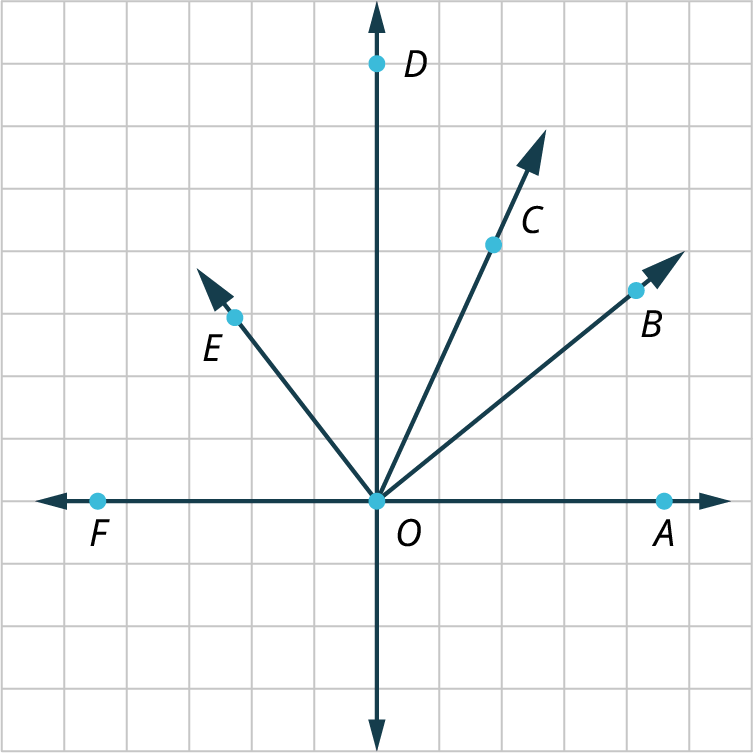
- Answer
-
- Acute angles measure less than : \(\angle AOB\), \(\angle AOC\), \(\angle BOC\), \(\angle BOD\), \(\angle COD\), \(\angle COE\), \(\angle DOE\), \(\angle EOF\)
- Right angles measure : \(\angle AOD\), \(\angle BOE\), \(\angle DOF\)
- Obtuse angles measure between and : \(\angle AOE\), \(\angle BOF\), \(\angle COF\)
- Straight angles measure : \(\angle AOF\)
Adjacent Angles
Two angles with the same starting point or vertex and one common side are called adjacent angles. In Figure \(\PageIndex{8}\), angle \(\angle D B C\) is adjacent to \(\angle C B A\). Notice that the way we designate an angle is with a point on each of its two sides and the vertex in the middle.
Supplementary Angles
Two angles are supplementary if the sum of their measures equals \(180^{\circ}\).
In Figure \(\PageIndex{9}\), given that \(m\measuredangle FBE = 35^{\circ}\), what is \(m\measuredangle ABE\)?
- Answer
-
These are supplementary angles. Therefore, because \(m\measuredangle ABF = 180^{\circ}\), and as \(180^{\circ} - 35^{\circ} = 145^{\circ}\), we have \(m\measuredangle ABE = 145^{\circ}\).
Solve for the angle measurements in Figure \(\PageIndex{10}\).
- Answer
-
Step 1: These are supplementary angles. We can see this because the two angles are part of a horizontal line, and a horizontal line represents \(180^{\circ}\). Therefore, the sum of the two angles equals \(180^{\circ}\).
Step 2: Set up and solve an equation based on the fact that the sum of the angles is \(180^{\circ}\).
\[\begin{aligned}
(32 x-7)+(5 x+2) & =180 \\
37 x-5 & =180 \\
37 x & =185 \\
x & =5
\end{aligned} \nonumber \]Step 3: Find the measure of each angle:
\[\begin{aligned}
32 x-7 & =32(5)-7 \\
& =153^{\circ} \\
5 x+2 & =5(5)+2 \\
& =27^{\circ}
\end{aligned} \nonumber \]Step 4: We check: \(153^{\circ}+27^{\circ}=180^{\circ}\).
Solve for the angle measurements in the figure shown.
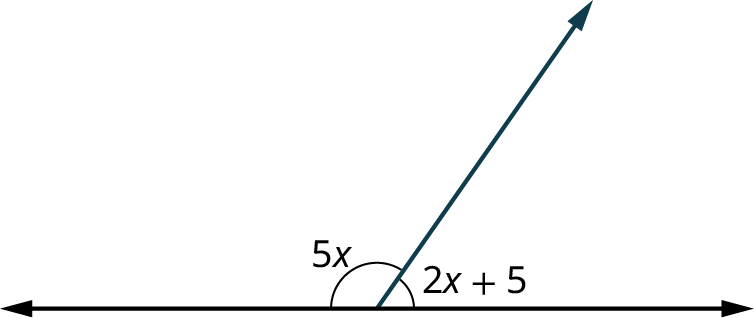
- Answer
-
\(125^{\circ}\) and \(55^{\circ}\)
Complementary Angles
Two angles are complementary if the sum of their measures equals \(90^{\circ}\).
Find the measure of \(\angle ABC\), which is complementary to \(m\measuredangle CBD = 64^{\circ}\), in Figure \(\PageIndex{12}\).
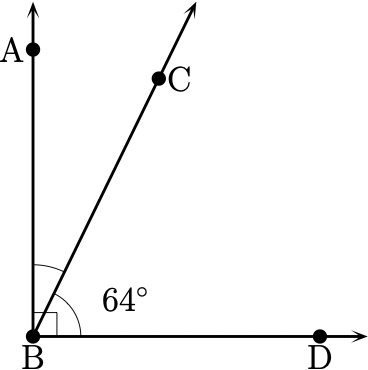
- Answer
-
\(m\measuredangle ABC = 26^{\circ}\)
Solve for the angle measurements in Figure \(\PageIndex{13}\)
- Answer
-
We have that
\[\begin{aligned}
(9 x-5)+4 x+(7 x-5) & =90 \\
20 x & =100 \\
x & =5
\end{aligned} \nonumber \]Then, \(m \measuredangle(9 x-5)=40^{\circ}, m \measuredangle(4 x)=20^{\circ}\), and \(m \measuredangle(7 x-5)=30^{\circ}\).
Find the measure of each angle in the illustration.
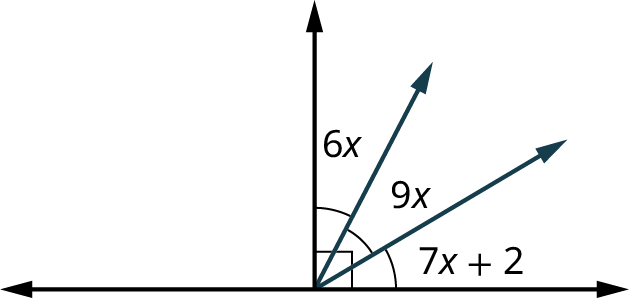
- Answer
-
\(24^{\circ}\), \(36^{\circ}\), and \(30^{\circ}\)
Vertical Angles
When two lines intersect, the opposite angles are called vertical angles, and vertical angles have equal measure. For example, Figure \(\PageIndex{15}\) shows two straight lines intersecting each other. One pair of vertical angles are indicated by angle markers; those angles have the same measure. The other two vertical angles have the same measure as well.
In Figure \(\PageIndex{16}\), one angle measures Find the measures of the remaining angles.
- Answer
-
The 40-degree angle and are vertical angles. Therefore,
Notice that and are supplementary angles, meaning that the sum of and equals Therefore, .
Since and are vertical angles, then equals
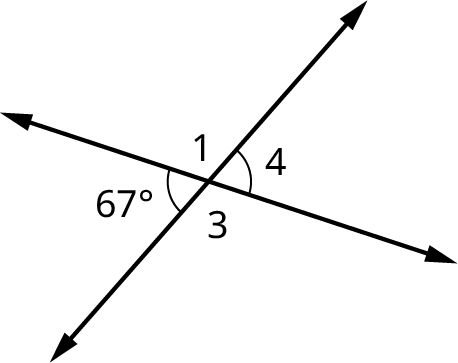
Given the two intersecting lines in the figure shown and \(m\measuredangle 2 = {67^ \circ },\) find the measure of the remaining angles.
- Answer
-
\(m\measuredangle 1 = 113^{\circ}\), \(m\measuredangle 3 = 113^{\circ}\), \(m\measuredangle 4 = 67^{\circ}\)
Transversals
When two parallel lines (lines in the same direction which never cross) are crossed by a straight line, or transversal, eight angles are formed. See Figure \(\PageIndex{18}\). Angles 1, 2, 7, and 8 are called exterior angles, and angles 3, 4, 5, and 6 are called interior angles.
Alternate Interior Angles
Alternate interior angles are the interior angles on opposite sides of the transversal. These two angles have the same measure. For example, \(\measuredangle 3\) and \(\measuredangle 6\) are alternate interior angles and have equal measure; \(\measuredangle 4\) and \(\measuredangle 5\) are alternate interior angles and have equal measure as well. See Figure \(\PageIndex{19}\).
Alternate Exterior Angles
Alternate exterior angles are exterior angles on opposite sides of the transversal and have the same measure. For example, in Figure \(\PageIndex{20}\), and are alternate exterior angles and have equal measures; and are alternate exterior angles and have equal measures as well.
Corresponding Angles
Corresponding angles refer to one exterior angle and one interior angle on the same side as the transversal, which have equal measures. In Figure \(\PageIndex{21}\), and are corresponding angles and have equal measures; and are corresponding angles and have equal measures; and are corresponding angles and have equal measures; and are corresponding angles and have equal measures as well.
Parker lives on the corner of First Avenue and Linton Street. They want to plant a garden in the far corner of the lot (Figure \(\PageIndex{22}\)) and fence off the area. However, the corner does not form a right angle. They learned from the city that the streets cross at an angle equal to What is the measure of the angle that will border Parker's garden?
- Answer
-
As the angle between Linton Street and First Avenue is the supplementary angle is Therefore, the garden will form a angle.
Suppose you have a similar property to the one in Figure \(\PageIndex{22}\), but the angle that corresponds to the garden corner is \({50^ \circ }\). What is the measure between the two cross streets?
- Answer
-
\(130^{\circ}\)
In Figure \(\PageIndex{23}\), given that angle 3 measures find the measures of the remaining angles and give a reason for your solution.
- Answer
-
by vertical angles.
by corresponding angles.
by vertical angles.
by supplementary angles.
by vertical angles.
by alternate exterior angles.
by vertical angles.
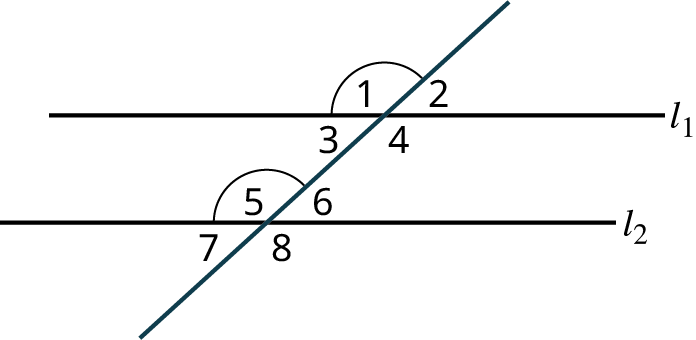
In the given figure if \(m\measuredangle 1 = {120^ \circ }\), find \(m\measuredangle 4\), \(m\measuredangle 5\), and \(m\measuredangle 8\).
- Answer
-
\(m\measuredangle 4 = m\measuredangle 5 = m\measuredangle 8 = 120^{\circ}\)
In Figure \(\PageIndex{25}\), given that angle 2 measures find the measure of the remaining angles and state the reason for your solution.
- Answer
-
by vertical angles, because and are the opposite angles formed by two intersecting lines.
by supplementary angles to or We see that and form a straight angle as does and A straight angle measures so
by vertical angles, because and are the two opposite angles formed by two intersecting lines.
by corresponding angles because they are the same angle formed by the transversal crossing two parallel lines, one exterior and one interior.
by vertical angles because and are the two opposite angles formed by two intersecting lines.
by alternate exterior angles because, like vertical angles, these angles are the opposite angles formed by the transversal intersecting two parallel lines.
by vertical angles because these are the opposite angles formed by two intersecting lines.
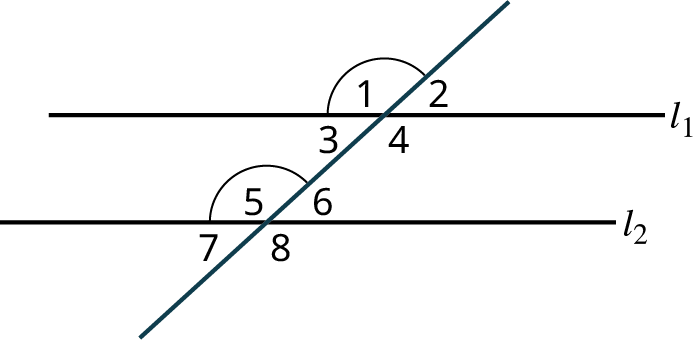
In the provided figure given that the \(m\measuredangle 2 = {48^ \circ }\), find \(m\measuredangle 1\), and \(m\measuredangle 5.\)
- Answer
-
\(m\measuredangle 1 = 132^{\circ}\) and \(m\measuredangle 5 = 132^{\circ}\)
Find the measures of the angles 1, 2, 4, 11, 12, and 14 in Figure \(\PageIndex{27}\) and the reason for your answer given that \(l_1\) and \(l_2\) are parallel.
- Answer
-
, supplementary angles
, vertical angles
, vertical angles
, corresponding angles
, vertical angles
, supplementary angles
Using Figure \(\PageIndex{27}\), find the measures of angles 5, 6, 7, 8, and 9.
- Answer
-
\(m\measuredangle 5 = 56^{\circ}\), \(m\measuredangle 6 = 62^{\circ}\), \(m\measuredangle 7 = 118^{\circ}\), \(m\measuredangle 8 = 62^{\circ}\), and \(m\measuredangle 9 = 118^{\circ}\),
Did you ever wonder why there are in a circle? Why not or The number 360 was chosen by Babylonian astronomers before the ancient Greeks as the number to represent how many degrees in one complete rotation around a circle. It is said that they chose 360 for a couple of reasons: It is close to the number of days in a year, and 360 is divisible by 2, 3, 4, 5, 6, 8, 9, 10, …
Exercises
Classify Angles
Classify the angles in the following exercises as acute, obtuse, right, or straight.
- \(m\measuredangle = {180^ \circ }\)
- \(m\measuredangle = {176^ \circ }\)
- \(m\measuredangle = {90^ \circ }\)
- \(m\measuredangle = {37^ \circ }\)
- \(m\measuredangle = {32^ \circ }\)
- \(m\measuredangle = {120^ \circ }\)
- \(m\measuredangle = {180^ \circ }\)
- \(m\measuredangle = {90^ \circ }\)
- \(m\measuredangle = {110^ \circ }\)
- \(m\measuredangle = {45^ \circ }\)
Supplementary, Complementary, and Vertical Angles and Transversals
For the following exercises, determine the measure of the angles in the given figure.
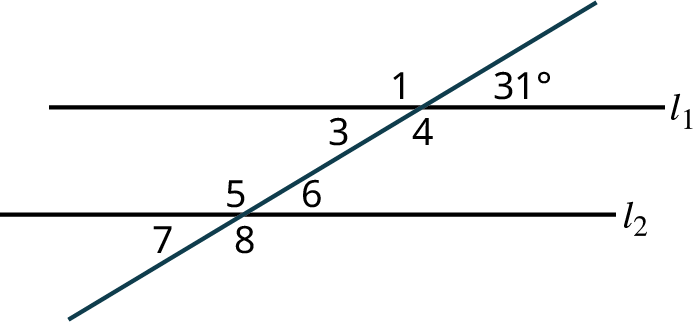
- Find the measure of \(\measuredangle 1\) and state the reason for your solution.
- Find the measure of \(\measuredangle 3\) and state the reason for your solution.
- Find the measure of \(\measuredangle 5\) and state the reason for your solution.
- Find the measure of \(\measuredangle 6\) and state the reason for your solution.
Use the given figure for the following exercises. Let angle 2 measure \({35^ \circ }\).

- Find the measure of angle 1 and state the reason for your solution.
- Find the measure of angle 3 and state the reason for your solution.
- Find the measure of angle 4 and state the reason for your solution.
- Find the measure of angle 5 and state the reason for your solution.
- Find the measure of angle 6 and state the reason and state the reason for your solution.
- Find the measure of angle 7 and state the reason for your solution.
- Find the measure of angle 8 and state the reason for your solution.
Use the given figure for the following exercises.

- Find the measure of angle 3 and explain the reason for your solution.
- Find the measure of angle 8 and explain the reason for your solution.
Use Algebra to Solve for Angle Measurements
-
Use the given figure to solve for the angle measurements.

-
Use the given figure to solve for the angle measurements.

- Give the measure of the supplement to \({89^ \circ }.\)
-
Use the given figure to solve for the angle measurements.

Exercise Answers
- Display answers
-
1. straight
3. right
5. acute
7. straight
9. obtuse
11. \(m\measuredangle 1 = 149^{\circ}\), supplementary with \(31^{\circ}\)
13. \(m\measuredangle 5 = 149^{\circ}\), corresponding with angle 1
15. \(m\measuredangle 1 = 145^{\circ}\), supplementary with angle 2
17. \(m\measuredangle 4 = 145^{\circ}\), supplementary with angle 2
19. \(m\measuredangle 6 = 35^{\circ}\), corresponding with angle 2
21. \(m\measuredangle 8 = 145^{\circ}\), supplementary with angle 6
23. \(m\measuredangle 3 = 50^{\circ}\), vertical with angle 1
25. \(65^{\circ}\), \(70^{\circ}\), and \(45^{\circ}\)
27. \(51^{\circ}\)