

17.3: Triangles
- Page ID
- 195956

\( \newcommand{\vecs}[1]{\overset { \scriptstyle \rightharpoonup} {\mathbf{#1}} } \)
\( \newcommand{\vecd}[1]{\overset{-\!-\!\rightharpoonup}{\vphantom{a}\smash {#1}}} \)
\( \newcommand{\dsum}{\displaystyle\sum\limits} \)
\( \newcommand{\dint}{\displaystyle\int\limits} \)
\( \newcommand{\dlim}{\displaystyle\lim\limits} \)
\( \newcommand{\id}{\mathrm{id}}\) \( \newcommand{\Span}{\mathrm{span}}\)
( \newcommand{\kernel}{\mathrm{null}\,}\) \( \newcommand{\range}{\mathrm{range}\,}\)
\( \newcommand{\RealPart}{\mathrm{Re}}\) \( \newcommand{\ImaginaryPart}{\mathrm{Im}}\)
\( \newcommand{\Argument}{\mathrm{Arg}}\) \( \newcommand{\norm}[1]{\| #1 \|}\)
\( \newcommand{\inner}[2]{\langle #1, #2 \rangle}\)
\( \newcommand{\Span}{\mathrm{span}}\)
\( \newcommand{\id}{\mathrm{id}}\)
\( \newcommand{\Span}{\mathrm{span}}\)
\( \newcommand{\kernel}{\mathrm{null}\,}\)
\( \newcommand{\range}{\mathrm{range}\,}\)
\( \newcommand{\RealPart}{\mathrm{Re}}\)
\( \newcommand{\ImaginaryPart}{\mathrm{Im}}\)
\( \newcommand{\Argument}{\mathrm{Arg}}\)
\( \newcommand{\norm}[1]{\| #1 \|}\)
\( \newcommand{\inner}[2]{\langle #1, #2 \rangle}\)
\( \newcommand{\Span}{\mathrm{span}}\) \( \newcommand{\AA}{\unicode[.8,0]{x212B}}\)
\( \newcommand{\vectorA}[1]{\vec{#1}} % arrow\)
\( \newcommand{\vectorAt}[1]{\vec{\text{#1}}} % arrow\)
\( \newcommand{\vectorB}[1]{\overset { \scriptstyle \rightharpoonup} {\mathbf{#1}} } \)
\( \newcommand{\vectorC}[1]{\textbf{#1}} \)
\( \newcommand{\vectorD}[1]{\overrightarrow{#1}} \)
\( \newcommand{\vectorDt}[1]{\overrightarrow{\text{#1}}} \)
\( \newcommand{\vectE}[1]{\overset{-\!-\!\rightharpoonup}{\vphantom{a}\smash{\mathbf {#1}}}} \)
\( \newcommand{\vecs}[1]{\overset { \scriptstyle \rightharpoonup} {\mathbf{#1}} } \)
\(\newcommand{\longvect}{\overrightarrow}\)
\( \newcommand{\vecd}[1]{\overset{-\!-\!\rightharpoonup}{\vphantom{a}\smash {#1}}} \)
\(\newcommand{\ket}[1]{\left| #1 \right>}\)
\(\newcommand{\bra}[1]{\left< #1 \right|}\)
\(\newcommand{\braket}[2]{\left< #1 \vphantom{#2} \right| \left. #2 \vphantom{#1} \right>}\)
\(\newcommand{\braopket}[3]{\left< #1 \vphantom{#2}\vphantom{#3} \right| #2 \vphantom{#1}\vphantom{#3} \left| #3 \vphantom{#1}\vphantom{#2} \right>}\)
\(\newcommand{\qmvec}[1]{\mathbf{\vec{#1}}}\)
\(\newcommand{\op}[1]{\hat{\mathbf{#1}}}\)
\(\newcommand{\expect}[1]{\langle #1 \rangle}\)
\(\newcommand{\dfn}[1]{\emph{\textbf{#1}}}\)
- Identify triangles by their sides.
- Identify triangles by their angles.
- Determine if triangles are congruent.
- Determine if triangles are similar.
- Find the missing side of similar triangles.
Before you get started, take this readiness quiz.
Define acute, right, obtuse, and straight angles.
- Answer
-
acute angles are less than \(90^{\circ}\), right angles equal \(90^{\circ}\), obtuse angles are between \(90^{\circ}\) and \(180^{\circ}\), and straight angles equal \(180^{\circ}\).
What is the measure of an angle supplementary to a \(70^{\circ}\) angle?
- Answer
-
\(110^{\circ}\)
How were the ancient Greeks able to calculate the radius of Earth? How was it possible centuries ago to estimate the height of a sail at sea? Triangles have always played a significant role in how we find heights of objects too high to measure or distances between objects too far away to calculate. In particular, the concept of similar triangles has countless applications in the real world, and we shall explore some of those applications in this section.
Technology has given us instruments that allow us to find measurements of distant objects with little effort. However, it is all based on the properties of triangles discovered centuries ago. In this section, we will explore the various types of triangles and their special properties, as well as how to measure interior and exterior angles. We will also explore congruence theorems and similarity.
Identifying Triangles
Joining any three noncollinear points with line segments produces a triangle. For example, given points \(A, B\), and \(C\), connected by the line segments \(\overline{A B}, \overline{B C}\), and \(\overline{A C}\), we have a triangle, as shown in Figure \(\PageIndex{1}\).
Triangles are classified by their angles and their sides. All angles in an acute triangle measure less than \(90^{\circ}\). One of the angles in a right triangle measures \(90^{\circ}\), symbolized by \(\square\). One angle in an obtuse triangle measures between \(90^{\circ}\) and \(180^{\circ}\). Sides that have equal length are indicated by the same hash marks. Figure \(\PageIndex{3}\) illustrates the shapes of the basic triangles, their names, and their properties.
A few other facts to remember as we move forward:
- The points where the line segments meet are called the vertices (plural for vertex).
- We often refer to sides of a triangle by the angle they are opposite. In other words, side is opposite angle , side is opposite angle , and side is opposite angle .
We want to add a special note about right triangles here, as they are referred to more than any other triangle. The side opposite the right angle is its longest side and is called the hypotenuse, and the sides adjacent to the right angle are called the legs.
One of the most important properties of triangles is that the sum of the interior angles equals \(180^{\circ}\). Euclid discovered and proved this property using parallel lines. The completed sketch is shown in Figure \(\PageIndex{4}\).
This is how the proof goes:
Step 1: Start with a straight line \(\overleftrightarrow{A B}\) and a point \(C\) not on the line.
Step 2: Draw a line through point \(C\) parallel to the line \(\overleftrightarrow{A B}\).
Step 3: Construct two transversals (a line crossing the parallel lines), one angled to the right and one angled to the left, to intersect the parallel lines.
Step 4: Because of the property that alternate interior angles inside parallel lines are equal, we have that
\[m \measuredangle 2=m \measuredangle 1 \quad \text { and } \quad m \measuredangle 3=m \measuredangle 4 . \nonumber \]
Step 5: Notice that \(m \measuredangle 2+m \measuredangle 5+m \measuredangle 4=180^{\circ}\) by the straight angle property.
Step 6: Therefore, by substitution, \(m \measuredangle 1=m \measuredangle 2\), and \(m \measuredangle 3=m \measuredangle 4\), we have that
\[m \measuredangle 1+m \measuredangle 3+m \measuredangle 5=180^{\circ} \nonumber \]
Therefore, the sum of the interior angles of a triangle is \(180^{\circ}\).
Find the measure of each angle in the triangle shown (Figure \(\PageIndex{5}\)).
- Answer
-
Step 1: As the sum of the interior angles equals \(180^{\circ}\), we can use algebra to find the measures:
\[\begin{aligned}
x+(x+17)+(3 x-62) & =180 \\
5 x-45 & =180 \\
5 x & =225 \\
x & =\frac{225}{5}=45
\end{aligned} \nonumber \]Step 2: Now that we have the value of \(x\), we can substitute 45 into the other two expressions to find the measure of those angles:
\[\begin{aligned}
(x+17) & =45+17=62^{\circ} \\
(3 x-62) & =3(45)-62=135-62=73^{\circ}
\end{aligned} \nonumber \]Step 3: Then, \(m \measuredangle x=45^{\circ}, m \measuredangle(x+17)=62^{\circ}\), and \(m \measuredangle(3 x-62)=73^{\circ}\).
Find the measures of each angle in the triangle shown.

- Answer
-
\(m\measuredangle x = 66\), \(m\measuredangle (x+1) = 67\), \(m\measuredangle (x-19) = 47\)
Find the measure of the angles numbered 1–5 in Figure \(\PageIndex{7}\).
- Answer
-
The because it is supplementary with the unknown angle of the adjacent triangle. The unknown angle measures The because of vertical angles. The because the angle that is supplementary to the measures , and angle 5 is the unknown angle in that triangle. The by vertical angles. Finally, as it is the third angle in the triangle with angles measuring and
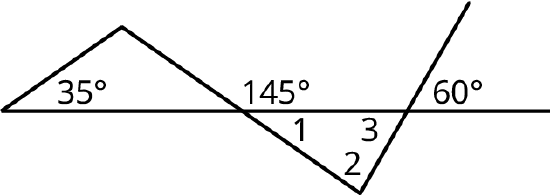
Find the measure of angles 1, 2, and 3 in the figure shown.
- Answer
-
\(m\measuredangle 1 = 35^{\circ}\), \(m\measuredangle 2 = 85^{\circ}\), and \(m\measuredangle 3 = 60^{\circ}\)
Congruence
If two triangles have equal angles and their sides lengths are equal, the triangles are congruent. In other words, if you can pick up one triangle and place it on top of the other triangle and they coincide, even if you have to rotate one, they are congruent. We use the symbol \(\cong\) to define congruence. For example, \(\triangle A B C \cong \triangle D E F\).
In Figure \(\PageIndex{9}\), is the triangle \(ABC\) congruent to triangle \(DEF\)?
- Answer
-
Triangle \(A B C\) is congruent to triangle \(D E F\). Angles \(A\) and \(C\) are congruent to angles \(D\) and \(F\), which implies that angle \(B\) is congruent to angle \(E\). Side \(A B\) is congruent to side \(D E\), and side \(C B\) is congruent to side \(F E\), which implies that side \(A C\) is congruent to side \(D F\).
In the figure shown, is triangle \(ABC\) congruent to triangle \(DEF\)?

- Answer
-
Yes, since two pairs of angles are congruent, the third must be as well. And since the angles are congruent and two of the pairs of corresponding sides are congruent, the third must be as well.
The Congruence Theorems
The following theorems are tools you can use to prove that two triangles are congruent.
Side-Side-Side (SSS). If three sides of one triangle are equal to the corresponding sides of the second triangle, then the triangles are congruent. See Figure \(\PageIndex{11}\).
We have that \(\overline{D F} \cong \overline{R T}, \overline{E F} \cong \overline{S T}\), and \(\overline{D E} \cong \overline{R S}\), then \(\triangle D E F \cong \Delta R S T\).
Side-Angle-Side (SAS). If two sides of a triangle and the angle between them are equal to the corresponding two sides and included angle of the second triangle, then the triangles are congruent. See Figure \(\PageIndex{12}\). We see that \(\overline{A B} \cong \overline{A^{\prime} B^{\prime}}\), \(\overline{B C} \cong \overline{B^{\prime} C^{\prime}}\), and \(m \measuredangle B=m \measuredangle B^{\prime}\), then \(\Delta A B C \cong \Delta A^{\prime} B^{\prime} C^{\prime}\)
Angle-Side-Angle (ASA). If two angles and the side between them in one triangle are congruent to the two corresponding angles and the side between them in a second triangle, then the two triangles are congruent. See Figure \(\PageIndex{13}\). Notice that , , and , then
Angle-Angle-Side (AAS). If two angles and one of the sides not between them in one triangle are congruent to the two corresponding angles and the corresponding side in a second triangle, then the two triangles are congruent. See Figure \(\PageIndex{14}\). Notice that \(m \measuredangle X \cong m \measuredangle X^{\prime}\), \(m \measuredangle Z \cong m \measuredangle Z^{\prime}\), and \(\overline{XY} \cong \overline{X^{\prime}Y^{\prime}}\), then \(\triangle XYZ \cong \triangle X^{\prime}Y^{\prime}Z^{\prime}\).
What congruence theorem is illustrated in Figure \(\PageIndex{15}\)7?
- Answer
-
The unmarked angles are congruent to the alternate marked angle. This illustrates either:
- AAS: Two angles and a non-included side in one triangle are congruent to the corresponding angles and side in the second triangle.
- ASA: Two angles and the included side in one triangle are congruent to the corresponding angles and side in the other.
Identify the congruence theorem being illustrated in the figure shown.

- Answer
-
SAS
What congruence theorem is illustrated in Figure \(\PageIndex{17}\)?
- Answer
-
The SSS theorem.
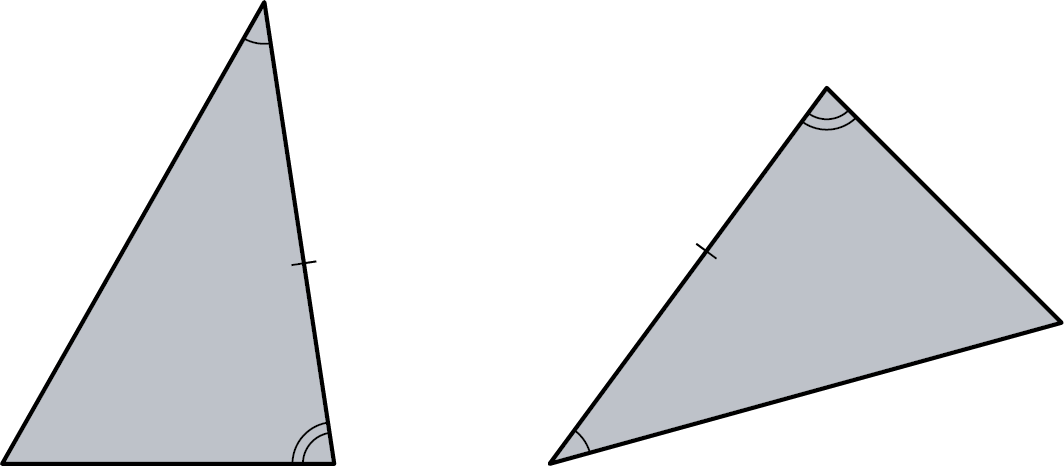
What congruence theorem is being illustrated in the figure shown?
- Answer
-
ASA
Similarity
If two triangles have the same angle measurements, then they are the same shape even if they differ in size. We say the two triangles are similar. The lengths of the sides of one triangle will be proportional to the corresponding sides of the second triangle. Recall that an equation asserting that two fractions equal to each other is called a proportion, such as
\[\frac{a}{b}=\frac{c}{d} . \nonumber \]
This rule of similarity applies to all shapes as well as triangles. Another way to view similarity is by applying a scaling factor, which is the ratio of corresponding measurements between an object or representation of the object, to a the second, similar image.
For example, the two images in Figure \(\PageIndex{19}\) are similar because they have the same proportions between elements.
Are the two triangles shown in Figure \(\PageIndex{20}\) similar?
- Answer
-
Solution 1: In each triangle, the angles are \(33^{\circ}\), \(57^{\circ}\), and \(90^{\circ}\), therefore the triangles are similar.
Solution 2: We will look at the proportions within each triangle. In triangle \(\alpha\) (alpha), the side opposite the \(57^{\circ}\) angle measures 7 , and the side opposite the \(33^{\circ}\) angle measures 4 . Then, the measures of the corresponding sides in triangle \(\beta\) (beta) measures 3.5 and 2 , respectively. We have
\[\frac{4}{7}=0.5714 \quad \frac{2}{3.5}=0.5714 \nonumber \]
This is the proportion \(\frac{4}{7}=\frac{2}{3.5}\).
Solution 3: Let's try another correspondence. In triangle \(\alpha\), the hypotenuse measures 8.06 and the side opposite the \(57^{\circ}\) angle measures 7 . In triangle \(\beta\), the hypotenuse measures 4.03 and the side opposite the \(57^{\circ}\) angle measures 3.5 . We have
\[\frac{7}{8.06}=0.8685 \quad \frac{3.5}{4.03}=0.8685 \nonumber \]
Solution 4: Now, let's look at the proportions between triangle \(\alpha\) and triangle \(\beta\). The side measuring 2 in triangle \(\beta\) corresponds to the side measuring 4 in triangle \(\alpha\), the side measuring 3.5 in triangle \(\beta\) corresponds to the side measuring 7 in triangle \(\alpha\), and the hypotenuse in triangle \(\beta\) corresponds to the hypotenuse in triangle \(\alpha\). We have
\[\frac{2}{4}=0.5 \quad \frac{3.5}{7}=0.5 \quad \frac{4.03}{8.06}=0.5 \nonumber \]
Thus, the corresponding angles are equal and the proportions between each pair of corresponding sides equals 0.5 . In other words, the scaling factor is 0.5. Therefore, the triangles are similar.
Is triangle \(EFG\) similar to triangle \(JKL\) in the figure shown?

- Answer
-
Since two of the angles in one triangle equal two of the angles in the other, which we know because of the angle marks, the third angles must also be equal (since the sum of the angles in a triangle is always \(180^{\circ}\)). And thus, the triangles are similar.
We can also compare the ratios of pairs of corresponding sides, for example the ratio of the longer of the legs to the hypotenuse is \(\frac{3.7}{5} = 0.74\) in the triangle on the left and \(\frac{4.9}{6.6} \approx 0.74\).
We can also compute the scaling factor, the ratio of the length of a side, and one triangle to the corresponding side of the other triangle, and confirm that value is the same for every pair of sides:
\[ \frac{6.6}{5} = 1.32 \qquad \frac{4.9}{3.7} = 1.32 \qquad \frac{4.5}{3.4} = 1.32 \nonumber\]
In Figure \(\PageIndex{22}\), is triangle \(\delta\) (delta) similar to triangle \(\epsilon\) (epsilon)? Find the lengths of sides \(x\) and \(y\).
- Answer
-
We can see that all three angles in triangle \(\delta\) are equal to the corresponding angles in triangle \(\epsilon\). That is enough to determine similarity. Now we want to find the values of \(x\) and \(y\).
Step 1: We have to set up the proportions between the corresponding sides. We have the side that measures 2.375 in triangle \(\delta\) corresponding to the side measuring 1.069 in triangle \(\epsilon\). We have the hypotenuse in triangle \(\delta\) measuring 6 corresponding to the hypotenuse/side labeled \(y\) in triangle \(\epsilon\). And, finally, the side labeled \(x\) in triangle \(\delta\) corresponds to the side measuring 2.475 in triangle \(\epsilon\).
Each proportion should be equal. We start with the ratio of the pair of known sides:
\[\frac{1.069}{2.375}. \nonumber \]
Step 2: We solve for \(y\) using the first proportion. Set the two ratios equal to each other, cross-multiply, and solve for \(y\). We have:
\[\begin{aligned}
\frac{1.069}{2.375} & =\frac{y}{6} \\
(6)(1.069) & =(2.375)(y) \\
6.414 & =2.375 y \\
\frac{6.414}{2.375} & =2.7=y
\end{aligned} \nonumber \]So, \(y=2.7\).
Step 3: Solving for \(x\), we will use the same proportion we used to solve for \(y\). We have:
\[\begin{aligned}
\frac{1.069}{2.375} & =\frac{2.475}{x} \\
1.069(x) & =2.475(2.375) \\
1.069(x) & =5.878 \\
x & =\frac{5.878}{1.069}=5.5 \\
\frac{2.475}{x} & =\frac{2.475}{5.5}=0.45
\end{aligned} \nonumber \]Step 4: We check the scaling factor. We have the following:
\[\frac{2.7}{6}=\frac{2.475}{5.5}=\frac{1.069}{2.375}=0.45 \nonumber \]
The ratios are all equal, as expected.
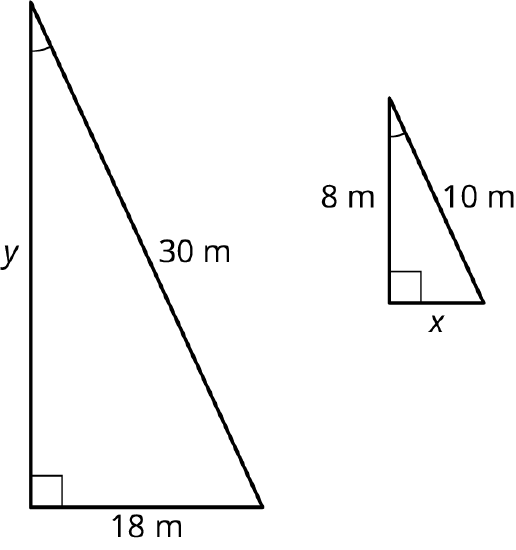
Are these triangles similar? Find the lengths of sides \(x\) and \(y\).
- Answer
-
Yes, they are similar because two angles are equal; \(x = 6\) m, \(y = 24\) m
A person who is 5 feet tall is standing 50 feet away from the base of a tree (see Figure \(\PageIndex{24}\)). The tree casts a 57-foot shadow. The person casts a 7-foot shadow. What is the height of the tree?
- Answer
-
The bigger triangle includes a tree at side \(x\) and the smaller triangle includes the person at the side labeled 5 ft . These two triangles are similar because the smaller triangle fits inside the larger triangle at the smallest angle. It would fit inside the larger triangle at either of the other two angles as well. That all angles are equal is one of the criteria for similar triangles, so we can solve using proportions:
\[\begin{aligned}
\frac{5}{7} & =\frac{x}{57} \\
5(57) & =7 x \\
\frac{285}{7} & =x=40.7
\end{aligned} \nonumber \]The tree is 40.7 feet tall.
A person who is 6 feet tall is standing 100 feet away from the base of a tree. The tree casts a shadow 107.5-foot shadow. The person’s shadow is 7.5 feet long. How tall is the tree?

- Answer
-
86 ft
At a certain time of day, a radio tower casts a shadow 180 feet long (Figure \(\PageIndex{26}\)). At the same time, a 9-foot truck casts a shadow 15 feet long. What is the height of the tower?
- Answer
-
These are similar triangles and the problem can be solved by using proportions:
\[\begin{aligned}
\frac{x}{180} & =\frac{9}{15} \\
9(180) & =15 x \\
1620 & =15 x \\
108 & =x
\end{aligned} \nonumber \]The height of the tower is 108 ft .
A tree casts a shadow of 180 feet early in the morning. A 10-foot high garage casts a shadow of 30 feet at the same time in the morning. What is the height of the tree?
- Answer
-
60 ft
Exercises
Classify Triangles
For the following exercises, classify the triangle with the listed angle measurements as acute, right, or obtuse.
- \(m\measuredangle A = {88^ \circ }\), \(m\measuredangle B = {32^ \circ }\), \(m\measuredangle C = {60^ \circ }\)
- \(m\measuredangle A = {65^ \circ }\), \(m\measuredangle B = {90^ \circ }\), \(m\measuredangle C = {25^ \circ }\)
- \(m\measuredangle A = {30^ \circ }\), \(m\measuredangle B = {120^ \circ }\), \(m\measuredangle C = {30^ \circ }\)
- \(m\measuredangle A = {85^ \circ }\), \(m\measuredangle B = {50^ \circ }\), \(m\measuredangle C = {45^ \circ }\)
Find Measure of Angles
-
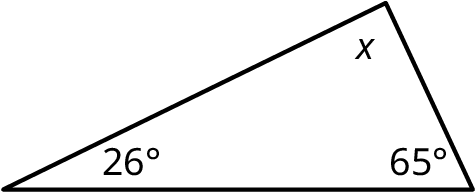
Find the measure of the missing angle in the given figure.
-
Find the measure of the missing angle in the given figure.
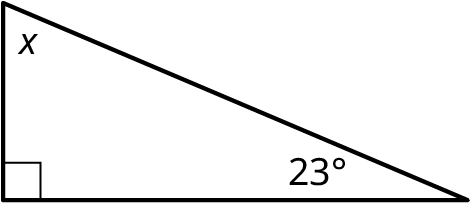
-
In the isosceles triangle shown, find the missing angles.

-
What are the measurements of each angle in the given figure?
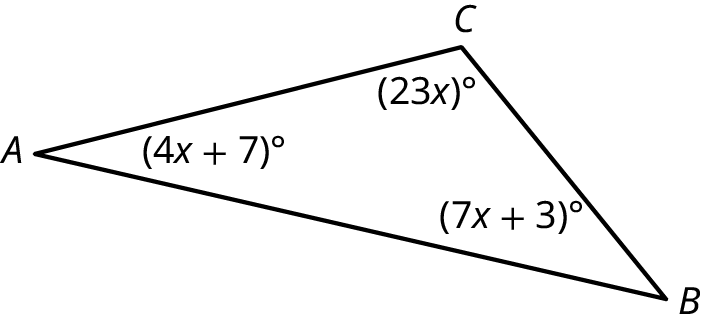
-
Find the angle measurements in the given figure.
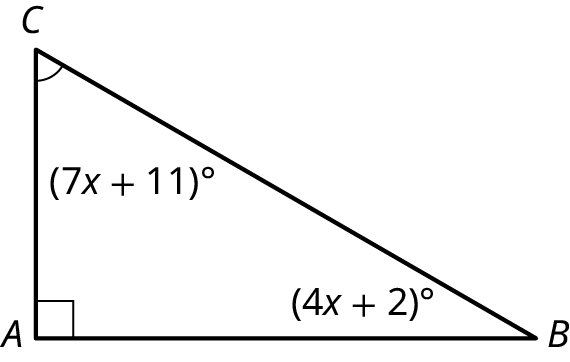
-
Find the angle measurements in the given figure.

Congruence and Similarity
For the following exercises, determine which congruence theorem is used to show that the two triangles are congruent.
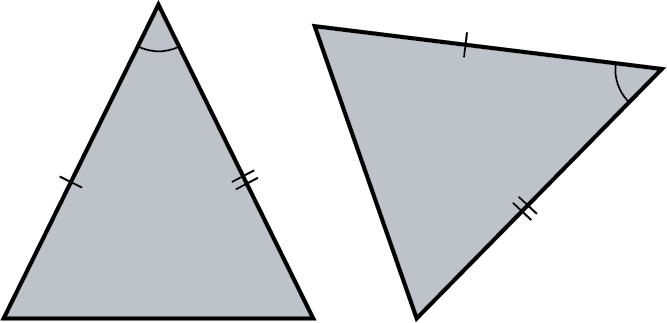
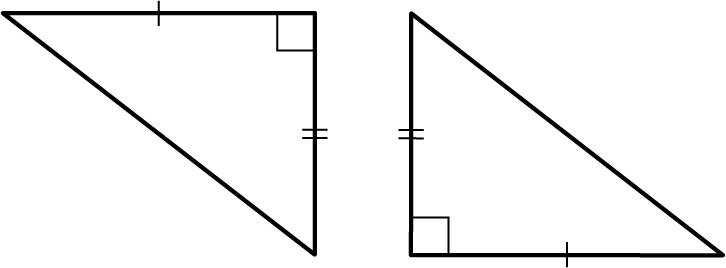
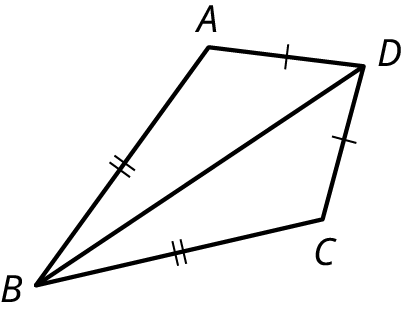
-
Are these triangles similar? If so, what is the common proportion or the scaling factor?
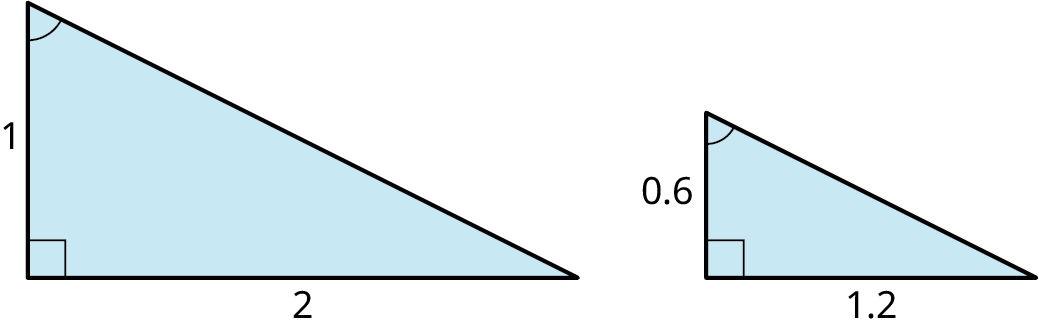
-
Are the images in the given figure similar? If so, what is the common proportion or the scaling factor?
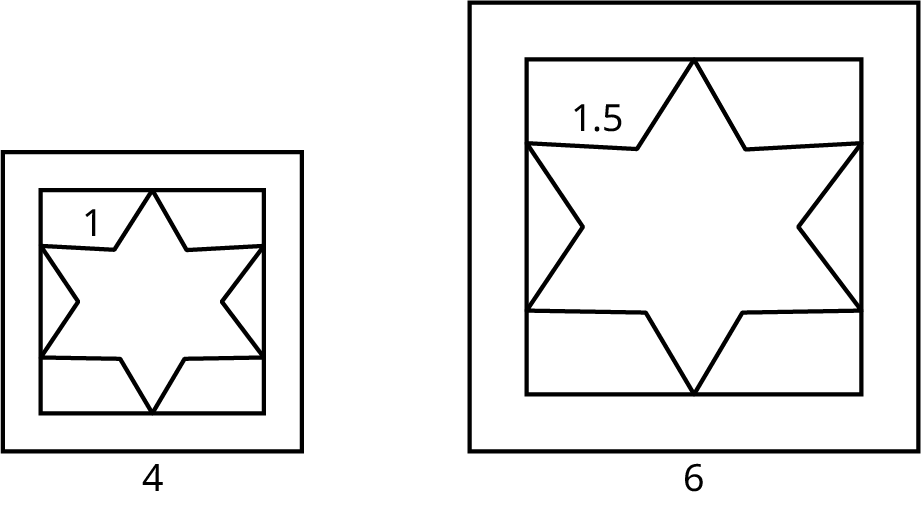
-
In the figure shown given \(\overline {BE}\) is parallel to \(\overline {CD}\), find \(x\) and \(y\).

-
In the figure shown, given \(\overline {BE}\) is parallel to \(\overline {CD} ,\) find \(x\) and \(y\).
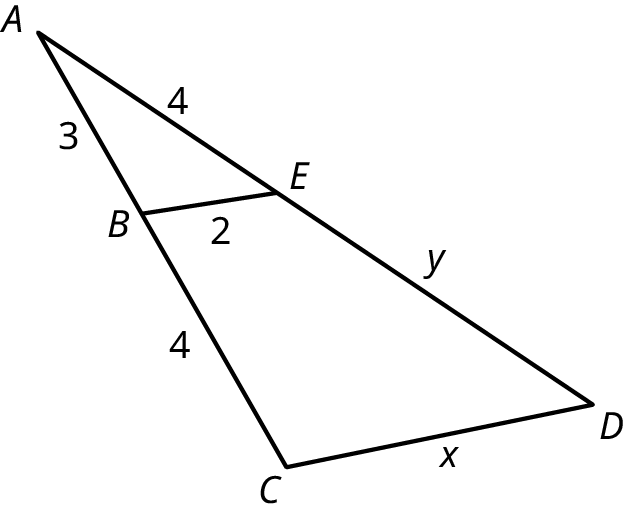
-
Find \(a\) and \(t\) in the given figure.

-
Find \(a\) and \(t\) in the given figure.
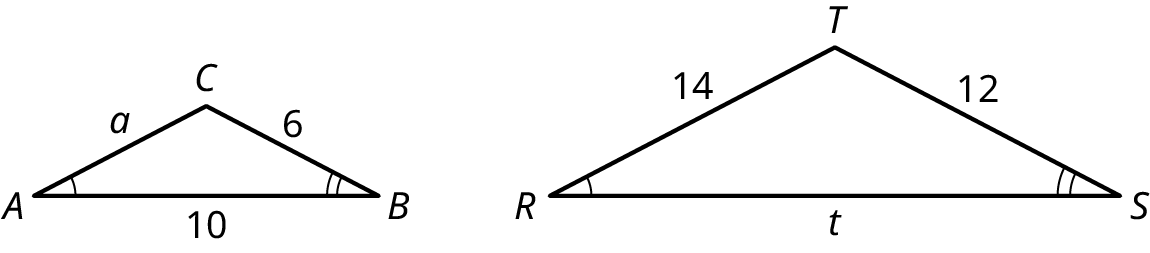
-
In the given figure, find the proportions and solve for \(a\) and \(b\).
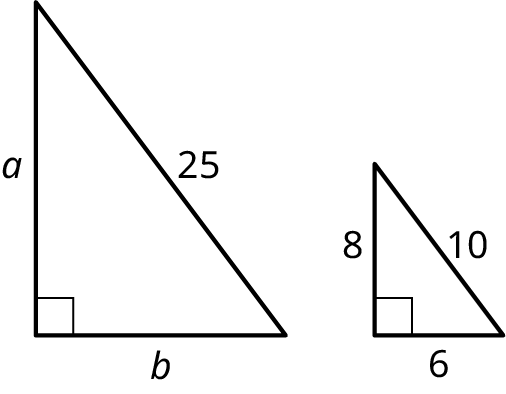
-
In the given figure, find the proportions and solve for \(r\).
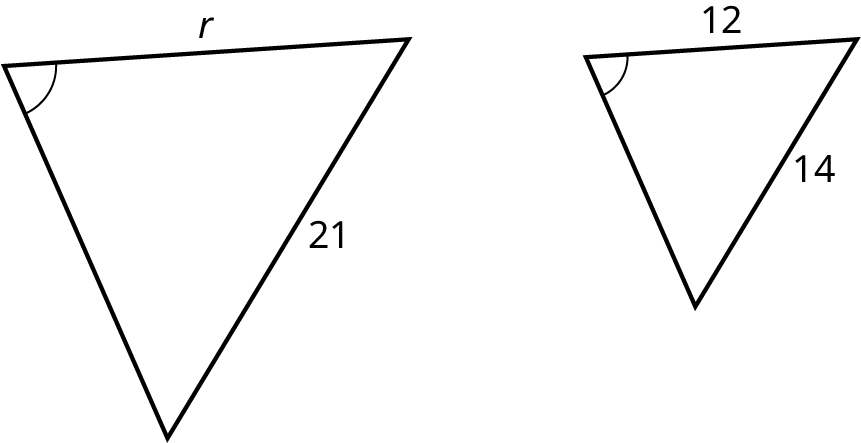
Exercise Answers
- Display answers
-
1. acute
3. obtuse
5. \(89^{\circ}\)
7. \(x=77^{\circ}, y=26^{\circ}\)
9. \(m\measuredangle (4x+2) = 30^{\circ}, m\measuredangle (7x+11) = 60^{\circ}\)
11. SAS
13. SSS
15. yes, \(1.5\)
17. \(x=\dfrac{14}{3}, y=\dfrac{16}{3}\)
19. \(a=7, t=20\)
21. \(r=18\)