

2.6: Natural Logarithms (How Can I Get That Variable Out of the Exponent?)
- Page ID
- 23748

\( \newcommand{\vecs}[1]{\overset { \scriptstyle \rightharpoonup} {\mathbf{#1}} } \)
\( \newcommand{\vecd}[1]{\overset{-\!-\!\rightharpoonup}{\vphantom{a}\smash {#1}}} \)
\( \newcommand{\dsum}{\displaystyle\sum\limits} \)
\( \newcommand{\dint}{\displaystyle\int\limits} \)
\( \newcommand{\dlim}{\displaystyle\lim\limits} \)
\( \newcommand{\id}{\mathrm{id}}\) \( \newcommand{\Span}{\mathrm{span}}\)
( \newcommand{\kernel}{\mathrm{null}\,}\) \( \newcommand{\range}{\mathrm{range}\,}\)
\( \newcommand{\RealPart}{\mathrm{Re}}\) \( \newcommand{\ImaginaryPart}{\mathrm{Im}}\)
\( \newcommand{\Argument}{\mathrm{Arg}}\) \( \newcommand{\norm}[1]{\| #1 \|}\)
\( \newcommand{\inner}[2]{\langle #1, #2 \rangle}\)
\( \newcommand{\Span}{\mathrm{span}}\)
\( \newcommand{\id}{\mathrm{id}}\)
\( \newcommand{\Span}{\mathrm{span}}\)
\( \newcommand{\kernel}{\mathrm{null}\,}\)
\( \newcommand{\range}{\mathrm{range}\,}\)
\( \newcommand{\RealPart}{\mathrm{Re}}\)
\( \newcommand{\ImaginaryPart}{\mathrm{Im}}\)
\( \newcommand{\Argument}{\mathrm{Arg}}\)
\( \newcommand{\norm}[1]{\| #1 \|}\)
\( \newcommand{\inner}[2]{\langle #1, #2 \rangle}\)
\( \newcommand{\Span}{\mathrm{span}}\) \( \newcommand{\AA}{\unicode[.8,0]{x212B}}\)
\( \newcommand{\vectorA}[1]{\vec{#1}} % arrow\)
\( \newcommand{\vectorAt}[1]{\vec{\text{#1}}} % arrow\)
\( \newcommand{\vectorB}[1]{\overset { \scriptstyle \rightharpoonup} {\mathbf{#1}} } \)
\( \newcommand{\vectorC}[1]{\textbf{#1}} \)
\( \newcommand{\vectorD}[1]{\overrightarrow{#1}} \)
\( \newcommand{\vectorDt}[1]{\overrightarrow{\text{#1}}} \)
\( \newcommand{\vectE}[1]{\overset{-\!-\!\rightharpoonup}{\vphantom{a}\smash{\mathbf {#1}}}} \)
\( \newcommand{\vecs}[1]{\overset { \scriptstyle \rightharpoonup} {\mathbf{#1}} } \)
\(\newcommand{\longvect}{\overrightarrow}\)
\( \newcommand{\vecd}[1]{\overset{-\!-\!\rightharpoonup}{\vphantom{a}\smash {#1}}} \)
\(\newcommand{\avec}{\mathbf a}\) \(\newcommand{\bvec}{\mathbf b}\) \(\newcommand{\cvec}{\mathbf c}\) \(\newcommand{\dvec}{\mathbf d}\) \(\newcommand{\dtil}{\widetilde{\mathbf d}}\) \(\newcommand{\evec}{\mathbf e}\) \(\newcommand{\fvec}{\mathbf f}\) \(\newcommand{\nvec}{\mathbf n}\) \(\newcommand{\pvec}{\mathbf p}\) \(\newcommand{\qvec}{\mathbf q}\) \(\newcommand{\svec}{\mathbf s}\) \(\newcommand{\tvec}{\mathbf t}\) \(\newcommand{\uvec}{\mathbf u}\) \(\newcommand{\vvec}{\mathbf v}\) \(\newcommand{\wvec}{\mathbf w}\) \(\newcommand{\xvec}{\mathbf x}\) \(\newcommand{\yvec}{\mathbf y}\) \(\newcommand{\zvec}{\mathbf z}\) \(\newcommand{\rvec}{\mathbf r}\) \(\newcommand{\mvec}{\mathbf m}\) \(\newcommand{\zerovec}{\mathbf 0}\) \(\newcommand{\onevec}{\mathbf 1}\) \(\newcommand{\real}{\mathbb R}\) \(\newcommand{\twovec}[2]{\left[\begin{array}{r}#1 \\ #2 \end{array}\right]}\) \(\newcommand{\ctwovec}[2]{\left[\begin{array}{c}#1 \\ #2 \end{array}\right]}\) \(\newcommand{\threevec}[3]{\left[\begin{array}{r}#1 \\ #2 \\ #3 \end{array}\right]}\) \(\newcommand{\cthreevec}[3]{\left[\begin{array}{c}#1 \\ #2 \\ #3 \end{array}\right]}\) \(\newcommand{\fourvec}[4]{\left[\begin{array}{r}#1 \\ #2 \\ #3 \\ #4 \end{array}\right]}\) \(\newcommand{\cfourvec}[4]{\left[\begin{array}{c}#1 \\ #2 \\ #3 \\ #4 \end{array}\right]}\) \(\newcommand{\fivevec}[5]{\left[\begin{array}{r}#1 \\ #2 \\ #3 \\ #4 \\ #5 \\ \end{array}\right]}\) \(\newcommand{\cfivevec}[5]{\left[\begin{array}{c}#1 \\ #2 \\ #3 \\ #4 \\ #5 \\ \end{array}\right]}\) \(\newcommand{\mattwo}[4]{\left[\begin{array}{rr}#1 \amp #2 \\ #3 \amp #4 \\ \end{array}\right]}\) \(\newcommand{\laspan}[1]{\text{Span}\{#1\}}\) \(\newcommand{\bcal}{\cal B}\) \(\newcommand{\ccal}{\cal C}\) \(\newcommand{\scal}{\cal S}\) \(\newcommand{\wcal}{\cal W}\) \(\newcommand{\ecal}{\cal E}\) \(\newcommand{\coords}[2]{\left\{#1\right\}_{#2}}\) \(\newcommand{\gray}[1]{\color{gray}{#1}}\) \(\newcommand{\lgray}[1]{\color{lightgray}{#1}}\) \(\newcommand{\rank}{\operatorname{rank}}\) \(\newcommand{\row}{\text{Row}}\) \(\newcommand{\col}{\text{Col}}\) \(\renewcommand{\row}{\text{Row}}\) \(\newcommand{\nul}{\text{Nul}}\) \(\newcommand{\var}{\text{Var}}\) \(\newcommand{\corr}{\text{corr}}\) \(\newcommand{\len}[1]{\left|#1\right|}\) \(\newcommand{\bbar}{\overline{\bvec}}\) \(\newcommand{\bhat}{\widehat{\bvec}}\) \(\newcommand{\bperp}{\bvec^\perp}\) \(\newcommand{\xhat}{\widehat{\xvec}}\) \(\newcommand{\vhat}{\widehat{\vvec}}\) \(\newcommand{\uhat}{\widehat{\uvec}}\) \(\newcommand{\what}{\widehat{\wvec}}\) \(\newcommand{\Sighat}{\widehat{\Sigma}}\) \(\newcommand{\lt}{<}\) \(\newcommand{\gt}{>}\) \(\newcommand{\amp}{&}\) \(\definecolor{fillinmathshade}{gray}{0.9}\)Your investment is earning compound interest of 6% per year. You wonder how long it will take to double in value. Answering this question requires you to solve an equation in which the unknown variable is located in the exponent instead of the base position. To find the answer, you need logarithms, which are reviewed in this section and will be applied in Chapter 9 and Chapter 11.
Logarithms
A logarithm is defined as the exponent to which a base must be raised to produce a particular power. Although the base can assume any value, two values for the base are most often used.
- A Base Value of 10. This is referred to as a common logarithm. Thus, if you have \(10^2 = 100\), then 2 is the common logarithm of 100 and this is written as \(\log_{10}(100) = 2\), or just \(\log(100) = 2\) (you can assume the 10 if the base is not written). The format for a common logarithm can then be summarized as
\[\text {log (power) }=\text { exponent }\nonumber \]
\[\text { If you have } 10^{x}=y, \text { then } \log (y)=x.\nonumber \]
- A Base Value of e. This is referred to as a natural logarithm. In mathematics, there is a known constant \(e\), which is a nonterminating decimal and has an approximate value of \(e = 2.71828182845\). If you have \(e^3 = 20.085537\), then 3 is the natural logarithm of 20.085537 and you write this as \(ln(20.085537) = 3\). The format for a natural logarithm is then summarized as:
\[\ln (\text { power })=\text { exponent }\nonumber \]
\[\text { If you have } e^{4}=54.59815, \text { then } \ln (54.59815)=4.\nonumber \]
Common logarithms have been used in the past when calculators were not equipped with power functions. However, with the advent of computers and advanced calculators that have power functions, the natural logarithm is now the most commonly used format. From here on, this textbook focuses on natural logarithms only.
Properties of Natural Logarithms
Natural logarithms possess six properties:
- The natural logarithm of 1 is zero. For example, if 1 is the power and 0 is the exponent, then you have \(e^0 = 1\). This obeys the laws of exponents discussed in Section 2.4 of this chapter.
- The natural logarithm of any number greater than 1 is a positive number. For example, the natural logarithm of 2 is 0.693147, or \(e^{0.693147} = 2\).
- The natural logarithm of any number less than 1 is a negative number. For example, the natural logarithm of 0.5 is \(−0.693147\), or \(e^{−0.693147} = 0.5\). Similar to property 1, this obeys the laws of exponents discussed in Section 2.4, where \(e^{−0.693147} = \dfrac{1}{e^{0.693147}}\), always producing a proper fraction.
- A natural logarithm cannot be less than or equal to zero. Since e is a positive number with an exponent, there is no value of the exponent that can produce a power of zero. As well, it is impossible to produce a negative number when the base is positive.
- The natural logarithm of the quotient of two positive numbers is \(\bf{\ln \left(\dfrac{x}{y}\right)=\ln (x)-\ln (y)}\). For example,
\[\ln \left(\dfrac{\$ 20,000}{\$ 15,000}\right)=\ln (\$ 20,000)-\ln (\$ 15,000).\nonumber \]
\[\ln (1 . \overline{3})=9.903487-9.615805\nonumber \]
\[0.287682=0.287682\nonumber \]
- The natural logarithm of a power of a positive base is \(\bf{\ln \left(x^{y}\right)=y(\ln x)}\). This property allows you to relocate the exponent down into the base. You will apply this property especially in Chapter 9 and Chapter 11. Demonstrating this principle,
\[\begin{aligned} \ln \left(x^{y}\right) &=y(\ln x) \\ \ln \left(1.05^{6}\right) &=6 \times \ln (1.05) \\ \ln (1.340095) &=6 \times 0.048790 \\ 0.292741 &=0.292741 \end{aligned}\nonumber \]
Important Notes
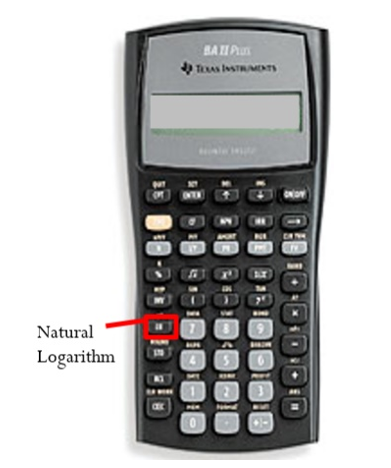
Applying natural logarithms on your TI BAII Plus calculator requires two steps.
- Input the power.
- With the power still on the display, press the LN key located in the left-hand column of your keypad. The solution on the display is the value of the exponent. If you key in an impossible value for the natural logarithm, an "Error 2" message is displayed on the screen.
If you know the exponent and want to find out the power, remember that \(e^x = \text {power}\). This is called the anti-log function. Thus, if you know the exponent is 2, then \(e^2 = 7.389056\). On your calculator, the anti-log can be located on the second shelf directly above the LN button. To access this function, key in the exponent first and then press \(2^{nd} e^x\).
Paths To Success
You do not have to memorize the mathematical constant value of \(e\). If you need to recall this value, use an exponent of 1 and access the \(e^x\) function. Hence, \(e^1 = 2.71828182845\).
For each of the following powers, determine if the natural logarithm is positive, negative, zero, or impossible.
- 2.3
- 1
- 0.45
- 0.97
- −2
- 4.83
- 0
- Answer
-
- positive (property 2)
- zero (Property 1)
- negative (property 3)
- negative (property 3)
- impossible (Property 4)
- positive (property 2)
- impossible (property 4)
Solve the first two questions using your calculator. For the next two questions, demonstrate the applicable property.
- \(\ln(2.035)\)
- \(\ln(0.3987)\)
- \(\ln \left(\dfrac{\$ 10,000}{\$ 6,250}\right)\)
- \(\ln \left[(1.035)^{12}\right]\)
Solution
You need to apply the properties of natural logarithms.
What You Already Know
The properties of natural logarithms are known.
How You Will Get There
- Apply property 2 and key this through your calculator.
- Apply property 3 and key this through your calculator.
- Apply property 5, \(\ln \left(\frac{x}{y}\right)=\ln (x)-\ln (y)\).
- Apply property 6, \(\ln \left(x^{y}\right)=y(\ln x)\)
Perform
- \(\ln(2.035) = 0.710496\)
- \(\ln(0.3987) = −0.919546\)
- \(\begin{aligned} \ln \left(\dfrac{\$ 10,000}{\$ 6,250}\right)&=\ln (\$ 10,000)-\ln (\$ 6,250) \\ \ln (1.6)&=9.210340-8.740336 \\ 0.470004&=0.470004 \end{aligned} \)
- \(\begin{aligned}
\ln \left[(1.035)^{12}\right]&=12 \times \ln (1.035)\\
\ln (1.511068)&=12 \times 0.034401\\
0.412817&=0.412817
\end{aligned}\)
Calculator Instructions
| Answer | |||
|---|---|---|---|
| a. | 2.035 | LN | 0.710496 |
| b. | 0.3987 | LN | -0.919546 |
| c. | \(10000 \div 6250=\) | LN | 0.470004 |
| d. | \(1.035 y^x 12=\) | LN | 0.412817 |
Organizing your answers into a more common format:
- \(e^{0.710496}=2.035\)
- \(e^{-0.919546}=0.3987\)
- \(\ln \left(\dfrac{\$ 10,000}{\$ 6,250}\right)=0.470004\) (as proven by the property)
- \(\ln \left[(1.035)^{12}\right]=0.412817\) (as proven by the property)