

2.6: The Vector Projection of One Vector onto Another
- Page ID
- 125033

\( \newcommand{\vecs}[1]{\overset { \scriptstyle \rightharpoonup} {\mathbf{#1}} } \)
\( \newcommand{\vecd}[1]{\overset{-\!-\!\rightharpoonup}{\vphantom{a}\smash {#1}}} \)
\( \newcommand{\dsum}{\displaystyle\sum\limits} \)
\( \newcommand{\dint}{\displaystyle\int\limits} \)
\( \newcommand{\dlim}{\displaystyle\lim\limits} \)
\( \newcommand{\id}{\mathrm{id}}\) \( \newcommand{\Span}{\mathrm{span}}\)
( \newcommand{\kernel}{\mathrm{null}\,}\) \( \newcommand{\range}{\mathrm{range}\,}\)
\( \newcommand{\RealPart}{\mathrm{Re}}\) \( \newcommand{\ImaginaryPart}{\mathrm{Im}}\)
\( \newcommand{\Argument}{\mathrm{Arg}}\) \( \newcommand{\norm}[1]{\| #1 \|}\)
\( \newcommand{\inner}[2]{\langle #1, #2 \rangle}\)
\( \newcommand{\Span}{\mathrm{span}}\)
\( \newcommand{\id}{\mathrm{id}}\)
\( \newcommand{\Span}{\mathrm{span}}\)
\( \newcommand{\kernel}{\mathrm{null}\,}\)
\( \newcommand{\range}{\mathrm{range}\,}\)
\( \newcommand{\RealPart}{\mathrm{Re}}\)
\( \newcommand{\ImaginaryPart}{\mathrm{Im}}\)
\( \newcommand{\Argument}{\mathrm{Arg}}\)
\( \newcommand{\norm}[1]{\| #1 \|}\)
\( \newcommand{\inner}[2]{\langle #1, #2 \rangle}\)
\( \newcommand{\Span}{\mathrm{span}}\) \( \newcommand{\AA}{\unicode[.8,0]{x212B}}\)
\( \newcommand{\vectorA}[1]{\vec{#1}} % arrow\)
\( \newcommand{\vectorAt}[1]{\vec{\text{#1}}} % arrow\)
\( \newcommand{\vectorB}[1]{\overset { \scriptstyle \rightharpoonup} {\mathbf{#1}} } \)
\( \newcommand{\vectorC}[1]{\textbf{#1}} \)
\( \newcommand{\vectorD}[1]{\overrightarrow{#1}} \)
\( \newcommand{\vectorDt}[1]{\overrightarrow{\text{#1}}} \)
\( \newcommand{\vectE}[1]{\overset{-\!-\!\rightharpoonup}{\vphantom{a}\smash{\mathbf {#1}}}} \)
\( \newcommand{\vecs}[1]{\overset { \scriptstyle \rightharpoonup} {\mathbf{#1}} } \)
\(\newcommand{\longvect}{\overrightarrow}\)
\( \newcommand{\vecd}[1]{\overset{-\!-\!\rightharpoonup}{\vphantom{a}\smash {#1}}} \)
\(\newcommand{\avec}{\mathbf a}\) \(\newcommand{\bvec}{\mathbf b}\) \(\newcommand{\cvec}{\mathbf c}\) \(\newcommand{\dvec}{\mathbf d}\) \(\newcommand{\dtil}{\widetilde{\mathbf d}}\) \(\newcommand{\evec}{\mathbf e}\) \(\newcommand{\fvec}{\mathbf f}\) \(\newcommand{\nvec}{\mathbf n}\) \(\newcommand{\pvec}{\mathbf p}\) \(\newcommand{\qvec}{\mathbf q}\) \(\newcommand{\svec}{\mathbf s}\) \(\newcommand{\tvec}{\mathbf t}\) \(\newcommand{\uvec}{\mathbf u}\) \(\newcommand{\vvec}{\mathbf v}\) \(\newcommand{\wvec}{\mathbf w}\) \(\newcommand{\xvec}{\mathbf x}\) \(\newcommand{\yvec}{\mathbf y}\) \(\newcommand{\zvec}{\mathbf z}\) \(\newcommand{\rvec}{\mathbf r}\) \(\newcommand{\mvec}{\mathbf m}\) \(\newcommand{\zerovec}{\mathbf 0}\) \(\newcommand{\onevec}{\mathbf 1}\) \(\newcommand{\real}{\mathbb R}\) \(\newcommand{\twovec}[2]{\left[\begin{array}{r}#1 \\ #2 \end{array}\right]}\) \(\newcommand{\ctwovec}[2]{\left[\begin{array}{c}#1 \\ #2 \end{array}\right]}\) \(\newcommand{\threevec}[3]{\left[\begin{array}{r}#1 \\ #2 \\ #3 \end{array}\right]}\) \(\newcommand{\cthreevec}[3]{\left[\begin{array}{c}#1 \\ #2 \\ #3 \end{array}\right]}\) \(\newcommand{\fourvec}[4]{\left[\begin{array}{r}#1 \\ #2 \\ #3 \\ #4 \end{array}\right]}\) \(\newcommand{\cfourvec}[4]{\left[\begin{array}{c}#1 \\ #2 \\ #3 \\ #4 \end{array}\right]}\) \(\newcommand{\fivevec}[5]{\left[\begin{array}{r}#1 \\ #2 \\ #3 \\ #4 \\ #5 \\ \end{array}\right]}\) \(\newcommand{\cfivevec}[5]{\left[\begin{array}{c}#1 \\ #2 \\ #3 \\ #4 \\ #5 \\ \end{array}\right]}\) \(\newcommand{\mattwo}[4]{\left[\begin{array}{rr}#1 \amp #2 \\ #3 \amp #4 \\ \end{array}\right]}\) \(\newcommand{\laspan}[1]{\text{Span}\{#1\}}\) \(\newcommand{\bcal}{\cal B}\) \(\newcommand{\ccal}{\cal C}\) \(\newcommand{\scal}{\cal S}\) \(\newcommand{\wcal}{\cal W}\) \(\newcommand{\ecal}{\cal E}\) \(\newcommand{\coords}[2]{\left\{#1\right\}_{#2}}\) \(\newcommand{\gray}[1]{\color{gray}{#1}}\) \(\newcommand{\lgray}[1]{\color{lightgray}{#1}}\) \(\newcommand{\rank}{\operatorname{rank}}\) \(\newcommand{\row}{\text{Row}}\) \(\newcommand{\col}{\text{Col}}\) \(\renewcommand{\row}{\text{Row}}\) \(\newcommand{\nul}{\text{Nul}}\) \(\newcommand{\var}{\text{Var}}\) \(\newcommand{\corr}{\text{corr}}\) \(\newcommand{\len}[1]{\left|#1\right|}\) \(\newcommand{\bbar}{\overline{\bvec}}\) \(\newcommand{\bhat}{\widehat{\bvec}}\) \(\newcommand{\bperp}{\bvec^\perp}\) \(\newcommand{\xhat}{\widehat{\xvec}}\) \(\newcommand{\vhat}{\widehat{\vvec}}\) \(\newcommand{\uhat}{\widehat{\uvec}}\) \(\newcommand{\what}{\widehat{\wvec}}\) \(\newcommand{\Sighat}{\widehat{\Sigma}}\) \(\newcommand{\lt}{<}\) \(\newcommand{\gt}{>}\) \(\newcommand{\amp}{&}\) \(\definecolor{fillinmathshade}{gray}{0.9}\)Projection
Let’s project vector \(\overrightarrow{u}\boldsymbol{=}\left\langle u_x,\left.u_y\right\rangle \right.\) onto the vector \(\overrightarrow{v}\boldsymbol{=}\left\langle v_x,\left.v_y\right\rangle \right.\).
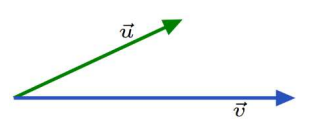
To do so, imagine a light bulb above \(\overrightarrow{u}\) shining perpendicular onto \(\overrightarrow{v}\).
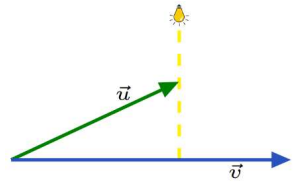
The light from the bulb will cast a shadow of \(\overrightarrow{u}\) onto \(\overrightarrow{v}\), and it is this shadow that we are looking for. The shadow is the projection of \(\overrightarrow{u}\) onto \(\overrightarrow{v}\).
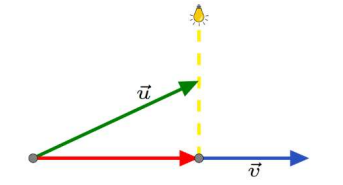
The red vector is the projection of \(\overrightarrow{u}\) onto \(\overrightarrow{v}\). The notation commonly used to represent the projection of \(\overrightarrow{u}\) onto \(\overrightarrow{v}\) is \({\mathrm{proj}}_{\overrightarrow{\mathrm{v}}}\overrightarrow{u}\).
Vector parallel to \(\overrightarrow{v}\) with magnitude \(\frac{\overrightarrow{u}\bullet \overrightarrow{v}}{\left\|\overrightarrow{v}\right\|}\) in the direction of \(\overrightarrow{v}\) is called projection of \(\overrightarrow{u}\) onto \(\overrightarrow{v}\).
The formula for \({\mathrm{proj}}_{\overrightarrow{\mathrm{v}}}\overrightarrow{u}\) is
\[\operatorname{proj}_{\overrightarrow{\mathrm{v}}} \vec{u}=\frac{\vec{u} \cdot \vec{v}}{\|\vec{v}\|^2} \vec{v} \nonumber \]
To find the projection of \(\vec{u}=\langle 4,3\rangle\) onto \(\vec{v}=\langle 2,8\rangle\), we need to compute both the dot product of \(\overrightarrow{u}\) and \(\overrightarrow{v}\), and the magnitude of \(\overrightarrow{v}\), then apply the formula.
Solution
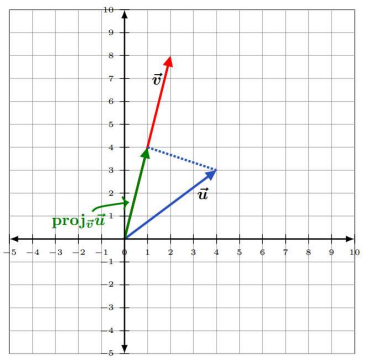
\(\begin{gathered}
\operatorname{proj}_{\overrightarrow{\mathrm{v}}} \vec{u}=\frac{\vec{u} \cdot \vec{v}}{\|\vec{v}\|^2} \vec{v} \\
\operatorname{proj}_{\vec{v}} \vec{u}=\frac{\langle 4,3\rangle \cdot\langle 2,8\rangle}{\|\langle 2,8\rangle\|^2}\langle 2,8\rangle \\
\operatorname{proj}_{\overrightarrow{\mathrm{v}}} \vec{u}=\frac{4 \cdot 2+3 \cdot 8}{\left(\sqrt{2^2+8^2}\right)^2}\langle 2,8\rangle \\
\operatorname{proj}_{\vec{v}} \vec{u}=\frac{32}{(\sqrt{4+64})^2}\langle 2,8\rangle \\
\operatorname{proj}_{\vec{v}} \vec{u}=\frac{32}{68}\langle 2,8\rangle \\
\operatorname{proj}_{\vec{v}} \vec{u}=\frac{8}{17}\langle 2,8\rangle \\
\operatorname{proj}_{\vec{v}} \vec{u}=\left\langle\frac{16}{17}, \frac{64}{17}\right\rangle
\end{gathered}\)
Using Technology
We can use technology to determine the projection of one vector onto another.
Go to www.wolframalpha.com.
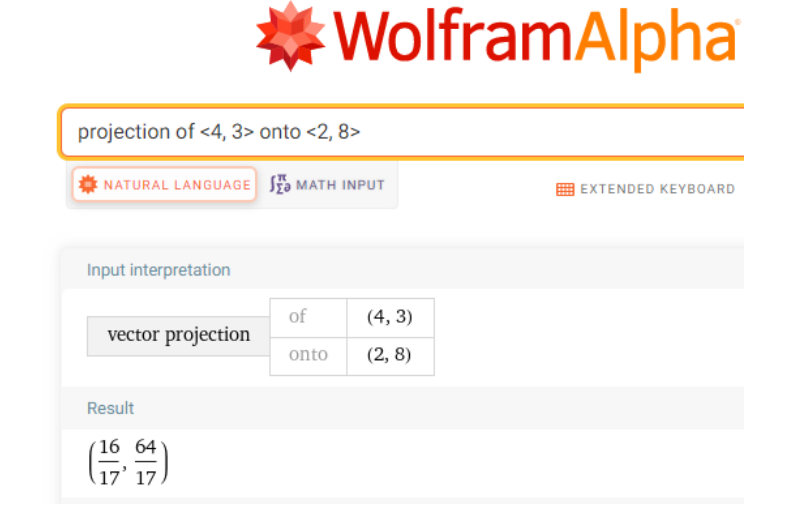
To find the projection of \(\overrightarrow{u}=\left\langle 4,\left.3\right\rangle \right.\) onto \(\vec{v}=\langle 2,8\rangle\), use the “projection” command. In the entry field enter projection of \(\mathrm{<}\)4, 3\(\mathrm{>}\) onto \(\mathrm{<}\)2, 8\(\mathrm{>}\).
 \\
\\
Wolfram alpha tells you what it thinks you entered, then tells you its answer. In this case, \(\left\langle \frac{16}{17},\left.\frac{64}{17}\right\rangle \right.\).
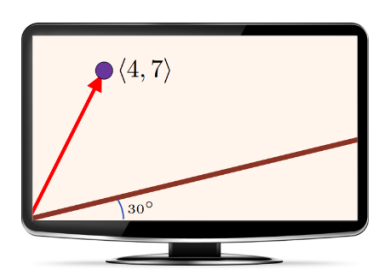
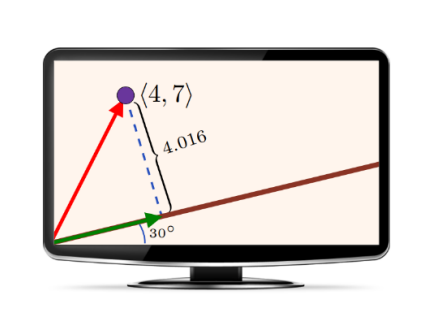
As an applied example, suppose a video game has a ball moving near a wall.
Solution
We take the origin at the bottom-left-most corner of the screen. The wall is at a 30\(\mathrm{{}^\circ}\) angle to the horizontal, and at a point in time, the ball is at position \(\overrightarrow{v}\boldsymbol{=\ }\)\(\mathrm{\langle }\)4,\(\ \left.7\right\rangle\). To find the perpendicular distance from the ball to the wall, we use the projection formula to project the vector \(\overrightarrow{v}\boldsymbol{=\ }\)\(\mathrm{\langle }\)4,\(\ \left.7\right\rangle\) onto the wall.
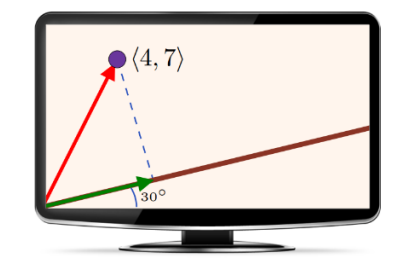
We begin by decomposing \(\overrightarrow{v}\) into two vectors \({\overrightarrow{v}}_1\) and \({\overrightarrow{v}}_2\) so that \(\overrightarrow{v}=\ {\overrightarrow{v}}_1+{\overrightarrow{v}}_2\) and \({\overrightarrow{v}}_1\) lies along the wall.
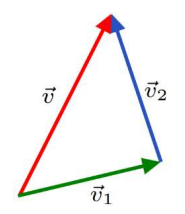
The length (magnitude) of the vector \(\overrightarrow{v}\) is then the distance from the ball to the wall.
The vector \({\overrightarrow{v}}_1\) is the projection of \(\overrightarrow{v}\) onto the wall. We can get \({\overrightarrow{v}}_1\) by scaling (multiplying) a unit vector \(\overrightarrow{w}\) that lies along the wall and, thus, along with \({\overrightarrow{v}}_1\).
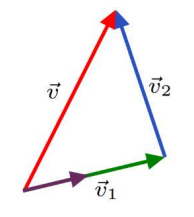
Since \(\overrightarrow{w}\) lies at a 30\(\mathrm{{}^\circ}\) angle to the horizontal, \(\overrightarrow{w}\boldsymbol{=}\left.\boldsymbol{\langle }\mathrm{cos}30{}^\circ ,\ \ \mathrm{sin}30{}^\circ \right\rangle \boldsymbol{=}\left.\boldsymbol{\langle }\mathrm{0.866},\ \mathrm{0.5}\right\rangle\), using the projection formula, we get the projection of \(\overrightarrow{v}\) that lies along the wall.
\(\begin{gathered}
\vec{v}_1=\operatorname{proj}_{\vec{w}} \vec{v}=\frac{\vec{v} \cdot \vec{w}}{\|\vec{w}\|^2} \vec{w} \\
\vec{v}_1 \frac{\langle 4,7\rangle \cdot\langle 0.866,0.5\rangle}{\left\|\left(\frac{\sqrt{3}}{2}, \frac{1}{2}\right)\right\|^2}\langle 0.866,0.5\rangle =\frac{4 \cdot(0.866)+7 \cdot(0.5)}{\left(\sqrt{(0.866)^2+(.5)^2}\right)^2}\langle 0.866,0.5\rangle \\
\vec{v}_1=\frac{6.964}{(\sqrt{1})^2}\langle 0.866,0.5\rangle\\
\vec{v}_1=(6.964)\langle 0.866,0.5\rangle \\
\vec{v}_1=\langle 6.031,3.482\rangle
\end{gathered}\)
Since that \(\vec{v}=\vec{v}_{\mathbf{1}}+\vec{v}_{\mathbf{2}}\), subtraction get us
\(\begin{gathered}
\vec{v}_2=\vec{v}-\vec{v}_1 \\
\vec{v}_2=\langle 4,7\rangle-\langle 6.031,3.482\rangle \\
\vec{v}_2=\langle 4-6.031,7-3.482\rangle \\
\vec{v}_2=\langle-2.031,3.518\rangle
\end{gathered}\)
To get the magnitude of \(\vec{v}_2\), we use
\(\begin{gathered}
\left\|\vec{v}_2\right\|=\sqrt{v_x^2+v_y^2} \\
\left\|\overrightarrow{\boldsymbol{v}}_2\right\|=\sqrt{(-2.031)^2+3.518^2} \\
\left\|\vec{v}_2\right\|=\sqrt{4.125+12.376} \\
\left\|\overrightarrow{\vec{v}_2}\right\|=4.062
\end{gathered}\)
Try These
Find the projection of the vector \(\vec{v}=\langle 3,5\rangle\) onto the vector \(\vec{u}=\langle 6,2\rangle\).
- Answer
-
\(\left\langle \frac{21}{5}\right.,\ \left.\frac{7}{5}\right\rangle\)
Find \(\operatorname{proj}_{\vec{v}} \vec{u}\), with \(\vec{u}=\langle-2,5\rangle\) and \(\vec{v}=\langle 6,-5\rangle\).
- Answer
-
\(\left\langle \frac{-222}{61}\right.,\ \left.\frac{185}{61}\right\rangle\)