

1.2: Finding Area by Decomposing and Rearranging
- Page ID
- 39428

\( \newcommand{\vecs}[1]{\overset { \scriptstyle \rightharpoonup} {\mathbf{#1}} } \)
\( \newcommand{\vecd}[1]{\overset{-\!-\!\rightharpoonup}{\vphantom{a}\smash {#1}}} \)
\( \newcommand{\dsum}{\displaystyle\sum\limits} \)
\( \newcommand{\dint}{\displaystyle\int\limits} \)
\( \newcommand{\dlim}{\displaystyle\lim\limits} \)
\( \newcommand{\id}{\mathrm{id}}\) \( \newcommand{\Span}{\mathrm{span}}\)
( \newcommand{\kernel}{\mathrm{null}\,}\) \( \newcommand{\range}{\mathrm{range}\,}\)
\( \newcommand{\RealPart}{\mathrm{Re}}\) \( \newcommand{\ImaginaryPart}{\mathrm{Im}}\)
\( \newcommand{\Argument}{\mathrm{Arg}}\) \( \newcommand{\norm}[1]{\| #1 \|}\)
\( \newcommand{\inner}[2]{\langle #1, #2 \rangle}\)
\( \newcommand{\Span}{\mathrm{span}}\)
\( \newcommand{\id}{\mathrm{id}}\)
\( \newcommand{\Span}{\mathrm{span}}\)
\( \newcommand{\kernel}{\mathrm{null}\,}\)
\( \newcommand{\range}{\mathrm{range}\,}\)
\( \newcommand{\RealPart}{\mathrm{Re}}\)
\( \newcommand{\ImaginaryPart}{\mathrm{Im}}\)
\( \newcommand{\Argument}{\mathrm{Arg}}\)
\( \newcommand{\norm}[1]{\| #1 \|}\)
\( \newcommand{\inner}[2]{\langle #1, #2 \rangle}\)
\( \newcommand{\Span}{\mathrm{span}}\) \( \newcommand{\AA}{\unicode[.8,0]{x212B}}\)
\( \newcommand{\vectorA}[1]{\vec{#1}} % arrow\)
\( \newcommand{\vectorAt}[1]{\vec{\text{#1}}} % arrow\)
\( \newcommand{\vectorB}[1]{\overset { \scriptstyle \rightharpoonup} {\mathbf{#1}} } \)
\( \newcommand{\vectorC}[1]{\textbf{#1}} \)
\( \newcommand{\vectorD}[1]{\overrightarrow{#1}} \)
\( \newcommand{\vectorDt}[1]{\overrightarrow{\text{#1}}} \)
\( \newcommand{\vectE}[1]{\overset{-\!-\!\rightharpoonup}{\vphantom{a}\smash{\mathbf {#1}}}} \)
\( \newcommand{\vecs}[1]{\overset { \scriptstyle \rightharpoonup} {\mathbf{#1}} } \)
\(\newcommand{\longvect}{\overrightarrow}\)
\( \newcommand{\vecd}[1]{\overset{-\!-\!\rightharpoonup}{\vphantom{a}\smash {#1}}} \)
\(\newcommand{\ket}[1]{\left| #1 \right>}\)
\(\newcommand{\bra}[1]{\left< #1 \right|}\)
\(\newcommand{\braket}[2]{\left< #1 \vphantom{#2} \right| \left. #2 \vphantom{#1} \right>}\)
\(\newcommand{\braopket}[3]{\left< #1 \vphantom{#2}\vphantom{#3} \right| #2 \vphantom{#1}\vphantom{#3} \left| #3 \vphantom{#1}\vphantom{#2} \right>}\)
\(\newcommand{\qmvec}[1]{\mathbf{\vec{#1}}}\)
\(\newcommand{\op}[1]{\hat{\mathbf{#1}}}\)
\(\newcommand{\expect}[1]{\langle #1 \rangle}\)
\(\newcommand{\dfn}[1]{\emph{\textbf{#1}}}\)
Lesson
Let's create shapes and find their areas.
Exercise \(\PageIndex{1}\): What is Area?
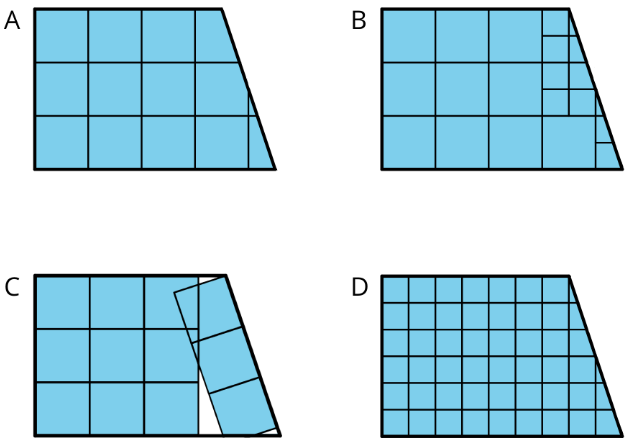
You may recall that the term area tells us something about the number of squares inside a two-dimensional shape.
- Here are four drawings that each show squares inside a shape. Select all drawings whose squares could be used to find the area of the shape. Be prepared to explain your reasoning.
- Write a definition of area that includes all the information that you think is important.
Exercise \(\PageIndex{2}\): Composing Shapes
This applet has one square and some small, medium, and large right triangles. The area of the square is 1 square unit.
Click on a shape and drag to move it. Grab the point at the vertex and drag to turn it.
- Notice that you can put together two small triangles to make a square. What is the area of the square composed of two small triangles? Be prepared to explain your reasoning.
- Use your shapes to create a new shape with an area of 1 square unit that is not a square. Draw your shape on paper and label it with its area.
- Use your shapes to create a new shape with an area of 2 square units. Draw your shape and label it with its area.
- Use your shapes to create a different shape with an area of 2 square units. Draw your shape and label it with its area.
- Use your shapes to create a new shape with an area of 4 square units. Draw your shape and label it with its area.
Are you ready for more?
Find a way to use all of your pieces to compose a single large square. What is the area of this large square?
Exercise \(\PageIndex{3}\): Tangram Triangles
Recall that the area of the square you saw earlier is 1 square unit. Complete each statement and explain your reasoning.
- The area of the small triangle is ____________ square units. I know this because . . .
- The area of the medium triangle is ____________ square units. I know this because . . .
- The area of the large triangle is ____________ square units. I know this because . . .
Summary
Here are two important principles for finding area:
- If two figures can be placed one on top of the other so that they match up exactly, then they have the same area.
- We can decompose a figure (break a figure into pieces) and rearrange the pieces (move the pieces around) to find its area.
Here are illustrations of the two principles.
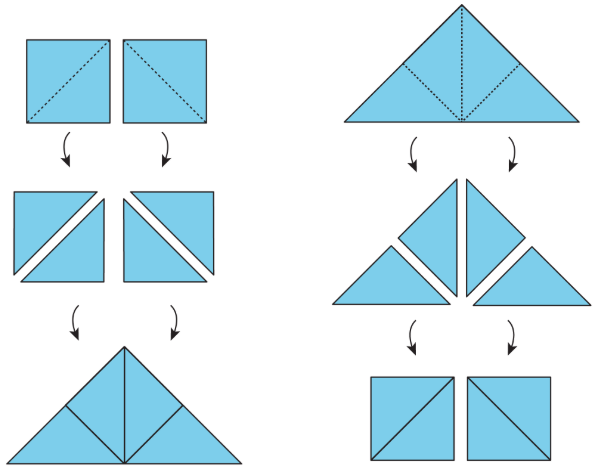
- Each square on the left can be decomposed into 2 triangles. These triangles can be rearranged into a large triangle. So the large triangle has the same area as the 2 squares.
- Similarly, the large triangle on the right can be decomposed into 4 equal triangles. The triangles can be rearranged to form 2 squares. If each square has an area of 1 square unit, then the area of the large triangle is 2 square units. We also can say that each small triangle has an area of \(\frac{1}{2}\) square unit.
Glossary Entries
Definition: Area
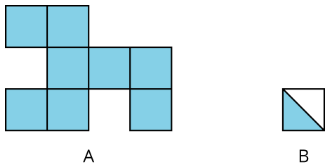
Area is the number of square units that cover a two-dimensional region, without any gaps or overlaps.
For example, the area of region A is 8 square units. The area of the shaded region of B is \(\frac{1}{2}\) square unit.
Definition: Compose
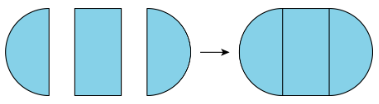
Compose means “put together.” We use the word compose to describe putting more than one figure together to make a new shape.
Definition: Decompose
Decompose means “take apart.” We use the word decompose to describe taking a figure apart to make more than one new shape.
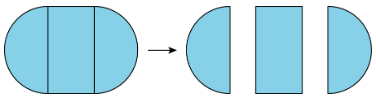
Definition: Region
A region is the space inside of a shape. Some examples of two-dimensional regions are inside a circle or inside a polygon. Some examples of three-dimensional regions are the inside of a cube or the inside of a sphere.
Practice
Exercise \(\PageIndex{4}\)
The diagonal of a rectangle is shown.

- Decompose the rectangle along the diagonal, and recompose the two pieces to make a different shape.
- How does the area of this new shape compare to the area of the original rectangle? Explain how you know.
Exercise \(\PageIndex{5}\)
Priya decomposed a square into 16 smaller, equal-size squares and then cut out 4 of the small squares and attached them around the outside of original square to make a new figure.
How does the area of her new figure compare with that of the original square?
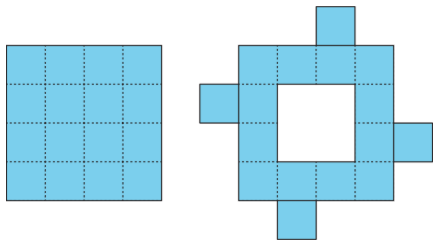
- The area of the new figure is greater.
- The two figures have the same area.
- The area of the original square is greater.
- We don’t know because neither the side length nor the area of the original square is known.
Exercise \(\PageIndex{6}\)
The area of the square is 1 square unit. Two small triangles can be put together to make a square or to make a medium triangle.

Which figure also has an area of \(1\frac{1}{2}\) square units? Select all that apply.
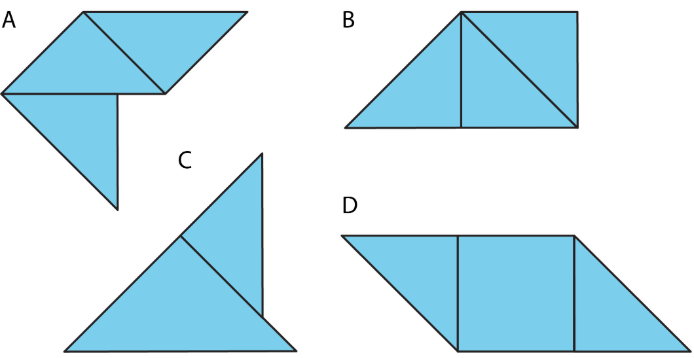
- Figure A
- Figure B
- Figure C
- Figure D
Exercise \(\PageIndex{7}\)
The area of a rectangular playground is 78 square meters. If the length of the playground is 13 meters, what is its width?
(From Unit 1.1.1)
Exercise \(\PageIndex{8}\)
A student said, “We can’t find the area of the shaded region because the shape has many different measurements, instead of just a length and a width that we could multiply.”

Explain why the student's statement about area is incorrect.
(From Unit 1.1.1)