

10: Linear Independence
- Page ID
- 1732

\( \newcommand{\vecs}[1]{\overset { \scriptstyle \rightharpoonup} {\mathbf{#1}} } \)
\( \newcommand{\vecd}[1]{\overset{-\!-\!\rightharpoonup}{\vphantom{a}\smash {#1}}} \)
\( \newcommand{\dsum}{\displaystyle\sum\limits} \)
\( \newcommand{\dint}{\displaystyle\int\limits} \)
\( \newcommand{\dlim}{\displaystyle\lim\limits} \)
\( \newcommand{\id}{\mathrm{id}}\) \( \newcommand{\Span}{\mathrm{span}}\)
( \newcommand{\kernel}{\mathrm{null}\,}\) \( \newcommand{\range}{\mathrm{range}\,}\)
\( \newcommand{\RealPart}{\mathrm{Re}}\) \( \newcommand{\ImaginaryPart}{\mathrm{Im}}\)
\( \newcommand{\Argument}{\mathrm{Arg}}\) \( \newcommand{\norm}[1]{\| #1 \|}\)
\( \newcommand{\inner}[2]{\langle #1, #2 \rangle}\)
\( \newcommand{\Span}{\mathrm{span}}\)
\( \newcommand{\id}{\mathrm{id}}\)
\( \newcommand{\Span}{\mathrm{span}}\)
\( \newcommand{\kernel}{\mathrm{null}\,}\)
\( \newcommand{\range}{\mathrm{range}\,}\)
\( \newcommand{\RealPart}{\mathrm{Re}}\)
\( \newcommand{\ImaginaryPart}{\mathrm{Im}}\)
\( \newcommand{\Argument}{\mathrm{Arg}}\)
\( \newcommand{\norm}[1]{\| #1 \|}\)
\( \newcommand{\inner}[2]{\langle #1, #2 \rangle}\)
\( \newcommand{\Span}{\mathrm{span}}\) \( \newcommand{\AA}{\unicode[.8,0]{x212B}}\)
\( \newcommand{\vectorA}[1]{\vec{#1}} % arrow\)
\( \newcommand{\vectorAt}[1]{\vec{\text{#1}}} % arrow\)
\( \newcommand{\vectorB}[1]{\overset { \scriptstyle \rightharpoonup} {\mathbf{#1}} } \)
\( \newcommand{\vectorC}[1]{\textbf{#1}} \)
\( \newcommand{\vectorD}[1]{\overrightarrow{#1}} \)
\( \newcommand{\vectorDt}[1]{\overrightarrow{\text{#1}}} \)
\( \newcommand{\vectE}[1]{\overset{-\!-\!\rightharpoonup}{\vphantom{a}\smash{\mathbf {#1}}}} \)
\( \newcommand{\vecs}[1]{\overset { \scriptstyle \rightharpoonup} {\mathbf{#1}} } \)
\(\newcommand{\longvect}{\overrightarrow}\)
\( \newcommand{\vecd}[1]{\overset{-\!-\!\rightharpoonup}{\vphantom{a}\smash {#1}}} \)
\(\newcommand{\ket}[1]{\left| #1 \right>}\)
\(\newcommand{\bra}[1]{\left< #1 \right|}\)
\(\newcommand{\braket}[2]{\left< #1 \vphantom{#2} \right| \left. #2 \vphantom{#1} \right>}\)
\(\newcommand{\braopket}[3]{\left< #1 \vphantom{#2}\vphantom{#3} \right| #2 \vphantom{#1}\vphantom{#3} \left| #3 \vphantom{#1}\vphantom{#2} \right>}\)
\(\newcommand{\qmvec}[1]{\mathbf{\vec{#1}}}\)
\(\newcommand{\op}[1]{\hat{\mathbf{#1}}}\)
\(\newcommand{\expect}[1]{\langle #1 \rangle}\)
\(\newcommand{\dfn}[1]{\emph{\textbf{#1}}}\)
Consider a plane \(P\) that includes the origin in \(\Re^{3}\) and a collection \(\{u,v,w\}\) of non-zero vectors in \(P\):
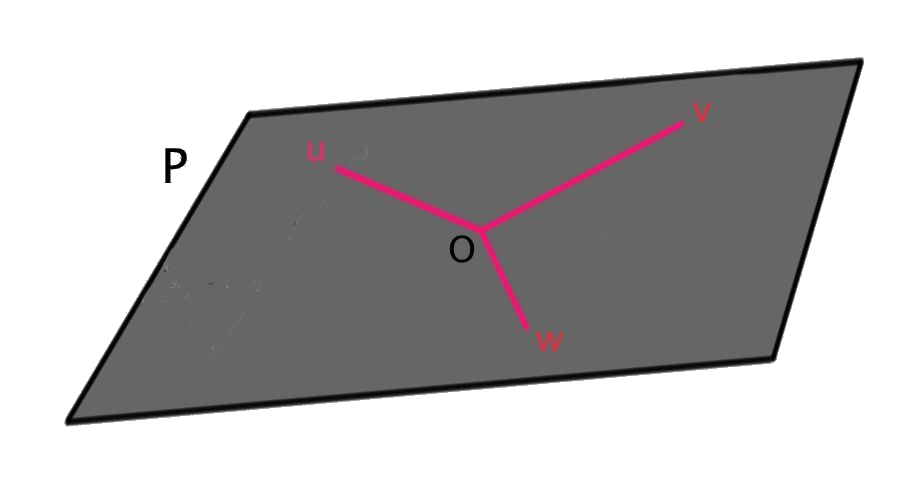
If no two of \(u, v\) and \(w\) are parallel, then \(P= span \{u,v,w\}\). But any two vectors determines a plane, so we should be able to span the plane using only two of the vectors \(u,v,w\). Then we could choose two of the vectors in \(\{u,v,w\}\) whose span is \(P\), and express the other as a linear combination of those two. Suppose \(u\) and \(v\) span \(P\). Then there exist constants \(d^{1}, d^{2}\) (not both zero) such that \(w=d^{1}u+d^{2}v\). Since \(w\) can be expressed in terms of \(u\) and \(v\) we say that it is not independent. More generally, the relationship
\[c^{1}u+c^{2}v+c^{3}w=0 \qquad c^{i} \in \Re, \textit{ some \(c^{i}\neq 0\)}\]
expresses the fact that \(u,v,w\) are not all independent.
We say that the vectors \(v_{1}, v_{2}, \ldots, v_{n}\) are \(\textit{linearly dependent}\) if there exist constants (usually our vector spaces are defined over \(\mathbb{R}\), but in general we can have vector spaces defined over different base fields such as \(\mathbb{C}\) or \(\mathbb{Z}_{2}\). The coefficients \(c^{i}\) should come from whatever our base field is (usually \(\mathbb{R}\)).} \(c^{1}, c^{2}, \ldots, c^{n}\) not all zero such that
\[c^{1}v_{1} + c^{2}v_{2}+ \cdots +c^{n}v_{n}=0.\]
Otherwise, the vectors \(v_{1}, v_{2}, \ldots, v_{n}\) are \(\textit{linearly independent.}\)
Remark
The zero vector \(0_{V}\) can \(\textit{never}\) be on a list of independent vectors because \(\alpha 0_{V}=0_{V}\) for any scalar \(\alpha\).
\(\PageIndex{1}\):
Consider the following vectors in \(\Re^{3}\):
\[
v_{1}=\begin{pmatrix}4\\-1\\3\end{pmatrix}, \qquad
v_{2}=\begin{pmatrix}-3\\7\\4\end{pmatrix}, \qquad
v_{3}=\begin{pmatrix}5\\12\\17\end{pmatrix}, \qquad
v_{4}=\begin{pmatrix}-1\\1\\0\end{pmatrix}.
\]
Are these vectors linearly independent?
No, since \(3v_{1}+2v_{2}-v_{3}+v_{4}=0\), the vectors are linearly \(\textit{dependent}\).
Contributor
David Cherney, Tom Denton, and Andrew Waldron (UC Davis)