

Registration is now open for this year's LibreFest! Join us virtually the week of July 13.

Register here
Mathematics LibreTexts

10.4E: Exercises

  • Page ID
    49978
  • \( \newcommand{\vecs}[1]{\overset { \scriptstyle \rightharpoonup} {\mathbf{#1}} } \)

    \( \newcommand{\vecd}[1]{\overset{-\!-\!\rightharpoonup}{\vphantom{a}\smash {#1}}} \)

    \( \newcommand{\dsum}{\displaystyle\sum\limits} \)

    \( \newcommand{\dint}{\displaystyle\int\limits} \)

    \( \newcommand{\dlim}{\displaystyle\lim\limits} \)

    \( \newcommand{\id}{\mathrm{id}}\) \( \newcommand{\Span}{\mathrm{span}}\)

    ( \newcommand{\kernel}{\mathrm{null}\,}\) \( \newcommand{\range}{\mathrm{range}\,}\)

    \( \newcommand{\RealPart}{\mathrm{Re}}\) \( \newcommand{\ImaginaryPart}{\mathrm{Im}}\)

    \( \newcommand{\Argument}{\mathrm{Arg}}\) \( \newcommand{\norm}[1]{\| #1 \|}\)

    \( \newcommand{\inner}[2]{\langle #1, #2 \rangle}\)

    \( \newcommand{\Span}{\mathrm{span}}\)

    \( \newcommand{\id}{\mathrm{id}}\)

    \( \newcommand{\Span}{\mathrm{span}}\)

    \( \newcommand{\kernel}{\mathrm{null}\,}\)

    \( \newcommand{\range}{\mathrm{range}\,}\)

    \( \newcommand{\RealPart}{\mathrm{Re}}\)

    \( \newcommand{\ImaginaryPart}{\mathrm{Im}}\)

    \( \newcommand{\Argument}{\mathrm{Arg}}\)

    \( \newcommand{\norm}[1]{\| #1 \|}\)

    \( \newcommand{\inner}[2]{\langle #1, #2 \rangle}\)

    \( \newcommand{\Span}{\mathrm{span}}\) \( \newcommand{\AA}{\unicode[.8,0]{x212B}}\)

    \( \newcommand{\vectorA}[1]{\vec{#1}}      % arrow\)

    \( \newcommand{\vectorAt}[1]{\vec{\text{#1}}}      % arrow\)

    \( \newcommand{\vectorB}[1]{\overset { \scriptstyle \rightharpoonup} {\mathbf{#1}} } \)

    \( \newcommand{\vectorC}[1]{\textbf{#1}} \)

    \( \newcommand{\vectorD}[1]{\overrightarrow{#1}} \)

    \( \newcommand{\vectorDt}[1]{\overrightarrow{\text{#1}}} \)

    \( \newcommand{\vectE}[1]{\overset{-\!-\!\rightharpoonup}{\vphantom{a}\smash{\mathbf {#1}}}} \)

    \( \newcommand{\vecs}[1]{\overset { \scriptstyle \rightharpoonup} {\mathbf{#1}} } \)

    \(\newcommand{\longvect}{\overrightarrow}\)

    \( \newcommand{\vecd}[1]{\overset{-\!-\!\rightharpoonup}{\vphantom{a}\smash {#1}}} \)

    \(\newcommand{\avec}{\mathbf a}\) \(\newcommand{\bvec}{\mathbf b}\) \(\newcommand{\cvec}{\mathbf c}\) \(\newcommand{\dvec}{\mathbf d}\) \(\newcommand{\dtil}{\widetilde{\mathbf d}}\) \(\newcommand{\evec}{\mathbf e}\) \(\newcommand{\fvec}{\mathbf f}\) \(\newcommand{\nvec}{\mathbf n}\) \(\newcommand{\pvec}{\mathbf p}\) \(\newcommand{\qvec}{\mathbf q}\) \(\newcommand{\svec}{\mathbf s}\) \(\newcommand{\tvec}{\mathbf t}\) \(\newcommand{\uvec}{\mathbf u}\) \(\newcommand{\vvec}{\mathbf v}\) \(\newcommand{\wvec}{\mathbf w}\) \(\newcommand{\xvec}{\mathbf x}\) \(\newcommand{\yvec}{\mathbf y}\) \(\newcommand{\zvec}{\mathbf z}\) \(\newcommand{\rvec}{\mathbf r}\) \(\newcommand{\mvec}{\mathbf m}\) \(\newcommand{\zerovec}{\mathbf 0}\) \(\newcommand{\onevec}{\mathbf 1}\) \(\newcommand{\real}{\mathbb R}\) \(\newcommand{\twovec}[2]{\left[\begin{array}{r}#1 \\ #2 \end{array}\right]}\) \(\newcommand{\ctwovec}[2]{\left[\begin{array}{c}#1 \\ #2 \end{array}\right]}\) \(\newcommand{\threevec}[3]{\left[\begin{array}{r}#1 \\ #2 \\ #3 \end{array}\right]}\) \(\newcommand{\cthreevec}[3]{\left[\begin{array}{c}#1 \\ #2 \\ #3 \end{array}\right]}\) \(\newcommand{\fourvec}[4]{\left[\begin{array}{r}#1 \\ #2 \\ #3 \\ #4 \end{array}\right]}\) \(\newcommand{\cfourvec}[4]{\left[\begin{array}{c}#1 \\ #2 \\ #3 \\ #4 \end{array}\right]}\) \(\newcommand{\fivevec}[5]{\left[\begin{array}{r}#1 \\ #2 \\ #3 \\ #4 \\ #5 \\ \end{array}\right]}\) \(\newcommand{\cfivevec}[5]{\left[\begin{array}{c}#1 \\ #2 \\ #3 \\ #4 \\ #5 \\ \end{array}\right]}\) \(\newcommand{\mattwo}[4]{\left[\begin{array}{rr}#1 \amp #2 \\ #3 \amp #4 \\ \end{array}\right]}\) \(\newcommand{\laspan}[1]{\text{Span}\{#1\}}\) \(\newcommand{\bcal}{\cal B}\) \(\newcommand{\ccal}{\cal C}\) \(\newcommand{\scal}{\cal S}\) \(\newcommand{\wcal}{\cal W}\) \(\newcommand{\ecal}{\cal E}\) \(\newcommand{\coords}[2]{\left\{#1\right\}_{#2}}\) \(\newcommand{\gray}[1]{\color{gray}{#1}}\) \(\newcommand{\lgray}[1]{\color{lightgray}{#1}}\) \(\newcommand{\rank}{\operatorname{rank}}\) \(\newcommand{\row}{\text{Row}}\) \(\newcommand{\col}{\text{Col}}\) \(\renewcommand{\row}{\text{Row}}\) \(\newcommand{\nul}{\text{Nul}}\) \(\newcommand{\var}{\text{Var}}\) \(\newcommand{\corr}{\text{corr}}\) \(\newcommand{\len}[1]{\left|#1\right|}\) \(\newcommand{\bbar}{\overline{\bvec}}\) \(\newcommand{\bhat}{\widehat{\bvec}}\) \(\newcommand{\bperp}{\bvec^\perp}\) \(\newcommand{\xhat}{\widehat{\xvec}}\) \(\newcommand{\vhat}{\widehat{\vvec}}\) \(\newcommand{\uhat}{\widehat{\uvec}}\) \(\newcommand{\what}{\widehat{\wvec}}\) \(\newcommand{\Sighat}{\widehat{\Sigma}}\) \(\newcommand{\lt}{<}\) \(\newcommand{\gt}{>}\) \(\newcommand{\amp}{&}\) \(\definecolor{fillinmathshade}{gray}{0.9}\)

    Practice Makes Perfect

    Exercise SET A: simplify expressions with \(a^{\frac{1}{n}}\)

    In the following exercises, write as a radical expression.

    1. a. \(x^{\frac{1}{2}}\) b. \(y^{\frac{1}{3}}\) c. \(z^{\frac{1}{4}}\)
    2. a. \(r^{\frac{1}{2}}\) b. \(s^{\frac{1}{3}}\) c. \(t^{\frac{1}{4}}\)
    3. a. \(u^{\frac{1}{5}}\) b. \(v^{\frac{1}{9}}\) c. \(w^{\frac{1}{20}}\)
    4. a. \(g^{\frac{1}{7}}\) b. \(h^{\frac{1}{5}}\) c. \(j^{\frac{1}{25}}\)
    Answer

    1. a. \(\sqrt{x}\) b. \(\sqrt[3]{y}\) c. \(\sqrt[4]{z}\)

    3. a. \(\sqrt[5]{u}\) b. \(\sqrt[9]{v}\) c. \(\sqrt[20]{w}\)

    Exercise Set B: simplify expressions with \(a^{\frac{1}{n}}\)

    In the following exercises, write with a rational exponent.

    1. a. \(\sqrt[7]{x}\) b. \(\sqrt[9]{y}\) c. \(\sqrt[5]{f}\)
    2. a. \(\sqrt[8]{4}\) b. \(\sqrt[10]{s}\) c. \(\sqrt[4]{t}\)
    3. a. \(\sqrt[3]{7c}\) b. \(\sqrt[7]{12d}\) c. \(2\sqrt[4]{6b}\)
    4. a. \(\sqrt[4]{5x}\) b. \(\sqrt[8]{9y}\) c. \(7\sqrt[5]{3z}\)
    5. a. \(\sqrt{21p}\) b. \(\sqrt[4]{8q}\) c. \(4\sqrt[6]{36r}\)
    6. a. \(\sqrt[3]{25a}\) b. \(\sqrt{3b}\) c. \(\sqrt[8]{40c}\)
    Answer

    1. a. \(x^{\frac{1}{7}}\) b. \(y^{\frac{1}{9}}\) c. \(f^{\frac{1}{5}}\)

    3. a. \((7 c)^{\frac{1}{4}}\) b. \((12 d)^{\frac{1}{7}}\) c. \(2(6 b)^{\frac{1}{4}}\)

    5. a. \((21 p)^{\frac{1}{2}}\) b. \((8 q)^{\frac{1}{4}}\) c. \(4(36 r)^{\frac{1}{6}}\)

    Exercise SET C: simplify expressions with \(a^{\frac{1}{n}}\)

    In the following exercises, simplify.

    1. a. \(81^{\frac{1}{2}}\) b. \(125^{\frac{1}{3}}\) c. \(64^{\frac{1}{2}}\)
    2. a. \(625^{\frac{1}{4}}\) b. \(243^{\frac{1}{5}}\) c. \(32^{\frac{1}{5}}\)
    3. a. \(16^{\frac{1}{4}}\) b. \(16^{\frac{1}{2}}\) c. \(625^{\frac{1}{4}}\)
    4. a. \(64^{\frac{1}{3}}\) b. \(32^{\frac{1}{5}}\) c. \(81^{\frac{1}{4}}\)
    5. a. \((-216)^{\frac{1}{3}}\) b. \(-216^{\frac{1}{3}}\) c. \((216)^{-\frac{1}{3}}\)
    6. a. \((-1000)^{\frac{1}{3}}\) b. \(-1000^{\frac{1}{3}}\) c. \((1000)^{-\frac{1}{3}}\)
    7. a. \((-81)^{\frac{1}{4}}\) b. \(-81^{\frac{1}{4}}\) c. \((81)^{-\frac{1}{4}}\)
    8. a. \((-49)^{\frac{1}{2}}\) b. \(-49^{\frac{1}{2}}\) c. \((49)^{-\frac{1}{2}}\)
    9. a. \((-36)^{\frac{1}{2}}\) b. \(-36^{\frac{1}{2}}\) c. \((36)^{-\frac{1}{2}}\)
    10. a. \((-16)^{\frac{1}{4}}\) b. \(-16^{\frac{1}{4}}\) c. \(16^{-\frac{1}{4}}\)
    11. a. \((-100)^{\frac{1}{2}}\) b. \(-100^{\frac{1}{2}}\) c. \((100)^{-\frac{1}{2}}\)
    12. a. \((-32)^{\frac{1}{5}}\) b. \((243)^{-\frac{1}{5}}\) c. \(-125^{\frac{1}{3}}\)
    Answer

    1. a. \(9\) b. \(5\) c. \(8\)

    3. a. \(2\) b. \(4\) c. \(5\)

    5. a. \(-6\) b. \(-6\) c. \(\frac{1}{6}\)

    7. a. not real b. \(-3\) c. \(\frac{1}{3}\)

    9. a. not real b. \(-6\) c. \(\frac{1}{6}\)

    11. a. not real b. \(-10\) c. \(\frac{1}{10}\)

    Exercise SET D: simplify expressions with \(a^{\frac{m}{n}}\)

    In the following exercises, write with a rational exponent.

    1. a. \(\sqrt{m^{5}}\) b. \((\sqrt[3]{3 y})^{7}\) c. \(\sqrt[5]{\left(\dfrac{4 x}{5 y}\right)^{3}}\)
    2. a. \(\sqrt[4]{r^{7}}\) b. \((\sqrt[5]{2 p q})^{3}\) c. \(\sqrt[4]{\left(\dfrac{12 m}{7 n}\right)^{3}}\)
    3. a. \(\sqrt[5]{u^{2}}\) b. \((\sqrt[3]{6 x})^{5}\) c. \(\sqrt[4]{\left(\dfrac{18 a}{5 b}\right)^{7}}\)
    4. a. \(\sqrt[3]{a}\) b. \((\sqrt[4]{21 v})^{3}\) c. \(\sqrt[4]{\left(\dfrac{2 x y}{5 z}\right)^{2}}\)
    Answer

    1. a. \(m^{\frac{5}{2}}\) b. \((3 y)^{\frac{7}{3}}\) c. \(\left(\dfrac{4 x}{5 y}\right)^{\frac{3}{5}}\)

    3. a. \(u^{\frac{2}{5}}\) b. \((6 x)^{\frac{5}{3}}\) c. \(\left(\dfrac{18 a}{5 b}\right)^{\frac{7}{4}}\)

    Exercise SET E: simplify expressions with \(a^{\frac{m}{n}}\)

    In the following exercises, simplify.

    1. a. \(64^{\frac{5}{2}}\) b. \(81^{\frac{-3}{2}}\) c. \((-27)^{\frac{2}{3}}\)
    2. a. \(25^{\frac{3}{2}}\) b. \(9^{-\frac{3}{2}}\) c. \((-64)^{\frac{2}{3}}\)
    3. a. \(32^{\frac{2}{5}}\) b. \(27^{-\frac{2}{3}}\) c. \((-25)^{\frac{1}{2}}\)
    4. a. \(100^{\frac{3}{2}}\) b. \(49^{-\frac{5}{2}}\) c. \((-100)^{\frac{3}{2}}\)
    5. a. \(-9^{\frac{3}{2}}\) b. \(-9^{-\frac{3}{2}}\) c. \((-9)^{\frac{3}{2}}\)
    6. a. \(-64^{\frac{3}{2}}\) b. \(-64^{-\frac{3}{2}}\) c. \((-64)^{\frac{3}{2}}\)
    Answer

    1. a. \(32,768\) b. \(\frac{1}{729}\) c. \(9\)

    3. a. \(4\) b. \(\frac{1}{9}\) c. not real

    5. a. \(-27\) b. \(-\frac{1}{27}\) c. not real

    Exercise SET F: use the laws of exponents to simplify expressions with rational exponents

    In the following exercises, simplify. Assume all variables are positive.

    1. a. \(c^{\frac{1}{4}} \cdot c^{\frac{5}{8}}\) b. \(\left(p^{12}\right)^{\frac{3}{4}}\) c. \(\dfrac{r^{\frac{4}{5}}}{r^{\frac{9}{5}}}\)
    2. a. \(6^{\frac{5}{2}} \cdot 6^{\frac{1}{2}}\) b. \(\left(b^{15}\right)^{\frac{3}{5}}\) c. \(\dfrac{w^{\frac{2}{7}}}{w^{\frac{9}{7}}}\)
    3. a. \(y^{\frac{1}{2}} \cdot y^{\frac{3}{4}}\) b. \(\left(x^{12}\right)^{\frac{2}{3}}\) c. \(\dfrac{m^{\frac{5}{8}}}{m^{\frac{13}{8}}}\)
    4. a. \(q^{\frac{2}{3}} \cdot q^{\frac{5}{6}}\) b. \(\left(h^{6}\right)^{\frac{4}{3}}\) c. \(\dfrac{n^{\frac{3}{5}}}{n^{\frac{8}{5}}}\)
    5. a. \(\left(27 q^{\frac{3}{2}}\right)^{\frac{4}{3}}\) b. \(\left(a^{\frac{1}{3}} b^{\frac{2}{3}}\right)^{\frac{3}{2}}\)
    6. a. \(\left(64 s^{\frac{3}{7}}\right)^{\frac{1}{6}}\) b. \(\left(m^{\frac{4}{3}} n^{\frac{1}{2}}\right)^{\frac{3}{4}}\)
    7. a. \(\left(16 u^{\frac{1}{3}}\right)^{\frac{3}{4}}\) b. \(\left(4 p^{\frac{1}{3}} q^{\frac{1}{2}}\right)^{\frac{3}{2}}\)
    8. a. \(\left(625 n^{\frac{8}{3}}\right)^{\frac{3}{4}}\) b. \(\left(9 x^{\frac{2}{5}} y^{\frac{3}{5}}\right)^{\frac{5}{2}}\)
    9. a. \(\dfrac{r^{\frac{5}{2}} \cdot r^{-\frac{1}{2}}}{r^{-\frac{3}{2}}}\) b. \(\left(\dfrac{36 s^{\frac{1}{5}} t^{-\frac{3}{2}}}{s^{-\frac{9}{5}} t^{\frac{1}{2}}}\right)^{\frac{1}{2}}\)
    10. a. \(\dfrac{a^{\frac{3}{4}} \cdot a^{-\frac{1}{4}}}{a^{-\frac{10}{4}}}\) b. \(\left(\dfrac{27 b^{\frac{2}{3}} c^{-\frac{5}{2}}}{b^{-\frac{7}{3}} c^{\frac{1}{2}}}\right)^{\frac{1}{3}}\)
    11. a. \(\dfrac{c^{\frac{5}{3}} \cdot c^{-\frac{1}{3}}}{c^{-\frac{2}{3}}}\) b. \(\left(\dfrac{8 x^{\frac{5}{3}} y^{-\frac{1}{2}}}{27 x^{-\frac{4}{3}} y^{\frac{5}{2}}}\right)^{\frac{1}{3}}\)
    12. a. \(\dfrac{m^{\frac{7}{4}} \cdot m^{-\frac{5}{4}}}{m^{-\frac{2}{4}}}\) b. \(\left(\dfrac{16 m^{\frac{1}{5}} n^{\frac{3}{2}}}{81 m^{\frac{9}{5}} n^{-\frac{1}{2}}}\right)^{\frac{1}{4}}\)
    Answer

    1. a. \(c^{\frac{7}{8}}\) b. \(p^{9}\) c. \(\frac{1}{r}\)

    3. a. \(y^{\frac{5}{4}}\) b. \(x^{8}\) c. \(\dfrac{1}{m}\)

    5. a. \(81 q^{2}\) b. \(a^{\frac{1}{2}} b\)

    7. a. \(8 u^{\frac{1}{4}}\) b. \(8 p^{\frac{1}{2}} q^{\frac{3}{4}}\)

    9. a. \(r^{\frac{7}{2}}\) b. \(\dfrac{6 s}{t}\)

    11. a. \(c^{2}\) b. \(\dfrac{2x}{3y}\)

    Exercise SET G: writing exercises
    1. Show two different algebraic methods to simplify \(4^{\frac{3}{2}}\). Explain all your steps.
    2. Explain why the expression \((-16)^{\frac{3}{2}}\) cannot be evaluated.
    Answer

    1. Answers will vary.

    Self Check

    a. After completing the exercises, use this checklist to evaluate your mastery of the objectives of this section.
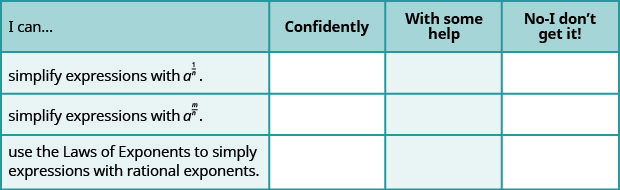
    This table has 4 rows and 4 columns. The first row is a header row and it labels each column. The first column header is “I can…”, the second is “Confidently”, the third is “With some help”, and the fourth is “No, I don’t get it”. Under the first column are the phrases “simplify expressions with a to the power of 1 divided by n.”, “simplify expression with a to the power of m divided by n”, and “use the laws of exponents to simplify expression with rational exponents”. The other columns are left blank so that the learner may indicate their mastery level for each topic.
    Figure 8.3.4

    b. What does this checklist tell you about your mastery of this section? What steps will you take to improve?

  • Page ID
    49978
  • \( \newcommand{\vecs}[1]{\overset { \scriptstyle \rightharpoonup} {\mathbf{#1}} } \)

    \( \newcommand{\vecd}[1]{\overset{-\!-\!\rightharpoonup}{\vphantom{a}\smash {#1}}} \)

    \( \newcommand{\dsum}{\displaystyle\sum\limits} \)

    \( \newcommand{\dint}{\displaystyle\int\limits} \)

    \( \newcommand{\dlim}{\displaystyle\lim\limits} \)

    \( \newcommand{\id}{\mathrm{id}}\) \( \newcommand{\Span}{\mathrm{span}}\)

    ( \newcommand{\kernel}{\mathrm{null}\,}\) \( \newcommand{\range}{\mathrm{range}\,}\)

    \( \newcommand{\RealPart}{\mathrm{Re}}\) \( \newcommand{\ImaginaryPart}{\mathrm{Im}}\)

    \( \newcommand{\Argument}{\mathrm{Arg}}\) \( \newcommand{\norm}[1]{\| #1 \|}\)

    \( \newcommand{\inner}[2]{\langle #1, #2 \rangle}\)

    \( \newcommand{\Span}{\mathrm{span}}\)

    \( \newcommand{\id}{\mathrm{id}}\)

    \( \newcommand{\Span}{\mathrm{span}}\)

    \( \newcommand{\kernel}{\mathrm{null}\,}\)

    \( \newcommand{\range}{\mathrm{range}\,}\)

    \( \newcommand{\RealPart}{\mathrm{Re}}\)

    \( \newcommand{\ImaginaryPart}{\mathrm{Im}}\)

    \( \newcommand{\Argument}{\mathrm{Arg}}\)

    \( \newcommand{\norm}[1]{\| #1 \|}\)

    \( \newcommand{\inner}[2]{\langle #1, #2 \rangle}\)

    \( \newcommand{\Span}{\mathrm{span}}\) \( \newcommand{\AA}{\unicode[.8,0]{x212B}}\)

    \( \newcommand{\vectorA}[1]{\vec{#1}}      % arrow\)

    \( \newcommand{\vectorAt}[1]{\vec{\text{#1}}}      % arrow\)

    \( \newcommand{\vectorB}[1]{\overset { \scriptstyle \rightharpoonup} {\mathbf{#1}} } \)

    \( \newcommand{\vectorC}[1]{\textbf{#1}} \)

    \( \newcommand{\vectorD}[1]{\overrightarrow{#1}} \)

    \( \newcommand{\vectorDt}[1]{\overrightarrow{\text{#1}}} \)

    \( \newcommand{\vectE}[1]{\overset{-\!-\!\rightharpoonup}{\vphantom{a}\smash{\mathbf {#1}}}} \)

    \( \newcommand{\vecs}[1]{\overset { \scriptstyle \rightharpoonup} {\mathbf{#1}} } \)

    \(\newcommand{\longvect}{\overrightarrow}\)

    \( \newcommand{\vecd}[1]{\overset{-\!-\!\rightharpoonup}{\vphantom{a}\smash {#1}}} \)

    \(\newcommand{\avec}{\mathbf a}\) \(\newcommand{\bvec}{\mathbf b}\) \(\newcommand{\cvec}{\mathbf c}\) \(\newcommand{\dvec}{\mathbf d}\) \(\newcommand{\dtil}{\widetilde{\mathbf d}}\) \(\newcommand{\evec}{\mathbf e}\) \(\newcommand{\fvec}{\mathbf f}\) \(\newcommand{\nvec}{\mathbf n}\) \(\newcommand{\pvec}{\mathbf p}\) \(\newcommand{\qvec}{\mathbf q}\) \(\newcommand{\svec}{\mathbf s}\) \(\newcommand{\tvec}{\mathbf t}\) \(\newcommand{\uvec}{\mathbf u}\) \(\newcommand{\vvec}{\mathbf v}\) \(\newcommand{\wvec}{\mathbf w}\) \(\newcommand{\xvec}{\mathbf x}\) \(\newcommand{\yvec}{\mathbf y}\) \(\newcommand{\zvec}{\mathbf z}\) \(\newcommand{\rvec}{\mathbf r}\) \(\newcommand{\mvec}{\mathbf m}\) \(\newcommand{\zerovec}{\mathbf 0}\) \(\newcommand{\onevec}{\mathbf 1}\) \(\newcommand{\real}{\mathbb R}\) \(\newcommand{\twovec}[2]{\left[\begin{array}{r}#1 \\ #2 \end{array}\right]}\) \(\newcommand{\ctwovec}[2]{\left[\begin{array}{c}#1 \\ #2 \end{array}\right]}\) \(\newcommand{\threevec}[3]{\left[\begin{array}{r}#1 \\ #2 \\ #3 \end{array}\right]}\) \(\newcommand{\cthreevec}[3]{\left[\begin{array}{c}#1 \\ #2 \\ #3 \end{array}\right]}\) \(\newcommand{\fourvec}[4]{\left[\begin{array}{r}#1 \\ #2 \\ #3 \\ #4 \end{array}\right]}\) \(\newcommand{\cfourvec}[4]{\left[\begin{array}{c}#1 \\ #2 \\ #3 \\ #4 \end{array}\right]}\) \(\newcommand{\fivevec}[5]{\left[\begin{array}{r}#1 \\ #2 \\ #3 \\ #4 \\ #5 \\ \end{array}\right]}\) \(\newcommand{\cfivevec}[5]{\left[\begin{array}{c}#1 \\ #2 \\ #3 \\ #4 \\ #5 \\ \end{array}\right]}\) \(\newcommand{\mattwo}[4]{\left[\begin{array}{rr}#1 \amp #2 \\ #3 \amp #4 \\ \end{array}\right]}\) \(\newcommand{\laspan}[1]{\text{Span}\{#1\}}\) \(\newcommand{\bcal}{\cal B}\) \(\newcommand{\ccal}{\cal C}\) \(\newcommand{\scal}{\cal S}\) \(\newcommand{\wcal}{\cal W}\) \(\newcommand{\ecal}{\cal E}\) \(\newcommand{\coords}[2]{\left\{#1\right\}_{#2}}\) \(\newcommand{\gray}[1]{\color{gray}{#1}}\) \(\newcommand{\lgray}[1]{\color{lightgray}{#1}}\) \(\newcommand{\rank}{\operatorname{rank}}\) \(\newcommand{\row}{\text{Row}}\) \(\newcommand{\col}{\text{Col}}\) \(\renewcommand{\row}{\text{Row}}\) \(\newcommand{\nul}{\text{Nul}}\) \(\newcommand{\var}{\text{Var}}\) \(\newcommand{\corr}{\text{corr}}\) \(\newcommand{\len}[1]{\left|#1\right|}\) \(\newcommand{\bbar}{\overline{\bvec}}\) \(\newcommand{\bhat}{\widehat{\bvec}}\) \(\newcommand{\bperp}{\bvec^\perp}\) \(\newcommand{\xhat}{\widehat{\xvec}}\) \(\newcommand{\vhat}{\widehat{\vvec}}\) \(\newcommand{\uhat}{\widehat{\uvec}}\) \(\newcommand{\what}{\widehat{\wvec}}\) \(\newcommand{\Sighat}{\widehat{\Sigma}}\) \(\newcommand{\lt}{<}\) \(\newcommand{\gt}{>}\) \(\newcommand{\amp}{&}\) \(\definecolor{fillinmathshade}{gray}{0.9}\)
    • Was this article helpful?