Mathematics LibreTexts

Ellipses

  • Page ID
    221331
  • \( \newcommand{\vecs}[1]{\overset { \scriptstyle \rightharpoonup} {\mathbf{#1}} } \)

    \( \newcommand{\vecd}[1]{\overset{-\!-\!\rightharpoonup}{\vphantom{a}\smash {#1}}} \)

    \( \newcommand{\dsum}{\displaystyle\sum\limits} \)

    \( \newcommand{\dint}{\displaystyle\int\limits} \)

    \( \newcommand{\dlim}{\displaystyle\lim\limits} \)

    \( \newcommand{\id}{\mathrm{id}}\) \( \newcommand{\Span}{\mathrm{span}}\)

    ( \newcommand{\kernel}{\mathrm{null}\,}\) \( \newcommand{\range}{\mathrm{range}\,}\)

    \( \newcommand{\RealPart}{\mathrm{Re}}\) \( \newcommand{\ImaginaryPart}{\mathrm{Im}}\)

    \( \newcommand{\Argument}{\mathrm{Arg}}\) \( \newcommand{\norm}[1]{\| #1 \|}\)

    \( \newcommand{\inner}[2]{\langle #1, #2 \rangle}\)

    \( \newcommand{\Span}{\mathrm{span}}\)

    \( \newcommand{\id}{\mathrm{id}}\)

    \( \newcommand{\Span}{\mathrm{span}}\)

    \( \newcommand{\kernel}{\mathrm{null}\,}\)

    \( \newcommand{\range}{\mathrm{range}\,}\)

    \( \newcommand{\RealPart}{\mathrm{Re}}\)

    \( \newcommand{\ImaginaryPart}{\mathrm{Im}}\)

    \( \newcommand{\Argument}{\mathrm{Arg}}\)

    \( \newcommand{\norm}[1]{\| #1 \|}\)

    \( \newcommand{\inner}[2]{\langle #1, #2 \rangle}\)

    \( \newcommand{\Span}{\mathrm{span}}\) \( \newcommand{\AA}{\unicode[.8,0]{x212B}}\)

    \( \newcommand{\vectorA}[1]{\vec{#1}}      % arrow\)

    \( \newcommand{\vectorAt}[1]{\vec{\text{#1}}}      % arrow\)

    \( \newcommand{\vectorB}[1]{\overset { \scriptstyle \rightharpoonup} {\mathbf{#1}} } \)

    \( \newcommand{\vectorC}[1]{\textbf{#1}} \)

    \( \newcommand{\vectorD}[1]{\overrightarrow{#1}} \)

    \( \newcommand{\vectorDt}[1]{\overrightarrow{\text{#1}}} \)

    \( \newcommand{\vectE}[1]{\overset{-\!-\!\rightharpoonup}{\vphantom{a}\smash{\mathbf {#1}}}} \)

    \( \newcommand{\vecs}[1]{\overset { \scriptstyle \rightharpoonup} {\mathbf{#1}} } \)

    \(\newcommand{\longvect}{\overrightarrow}\)

    \( \newcommand{\vecd}[1]{\overset{-\!-\!\rightharpoonup}{\vphantom{a}\smash {#1}}} \)

    \(\newcommand{\avec}{\mathbf a}\) \(\newcommand{\bvec}{\mathbf b}\) \(\newcommand{\cvec}{\mathbf c}\) \(\newcommand{\dvec}{\mathbf d}\) \(\newcommand{\dtil}{\widetilde{\mathbf d}}\) \(\newcommand{\evec}{\mathbf e}\) \(\newcommand{\fvec}{\mathbf f}\) \(\newcommand{\nvec}{\mathbf n}\) \(\newcommand{\pvec}{\mathbf p}\) \(\newcommand{\qvec}{\mathbf q}\) \(\newcommand{\svec}{\mathbf s}\) \(\newcommand{\tvec}{\mathbf t}\) \(\newcommand{\uvec}{\mathbf u}\) \(\newcommand{\vvec}{\mathbf v}\) \(\newcommand{\wvec}{\mathbf w}\) \(\newcommand{\xvec}{\mathbf x}\) \(\newcommand{\yvec}{\mathbf y}\) \(\newcommand{\zvec}{\mathbf z}\) \(\newcommand{\rvec}{\mathbf r}\) \(\newcommand{\mvec}{\mathbf m}\) \(\newcommand{\zerovec}{\mathbf 0}\) \(\newcommand{\onevec}{\mathbf 1}\) \(\newcommand{\real}{\mathbb R}\) \(\newcommand{\twovec}[2]{\left[\begin{array}{r}#1 \\ #2 \end{array}\right]}\) \(\newcommand{\ctwovec}[2]{\left[\begin{array}{c}#1 \\ #2 \end{array}\right]}\) \(\newcommand{\threevec}[3]{\left[\begin{array}{r}#1 \\ #2 \\ #3 \end{array}\right]}\) \(\newcommand{\cthreevec}[3]{\left[\begin{array}{c}#1 \\ #2 \\ #3 \end{array}\right]}\) \(\newcommand{\fourvec}[4]{\left[\begin{array}{r}#1 \\ #2 \\ #3 \\ #4 \end{array}\right]}\) \(\newcommand{\cfourvec}[4]{\left[\begin{array}{c}#1 \\ #2 \\ #3 \\ #4 \end{array}\right]}\) \(\newcommand{\fivevec}[5]{\left[\begin{array}{r}#1 \\ #2 \\ #3 \\ #4 \\ #5 \\ \end{array}\right]}\) \(\newcommand{\cfivevec}[5]{\left[\begin{array}{c}#1 \\ #2 \\ #3 \\ #4 \\ #5 \\ \end{array}\right]}\) \(\newcommand{\mattwo}[4]{\left[\begin{array}{rr}#1 \amp #2 \\ #3 \amp #4 \\ \end{array}\right]}\) \(\newcommand{\laspan}[1]{\text{Span}\{#1\}}\) \(\newcommand{\bcal}{\cal B}\) \(\newcommand{\ccal}{\cal C}\) \(\newcommand{\scal}{\cal S}\) \(\newcommand{\wcal}{\cal W}\) \(\newcommand{\ecal}{\cal E}\) \(\newcommand{\coords}[2]{\left\{#1\right\}_{#2}}\) \(\newcommand{\gray}[1]{\color{gray}{#1}}\) \(\newcommand{\lgray}[1]{\color{lightgray}{#1}}\) \(\newcommand{\rank}{\operatorname{rank}}\) \(\newcommand{\row}{\text{Row}}\) \(\newcommand{\col}{\text{Col}}\) \(\renewcommand{\row}{\text{Row}}\) \(\newcommand{\nul}{\text{Nul}}\) \(\newcommand{\var}{\text{Var}}\) \(\newcommand{\corr}{\text{corr}}\) \(\newcommand{\len}[1]{\left|#1\right|}\) \(\newcommand{\bbar}{\overline{\bvec}}\) \(\newcommand{\bhat}{\widehat{\bvec}}\) \(\newcommand{\bperp}{\bvec^\perp}\) \(\newcommand{\xhat}{\widehat{\xvec}}\) \(\newcommand{\vhat}{\widehat{\vvec}}\) \(\newcommand{\uhat}{\widehat{\uvec}}\) \(\newcommand{\what}{\widehat{\wvec}}\) \(\newcommand{\Sighat}{\widehat{\Sigma}}\) \(\newcommand{\lt}{<}\) \(\newcommand{\gt}{>}\) \(\newcommand{\amp}{&}\) \(\definecolor{fillinmathshade}{gray}{0.9}\)

    Ellipses and Hyperbolae


    Draw an Ellipse With a String and Two Fixed Points


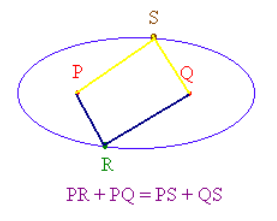
    Geometrically an ellipse is defined as follows:  Let P and Q be fixed points in the plane and let k be a positive real number.  Then a point R is in the ellipse if the sum of the distances from P to R and from Q to R is k

            PR + QR  =  k

            Graph of an ellipse with foci P and Q and points R and S.  It shows PR + QR = PS + QS


    The Standard Form of an Ellipse Centered at The Origin

    Recall that the equation of a circle centered at the origin has equation

            x2 +  y2  =  r2

    where r is the radius. Dividing by r2 we have

            x            y2   
                    +               =   1                
            r2             r2

    for an ellipse there are two radii, so that we can expect that the denominators should be different.  Hence we have the standard form of an ellipse centered at the origin:

            x            y2   
                    +               =   1                
            a2             b2


    The points (a,0)(-a,0)(0,b), and (0,-b) are called the vertices of the ellipse.

    Note:  Although we have written the a below the x and the b below the y, it is customary to let a be the larger of the two and b be the smaller.


    Example

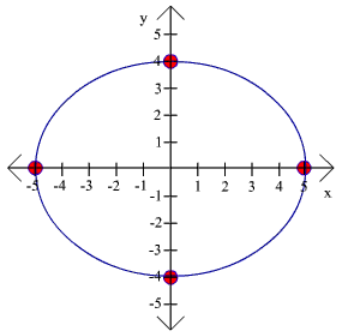
    Graph the ellipse

               x2               y2 
                       +                 =   1
              25               16

    Solution

    First identify a and b, remembering to take square roots.

            a  =  5        b  =  4

    Next plot the vertices 

            (-5,0)(5,0)(0,4), and (0,-4)

    Finally, connect the dots.  The graph is shown below.

    Graph of the ellipse centered at (0,0) with x-intrecpts -5 and 5, and y-intercepts -4 and 4.


    Example

    Graph the ellipse

            4x2 + y2  =  16


    Solution

    This is not in standard form since the right hand side is not 1.  To rectify this, we just divide by 36 to get

              4x2              y2 
                       +                 =   1
              16               16

    or since 9/36 = 1/4, we get

               x2               y2 
                       +                 =   1

               4               16

    Now we can sketch the graph.  Notice that 16 is larger than 4 so we let a be the square root of 16 and b be the square root of 4.  We have

            a  =  4        and          b  =  2

    We plot the vertices 

            (0,4), (0,-4), (2,0), and (-2,0)

    and connect the vertices with a conic as shown below.

    Graph of the ellipse centered at (0,0) with x-intrecpts -2 and 2, and y-intercepts -4 and 4.


    Example

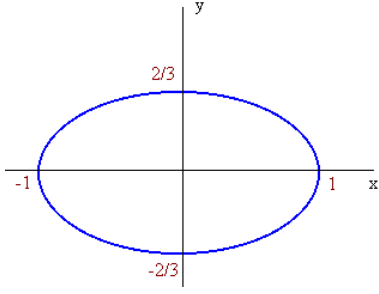
    Graph the ellipse 

            4x2 + 9y2 = 4


    Solution:  

    First divide by 4

            x2 + 9/4y2 = 1

    Since the 9/4 is not in the denominator, we need to use the following fact about division of numbers

             9                  1
                       =                
             4                4/9

    This comes from looking at the right hand side and and noticing that it is just a division of the fraction 1/1 by 4/9, which becomes a multiplication of 1/1 by 9/4.

            x            y2   
                    +                =   1                
            1             4/9

    so that 

            a = 1     and     b = 2/3

    Graph of the ellipse centered at (0,0) with x-intrecpts -1 and 1, and y-intercepts -2/3 and 2/3.


    Application:  Astronomy

    Suppose that an asteroid orbits the sun (in an elliptical orbit).  And suppose that the longest opposite ends of the orbit are 800 million miles apart and that the shortest opposite ends are 200 million miles apart.  Give an equation for the orbit of the asteroid.

    Solution:  

    We have 

            2a  =  800 million miles 

    and 

            2b  =  200 million miles

    thus

            a  =  400 million miles     and     b  =  100 million miles

    so that

                     x2                                          y2  
                                           +                                   =   1                                                             
            (400,000,000)2              (100,000,000)2      


    The Hyperbola

    Recall the equation of the ellipse:

            x            y2   
                    +               =   1                
            a2             b2

    If instead of a "+" we have a "-", we end up with a different conic called the hyperbola.  


            x            y2   
                    -               =   1                
            a2             b2


    Example   

    Sketch the graph of

            x            y2   
                    -               =   1                
            4              9


    Solution

    Check for intercepts:

    If x = 0 then 

                  y2  
              -         =  1 
    which has no solution
                  9

    If y = 0 then 

               x2  
                      =  1
               4

             x2  =  4 

    so that 

            x  =  2     or     x  =  -2

    If instead of the 1, we have a 0 then

            x            y2   
                    -               =   0               
            4             9

    so that 

            x            y2   
                    =                           
            4              9

    hence

            y = (3/2)x     or     y = -(3/2)x

    These two lines are called the asymptotes of the hyperbola and are found by

            y   =    b/a


    To plot the hyperbola with equation  

            x            y2   
                    -               =   1                
            a2             b2

     we follow these steps:


    1. Plot the intercepts 

              (a,0),   (-a,0) 

      and the points 

              (0,b), (0,-b) 

      as with the ellipse.


    2. Draw a rectangle containing these four points.


    3. Draw the lines that contain the diagonals of the rectangle (these are the asymptotes)


    4. Draw the hyperbola that with the vertices 

              (a,0) and (-a,0) 

      that has the drawn asymptotes.


    Following these steps, to sketch the graph of  

            x            y2   
                    -               =   1                
            4             16

    We have

            a  =  2        and        b  =  4

    The vertices are at 

            (2,0)    and    (-2,0)

    and the helper points are at 

            (0,4)    and    (0,-4)

    Plot these points.  Then draw the rectangle with vertices (2,4)(-2,4)(-2,-4), and (2,-4).  

    Next draw the two lines through the opposite vertices of the rectangle.  These are the asymptotes.  Finally draw the hyperbola.  On the right this process is shown.  


    Example:

    Sketch the graph of

            9x2  -  4y2   =   16 

    First we have to divide by 16 to get

              x              y2   
                        -                =   1                
            16/9             4

    We see that 

            a = 4/3    and    b = 2  


    Note: If the equation is

            y            x2   
                    -               =   1                
            a2            b2

    we follow the same procedure except that (0,a) and (0,-a) are the vertices instead of (b,0) and (-b,0).


    Example:  

            y               
                    -   x2    =   1                
            16           

    Here 

            b = 1     and     a = 4

    The intercepts are (0,4) and (0,-4) and the other two convenient points that make up the fundamental rectangle are (1,0) and (0,1).  The graph is shown below

                    Graph of the hyperbola y^2/16 - x^2 = 1 centered at (0,0) with y-intrecpts -4 and 4.


    Back to the Conics Home Page


    Ellipses is shared under a not declared license and was authored, remixed, and/or curated by LibreTexts.

    • Was this article helpful?