Lecture Notes
- Page ID
- 221330
\( \newcommand{\vecs}[1]{\overset { \scriptstyle \rightharpoonup} {\mathbf{#1}} } \)
\( \newcommand{\vecd}[1]{\overset{-\!-\!\rightharpoonup}{\vphantom{a}\smash {#1}}} \)
\( \newcommand{\dsum}{\displaystyle\sum\limits} \)
\( \newcommand{\dint}{\displaystyle\int\limits} \)
\( \newcommand{\dlim}{\displaystyle\lim\limits} \)
\( \newcommand{\id}{\mathrm{id}}\) \( \newcommand{\Span}{\mathrm{span}}\)
( \newcommand{\kernel}{\mathrm{null}\,}\) \( \newcommand{\range}{\mathrm{range}\,}\)
\( \newcommand{\RealPart}{\mathrm{Re}}\) \( \newcommand{\ImaginaryPart}{\mathrm{Im}}\)
\( \newcommand{\Argument}{\mathrm{Arg}}\) \( \newcommand{\norm}[1]{\| #1 \|}\)
\( \newcommand{\inner}[2]{\langle #1, #2 \rangle}\)
\( \newcommand{\Span}{\mathrm{span}}\)
\( \newcommand{\id}{\mathrm{id}}\)
\( \newcommand{\Span}{\mathrm{span}}\)
\( \newcommand{\kernel}{\mathrm{null}\,}\)
\( \newcommand{\range}{\mathrm{range}\,}\)
\( \newcommand{\RealPart}{\mathrm{Re}}\)
\( \newcommand{\ImaginaryPart}{\mathrm{Im}}\)
\( \newcommand{\Argument}{\mathrm{Arg}}\)
\( \newcommand{\norm}[1]{\| #1 \|}\)
\( \newcommand{\inner}[2]{\langle #1, #2 \rangle}\)
\( \newcommand{\Span}{\mathrm{span}}\) \( \newcommand{\AA}{\unicode[.8,0]{x212B}}\)
\( \newcommand{\vectorA}[1]{\vec{#1}} % arrow\)
\( \newcommand{\vectorAt}[1]{\vec{\text{#1}}} % arrow\)
\( \newcommand{\vectorB}[1]{\overset { \scriptstyle \rightharpoonup} {\mathbf{#1}} } \)
\( \newcommand{\vectorC}[1]{\textbf{#1}} \)
\( \newcommand{\vectorD}[1]{\overrightarrow{#1}} \)
\( \newcommand{\vectorDt}[1]{\overrightarrow{\text{#1}}} \)
\( \newcommand{\vectE}[1]{\overset{-\!-\!\rightharpoonup}{\vphantom{a}\smash{\mathbf {#1}}}} \)
\( \newcommand{\vecs}[1]{\overset { \scriptstyle \rightharpoonup} {\mathbf{#1}} } \)
\(\newcommand{\longvect}{\overrightarrow}\)
\( \newcommand{\vecd}[1]{\overset{-\!-\!\rightharpoonup}{\vphantom{a}\smash {#1}}} \)
\(\newcommand{\ket}[1]{\left| #1 \right>}\)
\(\newcommand{\bra}[1]{\left< #1 \right|}\)
\(\newcommand{\braket}[2]{\left< #1 \vphantom{#2} \right| \left. #2 \vphantom{#1} \right>}\)
\(\newcommand{\braopket}[3]{\left< #1 \vphantom{#2}\vphantom{#3} \right| #2 \vphantom{#1}\vphantom{#3} \left| #3 \vphantom{#1}\vphantom{#2} \right>}\)
\(\newcommand{\qmvec}[1]{\mathbf{\vec{#1}}}\)
\(\newcommand{\op}[1]{\hat{\mathbf{#1}}}\)
\(\newcommand{\expect}[1]{\langle #1 \rangle}\)
\(\newcommand{\dfn}[1]{\emph{\textbf{#1}}}\)
|
Circles and Distance
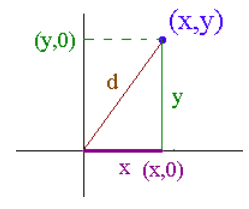
The Distance Formula Recall that the Pythagorean Theorem states that if a, b, c are sides of a right triangle with c the hypotenuse, then a2 + b2 = c2 Let (x,y) be a point in the plane. Then if we draw the triangle with one vertex at the origin, one at (x,y) and one at (x,0) then we have a right triangle which has one leg of length x and the other of length y. The length of the hypotenuse is the distance from the origin to the point (x,y). By the Pythagorean Theorem, this distance is
\( d = \sqrt{x^2+y^2} \)
Exercise: Find the distance from the origin to the point (5,12)
We can generalize this notion to find the distance between two points (x1,y1) and (x2,y2) We draw the triangle and see that the length of its legs equal x2 - x1 and y2 - y1 Therefore the distance from (x1,y1) to (x2,y2) is
\( d = \sqrt{(x_2 - x_1)^2+(y_2 - y_1)^2} \)
Example Find the distance from (2,-3) to (-1,4)
Solution: We use the distance formula: \( d = \sqrt{(-1 - 2)^2+(4 - (-3))^2} = \sqrt{9+49} = \sqrt{58}\)
Recall that a circle with radius r and center (h,k) is defined by the set of point of distance r from the point (h,k). If (x,y) is on the circle then the distance from (h,k) to (x,y) is r. The distance formula tells us that (x - h)2 + (y - k)2 = r2 This is called the standard form of the equation of the circle.
Example The equation of the circle with radius 3 centered at (1,2) is (x - 1)2 + (y - 2)2 = 9
Example: Find the center and radius of the circle x2 + y2 - 4x + 6y - 12 = 0 We must get the equation into standard form by completing the squares. We have x2 - 4x + y2 + 6y = 12 -4/2 = -2 and 6/2 = 3 (-2)2 = 4 and 32 = 9 Adding and subtracting we have x2 - 4x + 4 - 4 + y2 + 6y + 9 - 9 = 12 (x - 2)2 + (y + 3)2 = 12 + 4 + 9 = 25 = 52 So that the center of the circle is (2,-3) and the radius is 5. |