

3.2: Basic Concepts
- Page ID
- 160144

\( \newcommand{\vecs}[1]{\overset { \scriptstyle \rightharpoonup} {\mathbf{#1}} } \)
\( \newcommand{\vecd}[1]{\overset{-\!-\!\rightharpoonup}{\vphantom{a}\smash {#1}}} \)
\( \newcommand{\dsum}{\displaystyle\sum\limits} \)
\( \newcommand{\dint}{\displaystyle\int\limits} \)
\( \newcommand{\dlim}{\displaystyle\lim\limits} \)
\( \newcommand{\id}{\mathrm{id}}\) \( \newcommand{\Span}{\mathrm{span}}\)
( \newcommand{\kernel}{\mathrm{null}\,}\) \( \newcommand{\range}{\mathrm{range}\,}\)
\( \newcommand{\RealPart}{\mathrm{Re}}\) \( \newcommand{\ImaginaryPart}{\mathrm{Im}}\)
\( \newcommand{\Argument}{\mathrm{Arg}}\) \( \newcommand{\norm}[1]{\| #1 \|}\)
\( \newcommand{\inner}[2]{\langle #1, #2 \rangle}\)
\( \newcommand{\Span}{\mathrm{span}}\)
\( \newcommand{\id}{\mathrm{id}}\)
\( \newcommand{\Span}{\mathrm{span}}\)
\( \newcommand{\kernel}{\mathrm{null}\,}\)
\( \newcommand{\range}{\mathrm{range}\,}\)
\( \newcommand{\RealPart}{\mathrm{Re}}\)
\( \newcommand{\ImaginaryPart}{\mathrm{Im}}\)
\( \newcommand{\Argument}{\mathrm{Arg}}\)
\( \newcommand{\norm}[1]{\| #1 \|}\)
\( \newcommand{\inner}[2]{\langle #1, #2 \rangle}\)
\( \newcommand{\Span}{\mathrm{span}}\) \( \newcommand{\AA}{\unicode[.8,0]{x212B}}\)
\( \newcommand{\vectorA}[1]{\vec{#1}} % arrow\)
\( \newcommand{\vectorAt}[1]{\vec{\text{#1}}} % arrow\)
\( \newcommand{\vectorB}[1]{\overset { \scriptstyle \rightharpoonup} {\mathbf{#1}} } \)
\( \newcommand{\vectorC}[1]{\textbf{#1}} \)
\( \newcommand{\vectorD}[1]{\overrightarrow{#1}} \)
\( \newcommand{\vectorDt}[1]{\overrightarrow{\text{#1}}} \)
\( \newcommand{\vectE}[1]{\overset{-\!-\!\rightharpoonup}{\vphantom{a}\smash{\mathbf {#1}}}} \)
\( \newcommand{\vecs}[1]{\overset { \scriptstyle \rightharpoonup} {\mathbf{#1}} } \)
\(\newcommand{\longvect}{\overrightarrow}\)
\( \newcommand{\vecd}[1]{\overset{-\!-\!\rightharpoonup}{\vphantom{a}\smash {#1}}} \)
\(\newcommand{\ket}[1]{\left| #1 \right>}\)
\(\newcommand{\bra}[1]{\left< #1 \right|}\)
\(\newcommand{\braket}[2]{\left< #1 \vphantom{#2} \right| \left. #2 \vphantom{#1} \right>}\)
\(\newcommand{\braopket}[3]{\left< #1 \vphantom{#2}\vphantom{#3} \right| #2 \vphantom{#1}\vphantom{#3} \left| #3 \vphantom{#1}\vphantom{#2} \right>}\)
\(\newcommand{\qmvec}[1]{\mathbf{\vec{#1}}}\)
\(\newcommand{\op}[1]{\hat{\mathbf{#1}}}\)
\(\newcommand{\expect}[1]{\langle #1 \rangle}\)
\(\newcommand{\dfn}[1]{\emph{\textbf{#1}}}\)
If you roll a die, pick a card from deck of playing cards, or randomly select a person and observe their hair color, we are executing an experiment or procedure. In probability, we look at the likelihood of different outcomes. We begin with some terminology.
The result of an experiment is called an outcome.
An event is any particular outcome or group of outcomes.
A simple event is an event that cannot be broken down further
The sample space is the set of all possible simple events.
If we roll a standard 6-sided die, describe the sample space and some simple events.
The sample space is the set of all possible simple events: \(\{1,2,3,4,5,6\}\)
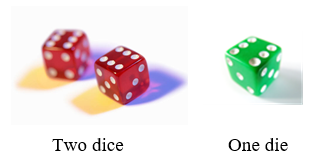
Some examples of simple events:
We roll a 1
We roll a 5
Some compound events:
We roll a number bigger than 4
We roll an even number
Given that all outcomes are equally likely, we can compute the probability of an event \(E\) using this formula:
\(P(E)=\frac{\text { Number of outcomes corresponding to the event } \mathrm{E}}{\text { Total number of equally - likely outcomes }}\)
If we roll a 6-sided die, calculate
- P(rolling a 1)
- P(rolling a number bigger than 4)
Solution
Recall that the sample space is \(\{1,2,3,4,5,6\}\)
- There is one outcome corresponding to “rolling a 1”, so the probability is \(\frac{1}{6}\)
- There are two outcomes bigger than a 4, so the probability is \(\frac{2}{6}=\frac{1}{3}\)
Probabilities are essentially fractions, and can be reduced to lower terms like fractions.
Let's say you have a bag with 20 cherries, 14 sweet and 6 sour. If you pick a cherry at random, what is the probability that it will be sweet?
Solution
There are 20 possible cherries that could be picked, so the number of possible outcomes is 20. Of these 20 possible outcomes, 14 are favorable (sweet), so the probability that the cherry will be sweet is \(\frac{14}{20}=\frac{7}{10}\).
There is one potential complication to this example, however. It must be assumed that the probability of picking any of the cherries is the same as the probability of picking any other. This wouldn't be true if (let us imagine) the sweet cherries are smaller than the sour ones. (The sour cherries would come to hand more readily when you sampled from the bag.) Let us keep in mind, therefore, that when we assess probabilities in terms of the ratio of favorable to all potential cases, we rely heavily on the assumption of equal probability for all outcomes.
At some random moment, you look at your clock and note the minutes reading.
- What is probability the minutes reading is 15?
- What is the probability the minutes reading is 15 or less?
- Answer
-
There are 60 possible readings, from 00 to 59.
- \(\frac{1}{60}\)
- \(\frac{16}{60}\) (counting 00 through 15)
A standard deck of 52 playing cards consists of four suits (hearts, spades, diamonds and clubs). Spades and clubs are black while hearts and diamonds are red. Each suit contains 13 cards, each of a different rank: an Ace (which in many games functions as both a low card and a high card), cards numbered 2 through 10, a Jack, a Queen and a King.
Compute the probability of randomly drawing one card from a deck and getting an Ace.
Solution
There are 52 cards in the deck and 4 Aces so
\[P(A c e)=\dfrac{4}{52}=\frac{1}{13} \approx 0.0769 \nonumber \]
We can also think of probabilities as percents: There is a 7.69% chance that a randomly selected card will be an Ace.
Notice that the smallest possible probability is 0 – if there are no outcomes that correspond with the event. The largest possible probability is 1 – if all possible outcomes correspond with the event.
An impossible event has a probability of 0.
A certain event has a probability of 1.
The probability of any event must be \(0 \leq P(E) \leq 1\).
In the course of this chapter, if you compute a probability and get an answer that is negative or greater than 1, you have made a mistake and should check your work.
A fair coin is flipped 3 times. What is the probability that we get exactly two heads?
Solution
Let's first consider the sample space for this experiment. Below are the possible outcomes for flipping a fair coin 3 times.
{HHH, HTH, HHT, THH, TTH, HTH, HTT, TTT}
The number of outcomes with exactly two heads (H) is 3, and the total number of outcomes is 8.
Recall that basic probability is calculated as \( P(E)=\frac{\text{frequency of event}}{\text{total number of outcomes}}\) So we have \( P(\text{exactly two H})=\frac{\text{number of exactly 2 head outcomes}}{\text{total number of outcomes}}=\frac{3}{8}.\)
If we need to convert this number into a decimal or percent, we simply divide the numerator by the denominator (for the decimal) then multiply by 100 (for the percent). Calculating, we get \( 3\div 8=0.375\) and \( 0.375\times 100=37.5\%\). Notice that as is appropriate for all probability examples, the decimal number is between 0 and 1.