

27.33: Law of Sines
- Page ID
- 248198

\( \newcommand{\vecs}[1]{\overset { \scriptstyle \rightharpoonup} {\mathbf{#1}} } \)
\( \newcommand{\vecd}[1]{\overset{-\!-\!\rightharpoonup}{\vphantom{a}\smash {#1}}} \)
\( \newcommand{\dsum}{\displaystyle\sum\limits} \)
\( \newcommand{\dint}{\displaystyle\int\limits} \)
\( \newcommand{\dlim}{\displaystyle\lim\limits} \)
\( \newcommand{\id}{\mathrm{id}}\) \( \newcommand{\Span}{\mathrm{span}}\)
( \newcommand{\kernel}{\mathrm{null}\,}\) \( \newcommand{\range}{\mathrm{range}\,}\)
\( \newcommand{\RealPart}{\mathrm{Re}}\) \( \newcommand{\ImaginaryPart}{\mathrm{Im}}\)
\( \newcommand{\Argument}{\mathrm{Arg}}\) \( \newcommand{\norm}[1]{\| #1 \|}\)
\( \newcommand{\inner}[2]{\langle #1, #2 \rangle}\)
\( \newcommand{\Span}{\mathrm{span}}\)
\( \newcommand{\id}{\mathrm{id}}\)
\( \newcommand{\Span}{\mathrm{span}}\)
\( \newcommand{\kernel}{\mathrm{null}\,}\)
\( \newcommand{\range}{\mathrm{range}\,}\)
\( \newcommand{\RealPart}{\mathrm{Re}}\)
\( \newcommand{\ImaginaryPart}{\mathrm{Im}}\)
\( \newcommand{\Argument}{\mathrm{Arg}}\)
\( \newcommand{\norm}[1]{\| #1 \|}\)
\( \newcommand{\inner}[2]{\langle #1, #2 \rangle}\)
\( \newcommand{\Span}{\mathrm{span}}\) \( \newcommand{\AA}{\unicode[.8,0]{x212B}}\)
\( \newcommand{\vectorA}[1]{\vec{#1}} % arrow\)
\( \newcommand{\vectorAt}[1]{\vec{\text{#1}}} % arrow\)
\( \newcommand{\vectorB}[1]{\overset { \scriptstyle \rightharpoonup} {\mathbf{#1}} } \)
\( \newcommand{\vectorC}[1]{\textbf{#1}} \)
\( \newcommand{\vectorD}[1]{\overrightarrow{#1}} \)
\( \newcommand{\vectorDt}[1]{\overrightarrow{\text{#1}}} \)
\( \newcommand{\vectE}[1]{\overset{-\!-\!\rightharpoonup}{\vphantom{a}\smash{\mathbf {#1}}}} \)
\( \newcommand{\vecs}[1]{\overset { \scriptstyle \rightharpoonup} {\mathbf{#1}} } \)
\(\newcommand{\longvect}{\overrightarrow}\)
\( \newcommand{\vecd}[1]{\overset{-\!-\!\rightharpoonup}{\vphantom{a}\smash {#1}}} \)
\(\newcommand{\ket}[1]{\left| #1 \right>}\)
\(\newcommand{\bra}[1]{\left< #1 \right|}\)
\(\newcommand{\braket}[2]{\left< #1 \vphantom{#2} \right| \left. #2 \vphantom{#1} \right>}\)
\(\newcommand{\braopket}[3]{\left< #1 \vphantom{#2}\vphantom{#3} \right| #2 \vphantom{#1}\vphantom{#3} \left| #3 \vphantom{#1}\vphantom{#2} \right>}\)
\(\newcommand{\qmvec}[1]{\mathbf{\vec{#1}}}\)
\(\newcommand{\op}[1]{\hat{\mathbf{#1}}}\)
\(\newcommand{\expect}[1]{\langle #1 \rangle}\)
\(\newcommand{\dfn}[1]{\emph{\textbf{#1}}}\)
Definitions and Theorems
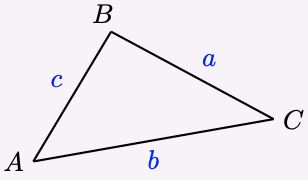
If the angles of a triangle are \(A\), \(B\), and \(C\), and the opposite sides are \(a\), \(b\), and \(c\), respectively, then
\[\dfrac{\sin\left( A \right)}{a}=\dfrac{\sin\left( B \right)}{b}=\dfrac{\sin\left( C \right)}{c},\nonumber \]or equivalently,\[\dfrac{a}{\sin\left( A \right)}=\dfrac{b}{\sin\left( B \right)}=\dfrac{c}{\sin\left( C \right)}.\nonumber \]
- Proof
-
Consider the oblique triangle in the figure below.

By drawing in the altitude \(h\) of the triangle, we create two right triangles, \(\triangle B C D\) and \(\triangle A B D\). We can write expressions in terms of \(h\) for \(\sin \left(A\right)\) and for \(\sin \left(C\right)\).
Looking at \(\triangle B C D\), we see that\[\dfrac{h}{a}=\sin\left( C\right).\nonumber \]Looking at \(\triangle A B D\), we see that\[\dfrac{h}{c}=\sin \left(A\right).\nonumber \]Now we solve each of these equations for \(h\):\[ \begin{array}{crcl}
\quad & \dfrac{h}{a} = \sin\left( C \right) & \implies & h = a \, \sin\left( C \right) \\[6pt] \text{and} & \dfrac{h}{c}=\sin\left( A \right) & \implies & h = c \, \sin\left( A \right) \\[6pt] \end{array} \nonumber \]Therefore,\[ \begin{array}{rrclcl}
& a \, \sin\left( C \right) & = & c \, \sin\left( A \right) & & \\[6pt] \implies & \dfrac{\sin\left( C \right)}{c} & = & \dfrac{\sin\left( A \right)}{a} & \quad & \left( \text{divide both sides by }ac \right) \\[6pt] \end{array} \nonumber \]We have derived a relationship between the angles \(A\) and \(C\) and their opposite sides, \(a\) and \(c\). If we know any three of these quantities, we can find the fourth.In a similar way, by drawing in the altitude from the vertex \(C\), we can show that\[\dfrac{\sin\left( A \right)}{a}=\dfrac{\sin\left( B \right)}{b}. \nonumber \]Putting both results together, we have proved the Law of Sines.
Suppose we are given an angle \(\alpha\), the side \(a\) opposite \(\alpha\), and a second side \(b\). Let \(h = b\sin(\alpha)\), the length of the altitude from \(C\) to the horizontal side in each image.
If \(\alpha\) is acute:
The "No Triangle" Case
Case: \(a \lt h\)

Reason: \(a\) is shorter than the altitude of the (non-existent) triangle. Therefore, it is impossible for side \( a \) to intersect the base of the "triangle."
The "One Triangle" Cases
Case: \(a = h\)

Reason: \(a\) is exactly the right length to make a right triangle.
Case: \( a \ge b\)

Reason: If \( a \gt b \), then one triangle is created as side \( a \) swings downward to intersect the base; however, as that side continues to swing, it is too long to strike the base again. Hence, there can be only one triangle.
The "Two Triangles" Case
Case: \(h \lt a \lt b\)

Reason: Since \( a \gt h \), side \( a \) will strike the base a it swings downward, but before becoming vertical. Moreover, because \( a \lt b \), side \( a \) will strike the base once more as it continues to swing clockwise.
If \(\alpha\) is right or obtuse:
The "No Triangle" Case
Case: \( a \le b\)

Reason: A right or obtuse angle is the largest angle of any triangle containing it, so the side opposite it must be the longest side. Since \(a \le b\), side \(a\) is not the longest side, so no triangle exists. (If \(a = b\), the triangle would be isosceles with two angles of at least \(90^{\circ}\), which is impossible.)
The "One Triangle" Case
Case: \(a \gt b\)

Reason: Since \(a \gt b\), \(\sin(\beta) = \frac{b\sin(\alpha)}{a} \lt \sin(\alpha) \le 1\), so \(\hat{\beta} = \sin^{-1}\left(\frac{b\sin(\alpha)}{a}\right)\) exists. The supplement \(180^{\circ} - \hat{\beta}\) is obtuse, and a triangle cannot have two angles of \(90^{\circ}\) or more, so it is rejected. The acute candidate works. Since \(\sin(\hat{\beta}) \lt \sin(\alpha) = \sin(180^{\circ} - \alpha)\), and both \(\hat{\beta}\) and \(180^{\circ} - \alpha\) lie in \([0^{\circ}, 90^{\circ}]\), where sine is increasing, \(\hat{\beta} \lt 180^{\circ} - \alpha\). That is, \(\alpha + \hat{\beta} \lt 180^{\circ}\), so exactly one triangle exists.