

3.2: Domain and range
- Page ID
- 238561

\( \newcommand{\vecs}[1]{\overset { \scriptstyle \rightharpoonup} {\mathbf{#1}} } \)
\( \newcommand{\vecd}[1]{\overset{-\!-\!\rightharpoonup}{\vphantom{a}\smash {#1}}} \)
\( \newcommand{\dsum}{\displaystyle\sum\limits} \)
\( \newcommand{\dint}{\displaystyle\int\limits} \)
\( \newcommand{\dlim}{\displaystyle\lim\limits} \)
\( \newcommand{\id}{\mathrm{id}}\) \( \newcommand{\Span}{\mathrm{span}}\)
( \newcommand{\kernel}{\mathrm{null}\,}\) \( \newcommand{\range}{\mathrm{range}\,}\)
\( \newcommand{\RealPart}{\mathrm{Re}}\) \( \newcommand{\ImaginaryPart}{\mathrm{Im}}\)
\( \newcommand{\Argument}{\mathrm{Arg}}\) \( \newcommand{\norm}[1]{\| #1 \|}\)
\( \newcommand{\inner}[2]{\langle #1, #2 \rangle}\)
\( \newcommand{\Span}{\mathrm{span}}\)
\( \newcommand{\id}{\mathrm{id}}\)
\( \newcommand{\Span}{\mathrm{span}}\)
\( \newcommand{\kernel}{\mathrm{null}\,}\)
\( \newcommand{\range}{\mathrm{range}\,}\)
\( \newcommand{\RealPart}{\mathrm{Re}}\)
\( \newcommand{\ImaginaryPart}{\mathrm{Im}}\)
\( \newcommand{\Argument}{\mathrm{Arg}}\)
\( \newcommand{\norm}[1]{\| #1 \|}\)
\( \newcommand{\inner}[2]{\langle #1, #2 \rangle}\)
\( \newcommand{\Span}{\mathrm{span}}\) \( \newcommand{\AA}{\unicode[.8,0]{x212B}}\)
\( \newcommand{\vectorA}[1]{\vec{#1}} % arrow\)
\( \newcommand{\vectorAt}[1]{\vec{\text{#1}}} % arrow\)
\( \newcommand{\vectorB}[1]{\overset { \scriptstyle \rightharpoonup} {\mathbf{#1}} } \)
\( \newcommand{\vectorC}[1]{\textbf{#1}} \)
\( \newcommand{\vectorD}[1]{\overrightarrow{#1}} \)
\( \newcommand{\vectorDt}[1]{\overrightarrow{\text{#1}}} \)
\( \newcommand{\vectE}[1]{\overset{-\!-\!\rightharpoonup}{\vphantom{a}\smash{\mathbf {#1}}}} \)
\( \newcommand{\vecs}[1]{\overset { \scriptstyle \rightharpoonup} {\mathbf{#1}} } \)
\(\newcommand{\longvect}{\overrightarrow}\)
\( \newcommand{\vecd}[1]{\overset{-\!-\!\rightharpoonup}{\vphantom{a}\smash {#1}}} \)
\(\newcommand{\ket}[1]{\left| #1 \right>}\)
\(\newcommand{\bra}[1]{\left< #1 \right|}\)
\(\newcommand{\braket}[2]{\left< #1 \vphantom{#2} \right| \left. #2 \vphantom{#1} \right>}\)
\(\newcommand{\braopket}[3]{\left< #1 \vphantom{#2}\vphantom{#3} \right| #2 \vphantom{#1}\vphantom{#3} \left| #3 \vphantom{#1}\vphantom{#2} \right>}\)
\(\newcommand{\qmvec}[1]{\mathbf{\vec{#1}}}\)
\(\newcommand{\op}[1]{\hat{\mathbf{#1}}}\)
\(\newcommand{\expect}[1]{\langle #1 \rangle}\)
\(\newcommand{\dfn}[1]{\emph{\textbf{#1}}}\)
Warm-up:
ADAPT \(\PageIndex{1}\)
ADAPT \(\PageIndex{1}\)
ADAPT \(\PageIndex{1}\)
ADAPT \(\PageIndex{1}\)
1. For what value(s), if any, is each function undefined? Explain in a sentence what causes the trouble.
- \(f(x)=\frac{x-2}{x-3}\)
- \\(h(x)=\sqrt{x-15}\)
- \(g(x)=\frac{1}{\sqrt{x-15}}\)
- What is the difference in your answer between part (b) and part (c)?
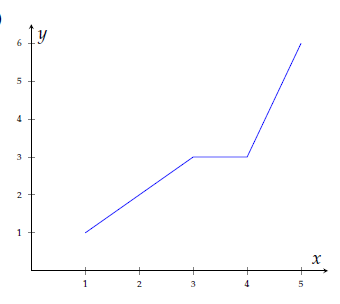
2. Estimate the domain and range of the function. Write your answer as an inequality. Assume the entire graph is shown.

3. Find the domain of each function algebraically.
- \(f(x)=\frac{1}{x+3}\)
- \(g(t)=\frac{1}{t^2-4}\)
- \(h(s)=\frac{1}{s^4+2}\)
- \(p(r)=\sqrt{r^2-16}\)
- \(q(a)=\frac{a-2}{\sqrt{a-5}}\)
4. Give a formula for a function that meets the criteria given.
- The domain is all values of \(x\) except \(x=-5\).
- The function is undefined for \(x<6\).
- The function is undefined for \(x=-2\) and for \(x<-4\), but is defined everywhere else.
5. A movie theater seats 200 people. For any particular show, the amount of money the theater makes is a function of the number of people, \(n\), in attendance. If a tickets costs \$4.00, find the domain and range of this function. Sketch its graph.
6. In month \(t=0\), a small group of rabbits escapes from a ship onto an island where there are no rabbits. The island rabbit population, \(p(t)\), in month \(t\) is given by
\[p(t)=\frac{1000}{1+19(0.9)^t}, \quad t \geq 0 \notag\]
- Evaluate \(p(0), p(10), p(50)\), and explain their meaning in terms of rabbits.
- Graph \(p(t)\) for \(0 \leq t \leq 100\). Describe the graph in words. Does it suggest the growth in population you would expect among rabbits on an island?
- Estimate the range of \(p(t)\). What does this tell you about the rabbit population?
- Explain how you can find the range of \(p(t)\) from its formula.