

3.3: Function composition
- Page ID
- 238563

\( \newcommand{\vecs}[1]{\overset { \scriptstyle \rightharpoonup} {\mathbf{#1}} } \)
\( \newcommand{\vecd}[1]{\overset{-\!-\!\rightharpoonup}{\vphantom{a}\smash {#1}}} \)
\( \newcommand{\dsum}{\displaystyle\sum\limits} \)
\( \newcommand{\dint}{\displaystyle\int\limits} \)
\( \newcommand{\dlim}{\displaystyle\lim\limits} \)
\( \newcommand{\id}{\mathrm{id}}\) \( \newcommand{\Span}{\mathrm{span}}\)
( \newcommand{\kernel}{\mathrm{null}\,}\) \( \newcommand{\range}{\mathrm{range}\,}\)
\( \newcommand{\RealPart}{\mathrm{Re}}\) \( \newcommand{\ImaginaryPart}{\mathrm{Im}}\)
\( \newcommand{\Argument}{\mathrm{Arg}}\) \( \newcommand{\norm}[1]{\| #1 \|}\)
\( \newcommand{\inner}[2]{\langle #1, #2 \rangle}\)
\( \newcommand{\Span}{\mathrm{span}}\)
\( \newcommand{\id}{\mathrm{id}}\)
\( \newcommand{\Span}{\mathrm{span}}\)
\( \newcommand{\kernel}{\mathrm{null}\,}\)
\( \newcommand{\range}{\mathrm{range}\,}\)
\( \newcommand{\RealPart}{\mathrm{Re}}\)
\( \newcommand{\ImaginaryPart}{\mathrm{Im}}\)
\( \newcommand{\Argument}{\mathrm{Arg}}\)
\( \newcommand{\norm}[1]{\| #1 \|}\)
\( \newcommand{\inner}[2]{\langle #1, #2 \rangle}\)
\( \newcommand{\Span}{\mathrm{span}}\) \( \newcommand{\AA}{\unicode[.8,0]{x212B}}\)
\( \newcommand{\vectorA}[1]{\vec{#1}} % arrow\)
\( \newcommand{\vectorAt}[1]{\vec{\text{#1}}} % arrow\)
\( \newcommand{\vectorB}[1]{\overset { \scriptstyle \rightharpoonup} {\mathbf{#1}} } \)
\( \newcommand{\vectorC}[1]{\textbf{#1}} \)
\( \newcommand{\vectorD}[1]{\overrightarrow{#1}} \)
\( \newcommand{\vectorDt}[1]{\overrightarrow{\text{#1}}} \)
\( \newcommand{\vectE}[1]{\overset{-\!-\!\rightharpoonup}{\vphantom{a}\smash{\mathbf {#1}}}} \)
\( \newcommand{\vecs}[1]{\overset { \scriptstyle \rightharpoonup} {\mathbf{#1}} } \)
\(\newcommand{\longvect}{\overrightarrow}\)
\( \newcommand{\vecd}[1]{\overset{-\!-\!\rightharpoonup}{\vphantom{a}\smash {#1}}} \)
\(\newcommand{\ket}[1]{\left| #1 \right>}\)
\(\newcommand{\bra}[1]{\left< #1 \right|}\)
\(\newcommand{\braket}[2]{\left< #1 \vphantom{#2} \right| \left. #2 \vphantom{#1} \right>}\)
\(\newcommand{\braopket}[3]{\left< #1 \vphantom{#2}\vphantom{#3} \right| #2 \vphantom{#1}\vphantom{#3} \left| #3 \vphantom{#1}\vphantom{#2} \right>}\)
\(\newcommand{\qmvec}[1]{\mathbf{\vec{#1}}}\)
\(\newcommand{\op}[1]{\hat{\mathbf{#1}}}\)
\(\newcommand{\expect}[1]{\langle #1 \rangle}\)
\(\newcommand{\dfn}[1]{\emph{\textbf{#1}}}\)
Warm-up:
1. Below are three functions: \(f\) and \(g\) are defined by graphs and \(h\) is defined by a table. Use them to answer the following questions.
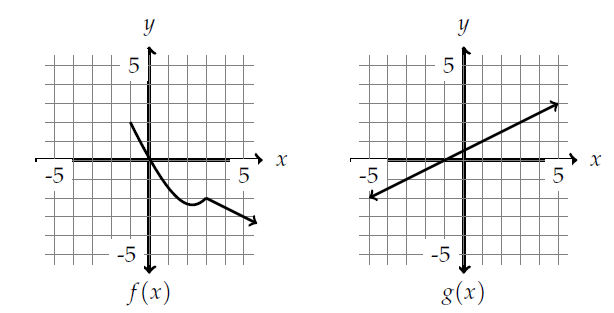
| \(x\) | -1 | 0 | 1 | 2 | 3 |
| \(h(x)\) | 2 | 1 | 3 | 4 | 1 |
- Estimate \(f \circ g(3)\). Remember, this means \(f(g(3))\).
- Estimate \(g \circ f(3)\).
- Estimate \(g(h(1))\).
- Find \(h(h(-1))\).
- What can you say about \(h(h(h(-1)))\) ?
2. Consider the functions \(f(x)=x^2+x-3 \text { and } g(x)=x-1\).
- Calculate \(f \circ g(4)\).
- Calculate \(f \circ g(-1)\).
- Give an expression of the form \(a x^2+b x+c\) for the function \(f \circ g(x)\). Hint: You need to substitute the \(x\) in the expression for \(f(x)\) with the expression for \(g(x)\), and then simplify.
- Check your answer to (c) by plugging in -1 and 4 for \(x\) and comparing with (a) and (b).
3. Write each of the following functions as a composition of two simpler functions. Be sure to give your simpler functions names, and write down the order in which they should be composed.
- \(h(x)=\frac{1}{x^2-1}\)
- \(v(x)=\sqrt{3 x+10}\)
4. Olive-Harvey College Cafeteria is preparing a big order for an event. The population (in thou-
sands) of the order of hot dog is given by the function \(P=f(t)\) in \(t\) years, and the yearly demand (in thousands) for hot dogs as a function of the population is: \(D=g(P)\). Write a sentence which gives the meaning of each the following expressions.
- \(f(12)=2.4\)
- \(g(3.5)=18.4\)
- \(g(f(4))=12.9\)