

6.1: Polygons
- Page ID
- 213685

\( \newcommand{\vecs}[1]{\overset { \scriptstyle \rightharpoonup} {\mathbf{#1}} } \)
\( \newcommand{\vecd}[1]{\overset{-\!-\!\rightharpoonup}{\vphantom{a}\smash {#1}}} \)
\( \newcommand{\dsum}{\displaystyle\sum\limits} \)
\( \newcommand{\dint}{\displaystyle\int\limits} \)
\( \newcommand{\dlim}{\displaystyle\lim\limits} \)
\( \newcommand{\id}{\mathrm{id}}\) \( \newcommand{\Span}{\mathrm{span}}\)
( \newcommand{\kernel}{\mathrm{null}\,}\) \( \newcommand{\range}{\mathrm{range}\,}\)
\( \newcommand{\RealPart}{\mathrm{Re}}\) \( \newcommand{\ImaginaryPart}{\mathrm{Im}}\)
\( \newcommand{\Argument}{\mathrm{Arg}}\) \( \newcommand{\norm}[1]{\| #1 \|}\)
\( \newcommand{\inner}[2]{\langle #1, #2 \rangle}\)
\( \newcommand{\Span}{\mathrm{span}}\)
\( \newcommand{\id}{\mathrm{id}}\)
\( \newcommand{\Span}{\mathrm{span}}\)
\( \newcommand{\kernel}{\mathrm{null}\,}\)
\( \newcommand{\range}{\mathrm{range}\,}\)
\( \newcommand{\RealPart}{\mathrm{Re}}\)
\( \newcommand{\ImaginaryPart}{\mathrm{Im}}\)
\( \newcommand{\Argument}{\mathrm{Arg}}\)
\( \newcommand{\norm}[1]{\| #1 \|}\)
\( \newcommand{\inner}[2]{\langle #1, #2 \rangle}\)
\( \newcommand{\Span}{\mathrm{span}}\) \( \newcommand{\AA}{\unicode[.8,0]{x212B}}\)
\( \newcommand{\vectorA}[1]{\vec{#1}} % arrow\)
\( \newcommand{\vectorAt}[1]{\vec{\text{#1}}} % arrow\)
\( \newcommand{\vectorB}[1]{\overset { \scriptstyle \rightharpoonup} {\mathbf{#1}} } \)
\( \newcommand{\vectorC}[1]{\textbf{#1}} \)
\( \newcommand{\vectorD}[1]{\overrightarrow{#1}} \)
\( \newcommand{\vectorDt}[1]{\overrightarrow{\text{#1}}} \)
\( \newcommand{\vectE}[1]{\overset{-\!-\!\rightharpoonup}{\vphantom{a}\smash{\mathbf {#1}}}} \)
\( \newcommand{\vecs}[1]{\overset { \scriptstyle \rightharpoonup} {\mathbf{#1}} } \)
\(\newcommand{\longvect}{\overrightarrow}\)
\( \newcommand{\vecd}[1]{\overset{-\!-\!\rightharpoonup}{\vphantom{a}\smash {#1}}} \)
\(\newcommand{\ket}[1]{\left| #1 \right>}\)
\(\newcommand{\bra}[1]{\left< #1 \right|}\)
\(\newcommand{\braket}[2]{\left< #1 \vphantom{#2} \right| \left. #2 \vphantom{#1} \right>}\)
\(\newcommand{\braopket}[3]{\left< #1 \vphantom{#2}\vphantom{#3} \right| #2 \vphantom{#1}\vphantom{#3} \left| #3 \vphantom{#1}\vphantom{#2} \right>}\)
\(\newcommand{\qmvec}[1]{\mathbf{\vec{#1}}}\)
\(\newcommand{\op}[1]{\hat{\mathbf{#1}}}\)
\(\newcommand{\expect}[1]{\langle #1 \rangle}\)
\(\newcommand{\dfn}[1]{\emph{\textbf{#1}}}\)
A polygon is:
- a plane figure
- that is bounded by a finite number of straight line segments
- in which each segment meets exactly two others, one at each of its endpoints.
A few comments about polygons:
- The line segments that make up a polygon are called its edges and the points where they meet are called its vertices (singular: vertex).
- Because of properties (2) and (3) in the definition, the boundaries of polygons are not self-intersecting.
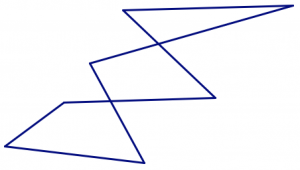
Not a polygon.
- Polygons are named based on the number of sides they have.
| name | # of sides | examples |
|---|---|---|
| triangle | 3 | 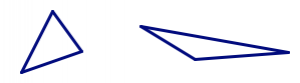 |
| quadrilateral | 4 | 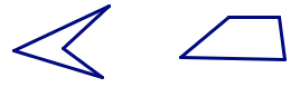 |
| pentagon | 5 |  |
| hexagon | 6 | 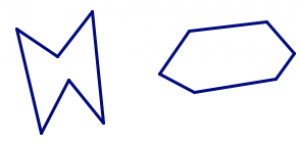 |
| heptagon | 7 | |
| octagon | 8 | |
| nonagon | 9 | |
| decagon | 10 |
- In general, we call a polygon with n sides an n-gon.
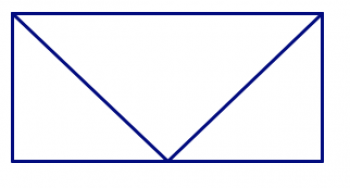
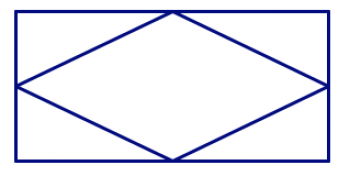
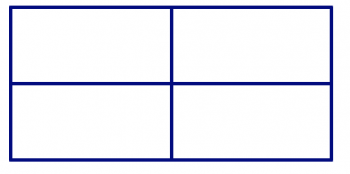
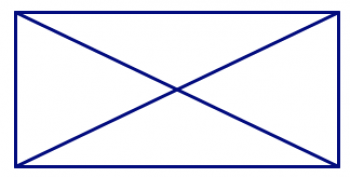
In the pictures below, there are polygons hidden in the design. In each design, find all of the triangles, quadrilaterals, pentagons, and hexagons. How can you be sure you’ve found them all and haven’t counted any twice?
Angle Sum
You know that the sum of the interior angles in any triangle is 180°. Can you say anything about the angles in other polygons?
You probably know that rectangles have four 90° angles. So if if all quadrilaterals have the same interior angle sum, it must be 360° (since 4 × 90° = 360°).
In general, the sum of the angles inside a polygon with n sides is (n - 2) × 180°. For example, the interior angles in a triangle, which has n = 3 sides, is (3 - 2) × 180° = 180°
A regular polygon has all sides the same length and all angles the same measure.
For example, squares are regular quadrilaterals — all four sides are the same length, and all four angles measure 90°. But a non-square rectangle is not regular. Even though all of the angles are 90°, the sides are not all the same length. Similarly, a non-square rhombus is not regular. Even though the sides of a rhombus are all the same length, the angles can be different.
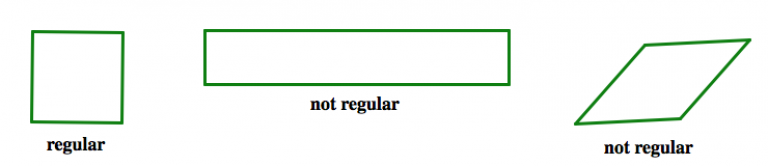
Since a square is a regular quadrilateral, you know that every angle in a regular quadrilateral measure 90°. What about angles in other regular polygons?
- What is the measure of each angle in a regular triangle? Explain how you know you are right.
- What is the measure of each angle in a regular pentagon? Explain how you know you are right.
- What is the measure of each angle in a regular hexagon? Explain how you know you are right.
- What is the measure of each angle in a regular n-gon? Explain how you know you are right.