

1.2: Linear Constant Coefficient Equations
- Page ID
- 90243

\( \newcommand{\vecs}[1]{\overset { \scriptstyle \rightharpoonup} {\mathbf{#1}} } \)
\( \newcommand{\vecd}[1]{\overset{-\!-\!\rightharpoonup}{\vphantom{a}\smash {#1}}} \)
\( \newcommand{\dsum}{\displaystyle\sum\limits} \)
\( \newcommand{\dint}{\displaystyle\int\limits} \)
\( \newcommand{\dlim}{\displaystyle\lim\limits} \)
\( \newcommand{\id}{\mathrm{id}}\) \( \newcommand{\Span}{\mathrm{span}}\)
( \newcommand{\kernel}{\mathrm{null}\,}\) \( \newcommand{\range}{\mathrm{range}\,}\)
\( \newcommand{\RealPart}{\mathrm{Re}}\) \( \newcommand{\ImaginaryPart}{\mathrm{Im}}\)
\( \newcommand{\Argument}{\mathrm{Arg}}\) \( \newcommand{\norm}[1]{\| #1 \|}\)
\( \newcommand{\inner}[2]{\langle #1, #2 \rangle}\)
\( \newcommand{\Span}{\mathrm{span}}\)
\( \newcommand{\id}{\mathrm{id}}\)
\( \newcommand{\Span}{\mathrm{span}}\)
\( \newcommand{\kernel}{\mathrm{null}\,}\)
\( \newcommand{\range}{\mathrm{range}\,}\)
\( \newcommand{\RealPart}{\mathrm{Re}}\)
\( \newcommand{\ImaginaryPart}{\mathrm{Im}}\)
\( \newcommand{\Argument}{\mathrm{Arg}}\)
\( \newcommand{\norm}[1]{\| #1 \|}\)
\( \newcommand{\inner}[2]{\langle #1, #2 \rangle}\)
\( \newcommand{\Span}{\mathrm{span}}\) \( \newcommand{\AA}{\unicode[.8,0]{x212B}}\)
\( \newcommand{\vectorA}[1]{\vec{#1}} % arrow\)
\( \newcommand{\vectorAt}[1]{\vec{\text{#1}}} % arrow\)
\( \newcommand{\vectorB}[1]{\overset { \scriptstyle \rightharpoonup} {\mathbf{#1}} } \)
\( \newcommand{\vectorC}[1]{\textbf{#1}} \)
\( \newcommand{\vectorD}[1]{\overrightarrow{#1}} \)
\( \newcommand{\vectorDt}[1]{\overrightarrow{\text{#1}}} \)
\( \newcommand{\vectE}[1]{\overset{-\!-\!\rightharpoonup}{\vphantom{a}\smash{\mathbf {#1}}}} \)
\( \newcommand{\vecs}[1]{\overset { \scriptstyle \rightharpoonup} {\mathbf{#1}} } \)
\(\newcommand{\longvect}{\overrightarrow}\)
\( \newcommand{\vecd}[1]{\overset{-\!-\!\rightharpoonup}{\vphantom{a}\smash {#1}}} \)
\(\newcommand{\avec}{\mathbf a}\) \(\newcommand{\bvec}{\mathbf b}\) \(\newcommand{\cvec}{\mathbf c}\) \(\newcommand{\dvec}{\mathbf d}\) \(\newcommand{\dtil}{\widetilde{\mathbf d}}\) \(\newcommand{\evec}{\mathbf e}\) \(\newcommand{\fvec}{\mathbf f}\) \(\newcommand{\nvec}{\mathbf n}\) \(\newcommand{\pvec}{\mathbf p}\) \(\newcommand{\qvec}{\mathbf q}\) \(\newcommand{\svec}{\mathbf s}\) \(\newcommand{\tvec}{\mathbf t}\) \(\newcommand{\uvec}{\mathbf u}\) \(\newcommand{\vvec}{\mathbf v}\) \(\newcommand{\wvec}{\mathbf w}\) \(\newcommand{\xvec}{\mathbf x}\) \(\newcommand{\yvec}{\mathbf y}\) \(\newcommand{\zvec}{\mathbf z}\) \(\newcommand{\rvec}{\mathbf r}\) \(\newcommand{\mvec}{\mathbf m}\) \(\newcommand{\zerovec}{\mathbf 0}\) \(\newcommand{\onevec}{\mathbf 1}\) \(\newcommand{\real}{\mathbb R}\) \(\newcommand{\twovec}[2]{\left[\begin{array}{r}#1 \\ #2 \end{array}\right]}\) \(\newcommand{\ctwovec}[2]{\left[\begin{array}{c}#1 \\ #2 \end{array}\right]}\) \(\newcommand{\threevec}[3]{\left[\begin{array}{r}#1 \\ #2 \\ #3 \end{array}\right]}\) \(\newcommand{\cthreevec}[3]{\left[\begin{array}{c}#1 \\ #2 \\ #3 \end{array}\right]}\) \(\newcommand{\fourvec}[4]{\left[\begin{array}{r}#1 \\ #2 \\ #3 \\ #4 \end{array}\right]}\) \(\newcommand{\cfourvec}[4]{\left[\begin{array}{c}#1 \\ #2 \\ #3 \\ #4 \end{array}\right]}\) \(\newcommand{\fivevec}[5]{\left[\begin{array}{r}#1 \\ #2 \\ #3 \\ #4 \\ #5 \\ \end{array}\right]}\) \(\newcommand{\cfivevec}[5]{\left[\begin{array}{c}#1 \\ #2 \\ #3 \\ #4 \\ #5 \\ \end{array}\right]}\) \(\newcommand{\mattwo}[4]{\left[\begin{array}{rr}#1 \amp #2 \\ #3 \amp #4 \\ \end{array}\right]}\) \(\newcommand{\laspan}[1]{\text{Span}\{#1\}}\) \(\newcommand{\bcal}{\cal B}\) \(\newcommand{\ccal}{\cal C}\) \(\newcommand{\scal}{\cal S}\) \(\newcommand{\wcal}{\cal W}\) \(\newcommand{\ecal}{\cal E}\) \(\newcommand{\coords}[2]{\left\{#1\right\}_{#2}}\) \(\newcommand{\gray}[1]{\color{gray}{#1}}\) \(\newcommand{\lgray}[1]{\color{lightgray}{#1}}\) \(\newcommand{\rank}{\operatorname{rank}}\) \(\newcommand{\row}{\text{Row}}\) \(\newcommand{\col}{\text{Col}}\) \(\renewcommand{\row}{\text{Row}}\) \(\newcommand{\nul}{\text{Nul}}\) \(\newcommand{\var}{\text{Var}}\) \(\newcommand{\corr}{\text{corr}}\) \(\newcommand{\len}[1]{\left|#1\right|}\) \(\newcommand{\bbar}{\overline{\bvec}}\) \(\newcommand{\bhat}{\widehat{\bvec}}\) \(\newcommand{\bperp}{\bvec^\perp}\) \(\newcommand{\xhat}{\widehat{\xvec}}\) \(\newcommand{\vhat}{\widehat{\vvec}}\) \(\newcommand{\uhat}{\widehat{\uvec}}\) \(\newcommand{\what}{\widehat{\wvec}}\) \(\newcommand{\Sighat}{\widehat{\Sigma}}\) \(\newcommand{\lt}{<}\) \(\newcommand{\gt}{>}\) \(\newcommand{\amp}{&}\) \(\definecolor{fillinmathshade}{gray}{0.9}\)Let’s consider the linear first order constant coefficient partial differential equation
\[\label{eq:1}au_x+bu_y+cu=f(x,y), \]
for \(a,\: b,\) and \(c\) constants with \(a^2 + b^2 > 0\). We will consider how such equations might be solved. We do this by considering two cases, \(b = 0\) and \(b\neq 0\).
Integrating this equation and solving for \(u(x, y)\), we have
\[\begin{align}\mu (x)u(x,y)&=\frac{1}{a}\int f(\xi ,y)\mu (\xi )d\xi +g(y) \nonumber \\ e^{\frac{c}{a}x}u(x,y)&=\frac{1}{a}\int f(\xi ,y)e^{\frac{c}{a}\xi}d\xi +g(y)\nonumber \\ u(x,y)&=\frac{1}{a}\int f(\xi ,y)e^{\frac{c}{a}(\xi -x)}d\xi +g(y)e^{-\frac{c}{a}x}.\label{eq:2}\end{align} \]
Here \(g(y)\) is an arbitrary function of \(y\).
For the second case, \(b\neq 0\), we have to solve the equation
\[au_x+bu_y+cu=f.\nonumber \]
It would help if we could find a transformation which would eliminate one of the derivative terms reducing this problem to the previous case. That is what we will do.
We first note that
\[\begin{align}au_x+bu_y&=(a\mathbf{i}+b\mathbf{j})\cdot (u_x\mathbf{i}+u_y\mathbf{j})\nonumber \\ &=(a\mathbf{i}+b\mathbf{j})\cdot\nabla u.\label{eq:3}\end{align} \]
Recall from multivariable calculus that the last term is nothing but a directional derivative of \(u(x, y)\) in the direction \(a\mathbf{i} + b\mathbf{j}\). [Actually, it is proportional to the directional derivative if \(a\mathbf{i} + b\mathbf{j}\) is not a unit vector.]
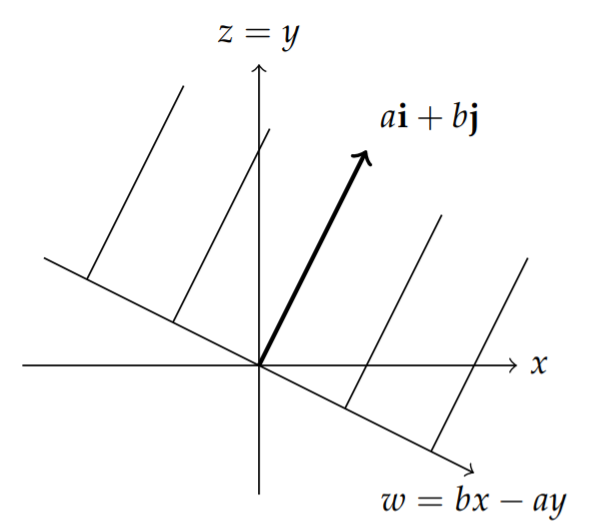
Therefore, we seek to write the partial differential equation as involving a derivative in the direction \(a\mathbf{i} + b\mathbf{j}\) but not in a directional orthogonal to this. In Figure \(\PageIndex{1}\) we depict a new set of coordinates in which the \(w\) direction is orthogonal to \(a\mathbf{i} + b\mathbf{j}\).
We consider the transformation
\[\begin{align}w&=bx-ay, \nonumber \\ z&=y.\label{eq:4}\end{align} \]
We first note that this transformation is invertible,
\[\begin{align} x&=\frac{1}{b}(w+az), \nonumber \\ y&=z.\label{eq:5}\end{align} \]
Next we consider how the derivative terms transform. Let \(u(x, y) = v(w, z)\). Then, we have
\[\begin{align}au_x+bu_y&=a\frac{\partial}{\partial x}v(w,z)+b\frac{\partial}{\partial y}v(w,z),\nonumber \\ &=a\left[\frac{\partial v}{\partial w}\frac{\partial w}{\partial x}+\frac{\partial v}{\partial z}\frac{\partial z}{\partial x}\right] \nonumber \\ &\: +b\left[\frac{\partial v}{\partial w}\frac{\partial w}{\partial y}+\frac{\partial v}{\partial z}\frac{\partial z}{\partial y}\right] \nonumber \\ &=a[bv_w+0\cdot v_z]+b[-av_w+v_z]\nonumber \\ &=bv_z.\label{eq:6}\end{align} \]
Therefore, the partial differential equation becomes
\[bv_z+cv=f\left(\frac{1}{b}(w+az),z\right).\nonumber \]
This is now in the same form as in the first case and can be solved using an integrating factor.
Find the general solution of the equation \(3u_x − 2u_y + u = x\).
Solution
First, we transform the equation into new coordinates.
\[w=bx-ay=-2x-3y,\nonumber \]
and \(z=y\). The,
\[\begin{align}u_x-2u_y&=3[-2v_w+0\cdot v_z]-2[-3v_w+v_z] \nonumber \\ &=-2v_z.\label{eq:7}\end{align} \]
Using this integrating factor, we can solve the differential equation for \(v(w, z)\).
\[\begin{align}\frac{\partial}{\partial z}\left(e^{-z/2}v\right)&=\frac{1}{4}(w+3z)e^{-z/2},\nonumber \\ e^{-z/2}v(w,z)&=\frac{1}{4}\int^z (w+3\xi )e^{-\xi /2}d\xi \nonumber \\ &=-\frac{1}{2}(w+6+3z)e^{-z/2}+c(w) \nonumber \\ v(w,z)&=-\frac{1}{2}(w+6+3z)+c(w)e^{z/2}\nonumber \\ u(x,y)&=x-3+c(-2x-3y)e^{y/2}.\label{eq:8}\end{align} \]