

1.6: Proof by Induction
- Page ID
- 243465

\( \newcommand{\vecs}[1]{\overset { \scriptstyle \rightharpoonup} {\mathbf{#1}} } \)
\( \newcommand{\vecd}[1]{\overset{-\!-\!\rightharpoonup}{\vphantom{a}\smash {#1}}} \)
\( \newcommand{\dsum}{\displaystyle\sum\limits} \)
\( \newcommand{\dint}{\displaystyle\int\limits} \)
\( \newcommand{\dlim}{\displaystyle\lim\limits} \)
\( \newcommand{\id}{\mathrm{id}}\) \( \newcommand{\Span}{\mathrm{span}}\)
( \newcommand{\kernel}{\mathrm{null}\,}\) \( \newcommand{\range}{\mathrm{range}\,}\)
\( \newcommand{\RealPart}{\mathrm{Re}}\) \( \newcommand{\ImaginaryPart}{\mathrm{Im}}\)
\( \newcommand{\Argument}{\mathrm{Arg}}\) \( \newcommand{\norm}[1]{\| #1 \|}\)
\( \newcommand{\inner}[2]{\langle #1, #2 \rangle}\)
\( \newcommand{\Span}{\mathrm{span}}\)
\( \newcommand{\id}{\mathrm{id}}\)
\( \newcommand{\Span}{\mathrm{span}}\)
\( \newcommand{\kernel}{\mathrm{null}\,}\)
\( \newcommand{\range}{\mathrm{range}\,}\)
\( \newcommand{\RealPart}{\mathrm{Re}}\)
\( \newcommand{\ImaginaryPart}{\mathrm{Im}}\)
\( \newcommand{\Argument}{\mathrm{Arg}}\)
\( \newcommand{\norm}[1]{\| #1 \|}\)
\( \newcommand{\inner}[2]{\langle #1, #2 \rangle}\)
\( \newcommand{\Span}{\mathrm{span}}\) \( \newcommand{\AA}{\unicode[.8,0]{x212B}}\)
\( \newcommand{\vectorA}[1]{\vec{#1}} % arrow\)
\( \newcommand{\vectorAt}[1]{\vec{\text{#1}}} % arrow\)
\( \newcommand{\vectorB}[1]{\overset { \scriptstyle \rightharpoonup} {\mathbf{#1}} } \)
\( \newcommand{\vectorC}[1]{\textbf{#1}} \)
\( \newcommand{\vectorD}[1]{\overrightarrow{#1}} \)
\( \newcommand{\vectorDt}[1]{\overrightarrow{\text{#1}}} \)
\( \newcommand{\vectE}[1]{\overset{-\!-\!\rightharpoonup}{\vphantom{a}\smash{\mathbf {#1}}}} \)
\( \newcommand{\vecs}[1]{\overset { \scriptstyle \rightharpoonup} {\mathbf{#1}} } \)
\(\newcommand{\longvect}{\overrightarrow}\)
\( \newcommand{\vecd}[1]{\overset{-\!-\!\rightharpoonup}{\vphantom{a}\smash {#1}}} \)
\(\newcommand{\ket}[1]{\left| #1 \right>}\)
\(\newcommand{\bra}[1]{\left< #1 \right|}\)
\(\newcommand{\braket}[2]{\left< #1 \vphantom{#2} \right| \left. #2 \vphantom{#1} \right>}\)
\(\newcommand{\braopket}[3]{\left< #1 \vphantom{#2}\vphantom{#3} \right| #2 \vphantom{#1}\vphantom{#3} \left| #3 \vphantom{#1}\vphantom{#2} \right>}\)
\(\newcommand{\qmvec}[1]{\mathbf{\vec{#1}}}\)
\(\newcommand{\op}[1]{\hat{\mathbf{#1}}}\)
\(\newcommand{\expect}[1]{\langle #1 \rangle}\)
\(\newcommand{\dfn}[1]{\emph{\textbf{#1}}}\)
Inductive Reasoning and Mathematical Induction: Inductive reasoning is the process of formulating a general conclusion based on specific observations, making it a valuable tool for identifying number patterns. While inductive reasoning can suggest that a statement is true, it cannot prove it: famous open problems like Goldbach's conjecture demonstrate how a pattern can hold for vast numbers of cases without being formally verified. In this course, however, we focus on accessible problems where mathematical induction can be applied to rigorously prove predictions made from initial observations. For instance, when predicting the \(n^{\text{th}}\) term of a sequence, mathematical induction provides the formal proof required for statements involving positive integers.
Process of Proof by Induction
There are two types of induction: regular and strong. The steps start the same but vary at the end. Here are the steps. In mathematics, we start with a statement of our assumptions and intent:
Let \(p(n), \forall n \geq n_0, \, n, \, n_0 \in \mathbb{Z_+}\) be a statement. We would show that p(n) is true for all possible values of n.
- Show that p(n) is true for the smallest possible value of n: In our case \(p(n_0)\). AND
- For Regular Induction: Assume that the statement is true for \(n = k,\) for some integer \(k \geq n_0\). Show that the statement is true for n = k + 1.
OR
For Strong Induction: Assume that the statement p(r) is true for all integers r, where \(n_0 ≤ r ≤ k \) for some \(k ≥ n_0\). Show that p(k+1) is true.
If these steps are completed and the statement holds, we are saying that, by mathematical induction, we can conclude that the statement is true for all values of \(n \geq n_0.\)
We shall use the following template for proof by induction:
Template for proof by induction
In order to prove a mathematical statement involving integers, we may use the following template:
Suppose \(p(n), \forall n \geq n_0, \, n, \, n_0 \in \mathbb{Z_+}\) be a statement.
For regular Induction:
- Base Case: We need to show that p(n) is true for the smallest possible value of n: In our case show that \(p(n_0)\) is true.
- Induction Hypothesis: Assume that the statement \(p(n)\) is true for any positive integer \(n = k,\) for s \(k \geq n_0\).
- Inductive Step: Show that the statement \(p(n)\) is true for \(n=k+1.\).
For strong Induction:
- Base Case: Show that p(n) is true for the smallest possible value of n: In our case \(p(n_0)\).
- Induction Hypothesis: Assume that the statement \(p(n)\) is true for all integers r, where \(n_0 ≤ r ≤ k \) for some \(k ≥ n_0\).
- Inductive Step: Show that the statement \(p(n)\) is true for \(n=k+1.\).
If these steps are completed and the statement holds, by mathematical induction, we can conclude that the statement is true for all values of \( n\geq n_0.\)
.jpg?revision=1&size=bestfit&width=590&height=443)
Example \(\PageIndex{1}\)
Prove 

Solution
Let 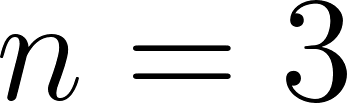
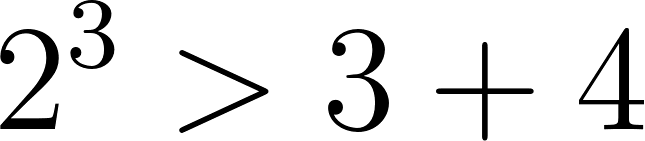
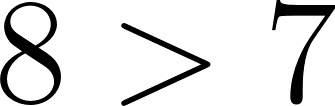

Assume that 
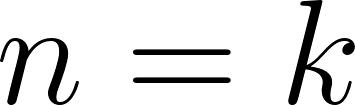
We will show that 
Consider 
Since 
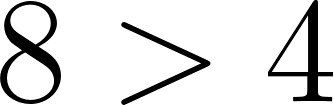

Thus the statement is true for all 
By induction, 

Exercise \(\PageIndex{1}\)
Prove that \(n < 2^n \) for \(n\in \mathbb{N}\).
- Answer
-
Hint: \(k+1 < 2^k(1+1)\).
Example \(\PageIndex{2}\)
Prove that \(1 + 2 + ... + n = \displaystyle \frac{n(n + 1)}{2}, \, \forall n \in \mathbb{Z}\).
Solution:
Base step: Choose \(n = 1\). Then L.H.S =\(1\). and R.H.S \( = \frac{(1)(1 + 1)}{2}=1\)
Induction Assumption: Assume that \( 1 + 2 + ... +k= \displaystyle\frac{k(k + 1)}{2}\), for \(k \in \mathbb{Z}\).
We shall show that \(1 + 2 + ... + k + (k + 1) = \displaystyle\frac{(k + 1)[(k + 1) + 1]}{2} = \frac{(k + 1)(k + 2)}{2}\)
Consider \(1 + 2 + ... + k + (k + 1) \)
\(= \displaystyle \frac{k(k + 1)}{2} + (k + 1)\)
\(= (k + 1) \left( \displaystyle\frac{k}{2} + \displaystyle\frac{1}{1}\right)\)
\(= (k + 1) \left( \displaystyle\frac{k + 2}{2}\right)\)
\(= \displaystyle \frac{(k + 1)(k + 2)}{2}\).
Thus, by induction we have \(1 + 2 + ... + n = \displaystyle\frac{n(n + 1)}{2}, \, \forall n \in \mathbb{Z}\).