

2.4: Cyclic groups
- Page ID
- 131666

\( \newcommand{\vecs}[1]{\overset { \scriptstyle \rightharpoonup} {\mathbf{#1}} } \)
\( \newcommand{\vecd}[1]{\overset{-\!-\!\rightharpoonup}{\vphantom{a}\smash {#1}}} \)
\( \newcommand{\dsum}{\displaystyle\sum\limits} \)
\( \newcommand{\dint}{\displaystyle\int\limits} \)
\( \newcommand{\dlim}{\displaystyle\lim\limits} \)
\( \newcommand{\id}{\mathrm{id}}\) \( \newcommand{\Span}{\mathrm{span}}\)
( \newcommand{\kernel}{\mathrm{null}\,}\) \( \newcommand{\range}{\mathrm{range}\,}\)
\( \newcommand{\RealPart}{\mathrm{Re}}\) \( \newcommand{\ImaginaryPart}{\mathrm{Im}}\)
\( \newcommand{\Argument}{\mathrm{Arg}}\) \( \newcommand{\norm}[1]{\| #1 \|}\)
\( \newcommand{\inner}[2]{\langle #1, #2 \rangle}\)
\( \newcommand{\Span}{\mathrm{span}}\)
\( \newcommand{\id}{\mathrm{id}}\)
\( \newcommand{\Span}{\mathrm{span}}\)
\( \newcommand{\kernel}{\mathrm{null}\,}\)
\( \newcommand{\range}{\mathrm{range}\,}\)
\( \newcommand{\RealPart}{\mathrm{Re}}\)
\( \newcommand{\ImaginaryPart}{\mathrm{Im}}\)
\( \newcommand{\Argument}{\mathrm{Arg}}\)
\( \newcommand{\norm}[1]{\| #1 \|}\)
\( \newcommand{\inner}[2]{\langle #1, #2 \rangle}\)
\( \newcommand{\Span}{\mathrm{span}}\) \( \newcommand{\AA}{\unicode[.8,0]{x212B}}\)
\( \newcommand{\vectorA}[1]{\vec{#1}} % arrow\)
\( \newcommand{\vectorAt}[1]{\vec{\text{#1}}} % arrow\)
\( \newcommand{\vectorB}[1]{\overset { \scriptstyle \rightharpoonup} {\mathbf{#1}} } \)
\( \newcommand{\vectorC}[1]{\textbf{#1}} \)
\( \newcommand{\vectorD}[1]{\overrightarrow{#1}} \)
\( \newcommand{\vectorDt}[1]{\overrightarrow{\text{#1}}} \)
\( \newcommand{\vectE}[1]{\overset{-\!-\!\rightharpoonup}{\vphantom{a}\smash{\mathbf {#1}}}} \)
\( \newcommand{\vecs}[1]{\overset { \scriptstyle \rightharpoonup} {\mathbf{#1}} } \)
\(\newcommand{\longvect}{\overrightarrow}\)
\( \newcommand{\vecd}[1]{\overset{-\!-\!\rightharpoonup}{\vphantom{a}\smash {#1}}} \)
\(\newcommand{\ket}[1]{\left| #1 \right>}\)
\(\newcommand{\bra}[1]{\left< #1 \right|}\)
\(\newcommand{\braket}[2]{\left< #1 \vphantom{#2} \right| \left. #2 \vphantom{#1} \right>}\)
\(\newcommand{\braopket}[3]{\left< #1 \vphantom{#2}\vphantom{#3} \right| #2 \vphantom{#1}\vphantom{#3} \left| #3 \vphantom{#1}\vphantom{#2} \right>}\)
\(\newcommand{\qmvec}[1]{\mathbf{\vec{#1}}}\)
\(\newcommand{\op}[1]{\hat{\mathbf{#1}}}\)
\(\newcommand{\expect}[1]{\langle #1 \rangle}\)
\(\newcommand{\dfn}[1]{\emph{\textbf{#1}}}\)
Order of group elements
Let \((G, \star)\) be a group with identity element \(e\), and let \(a \in G\). The order of the element \(a\), denoted by \(|a|\) or \(\operatorname{ord}(a)\), is the smallest positive integer \(n\) such that
\[
a^n = \underbrace{a \star a \star \dots \star a}_{n \text{ times}} = e.
\]
If no such positive integer \(n\) exists, we say \(a\) has infinite order, written \(|a| = \infty\).
Consider the group \(\mathbb{Z}_{10}\) with addition modulo \(10.\) What is the order of its elements?
Consider \(\mathbb{Z}_{10}=\{0, 1, 2, 3, 4, 5, 6, 7, 8, 9\}\). Note that \(0\) is the identity and its order is \(1. \)
|
element |
Order |
Calculations |
|
0 |
\(|\langle 0 \rangle |=1\) |
|
|
1 |
\(|\langle 1 \rangle |=10\) |
\(1^{10}\equiv 0 \pmod{10}\) |
|
2 |
\(|\langle 2 \rangle |=5\) |
\(2^{1}\equiv 2\pmod{10}\), \(2^2 \equiv 4 \pmod{10}\), \(2^{3}\equiv 6 \pmod{10}\), \(2^{4} \equiv 8 \pmod{10}\), and \(2^{5}\equiv 0 \pmod{10}\). |
|
3 |
\(|\langle 3 \rangle |=10\) |
\(3^1\equiv 3 \pmod{10}\), \(3^2\equiv 6 \pmod{10}\) , \(3^3\equiv 9 \pmod{10}\), \(3^4\equiv 2 \pmod{10}\), \(3^5\equiv 5 \pmod{10}\), \(3^6\equiv 8 \pmod{10}\), \(3^7\equiv 1 \pmod{10}\), \(3^8\equiv 4 \pmod{10}\), \(3^9\equiv 7 \pmod{10}\), and \(3^{10}\equiv 0 \pmod{10}\). |
|
4 |
\(|\langle 4 \rangle |=5\) |
\(4^1 \equiv 4 \pmod{10}\), \(4^2 \equiv 8 \pmod{10}\), \(4^3 \equiv 2 \pmod{10}\), \(4^4 \equiv 6 \pmod{10}\), and \(4^5 \equiv 0 \pmod{10}\). |
|
5 |
\(|\langle 5 \rangle |=2\) |
\(5^1 \equiv 5 \pmod{10}\), and \(5^2 \equiv 0 \pmod{10}\). |
|
6 |
\(|\langle 6 \rangle |=5\) |
\(6^1 \equiv 6 \pmod{10}\), \(6^2 \equiv 2 \pmod{10}\), \(6^3 \equiv 8 \pmod{10}\), \(6^4 \equiv 4 \pmod{10}\) and \(6^5 \equiv 0 \pmod{10}\). |
|
7 |
\(|\langle 7 \rangle |=10\) |
\(7^1 \equiv 7 \pmod{10}\), \(7^2 \equiv 4 \pmod{10}\), \(7^3 \equiv 1 \pmod{10}\), \(7^4 \equiv 8 \pmod{10}\), \(7^5 \equiv 5 \pmod{10}\), \(7^6 \equiv 2 \pmod{10}\), \(7^7 \equiv 9 \pmod{10}\), \(7^8 \equiv 6 \pmod{10}\), \(7^9 \equiv 3 \pmod{10}\), and \(7^{10} \equiv 0 \pmod{10}\). |
|
8 |
\(|\langle 8 \rangle |=5\) |
\(8^1 \equiv 8 \pmod{10}\), \(8^2 \equiv 6 \pmod{10}\), \(8^3 \equiv 4 \pmod{10}\), \(8^4 \equiv 2 \pmod{10}\), and \(8^5 \equiv 0 \pmod{10}\). |
|
9 |
\(|\langle 9 \rangle |=10\) |
\(9^1 \equiv 9 \pmod{10}\), \(9^2 \equiv 8 \pmod{10}\), \(9^3 \equiv 7 \pmod{10}\), \(9^4 \equiv 6 \pmod{10}\), \(9^5 \equiv 5 \pmod{10}\), \(9^6 \equiv 4 \pmod{10}\), \(9^7 \equiv 3 \pmod{10}\), \(9^8 \equiv 2 \pmod{10}\), \(9^9 \equiv 1 \pmod{10}\), and \(9^{10} \equiv 0 \pmod{10}\). |
The order of a group is the number of elements in the group.
The order of an element \(a \in G\), denoted by \(|a|\), be the smallest positive integer \(n\) such that \(a^n=e\).
Subgroups Generated by Sets
Let \((G,\star)\) be a group, and \(X\subseteq G\). The subgroup generated by \(X\) denoted,
\(
\langle X\rangle
\),
is the set of all finite products of elements in \(X\) and their
inverses:\[
\langle X \rangle = \left\{ x_1^{\epsilon_1} x_2^{\epsilon_2} \dots x_k^{\epsilon_k} \Bigm| k \ge 0, \, x_i \in X, \, \epsilon_i \in \{1, -1\} \right\}.
\]
If \(G\) is abelian, this simplifies to:
\[
\langle X \rangle = \left\{ x_1^{m_1} x_2^{m_2} \dots x_n^{m_n} \Bigm| m_i \in \mathbb{Z}, \, x_i \in X \right\}.
\]
Let \((G,\star)\) be a group.
Let \(a \in G\), then define the set generated by \(a\) denoted by \(\langle a \rangle \) is \(\{a^m|m\in \mathbb{Z}\}=\{\cdots, a^{-2}, a^{-1}, e, a, a^2, \cdots\}\).
Note: \(a^0=e\).
Let \((G,\star)\) be a group.
Let \(a \in G\), then \(\langle a \rangle \) is the smallest subgroup of \(G\) that contains \(a\).
- Proof
-
Let \((G,\star)\) be a group. Let \(a \in G\). If \(a=e\) then \(\langle a \rangle =\{e\}\) is the smallest subgroup of \(G\) that contains \(e\).
Suppose \(a \ne e.\) Clearly \(e \in \langle a \rangle.\) Let \(g,h \in \langle a \rangle.\) Then \(g=a^m\) for some \(m\in \mathbb{Z}\) and \(h=a^n\) for some \(n \in \mathbb{Z}\).
Consider \(gh^{-1}=a^m \left(a^n\right)^{-1}=a^m a^{-n}=a^{m-n}.\) Since \(m-n \in \mathbb{Z}\), \(gh^{-1} \in \langle a \rangle.\)
Thus, \(\langle a \rangle \leq G.\) Suppose \(H\) is a subgroup of \ (G \) containing \(a\). Clearly, \(\langle a \rangle \leq H.\) \(\square\)
Let \((G,\star)\) be a group.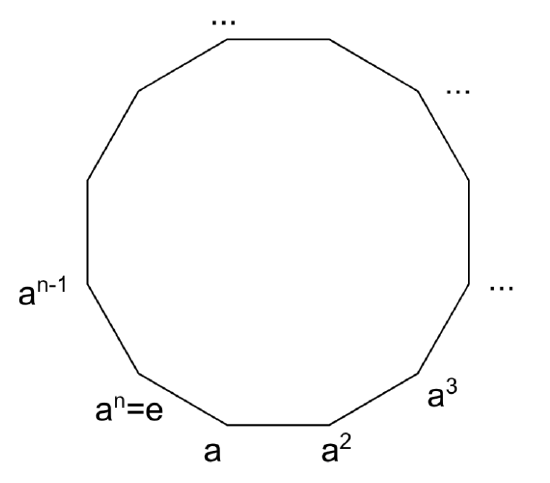
Let \(a \in G\), then \(\langle a \rangle \) is called cyclic subgroup of \( G.\)
\[
\langle[2]\rangle
=
\{[0],[2],[4],[6],[8]\}
\]
in \(\mathbb{Z}_{10}\) with addition modulo \(10.\)
A group \(G\) is called cyclic if there exists an element \(a \in G\) such that \(G = \langle a \rangle\). The element \(a\) is called a generator of \(G\).
Remember the definition of a unitary group:
Let \(n\) be a positive integer. Then define \(U(n)=\{[a]_n \in \mathbb{Z}_n| \gcd(a,n)=1\}.\) Then \((U(n), \cdot \pmod n)\) is an abelian group. The order of \(U(n)\) is given by Euler's totient function, \(|U(n)| = \phi(n)\).
\(U(15)=\{1, 2, 4, 7, 8, 11, 13, 14\}\) and \(\star= \cdot \pmod{15}\).
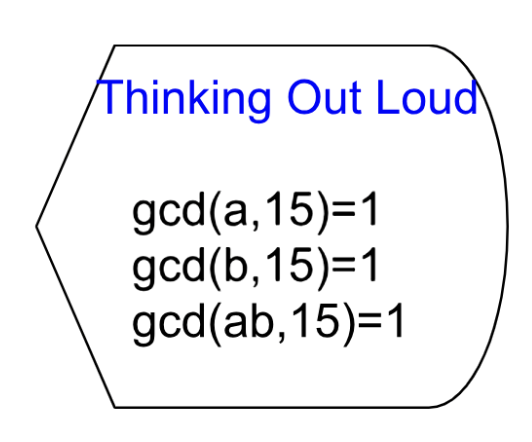 \(U(15)\) is a finite group; the order of the group is \(|U(15)|=8\). However, \(U(15)\) is not a cyclic group.
Proof (by exhaustion)
Since a group of order \(8\) is cyclic if and only if it has an element of order \(8\), we will show that \(\not \exists a \in U(15)\) such that \(| \langle a \rangle |=8\).
\(|\langle1 \rangle |=1\) since \(1^1 \equiv 1 \pmod{15}\)
\(|\langle2 \rangle |=4\) since \(2^4 \equiv 1 \pmod{15}\)
\(|\langle4 \rangle |=2\) since \(4^2 \equiv 1 \pmod{15}\)
\(|\langle7 \rangle |=4\) since \(7^4 \equiv 1 \pmod{15}\).
\(|\langle8 \rangle |=4\) since \(8^4 \equiv 1 \pmod{15}\).
\(|\langle11 \rangle |=2\) since \(11^2 \equiv 1 \pmod{15}\).
\(|\langle13 \rangle |=4\) since \(13^4 \equiv 1 \pmod{15}\).
\(|\langle14 \rangle |=2\) since \(14^2 \equiv 1 \pmod{15}\).
Since \(\not \exists a \in U(15)\), such that \(|\langle a \rangle |=8\), \(U(15)\) is not a cyclic group. \(\square\)
Prove that \((U(14),\cdot \pmod{14}\) is cyclic. 
Proof:
We will show that \(\exists a \in U(14)\) such that \(|\langle a \rangle |=|U(14)|\).
Consider \(U(14)=\{1,3,5,9,11,13\}\) where \(|U(14)|=6\).
Consider \(3^1\equiv 3 \pmod{14}\), \(3^2\equiv 9 \pmod{14}\), \(3^3 \equiv 13 \pmod{14}\), \(3^4\equiv 11 \pmod{14}\), \(3^5\equiv 5 \pmod{14}\) and \(3^6 \equiv 1 \pmod{14}\).
\(|\langle3 \rangle |=6\) since \(3^6 \equiv 1 \pmod{14}\).
Thus \(|\langle3 \rangle |=6\).
Therefore, \(U(14)\) is cyclic and \(3\) is a generator. \(\square\)
The following is an infinite cyclic group. Any infinite cyclic group is isomorphic to this group.
Is \((\mathbb{Z},+)\) cyclic group? If so, what are the possible generators?
Yes, \((\mathbb{Z},+)\) is a cyclic group that is generated by \(\pm 1\).
Proof of being a cyclic group:
Since the group generated by \(1\) contains \(1,\) the identity \(0,\) and the inverse of \(1, (-1),\) as well as all multiples of \(1 \) and \((-1)\), \((\mathbb{Z},+)\) is cyclic.
Possible Generators:
Note \(1^n\) is \(1+1+\cdots+1\) with \(n\) terms when \(n \rangle 0\) and \((-1)+(-1)+\cdots+(-1)\) with \(n\) terms when \(n\) is \(\langle0\).
We shall show \(\mathbb{Z}=\langle1 \rangle =\langle-1 \rangle \).
Consider that \(1^n\) means \(1+1+\cdots +1\) with \(n\) terms and that \(1^{-n}\) means \(+(-1)+(-1)+\cdots+(-1)\) with \(n\) terms.
It should be clear that \(1^n\) will generate \(\mathbb{Z}_+\) and that \(1^{-n}\) will generate \(\mathbb{Z}_-\). Note that \(1^0\) is interpreted as \(0\cdot 1=0\).
\(\langle 1 \rangle =\{ \ldots, -3,-2,-1,0,1,2,3,\ldots \}\).
Thus \(\langle1 \rangle \) is a generator of \((\mathbb{Z},+)\).
Similarly, we will show that \(\langle-1 \rangle \) is a generator of \((\mathbb{Z},+)\).
Consider that \((-1)^n\) means \(+(-1)+(-1)+\cdots+(-1)\) with \(n\) terms and that \(1^{-n}\) means \(1+1+\cdots +1\) with \(n\) terms.
It should be clear that \(1^n\) will generate \(\mathbb{Z}_-\) and that \(1^{-n}\) will generate \(\mathbb{Z}_+\). \(\langle-1 \rangle =\{ \ldots, -3,-2,-1,0,1,2,3,\ldots \}\).
Thus the generators of \((\mathbb{Z},+)\) are \(\langle1 \rangle \) and \(\langle-1 \rangle \).
Fundamental Properties and Theorems:
Cyclic groups are abelian.
- Proof:
-
Let \((G,\star)\) be a group.
If \(G\) is cyclic, then \(G\) is abelian.
Assume that \(G\) is cyclic.
Then \(G=\langle g \rangle \) for some \(g \in G\).
Let \(a,b \in G\).
We will show \(ab=ba\).
Then \(a=g^m\) and \(b=g^n\), \(m,n \in \mathbb{Z}\).
Consider \begin{align*} ab &=g^mg^n\\&=g^{m+n}\\&=g^{n+m}\\&=g^ng^m\\&=ba. \end{align*}
Hence, \(G\) is abelian. \(\square\)
The converse is false. Specifically, an abelian group is not necessarily cyclic. A counterexample is \((U(15), \bullet)\), which is abelian but not cyclic.
Every subgroup of a cyclic group is cyclic.
Let \((G, \star)\) be a cyclic group. If \(H \le G\), then \(H\) is cyclic.
- Proof
-
Let \(G=\langle g \rangle , \; g \in G\).
We will show \(H=\langle g^k \rangle \) for some \(k \in \mathbb{Z}\).
There are two cases to consider.
Case 1: \(H=\{e\}\)
Let \(H=\{e\}\), then we are done since \(e \star e=e\) thus \(|H|=|\langle e \rangle |=1\).
Case 2: \(H \ne \{e\}\)
Let \(H \ne \{e\}\).
Thus \(\exists h \in H\) such that \(h \ne e\).
Since \(h \in H\), \(h \in G\).
Hence \(h=g^m\) for some \(m \in \mathbb{Z}\).
If \(m<0\), then \(h^{-1}=g^{-m} \in H\), because \(H \le G\). Thus, by replacing \(h\) with its inverse when necessary, one may choose a positive exponent
Without loss of generality, we may assume \(m \in \mathbb{N}\).
Define \(S=\{n\in \mathbb{N}|g^n \in H\} \subseteq \mathbb{N}\).
Since \(S(\ne \{\})\) by the well ordering principle \(S\) has a smallest element \(k\).
We shall show that \(H = \ langle g^k \rangle\).
Since \(g^k \in H\), \(\langle g^k \rangle \le H\).
Let \(h \in H\).
We shall show that \(h \in \langle g^k \rangle \).
Since \(h \in H\), \(h=g^m, m \in \mathbb{Z}\).
Since \(k,m \in \mathbb{Z}\), by the division algorithm, there exists \(q,r\) such that \(m=qk+r, \; 0\le r<k\).
Then \(g^m=g^{qk}g^r\) and \(g^{m-qk}=g^r\).
Since \(g^m, g^{qk} \in H\), then \(g^r \in H\). If \(0< r<k\), then \(g^r \in H\) , contradicting the minimality of \(k\).Hence \(r=0\). Therefore \(g^m=(g^k)^q \in \langle g^k \rangle \).
Thus \(H \le \langle g^k \rangle \). \(\square\)
The Converse is false. Every subgroup of the Klein 4-group is cyclic, but the group is not.
Subgroups of \( (\mathbb{Z}, +)\) are precisely of the form \((n\mathbb{Z},+)\), \(n\in \mathbb{N}\).
Let \(G\) be a cyclic group such that \(G=\langle a \rangle \) and \(|G|=n\).
Then \(a^k=e\) iff \(n\mid k\).
- Proof
-
Let \(G=\langle a \rangle \) with \(a^n=e\).

\(\langle a \rangle =\{e,a,a^2\ldots,a^{n-1}\}\).
Let \(a^k=e, \; k \in \mathbb{Z}\).
By the division algorithm, unique integers q and r exist such that \(k=nq+r, \; 0\le r< n, \; q,r \in \mathbb{Z}\).
Consider \(a^r=a^{k-nq}\)
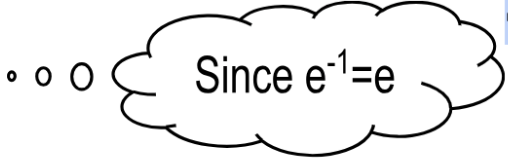
\(=a^k(a^n)^{-q}\) Note: \(a^k=e\) is our assumption & \(n\) is the order of group.
\(=ee^{-q}\)
\(=e\).
 Hence \(r=0\).
Thus \(k=nq\).
Therefore \(n|k\).
Conversely, assume that \(n|k\).
Then \(k=nm, m \in \mathbb{Z}\).
\(a^k=a^{nm}\).
\(=(a^n)^m\)
\(=e^m\)
\(=e\).
Hence the result. \(\square\)
Consider the group \(\mathbb{Z}_{12}\) with addition modulo \(12. \)
1. Is \((\mathbb{Z}_{12} ,+ \pmod{12} )\) cyclic group? If so, what are the possible generators? How many distinct generators are there? What can you say about the number of generators (hint: Euler totient function) and the possible generators (Hint: Divisors)?
3. Find all subgroups of \(\mathbb{Z}_{12}\) generated by each element. What are their orders? What can you say about these orders?
- Answer
-
1. Consider \(\mathbb{Z}_{12}=\{0, 1, 2, 3, 4, 5, 6, 7, 8, 9, 10, 11\}\) with addition modulo \(12. \) Note that \(\{0\}\) is the identity and its order is \(1 \) , also note that \(a^m=ma\) for all the elements \(a\) and \(m\in \mathbb{Z}\).
Element
Order
Calculations
\(0\)
\(| 0 |=1\)
\(1\)
\(|1 |=12\)
\(1^{12}\equiv 0 \pmod{12}\)
\(2\)
\(| 2 |=6\)
\(2^{1}\equiv 2\pmod{12}\), \(2^2 \equiv 4 \pmod{12}\), \(2^{3}\equiv 6 \pmod{12}\), \(2^{4} \equiv 8 \pmod{12}\), \(2^{5}\equiv 10 \pmod{12}\) and \(2^{6}\equiv 0 \pmod{12}\).
\(3\)
\(| 3 |=4\)
\(3^1\equiv 3 \pmod{12}\), \(3^2\equiv 6 \pmod{12}\) , \(3^3\equiv 9 \pmod{12}\), and \(3^4\equiv 0 \pmod{12}\).
\(4\)
\(| 4 |=3\)
\(4^1 \equiv 4 \pmod{12}\), \(4^2 \equiv 8 \pmod{12}\), and \(4^3 \equiv 0 \pmod{12}\).
\(5\)
\(| 5 |=12\)
\(5^1 \equiv 5 \pmod{12}\), \(5^2 \equiv 10 \pmod{12}\), \(5^3 \equiv 3 \pmod{12}\), \(5^4\equiv 8 \pmod{12}\), \(5^5 \equiv 1 \pmod{12}\), \(5^6 \equiv 6 \pmod{12}\), \(5^7 \equiv 11 \pmod{12}\), \(5^8 \equiv 4 \pmod{12}\),\(5^9 \equiv 9 \pmod{12}\), \(5^{10} \equiv 2 \pmod{12}\), \(5^{11} \equiv 7 \pmod{12}\), and \(5^{12} \equiv 0 \pmod{12}\).
\(6\)
\(| 6 |=2\) \(6^1 \equiv 6 \pmod{12}\), and \(6^2 \equiv 2 \pmod{12}\).
\(7\)
\(| 7 |=12\)
\(7^1 \equiv 7 \pmod{12}\), \(7^2 \equiv 2 \pmod{12}\), \(7^3 \equiv 9 \pmod{12}\), \(7^4 \equiv 4 \pmod{12}\), \(7^5 \equiv 11 \pmod{12}\), \(7^6 \equiv 6 \pmod{12}\), \(7^7 \equiv 1 \pmod{12}\), \(7^8 \equiv 8 \pmod{12}\), \(7^9 \equiv 3 \pmod{12}\), \(7^{10} \equiv 10 \pmod{12}\), \(7^{11} \equiv 5 \pmod{12}\), and \(7^{12} \equiv 0 \pmod{12}\).
\(8\)
\(|8 |=3\)
\(8^1 \equiv 8 \pmod{12}\), \(8^2 \equiv 4 \pmod{12}\) and \(8^3 \equiv 0 \pmod{12}\).
\(9\)
\(| 9 \ |=4\)
\(9^1 \equiv 9 \pmod{12}\), \(9^2 \equiv 6 \pmod{12}\), \(9^3 \equiv 3 \pmod{12}\) and \(9^4 \equiv 0 \pmod{12}\).
\(9^5 \equiv 5 \pmod{10}\), \(9^6 \equiv 4 \pmod{10}\), \(9^7 \equiv 3 \pmod{10}\), \(9^8 \equiv 2 \pmod{10}\), \(9^9 \equiv 1 \pmod{10}\), and \(9^{10} \equiv 0 \pmod{10}\).
\(10\) \(|10 |=6\) \(10^1 \equiv 10 \pmod{12}\), \(10^2 \equiv 8 \pmod{12}\), \(10^3 \equiv 6 \pmod{12}\), \(10^4 \equiv 4 \pmod{12}\), \(10^5 \equiv 2 \pmod{12}\) and \(10^6 \equiv 0 \pmod{12}\).
\(11\) \( 11 |=12\) \(11^1 \equiv 11 \pmod{12}\), \(11^2 \equiv 10 \pmod{12}\), \(11^3 \equiv 9 \pmod{12}\), \(11^4 \equiv 8 \pmod{12}\), \(11^5 \equiv 7 \pmod{12}\), \(11^6 \equiv 6 \pmod{12}\), \(11^7 \equiv 5 \pmod{12}\), \(11^8 \equiv 4 \pmod{12}\), \(11^9 \equiv 3 \pmod{12}\), \(11^{10} \equiv 2 \pmod{12}\), \(11^{11} \equiv 1 \pmod{12}\), and \(11^{12} \equiv 0 \pmod{12}\). From the table, \((\mathbb{Z}_{12}, + \pmod{12} )\) is a cyclic group, the set of all possible generators is \(\{1, 5, 7, 11\}=\{ a \in \mathbb{Z}| gcd(a,12)=1 ,\; 1 \leq a < 12 \} \). Hence, the number of generators equals the number of integers relatively prime to \(12=2^2\,3\). That is, the number of generators is the Euler totient number \( \phi(12) =(2^2-2)(3^1-1)= 4 \;\; .\)
2. From the above table, we see that the orders of the subgroups are \(1, 2, 3, 4, 6\) and 12, which are all divisors of the order of \(\mathbb{Z}_{12}\). Specifically, the order of the subgroup generated by \(g \in \mathbb{Z}_{12}\) is \(\dfrac{n}{ gcd(g, n)}.\)
Note that \(12=2^2 \, 3\). Then the cyclic subgroups are \(\langle 1 \rangle , \langle 6 \rangle , \langle 4 \rangle , \langle 3 \rangle , \langle 2 \rangle , \langle 0 \rangle \) with orders \(12, 2, 3, 4, 6\) and \(1.\)

Let \(G=\langle a \rangle \) be a cyclic group with \(|G|=n\).
1. Order of Powers in Cyclic Groups: \(\langle a^k \rangle =\langle a^{\gcd(n,k)} \rangle \). Also, for any integer \(k\): The order of \(a^k\) is given by:
\(
|a^k| = \frac{n}{\gcd(n, k)}.
\)
2. Number of Generators: \(G = \langle a^k \rangle\) if and only if \(\gcd(k, n) = 1\). Consequently, \(G\) has exactly \(\phi(n)\) distinct generators.
- Proof
-
1. Let \(G=\langle a \rangle \) with \(|G|=n\) and \(a \in G\).
Let \(a^n=e\).
We will show that \(\langle a^k \rangle =\langle a^{\gcd{(n,k)}} \rangle \).
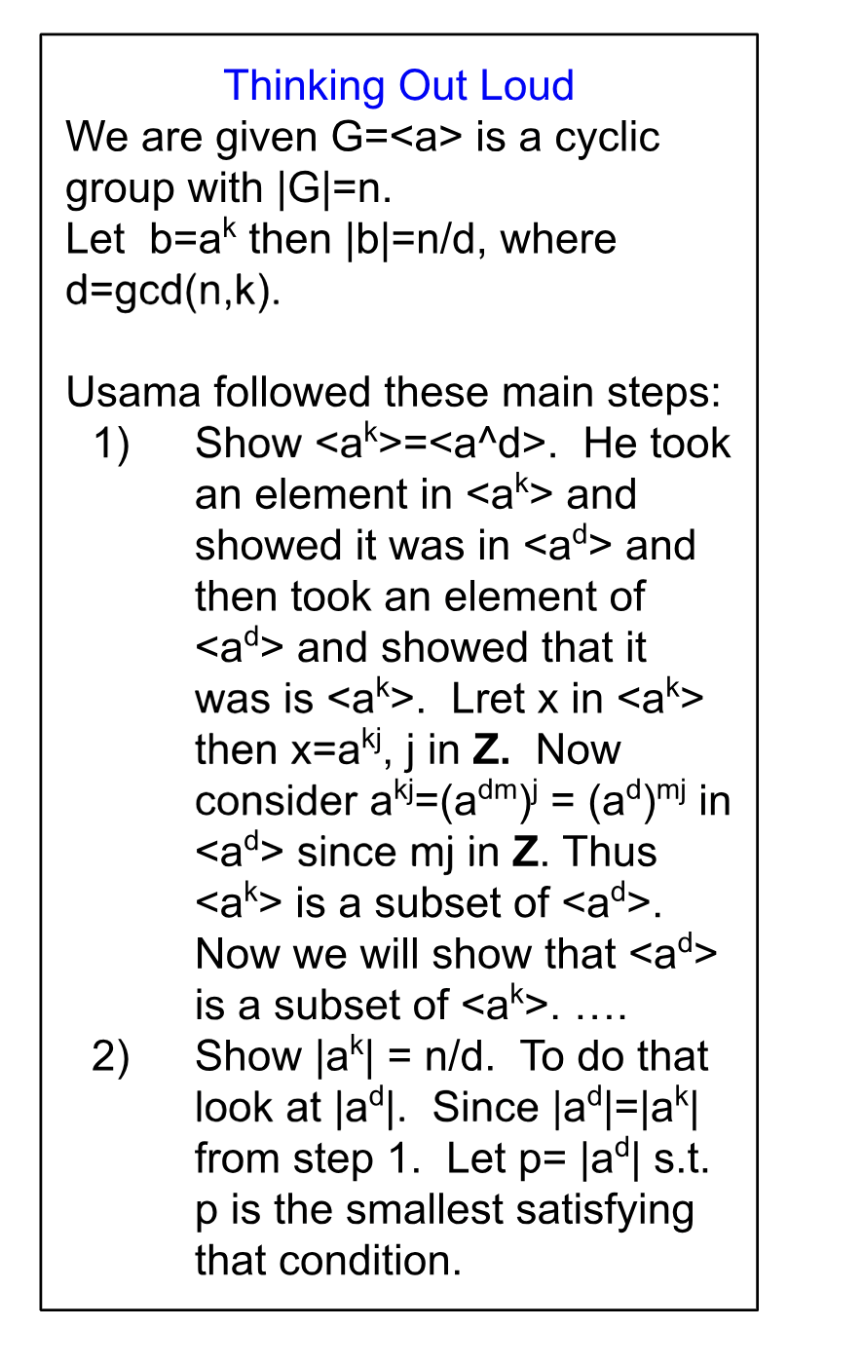
Let \(x \in \langle a^k \rangle \).
Since \(\gcd(n,k)=d\) for some \(d \in \mathbb{Z}_+\), \(d|n\) and \(d|k\).
Thus, \( k=md, m\in \mathbb{Z}\).
Consider an arbitrary power of \(a^k\), \((a^k)^j \in \langle a^k \rangle \).
\((a^k)^j = (a^{md})^j=(a^d)^{jm} \in \langle a^d \rangle \in \langle a^{\gcd{(n,k)}} \rangle \).
Let \(d=xn+yk, \; n,k \in \mathbb{Z}\).
Using the division algorithm, \((a^{xn+yk})^h= (a^n)^{xh} (a^k)^{yh}, \;n,k,h \in \mathbb{Z}\)
\(=(a^k)^{yh} \in \langle a^k \rangle \).
Thus \(a^k = a^d\).
Now we want to show \(|a^k|=\frac{n}{d}\).
Consider \((a^k)^{\frac{n}{d}}=(a^n)^{\frac{k}{d}}=e^{\frac{k}{d}}=e\).
Thus \(|a^k|\le \frac{n}{d}\).
Now consider \((a^d)^{\frac{n}{d}}=(a^n)=e \; \Rightarrow \; |a^d| \le \frac{n}{d}\).
Now consider \(0 \le i <\frac{n}{d}\).
Thus \(d < n\), and \(d\) is positive since it is the greatest common divisor.
Thus \((a^d)^i=a^{di}\ne e\) for \(di<n\).
Then we can show \(|a^d|=\frac{n}{d}\).
Consider \(|a^k|=|\langle a^k \rangle |=|\langle a^d \rangle |=|a^d|= \frac{n}{d}\).
Hence \(|a^k|=\frac{n}{d}\).
2.
Let \(G=\langle g \rangle \) be a cyclic group with \(|g|=n\). Then
\( g \in G \) and \(g^n=e\).Assume that \( G = \langle g^k \rangle \). Then \( g = (g^k)^ x \) for some \( x \in \mathbb{Z} \).
Thus,
\(
g^{1 - kx} = e.
\)
By Theorem 2.4.5, \( n \mid (1 - kx) \). Therefore,
\(1 - kx = ny, \) for some \(y \in \mathbb{Z}.
\)
Which implies,
\(
1 = kx + ny,
\)
hence,
\(
\gcd(k, n) = 1.
\)Conversely, we shall show that if \( \gcd(k, n) = 1 \), then \( G = \langle g^k \rangle \).
Suppose that \( \gcd(k, n) = 1 \). Then
\(kx + ny = 1\), for some \( x, y \in \mathbb{Z}.\)
By using the properties of powers in a group and \(g^n=e\), we get,
\[
g^1 = g^{kx + ny}=(g^k)^x (g^n)^y=(g^k)^x.
\]Hence \( g \in \langle g^k \rangle \).
Therefore, we have \( G \subseteq \langle g^k \rangle \). Since \( \langle g^k \rangle \ \subseteq G\),
\(
G = \langle g^k \rangle.
\)
Let \(G=\langle a \rangle \) be a cyclic group with \(|G|=n\). Then
a) Every subgroup of \(G\) is of the form \(\langle a^k \rangle\) where \(k \mid n\). Thus, if \(H\leq G\) then \(H=\langle a^k \rangle \) for some integer \(k\) that divides \(n\).
b) For each positive divisor \(k\) of \(n\), the group \(G\) has exactly one subgroup of order \(k\), which is \(\langle a^{n/k} \rangle\). Thus if \(k|n\, k >0) then \(\langle a^{\frac{n}{k}} \rangle\) is the unique subgroup of \(G\) of order \(k\).
- Proof
-
a) Let \(G = \langle a \rangle\) with \(|G| = n.\) Assume that \(H\leq G\). By Theorem 2.4.3, \(H\) is cyclic. Hence \( H=\langle a^k \rangle\) for some integer \(k \in \textbf{Z}. \) Let \(d=gcd(k,n)\). We shall show that \(H = \ langle a^d \rangle\). Since \(d=gcd(k,n)\), \(kx + ny = d\), for some \( x, y \in \mathbb{Z}.\) Consider, \[
a^d = a^{kx + ny}=(a^k)^x (a^n)^y=(a^k)^x.
\] Thus \(a^d \in H\). Therefore \(\langle a^d \rangle \subseteq H.\)
Since \(d|k, k=md,\) for some \( m\in \mathbb{Z}.\) Thus, \(a^k=a^{md}=\left(a^d\right)^m.\) Hence \( H \subseteq \langle a^d \rangle \). Thus \( H =\langle a^d \rangle\) and \(d|n.\)b) Let \(G = \langle a \rangle\) with \(|G| = n.\) Assume that \(k|n\). Suppose \(K\) be subgroup of \(G\) of order \(k\). We shall show that \(K=\langle a^{\frac{n}{k}} \rangle\). Since \(K\) is a subgroup of \(G\), \(K=\langle a^m \rangle\), for some, \( m \in \mathbb{Z}.\) By part a, \(m|n.\) Then \(\left(a^m\right)^{n/m}=e\). We shall show that \(\dfrac{n}{m}\) is the smallest positive integer with this property.
Now, \(|K|= \dfrac{n}{m}=k\). Thus, \(m=\dfrac{n}{k}\). Thus \(K= \langle a^\frac{n}{k} \rangle\) which is unique.
In the additive group \(\mathbb{Z}_n\), the order of an element \(a\in\mathbb{Z}_n\) is \[ |a|=\frac{n}{\gcd(a,n)}. \]
Consider \(\mathbb{Z}_{12}\). Then
\(|8|=\dfrac{12}{\gcd(8,12)}=\dfrac{12}{4}=3.\)
Indeed, \([8]+[8]+[8]=[24]=[0].\)
A group of prime order is cyclic.
- Proof
-
Let \(G\) be a group such that \(|G|=p\), where \(p\) is a prime number.
Let \(g \in G\) such that \(H=\langle g \rangle \) is a subgroup of \(G\).Since \(p > 1\), \(g \ne \{e\}\).
Since \(H\) is cyclic, \(\exists \; g^k=e\), for some \( k \in \mathbb{Z}\).
By the division algorithm, \(k=nq+r\) where \(0 \le r < n\).
Hence, \(e=g^k=g^{nq+r}=g^{nq}g^r=eg^r=g^r\).
Since the smallest positive integer \(k\) such that \(g^k=e\) is \(n\), \(r=0\). Thus \(n|k\).
Conversely, if \(n|k\), then \(k=nm\), \(m \in \mathbb{Z}\).
Consequently, \(g^k=g^{nm}=(g^n)^m=e^m=e\).
Thus, \(|\langle g \rangle |\) divides \(|G|\).
Consider that the only two divisors of a prime number are the prime number itself and 1.
Since \(p < 1\), \(|G|=p\).
Since \(|G|=p\), \(G\) is cyclic. \(\square\)
List all the cyclic subgroups of \(U(30)\).
\(U(30)=\{1,7,11,13,17,19,23,29\}\) and \(|U(30)|=8\).
|
\(k\) |
Calculations |
\(|k|\) |
|
7 |
\(7^1 \equiv 7 \pmod{30}\), \(7^2 \equiv 19 \pmod{30}\), \(7^3 \equiv 13 \pmod{30}\), \(7^4 \equiv 1 \pmod{30}\) |
4 |
|
11 |
\(11^1 \equiv 11 \pmod{30}\), \(11^2 \equiv 1 \pmod{30}\) |
2 |
|
13 |
\(13^1 \equiv 13 \pmod{30}\), \(13^2 \equiv 19 \pmod{30}\), \(13^3 \equiv 7 \pmod{30}\), \(13^4 \equiv 1 \pmod{30}\) |
4 |
|
17 |
\(17^1 \equiv 17 \pmod{30}\), \(17^2 \equiv 19 \pmod{30}\), \(17^3 \equiv 23 \pmod{30}\), \(17^4 \equiv 1 \pmod{30}\) |
4 |
|
19 |
\(19^1 \equiv 19 \pmod{30}\), \(19^2 \equiv 1 \pmod{30}\) |
2 |
|
23 |
\(23^1 \equiv 23 \pmod{30}\), \(23^2 \equiv 19 \pmod{30}\), \(23^3 \equiv 17 \pmod{30}\), \(23^4 \equiv 1 \pmod{30}\) |
4 |
|
29 |
\(29^1 \equiv 29 \pmod{30}\), \(29^2 \equiv 1 \pmod{30}\) |
2 |
Since \(\not \exists a \in U(30)\) such that \(|\langle a \rangle |=|U(30)|=8\), \(U(30)\) is not a cyclic group.
However the following subgroups of \(U(30)\) are cyclic: \(\{1,7,13,19\}\), \(\{1,17,19,23\}\), \(\{1,11\}\), \( \{1,19\} \), \(\{1,29\}\) and \(\{1\}\).
Let \(n \geq 1.\) Then \(U(n)\) is cyclic if and only if \(n=1, 2, 4, p^k\) or \(2p^k\) where \(p\) is an odd prime and \(k \geq 1.\)
\(U(n)\) is not cyclic if \(n\) is divisible by two distinct odd primes or by \(4\) and an odd prime.
\(U(1), U(2), U(3), U(4), U(5), U(6), U(7), U(9), U(10), U(11), U(18), U(27)\) are cyclic.
\(U(8), U(16), U(20), U(30)\) are not cyclic.
Detailed Examples and Subgroup Lattices
Consider \((\mathbb{Z}_{12}, + \pmod{12})\). The group order is \(n = 12\). The positive divisors of 12 are \(1, 2, 3, 4, 6, 12\).
| Generator | Subgroup Elements | Subgroup Order |
| \(\langle 0 \rangle\) | \(\{0\}\) | 1 |
| \(\langle 6 \rangle\) | \(\{0, 6\}\) | 2 |
| \(\langle 4 \rangle\) | \(\{0, 4, 8\}\) | 3 |
| \(\langle 3 \rangle\ | \(\{0, 3, 6, 9\}\) | 4 |
| \(\langle 2 \rangle\) | \(\{0, 2, 4, 6, 8, 10\}\) | 6 |
| \(\langle 1 \rangle\) | \(\{0, 1, 2, 3, 4, 5, 6, 7, 8, 9, 10, 11\} = \mathbb{Z}_{12}\) | 12 |
The set of generators of \(\mathbb{Z}_{12}\) consists of all elements \(a\) such that \(\gcd(a, 12) = 1\):
\(
\text{Generators} = \{1, 5, 7, 11\}.
\)
The number of distinct generators is \(\phi(12) = 12 \left(1 - \frac{1}{2}\right)\left(1 - \frac{1}{3}\right) = 4.\)
