

1.3: Limit Laws and the Squeeze Theorem
- Page ID
- 116549

\( \newcommand{\vecs}[1]{\overset { \scriptstyle \rightharpoonup} {\mathbf{#1}} } \)
\( \newcommand{\vecd}[1]{\overset{-\!-\!\rightharpoonup}{\vphantom{a}\smash {#1}}} \)
\( \newcommand{\dsum}{\displaystyle\sum\limits} \)
\( \newcommand{\dint}{\displaystyle\int\limits} \)
\( \newcommand{\dlim}{\displaystyle\lim\limits} \)
\( \newcommand{\id}{\mathrm{id}}\) \( \newcommand{\Span}{\mathrm{span}}\)
( \newcommand{\kernel}{\mathrm{null}\,}\) \( \newcommand{\range}{\mathrm{range}\,}\)
\( \newcommand{\RealPart}{\mathrm{Re}}\) \( \newcommand{\ImaginaryPart}{\mathrm{Im}}\)
\( \newcommand{\Argument}{\mathrm{Arg}}\) \( \newcommand{\norm}[1]{\| #1 \|}\)
\( \newcommand{\inner}[2]{\langle #1, #2 \rangle}\)
\( \newcommand{\Span}{\mathrm{span}}\)
\( \newcommand{\id}{\mathrm{id}}\)
\( \newcommand{\Span}{\mathrm{span}}\)
\( \newcommand{\kernel}{\mathrm{null}\,}\)
\( \newcommand{\range}{\mathrm{range}\,}\)
\( \newcommand{\RealPart}{\mathrm{Re}}\)
\( \newcommand{\ImaginaryPart}{\mathrm{Im}}\)
\( \newcommand{\Argument}{\mathrm{Arg}}\)
\( \newcommand{\norm}[1]{\| #1 \|}\)
\( \newcommand{\inner}[2]{\langle #1, #2 \rangle}\)
\( \newcommand{\Span}{\mathrm{span}}\) \( \newcommand{\AA}{\unicode[.8,0]{x212B}}\)
\( \newcommand{\vectorA}[1]{\vec{#1}} % arrow\)
\( \newcommand{\vectorAt}[1]{\vec{\text{#1}}} % arrow\)
\( \newcommand{\vectorB}[1]{\overset { \scriptstyle \rightharpoonup} {\mathbf{#1}} } \)
\( \newcommand{\vectorC}[1]{\textbf{#1}} \)
\( \newcommand{\vectorD}[1]{\overrightarrow{#1}} \)
\( \newcommand{\vectorDt}[1]{\overrightarrow{\text{#1}}} \)
\( \newcommand{\vectE}[1]{\overset{-\!-\!\rightharpoonup}{\vphantom{a}\smash{\mathbf {#1}}}} \)
\( \newcommand{\vecs}[1]{\overset { \scriptstyle \rightharpoonup} {\mathbf{#1}} } \)
\(\newcommand{\longvect}{\overrightarrow}\)
\( \newcommand{\vecd}[1]{\overset{-\!-\!\rightharpoonup}{\vphantom{a}\smash {#1}}} \)
\(\newcommand{\avec}{\mathbf a}\) \(\newcommand{\bvec}{\mathbf b}\) \(\newcommand{\cvec}{\mathbf c}\) \(\newcommand{\dvec}{\mathbf d}\) \(\newcommand{\dtil}{\widetilde{\mathbf d}}\) \(\newcommand{\evec}{\mathbf e}\) \(\newcommand{\fvec}{\mathbf f}\) \(\newcommand{\nvec}{\mathbf n}\) \(\newcommand{\pvec}{\mathbf p}\) \(\newcommand{\qvec}{\mathbf q}\) \(\newcommand{\svec}{\mathbf s}\) \(\newcommand{\tvec}{\mathbf t}\) \(\newcommand{\uvec}{\mathbf u}\) \(\newcommand{\vvec}{\mathbf v}\) \(\newcommand{\wvec}{\mathbf w}\) \(\newcommand{\xvec}{\mathbf x}\) \(\newcommand{\yvec}{\mathbf y}\) \(\newcommand{\zvec}{\mathbf z}\) \(\newcommand{\rvec}{\mathbf r}\) \(\newcommand{\mvec}{\mathbf m}\) \(\newcommand{\zerovec}{\mathbf 0}\) \(\newcommand{\onevec}{\mathbf 1}\) \(\newcommand{\real}{\mathbb R}\) \(\newcommand{\twovec}[2]{\left[\begin{array}{r}#1 \\ #2 \end{array}\right]}\) \(\newcommand{\ctwovec}[2]{\left[\begin{array}{c}#1 \\ #2 \end{array}\right]}\) \(\newcommand{\threevec}[3]{\left[\begin{array}{r}#1 \\ #2 \\ #3 \end{array}\right]}\) \(\newcommand{\cthreevec}[3]{\left[\begin{array}{c}#1 \\ #2 \\ #3 \end{array}\right]}\) \(\newcommand{\fourvec}[4]{\left[\begin{array}{r}#1 \\ #2 \\ #3 \\ #4 \end{array}\right]}\) \(\newcommand{\cfourvec}[4]{\left[\begin{array}{c}#1 \\ #2 \\ #3 \\ #4 \end{array}\right]}\) \(\newcommand{\fivevec}[5]{\left[\begin{array}{r}#1 \\ #2 \\ #3 \\ #4 \\ #5 \\ \end{array}\right]}\) \(\newcommand{\cfivevec}[5]{\left[\begin{array}{c}#1 \\ #2 \\ #3 \\ #4 \\ #5 \\ \end{array}\right]}\) \(\newcommand{\mattwo}[4]{\left[\begin{array}{rr}#1 \amp #2 \\ #3 \amp #4 \\ \end{array}\right]}\) \(\newcommand{\laspan}[1]{\text{Span}\{#1\}}\) \(\newcommand{\bcal}{\cal B}\) \(\newcommand{\ccal}{\cal C}\) \(\newcommand{\scal}{\cal S}\) \(\newcommand{\wcal}{\cal W}\) \(\newcommand{\ecal}{\cal E}\) \(\newcommand{\coords}[2]{\left\{#1\right\}_{#2}}\) \(\newcommand{\gray}[1]{\color{gray}{#1}}\) \(\newcommand{\lgray}[1]{\color{lightgray}{#1}}\) \(\newcommand{\rank}{\operatorname{rank}}\) \(\newcommand{\row}{\text{Row}}\) \(\newcommand{\col}{\text{Col}}\) \(\renewcommand{\row}{\text{Row}}\) \(\newcommand{\nul}{\text{Nul}}\) \(\newcommand{\var}{\text{Var}}\) \(\newcommand{\corr}{\text{corr}}\) \(\newcommand{\len}[1]{\left|#1\right|}\) \(\newcommand{\bbar}{\overline{\bvec}}\) \(\newcommand{\bhat}{\widehat{\bvec}}\) \(\newcommand{\bperp}{\bvec^\perp}\) \(\newcommand{\xhat}{\widehat{\xvec}}\) \(\newcommand{\vhat}{\widehat{\vvec}}\) \(\newcommand{\uhat}{\widehat{\uvec}}\) \(\newcommand{\what}{\widehat{\wvec}}\) \(\newcommand{\Sighat}{\widehat{\Sigma}}\) \(\newcommand{\lt}{<}\) \(\newcommand{\gt}{>}\) \(\newcommand{\amp}{&}\) \(\definecolor{fillinmathshade}{gray}{0.9}\)
The following is a list of learning objectives for this section.
|
.png?revision=1) To access the Hawk A.I. Tutor, you will need to be logged into your campus Gmail account. |
In the previous section, we evaluated limits by looking at graphs or by constructing a table of values. In this section, we establish laws for calculating limits and learn how to apply these laws. In the Student Project at the end of this section, you have the opportunity to use the Limit Laws to derive the formula for the area of a circle by adapting a method devised by the Greek mathematician Archimedes.
We begin by restating two useful limit results from the previous section. These two results, which we will call the Basic Limit Laws, together with the Limit Laws we will be introducing momentarily, serve as a foundation for calculating many limits.
For any real number \(a\) and any constant \(c\),
- \(\displaystyle \lim_{x \to a}x=a\)
- \(\displaystyle \lim_{x \to a}c=c\)
Evaluate each of the following limits.
- \(\displaystyle \lim_{x \to 2}x\)
- \(\displaystyle \lim_{x \to 2}5\)
- Solutions
-
- The limit of \(x\) as \(x\) approaches \(a\) is \(a\): \(\displaystyle \lim_{x \to 2}x=2\).
- The limit of a constant is that constant: \(\displaystyle \lim_{x \to 2}5=5\).
Evaluating Finite Limits with the Limit Laws
We now take a look at the Limit Laws, the individual properties of limits. The proofs that these laws hold are omitted at this time; however, we will prove some of these once we have formalized the definition of a limit.
Let \(f(x)\) and \(g(x)\) be defined for all \(x \neq a\) over some open interval containing \(a\). Assume that \(L\) and \(M\) are real numbers such that \(\displaystyle \lim_{x \to a}f(x)=L\) and \(\displaystyle \lim_{x \to a}g(x)=M\). Let \(c\) be a constant. Then, each of the following statements holds:
- Sum Law for Limits:\[\lim_{x \to a}(f(x)+g(x))=\lim_{x \to a}f(x)+\lim_{x \to a}g(x)=L+M \nonumber \]
- Difference Law for Limits:\[\lim_{x \to a}(f(x)−g(x))=\lim_{x \to a}f(x)−\lim_{x \to a}g(x)=L−M \nonumber \]
- Constant Multiple Law for Limits:\[\lim_{x \to a}cf(x)=c \cdot \lim_{x \to a}f(x)=cL \nonumber \]
- Product Law for Limits:\[\lim_{x \to a}(f(x) \cdot g(x))=\lim_{x \to a}f(x) \cdot \lim_{x \to a}g(x)=L \cdot M \nonumber \]
- Quotient Law for Limits:\[\lim_{x \to a}\dfrac{f(x)}{g(x)}=\dfrac{\displaystyle \lim_{x \to a}f(x)}{\displaystyle \lim_{x \to a}g(x)}=\dfrac{L}{M} \nonumber \]for \(M \neq 0\).
- Power Law for Limits:\[\lim_{x \to a}\big(f(x)\big)^n=\big(\lim_{x \to a}f(x)\big)^n=L^n \nonumber \]for every positive integer \(n\).
- Root Law for Limits:\[\lim_{x \to a}\sqrt[n]{f(x)}=\sqrt[n]{\lim_{x \to a} f(x)}=\sqrt[n]{L} \nonumber \]for all \(L\) if \(n\) is odd and for \(L \geq 0\) if \(n\) is even.
Before we go any further, a cautionary statement is required.
A common mistake is to think that the Limit Laws apply to every limit encountered by the student. To be able to use the Limit Laws, both of the component limits\[\lim_{x \to a}f(x) \quad \text{and} \quad \lim_{x \to a}g(x) \nonumber \]must exist and be finite.
Use the Limit Laws to evaluate\[\lim_{x \to −3}(4x+2). \nonumber \]
- Solution
-
Let's apply the Limit Laws one step at a time to be sure we understand how they work. We need to remember that, at each application of a limit law, new limits must exist for the limit law to be applied.\[\begin{array}{rclcl}
\displaystyle \lim_{x \to −3}(4x+2) & = & \displaystyle \lim_{x \to −3} 4x + \lim_{x \to −3} 2 & \quad & \left( \text{Sum Law} \right) \\[4pt]
& = & 4 \cdot \displaystyle \lim_{x \to −3} x + \lim_{x \to −3} 2 & \quad & \left( \text{Constant Multiple Law} \right) \\[4pt]
& = & \displaystyle 4 \cdot (−3)+2 & \quad & \left( \text{Basic Limit Laws} \right) \\[4pt]
& = & −10 & & \\[4pt]
\end{array} \nonumber \]
Use the Limit Laws to evaluate\[\lim_{x \to 2}\frac{2x^2−3x+1}{x^3+4}. \nonumber \]
- Solution
-
To find this limit, we need to apply the Limit Laws several times. Again, we must remember that as we rewrite the limit in terms of other limits, each new limit must exist for the limit law to be applied.\[\begin{array}{rclcl}
\displaystyle \lim_{x \to 2}\dfrac{2x^2−3x+1}{x^3+4} & = & \dfrac{\displaystyle \lim_{x \to 2}(2x^2−3x+1)}{\displaystyle \lim_{x \to 2}(x^3+4)} & \quad & \left(\text{Quotient Law} \right) \\[8pt]
& = & \dfrac{\displaystyle 2 \cdot \lim_{x \to 2}x^2−3 \cdot \lim_{x \to 2}x+\lim_{x \to 2}1}{\displaystyle \lim_{x \to 2}x^3+\lim_{x \to 2}4} & \quad & \left( \text{Sum and Constant Multiple Laws} \right)\\[8pt]
& = & \dfrac{\displaystyle 2 \cdot \left(\lim_{x \to 2}x\right)^2−3 \cdot \lim_{x \to 2}x+\lim_{x \to 2}1}{\displaystyle \left(\lim_{x \to 2}x\right)^3+\lim_{x \to 2}4} & \quad & \left(\text{Power Law} \right) \\[8pt]
& = & \dfrac{2(4)−3(2)+1}{(2)^3+4} & \quad & \left( \text{Basic Limit Laws} \right) \\[8pt]
& = & \dfrac{1}{4} & & \\
\end{array} \nonumber \]
Use the Limit Laws to evaluate \(\displaystyle \lim_{x \to 6}\left[(2x−1)\sqrt{x+4}\right]\). In each step, indicate the limit law applied.
- Answer
-
\(11\sqrt{10}\)
Limits of Polynomial and Rational Functions
By now you have probably noticed that, in each of the previous examples, it has been the case that \(\displaystyle \lim_{x \to a}f(x)=f(a)\). This is not always true; however, we will focus on such functions for the rest of this section. Specifically, it holds for all polynomials for any choice of \(a\) and for all rational functions at all values of \(a\) in the domain of the rational function.
Let \(p(x)\) and \(q(x)\) be polynomial functions. Let \(a\) be a real number. Then,\[\lim_{x \to a}p(x)=p(a) \nonumber \]and\[\lim_{x \to a}\frac{p(x)}{q(x)}=\frac{p(a)}{q(a)} \nonumber \]when \(q(a) \neq 0\).
- Proof
-
Let\[p(x)=c_nx^n+c_{n−1}x^{n−1}+ \cdots +c_1x+c_0. \nonumber \]Then by applying the Sum, Constant Multiple, and Power Laws, we end up with\[ \begin{array}{rclcl}
\displaystyle \lim_{x \to a}p(x) & = & \displaystyle \lim_{x \to a}(c_nx^n+c_{n−1}x^{n−1}+ \cdots +c_1x+c_0) & \quad & \\[8pt]
& = & \displaystyle \lim_{x \to a}{\left(c_n x^n \right)} + \displaystyle \lim_{x \to a}{\left(c_{n−1} x^{n−1} \right)} + \cdots + \displaystyle \lim_{x \to a}{\left(c_1 x \right)} + \displaystyle \lim_{x \to a}{c_0} & & \left(\text{Sum Law}\right) \\[8pt]
& = & c_n \displaystyle \lim_{x \to a}{x^n} + c_{n−1} \displaystyle \lim_{x \to a}{x^{n−1}} + \cdots + c_1 \displaystyle \lim_{x \to a}{x} + c_0 & & \left(\text{Constant Multiple Law}\right) \\[8pt]
& = & c_n \displaystyle \left(\lim_{x \to a}x\right)^n+c_{n−1}\left( \displaystyle \lim_{x \to a}x\right)^{n−1} + \cdots + c_1\left( \displaystyle \lim_{x \to a}x\right) + c_0 & & \left(\text{Power Law}\right) \\[8pt]
& = & c_na^n+c_{n−1}a^{n−1}+ \cdots +c_1a+c_0 & & \\[8pt]
& = & p(a) & & \\
\end{array} \nonumber \]It now follows from the Quotient Law that if \(p(x)\) and \(q(x)\) are polynomials for which \(q(a) \neq 0\), then\[\lim_{x \to a}\frac{p(x)}{q(x)}=\frac{p(a)}{q(a)}. \nonumber \]
Evaluate the \(\displaystyle \lim_{x \to 3}\frac{2x^2−3x+1}{5x+4}\).
- Solution
-
Since 3 is in the domain of the rational function \(f(x)=\displaystyle \frac{2x^2−3x+1}{5x+4}\), we can calculate the limit by substituting 3 for \(x\) into the function. Thus,\[\lim_{x \to 3}\frac{2x^2−3x+1}{5x+4}=\frac{10}{19}. \nonumber \]
Evaluate \(\displaystyle \lim_{x \to −2}(3x^3−2x+7)\).
- Answer
-
−13
Question: Evaluate \( \displaystyle \lim_{x \to a}{\frac{p(x)}{q(x)}}\), where \( \displaystyle \lim_{x \to a}{q(x)} = 0\).
Student Answer: \(\frac{p(a)}{0} = \text{DNE}\)
Mistake: The Direct Substitution Property (for rational functions) can only be applied if the limit in the denominator is nonzero. Your answer will only be "DNE" if you have evaluated both left- and right-hand limits and found them to not be equal.
Revisiting One-Sided Limits
Simple modifications to the Limit Laws allow us to apply them to one-sided limits. For example, to apply the Limit Laws to a limit of the form \(\displaystyle \lim_{x \to a^−}h(x)\), we require the function \(h(x)\) to be defined over an open interval of the form \((b, a)\); for a limit of the form \(\displaystyle \lim_{x \to a^+}h(x)\), we require the function \(h(x)\) to be defined over an open interval of the form \((a,c)\). Example \(\PageIndex{5}\) illustrates this point.
Evaluate each of the following limits, if possible.
- \(\displaystyle \lim_{x \to 3^−}\sqrt{x−3}\)
- \( \displaystyle \lim_{x \to 3^+}\sqrt{x−3}\)
- Solutions
-
Figure \(\PageIndex{1}\) illustrates the function \(f(x)=\sqrt{x−3}\) and aids in our understanding of these limits.
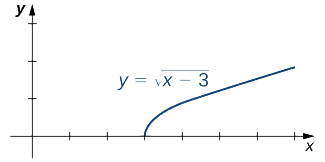
Figure \(\PageIndex{1}\): The graph shows the function \(f(x)=\sqrt{x−3}\).- The function \(f(x)=\sqrt{x−3}\) is defined over the interval \([3,\infty)\). Since this function is not defined to the left of 3, we cannot apply the Limit Laws to compute \(\displaystyle\lim_{x \to 3^−}\sqrt{x−3}\). In fact, since \(f(x)=\sqrt{x−3}\) is undefined to the left of 3, \(\displaystyle\lim_{x \to 3^−}\sqrt{x−3}\) does not exist.
- Since \(f(x)=\sqrt{x−3}\) is defined for \( x > 3 \), the Limit Laws apply to \(\displaystyle\lim_{x \to 3^+}\sqrt{x−3}\). By applying these Limit Laws we obtain \(\displaystyle\lim_{x \to 3^+}\sqrt{x−3}=0\).
In Example \(\PageIndex{6}\), we look at the one-sided limits of a piecewise-defined function and use these limits to draw a conclusion about a two-sided limit of the same function.
For\[f(x)=\begin{cases}4x−3, & \mathrm{if} \; x<2 \\ (x−3)^2, & \mathrm{if} \; x \geq 2\end{cases},\nonumber \]evaluate each of the following limits:
- \(\displaystyle \lim_{x \to 2^−}f(x)\)
- \(\displaystyle \lim_{x \to 2^+}f(x)\)
- \(\displaystyle \lim_{x \to 2}f(x)\)
- Solutions
-
Figure \(\PageIndex{2}\) illustrates the function \(f(x)\) and aids in our understanding of these limits.

Figure \(\PageIndex{2}\): This graph shows a function \(f(x)\).- Since \(f(x)=4x−3\) for all \(x\) in \((−\infty,2)\), replace \(f(x)\) in the limit with \(4x−3\) and apply the Limit Laws:\[\lim_{x \to 2^−}f(x)=\lim_{x \to 2^−}(4x−3)=5\nonumber \]
- Since \(f(x)=(x−3)^2\) for all \(x\) in \((2,+\infty)\), replace \(f(x)\) in the limit with \((x−3)^2\) and apply the Limit Laws:\[\lim_{x \to 2^+}f(x)=\lim_{x \to 2^−}(x−3)^2=1. \nonumber \]
- Since \(\displaystyle \lim_{x \to 2^−}f(x)=5\) and \(\displaystyle \lim_{x \to 2^+}f(x)=1\), we conclude that \(\displaystyle \lim_{x \to 2}f(x)\) does not exist.
Graph\[f(x)=\begin{cases}−x−2, & \mathrm{if} \; x<−1\\ 2, & \mathrm{if} \; x=−1 \\ x^3, & \mathrm{if} \; x>−1\end{cases}\nonumber \]and evaluate \(\displaystyle \lim_{x \to −1^−}f(x)\).
- Answer
-

\[\lim_{x \to −1^−}f(x)=−1\nonumber \]
Breaking the (Limit) Laws
As stated in earlier, the Limit Laws can only be applied when the component limits are finite. A very common mistake made early in Calculus is for a student to think that they can apply the Limit Laws to any limit - again, this is not true.
Evaluate each of the following limits.
- \( \displaystyle \lim_{x \to 3^+}{\left( (x-3) \cdot \frac{1}{x-3} \right)} \)
- \( \displaystyle \lim_{x \to 3^-}{\left( (x-3)^2 \cdot \frac{1}{x-3} \right)} \)
- \( \displaystyle \lim_{x \to 3^+}{\left( (x-3) \cdot \frac{1}{(x-3)^3} \right)} \)
- Solutions
-
- If we were to try to apply the Product Law for Limits, we would arrive at\[\displaystyle \lim_{x \to 3^+}{(x-3)} \cdot \displaystyle \lim_{x \to 3^+}{\frac{1}{x-3}} = 0 \cdot \infty = 0 \text{ or is it } \infty? \nonumber\]This is wrong on several levels.
First, what is the product of something approaching \(0\) and something approaching \(\infty\)? This is a key difference between Algebra and Calculus. In Algebra, you are consistently dealing with finite values and, as such, the rules of Arithmetic apply neatly. In Calculus, you are dealing with levels of infinity (and the infinitesimal). These concepts do not obey the traditional rules of Arithmetic.
The second issue is that we are breaking the Limit Laws! Remember, you can only use the Limit Laws if the component limits exist and are finite.
So, how would you deal with the given limit? We begin by performing some very simple Algebra.\[\displaystyle \lim_{x \to 3^+}{\left( (x-3) \cdot \frac{1}{x-3} \right)} = \displaystyle \lim_{x \to 3^+}{\left( \cancel{(x-3)} \cdot \frac{1}{\cancel{(x-3)}} \right)} = \displaystyle \lim_{x \to 3^+}{1} = 1 \nonumber\] - Trying to apply the Product Law for Limits, we would get\[\displaystyle \lim_{x \to 3^-}{(x-3)^2} \cdot \displaystyle \lim_{x \to 3^-}{\frac{1}{x-3}} = 0 \cdot -\infty = 0 \text{ or is it } -\infty? \nonumber\]Just like part a, we are improperly trying to apply the Limit Laws in a situation where they are not applicable. That second limit, approaching \(-\infty\), prevents us from using the Limit Laws. Instead, the proper way to evaluate this limit is to use some simple Algebra first.\[\displaystyle \lim_{x \to 3^-}{\left( (x-3)^2 \cdot \frac{1}{x-3} \right)} = \displaystyle \lim_{x \to 3^-}{(x-3)} = 0 \nonumber\]
- Again, incorrectly applying the Product Law for Limits, we would get\[\displaystyle \lim_{x \to 3^+}{(x-3)} \cdot \displaystyle \lim_{x \to 3^+}{\frac{1}{(x-3)^3}} = 0 \cdot \infty = 0 \text{ or is it } \infty? \nonumber\]As in the previous two examples, we are breaking the Limit Laws because one of the component limits is not finite. We should have performed some simple Algebra first.\[\displaystyle \lim_{x \to 3^+}{\left( (x-3) \cdot \frac{1}{(x-3)^3} \right)} = \displaystyle \lim_{x \to 3^+}{\left( \frac{1}{\cancel{(x-3)^2}} \right)} = \infty \nonumber\]
- If we were to try to apply the Product Law for Limits, we would arrive at\[\displaystyle \lim_{x \to 3^+}{(x-3)} \cdot \displaystyle \lim_{x \to 3^+}{\frac{1}{x-3}} = 0 \cdot \infty = 0 \text{ or is it } \infty? \nonumber\]This is wrong on several levels.
Pay close attention to Example \(\PageIndex{7}\). It should serve as a warning that anytime you reach an "answer" of the form \(0 \cdot \infty\), you are wrong.
The Squeeze Theorem
The techniques we have developed thus far work well for algebraic functions. However, we still need to evaluate the limits of elementary trigonometric functions. The next theorem, called the Squeeze Theorem, proves very useful for establishing basic trigonometric limits. It also helps us evaluate very abstract and theoretical limits for functions that cannot be described using simple functions from our Algebra courses. This theorem allows us to calculate limits by "squeezing" a function, with a limit at a point \(a\) that is unknown, between two functions having a common known limit at \(a\). Figure \(\PageIndex{3}\) illustrates this idea.

Figure \(\PageIndex{3}\): The Squeeze Theorem applies when \(f(x) \leq g(x) \leq h(x)\) and \(\displaystyle \lim_{x \to a}f(x)=\lim_{x \to a}h(x)\).
Let \(f(x)\) ,\(g(x)\), and \(h(x)\) be defined for all \(x \neq a\) over an open interval containing \(a\). If\[f(x) \leq g(x) \leq h(x) \nonumber \]for all \(x \neq a\) in an open interval containing \(a\) and\[\lim_{x \to a}f(x)=L=\lim_{x \to a}h(x) \nonumber \]where \(L\) is a real number, then \(\displaystyle \lim_{x \to a}g(x)=L.\)
Evaluate \(\displaystyle \lim_{x \to 0}{\left(x\cos{(x)}\right)}\).
- Solution
-
If we were to try to evaluate this limit using the Limit Laws, we would arrive at\[\displaystyle \lim_{x \to 0}{\left(x\cos{(x)}\right)} = \displaystyle \lim_{x \to 0}{(x)} \cdot \displaystyle \lim_{x \to 0}{\cos{(x)}} = 0 \cdot \text{... ummm... what is this?} \nonumber \]I get it, you are going to say, "But, I know that \(\cos{(x)}\) approaches \(1\) as \(x\) approaches \(0\)!" However, our theory up to this point only includes algebraic functions (specifically, polynomial and rational functions). Therefore, our "intuition" of what this limit will be is not allowed.
We have the limit of the product of two functions. We know the limit of one of those functions; however, if we don't know the limit of the other function, or if we know the limit of the other function does not exist, the Squeeze Theorem can be very helpful if you can bound the function with the unknown or undefined limit.
In this case, we don't (officially) know the limit of the cosine as \(x\) is approaching \(1\). So, we build a bound for this function.\[ -1 \le \cos{(x)} \le 1 \nonumber \]We now rebuild the original limit by multiplying all three "sides" of this inequality by \(x\). Before we do so, it is important to note two things: \(x \neq 0\) and we don't know the sign of \(x\). The first statement is just peripherally important so we know that we are not getting something trivial like \(0 \le 0 \le 0\). The second statement is just for completeness. If \(x \gt 0\), then we would get\[ -x \le x \cos{(x)} \le x \nonumber \]If \(x \lt 0\), then the inequality signs switch direction to\[ -x \ge x \cos{(x)} \ge x \nonumber \]In either case, since \( \displaystyle \lim_{x \to 0}{(-x)} = 0 = \displaystyle \lim_{x \to 0}{(x)} \), from the Squeeze Theorem, we obtain \( \displaystyle \lim_{x \to 0}{(x \cos{(x)})} = 0 \). The graphs of \(f(x)=−x,\;g(x)=x\cos x\), and \(h(x)=x\) are shown in Figure \(\PageIndex{4}\).
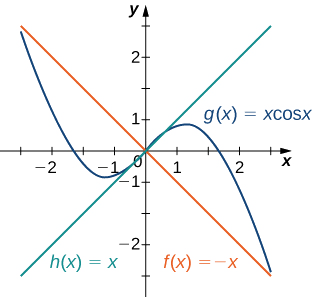
Figure \(\PageIndex{4}\): The graphs of \(f(x),\,g(x)\), and \(h(x)\) are shown around the point \(x=0\).
Use the Squeeze Theorem to evaluate \(\displaystyle \lim_{x \to 0}x^2 \sin\frac{1}{x}\).
- Hint
-
Use the fact that \(−x^2 \leq x^2\sin (1/x) \leq x^2\) to help you find two functions such that \(x^2\sin (1/x)\) is squeezed between them.
- Answer
-
0
Limits Involving the Sine and Cosine
We now use the Squeeze Theorem to tackle several fundamental limits presented as a theorem here. Although this discussion is lengthy, these limits prove invaluable for the development of the material involving trigonometric functions for the rest of Calculus.
\[ \displaystyle \lim_{\theta \to 0}{\left(\sin{(\theta)}\right)} = 0 \nonumber \]and\[ \displaystyle \lim_{\theta \to 0}{\left(\cos{(\theta)}\right)} = 1 \nonumber\]
- Proof
-
The first of these limits is \( \displaystyle \lim_{\theta \to 0}{\left( \sin{(\theta)} \right)} \). Consider the unit circle shown in Figure \(\PageIndex{5}\). In the figure, we see that \(\sin{(\theta)}\) is the \(y\)-coordinate on the unit circle, and it corresponds to the line segment shown in blue. The radian measure of angle \(\theta\) is the length of the arc it subtends on the unit circle. Therefore, we see that for \(0 \lt \theta \lt \dfrac{\pi}{2},\) we have \(0 \lt \sin{(\theta)} \lt \theta.\)

Figure \(\PageIndex{5}\): The sine function is shown as a line on the unit circle.Because \(\displaystyle \lim_{\theta \to 0^+} 0 = 0\) and \(\displaystyle \lim_{\theta \to 0^+} \theta =0\), by using the Squeeze Theorem we conclude that\[\lim_{\theta \to 0^+}{\left( \sin{(\theta)} \right)} = 0.\nonumber \]To see that \(\displaystyle \lim_{\theta \to 0^−}{\left( \sin{(\theta)} \right) } = 0\) as well, observe that for \(−\dfrac{\pi}{2} \lt \theta \lt 0, 0 \lt −\theta \lt \dfrac{\pi}{2}\) and hence, \(0 \lt \sin{(−\theta)} \lt −\theta\). Consequently, \(0 \lt −\sin{(\theta)} \lt −\theta\). It follows that \(0 \gt \sin{(\theta)} \gt \theta\). An application of the Squeeze Theorem produces the desired limit. Thus, since \(\displaystyle \lim_{\theta \to 0^+}{\sin{(\theta)}} = 0\) and \(\displaystyle \lim_{\theta \to 0^−}{\sin{(\theta)}} = 0\),\[\lim_{\theta \to 0}{\sin{(\theta)}} = 0\nonumber \]Next, using the identity \(\cos{(\theta)}=\sqrt{1−\sin^2{(\theta)}}\) for \(−\dfrac{\pi}{2} \lt \theta \lt \dfrac{\pi}{2}\), we see that\[\lim_{\theta \to 0}{(\cos{(\theta)})} = \lim_{\theta \to 0}{\sqrt{1−\sin^2{(\theta)}}} = 1.\nonumber \]
The theorem just introduced is the reason we stated way back in the first section that radians must be used when working in Calculus. The proof of both limits require radian measure. As such, all of the Calculus we build surrounding the trigonometric functions relies on us using radian measure. That is, Calculus and degree measure do not get along!
We now take a look at two limits that play important roles in later chapters.
\[ \displaystyle \lim_{\theta \to 0}{\frac{\sin{\theta}}{\theta} } = 1 \nonumber \]and\[ \displaystyle \lim_{\theta \to 0}{\frac{1 - \cos{\theta}}{\theta} } = 0 \nonumber \]
- Proof
-
To prove the first of these limits, we use the unit circle in Figure \(\PageIndex{6}\). Notice that this figure adds one additional triangle to Figure \(\PageIndex{6}\) from the proof of the previous theorem. We see that the length of the side opposite angle \(\theta\) in this new triangle is \(\tan{(\theta)}\). Thus, we see that for \(0 \lt \theta \lt \dfrac{\pi}{2}\), we have \(\sin{(\theta)} \lt \theta \lt \tan{(\theta)}\).

Figure \(\PageIndex{6}\): The sine and tangent functions are shown as lines on the unit circle.By dividing by \(\sin{(\theta)}\) in all parts of the inequality, we obtain\[1 \lt \dfrac{\theta}{\sin{(\theta)}} \lt \dfrac{1}{\cos{(\theta)}}.\nonumber \]Equivalently, we have\[1 \gt \dfrac{\sin{(\theta)}}{\theta} \gt \cos{(\theta)}.\nonumber \]Since \(\displaystyle \lim_{\theta \to 0^+}1 = 1 = \lim_{\theta \to 0^+}\cos{(\theta)}\), we conclude that \(\displaystyle \lim_{\theta \to 0^+}\dfrac{\sin{(\theta)}}{\theta} = 1\), by the Squeeze Theorem. By applying a manipulation similar to that used in demonstrating that \(\displaystyle \lim_{\theta \to 0^-}{(\sin{(\theta)})} = 0\), we can show that \(\displaystyle \lim_{\theta \to 0^−}\dfrac{\sin{(\theta)}}{\theta} = 1\). Thus,\[\lim_{\theta \to 0}\dfrac{\sin{(\theta)}}{\theta}=1. \nonumber \]In Example \(\PageIndex{9}\), we use this limit to establish \(\displaystyle \lim_{\theta \to 0}\dfrac{1−\cos{(\theta)}}{\theta}=0\). This limit will also prove useful in later chapters.
Evaluate \(\displaystyle \lim_{ \theta \to 0 }\dfrac{1−\cos \theta }{ \theta }\).
- Solution
-
In the first step, we multiply by the conjugate so that we can use a trigonometric identity to convert the cosine in the numerator to a sine:\[\begin{array}{rcl}
\lim_{ \theta \to 0}\dfrac{1−\cos \theta }{ \theta } & = & \displaystyle \lim_{ \theta \to 0}\dfrac{1−\cos \theta }{ \theta } \cdot \dfrac{1+\cos \theta }{1+\cos \theta }\\[8pt]
&=& \lim_{ \theta \to 0}\dfrac{1−\cos^2 \theta }{ \theta (1+\cos \theta )}\\[8pt]
&= &\lim_{ \theta \to 0}\dfrac{\sin^2 \theta }{ \theta (1+\cos \theta )}\\[8pt]
&= &\lim_{ \theta \to 0}\dfrac{\sin \theta }{ \theta } \cdot \dfrac{\sin \theta }{1+\cos \theta }\\[8pt]
&= &\left(\lim_{ \theta \to 0}\dfrac{\sin \theta }{ \theta } \right)\cdot\left( \lim_{ \theta \to 0} \dfrac{\sin \theta }{1+\cos \theta }\right) \\[8pt]
&= &1 \cdot \dfrac{0}{2}=0. \\
\end{array}\nonumber \]Therefore,\[\lim_{ \theta \to 0}\dfrac{1−\cos \theta }{ \theta }=0. \nonumber \]
Evaluate the following limit.\[ \displaystyle \lim_{\theta \to 0}{\frac{7\theta}{\sin{(5\theta)}}} \nonumber \]
- Solution
- \[ \begin{array}{rclcl}
\displaystyle \lim_{\theta \to 0}{\dfrac{7\theta}{\sin{(5\theta)}}} & = & \displaystyle \lim_{\theta \to 0}{\dfrac{\frac{7}{5}}{\frac{\sin{(5\theta)}}{5 \theta}}} & & \\[8pt]
& = & \dfrac{\displaystyle \lim_{\theta \to 0}{\frac{7}{5}}}{\displaystyle \lim_{\theta \to 0}{\frac{\sin{(5\theta)}}{5 \theta}}} & \quad & \left(\text{Limit Law}\right) \\[8pt]
& = & \dfrac{\frac{7}{5}}{\displaystyle \lim_{\theta \to 0}{\frac{\sin{(5\theta)}}{5 \theta}}} & \quad & \left(\text{Limit Law}\right) \\[8pt]
& = & \dfrac{7}{5} \cdot \dfrac{1}{\displaystyle \lim_{x \to 0}{\frac{\sin{(x)}}{x}}} & \quad & (\text{Let }x = 5\theta\text{. Then }x \to 0\text{ as }\theta \to 0) \\[8pt]
& \overset{\text{D.S.}}{=} & \dfrac{7}{5}\cdot \dfrac{1}{1} & \quad & \left( \text{Direct Substitution} \right) \\[8pt]
& = & \dfrac{7}{5} & & \\
\end{array} \nonumber \]
Evaluate \(\displaystyle \lim_{ \theta \to 0}\dfrac{1−\cos \theta }{\sin \theta }\).
- Answer
-
0
Student Project
Some of the geometric formulas we take for granted today were first derived by methods that anticipate some of the methods of calculus. The Greek mathematician Archimedes (ca. 287−212; BCE) was particularly inventive, using polygons inscribed within circles to approximate the area of the circle as the number of sides of the polygon increased. He never came up with the idea of a limit. Still, we can use this idea to see what his geometric constructions could have predicted about the limit.
We can estimate the area of a circle by computing the area of an inscribed regular polygon. Think of the regular polygon as being made up of \(n\) triangles. By taking the limit as the vertex angle of these triangles goes to zero, you can obtain the area of the circle. To see this, carry out the following steps:
- Express the height \(h\) and the base \(b\) of the isosceles triangle in Figure \(\PageIndex{7}\) in terms of \( \theta \) and \(r\).

Figure \(\PageIndex{7}\) - Using the expressions that you obtained in step 1, express the area of the isosceles triangle in terms of \( \theta \) and \(r\).
(Substitute \(\frac{1}{2}\sin \theta \) for \(\sin\left(\frac{ \theta }{2}\right)\cos\left(\frac{ \theta }{2}\right)\) in your expression.) - If an \(n\)-sided regular polygon is inscribed in a circle of radius \(r\), find a relationship between \( \theta \) and \(n\). Solve this for \(n\). Keep in mind there are \(2 \pi \) radians in a circle. (Use radians, not degrees.)
- Find an expression for the area of the \(n\)-sided polygon in terms of \(r\) and \( \theta \).
- To find a formula for the circle's area, find the expression's limit in step 4 as \( \theta \) goes to zero. (Hint: \(\displaystyle \lim_{ \theta \to 0}\dfrac{\sin \theta }{ \theta }=1)\).
The technique of estimating areas of regions by using polygons is revisited later in this course.