

1.4: Primes, Prime factorization, GCD and LCM
- Page ID
- 131033

\( \newcommand{\vecs}[1]{\overset { \scriptstyle \rightharpoonup} {\mathbf{#1}} } \)
\( \newcommand{\vecd}[1]{\overset{-\!-\!\rightharpoonup}{\vphantom{a}\smash {#1}}} \)
\( \newcommand{\dsum}{\displaystyle\sum\limits} \)
\( \newcommand{\dint}{\displaystyle\int\limits} \)
\( \newcommand{\dlim}{\displaystyle\lim\limits} \)
\( \newcommand{\id}{\mathrm{id}}\) \( \newcommand{\Span}{\mathrm{span}}\)
( \newcommand{\kernel}{\mathrm{null}\,}\) \( \newcommand{\range}{\mathrm{range}\,}\)
\( \newcommand{\RealPart}{\mathrm{Re}}\) \( \newcommand{\ImaginaryPart}{\mathrm{Im}}\)
\( \newcommand{\Argument}{\mathrm{Arg}}\) \( \newcommand{\norm}[1]{\| #1 \|}\)
\( \newcommand{\inner}[2]{\langle #1, #2 \rangle}\)
\( \newcommand{\Span}{\mathrm{span}}\)
\( \newcommand{\id}{\mathrm{id}}\)
\( \newcommand{\Span}{\mathrm{span}}\)
\( \newcommand{\kernel}{\mathrm{null}\,}\)
\( \newcommand{\range}{\mathrm{range}\,}\)
\( \newcommand{\RealPart}{\mathrm{Re}}\)
\( \newcommand{\ImaginaryPart}{\mathrm{Im}}\)
\( \newcommand{\Argument}{\mathrm{Arg}}\)
\( \newcommand{\norm}[1]{\| #1 \|}\)
\( \newcommand{\inner}[2]{\langle #1, #2 \rangle}\)
\( \newcommand{\Span}{\mathrm{span}}\) \( \newcommand{\AA}{\unicode[.8,0]{x212B}}\)
\( \newcommand{\vectorA}[1]{\vec{#1}} % arrow\)
\( \newcommand{\vectorAt}[1]{\vec{\text{#1}}} % arrow\)
\( \newcommand{\vectorB}[1]{\overset { \scriptstyle \rightharpoonup} {\mathbf{#1}} } \)
\( \newcommand{\vectorC}[1]{\textbf{#1}} \)
\( \newcommand{\vectorD}[1]{\overrightarrow{#1}} \)
\( \newcommand{\vectorDt}[1]{\overrightarrow{\text{#1}}} \)
\( \newcommand{\vectE}[1]{\overset{-\!-\!\rightharpoonup}{\vphantom{a}\smash{\mathbf {#1}}}} \)
\( \newcommand{\vecs}[1]{\overset { \scriptstyle \rightharpoonup} {\mathbf{#1}} } \)
\(\newcommand{\longvect}{\overrightarrow}\)
\( \newcommand{\vecd}[1]{\overset{-\!-\!\rightharpoonup}{\vphantom{a}\smash {#1}}} \)
\(\newcommand{\ket}[1]{\left| #1 \right>}\)
\(\newcommand{\bra}[1]{\left< #1 \right|}\)
\(\newcommand{\braket}[2]{\left< #1 \vphantom{#2} \right| \left. #2 \vphantom{#1} \right>}\)
\(\newcommand{\braopket}[3]{\left< #1 \vphantom{#2}\vphantom{#3} \right| #2 \vphantom{#1}\vphantom{#3} \left| #3 \vphantom{#1}\vphantom{#2} \right>}\)
\(\newcommand{\qmvec}[1]{\mathbf{\vec{#1}}}\)
\(\newcommand{\op}[1]{\hat{\mathbf{#1}}}\)
\(\newcommand{\expect}[1]{\langle #1 \rangle}\)
\(\newcommand{\dfn}[1]{\emph{\textbf{#1}}}\)
Definition:
An integer \(p>1\) is prime if its only positive divisors are \(1 \) and \(p\). An integer \(n>1\) that is not prime is composite. Neither \(1\) nor negative integers are prime under this convention.
Example \(\PageIndex{1}\): Method of Sieve of Eratosthenes
Examples of prime numbers are \(2\) (this is the only even prime number), \(3, 5, 7, 11, 13, 17, \ldots\).
Method of Sieve of Eratosthenes:
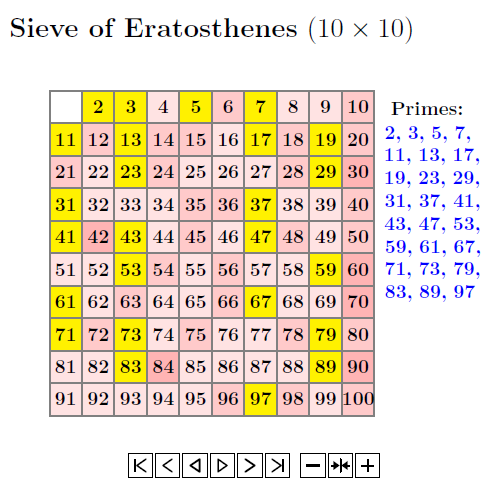
The following will provide a way to determine whether a given number is prime.
Theorem \(\PageIndex{1}\)
Let \(n\) be a composite number with exactly \(3\) positive divisors. Then there exists a prime \(p\) such that \(n=p^2. \)
- Proof
-
Let \(n\) be a positive integer with exactly \(3\) positive divisors. Then two of the positive divisors are \(1\) and \(n.\)
Let \(d \) be the third positive divisor. Then \(1 < d < n \) and the only positive divisors of \(d\) are \(1 \) and \(d.\)
Therefore \(d\) is prime.
Since \(d \mid n\), \(n=md, m \in\mathbb{Z_+}\).
Since \(m \mid n\) and \(1 <m<n, m=d, n=d^2.\)
Thus, \(d \) is prime. \(\Box\)
Theorem \(\PageIndex{2}\)
Every composite number \(n\) has a prime divisor less than or equal to \(\sqrt{n}\). If \(p\) is a prime number and \(p \mid n\), then \(1<p \leq \sqrt{n}.\)
- Proof
-
Suppose \(p\) is the smallest prime divisor of \(n\). Then there exists an integer \(m\) such that \(n=pm\). Assume that \(p > \sqrt{n}\). Then \(m < \sqrt{n}.\)
Let \( q\) be any prime divisor of \(m\). Then \( q \) is also a prime divisor of \(n\) and \( q < m < \sqrt{n} < p.\) This is a contradiction.
Example \(\PageIndex{2}\):
Is \(223\) a prime number?
Solution:
The prime numbers \(< \sqrt{223}\) are as follows: \(2, 3, 5, 7, 11,\) and \(13\). Note that \( 17^2 >223.\)
Since \(223\) is not divisible by any of the prime numbers identified above, \(223\) is a prime number.
Exercise \(\PageIndex{3}\)
Is \(2011\) a prime number?
- Answer
-
yes.
Theorem \(\PageIndex{3}\): Prime divisibility theorem
Let \(p\) be a prime number and let \(a,b \in \mathbb{Z}\). If \(p \mid ab, \) then \(p\mid a\) or \(p\mid b\).
- Proof
-
Let \(p\) be a prime number and let \(a,b \in \mathbb{Z}\) such that \(p \mid ab\). If \(p\mid a\), we are done. So we suppose that \(p\) does not divide \(a\). Since \(p\) is prime, \(gcd(a,p)=1.\) Thus there exists \(x,y \in \mathbb{Z}\) such that \(1=ax+py\). Hence \(b=abx+pby\). Since \(p \mid ab\), \(ab=pm, m\in \mathbb{Z}.\) Thus \(b=pmx+pby=p(mx+by).\) Hence, \(p\mid b.\)
Theorem \(\PageIndex{5}\)
There are infinitely many primes.
- Proof
-
Proof by contradiction.
Suppose the complete list of primes is
\(
p_1,p_2,\ldots,p_n.
\)Define
\(
Q=p_1p_2\cdots p_n+1.
\)Since \(Q>1\), it has some prime divisor \(q\).
For every \(i\),
\(
Q\equiv1\pmod{p_i}.
\)Therefore,
\(
p_i\nmid Q.
\)Thus \(q\) is not among
\(
p_1,\ldots,p_n,
\)
which is a contradiction.
The following theorem explains the gaps between prime numbers:
Theorem \(\PageIndex{5}\)
Let \(n\) be a positive integer. Then there exist \(n\) consecutive composite integers.
- Proof
-
Let \(n\) be an integer. Consider the sequence of integers \[(n+1)!+2, (n+1)!+3,...,(n+1)!+n, (n+1)!+(n+1)\]
Notice that every integer in the above sequence is composite because \(k\) divides \((n+1)!+k\) if \(2\leq k\leq (n+1)\).
Example \(\PageIndex{4}\):
Does there exist a block of \(1000000\) consecutive integers that contains no prime numbers?
Solution
Use \(1000001 !\) and consider \(1000001 ! +2 , \ldots, 1000001!+1000001\)
Example \(\PageIndex{5}\):
Consider the formula \(y=x^2+x+13\). Then
1. Find the values \(y\) for \( x=1, \cdots, 12\). How many of these values are prime?
2. Can we conclude that this formula always generates a prime number?
Definition: Twin primes
Two prime numbers are called twin primes if they differ by \(2\).
Theorem \(\PageIndex{6}\) Fundamental Theorem of Arithmetic (FTA)
Every integer \(n>1\) has a unique prime factorization, up to the order the factors. Equivalently,
\(n=p_1^{n_1} p_2^{n_2} \cdots p_k^{n_k}\), where \(p_1 <p_2< ... <p_k\) are primes and positive integers \(n_1, \cdots, n_k\).
Neither the fundamental theorem nor the proof shows us how to find the prime factors. We can use divisibility tests to find prime factors whenever possible.
Example \(\PageIndex{6}\):
Find the prime factorization of
1. \(252\)
2.\(2018\).
3. \(1000\)
Solution
1. Using divisibility tests, we can find that \(252= 2^2 3^2 7\)
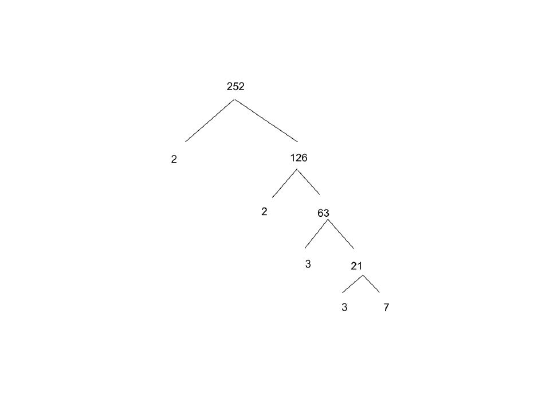
2. We can see that \(2018\) is divisible by 2, and \(2018= 2 \times 1009\). \(1009 \) is prime (why?).
3. \(1000=10^3=((2)(5))^3=2^3 5^3\)
Example \(\PageIndex{7}\):
Find the prime factorization of \(1000001\).
Solution
Consider \(1000001=1000000+1= 10^6+1=(10^2)^3+1^3= (10^2+1^2) (10^4-10^2+1^2)= 101 \times 9901 \). \(101\) and \(9901\) are prime (why?)
Determine \( gcd( 2^6 \times 3^9, 2^4 \times 3^8 \times 5^2)\) and \(lcm( 2^6 \times 3^9, 2^4 \times 3^8 \times 5^2)\).
Solution
\( gcd( 2^6 \times 3^9, 2^4 \times 3^8 \times 5^2)= 2^4 \times 3^8\) (the lowest powers of all prime factors that appear in both factorizations) and \(lcm( 2^6 \times 3^9, 2^4 \times 3^8 \times 5^2)= 2^6 \times 3^9 \times 5^2\) (the largest powers of each prime factors that appear in factorizations).
For \(a,b>0\) with prime factorizations, the GCD uses minimum exponents; the LCM uses maximum exponents.
Note: Conjectures
Goldbach's Conjecture(1742)
Every even integer \(n >2\) is the sum of two primes.
Goldbach's Ternary Conjecture:
Every odd integer \(n \geq 5 \) is the sum of at most three primes.
Wilson's Theorem
Let \(p\) be a prime number. Then \((p - 1)! + 1\) is divisible by \(p\).
- Proof:
-
Consider the product \(P = 1 \cdot 2 \cdot 3 \cdots (p-1)\). Now, let's pair each number \(k\) from \(1\) to \(p-1\) with its modular inverse \(k^{-1}\) modulo \(p\).
We know that for every \(k\) such that \(1 \leq k \leq p-1\), there exists a unique \(k^{-1}\) such that \(kk^{-1} \equiv 1 \pmod{p}\). Moreover, these pairs will be distinct because if \(kk^{-1} \equiv 1 \pmod{p}\) and \(jj^{-1} \equiv 1 \pmod{p}\) for \(k \neq j\), then \(k = kj^{-1}\) and \(j = jk^{-1}\), implying \(k = j\), which contradicts the distinctness of the pairs.
Thus, we can pair each \(k\) with \(k^{-1}\) such that the product of these pairs is congruent to \(1 \pmod{p}\). Therefore, \(P \equiv (p-1)! \equiv -1 \pmod{p}\). Adding \(1\) to both sides gives \((p-1)! + 1 \equiv 0 \pmod{p}\), which means \((p-1)! + 1\) is divisible by \(p\).
Fermat's Little Theorem
For any prime number \( p \) and any positive integer \( a \) such that \( p \) does not divide \( a \), we have \( a^{p-1} \equiv 1 \pmod{p} \).
If \(n\) is prime, then by Fermat's little theorem, \(a^{(n-1)}\equiv 1\pmod \, n),\) for all integers \(a\) that are relatively prime to \(n.\) Thus, if \(gcd(a,n)=1\) and \(n\) is prime then \(a^{-1}\equiv a^{(n-2)} \pmod n),\)
Euler's Theorem
If \(a\) and \(n\) are relatively prime (i.e., \(\gcd(a, n) = 1\)), then \[ a^{\phi(n)} \equiv 1 \pmod{n} \]
The following results will help us find Euler's totient function \(\phi(n)\) for \(n\in \mathbb{N}\).
1. If \(p\) is prime then \(\phi(p)=p-1.\)
2. If \(p\) is prime and \(k\) is a positive integer then \(\phi(p^k)=p^k-p^{k-1}.\)
3. If \(m\) and \(n\) are relatively prime, then \(\phi(mn)=\phi(m)\phi(n).\)
4. \[ \phi(n) = n \times \prod_{p|n} \left(1 - \frac{1}{p}\right) \] where the product is taken over distinct prime factors \(p\) of \(n.\)
Find \(\phi(252)\).
Solution
Since \(252= 2^2 3^2 7\), \(\phi(252)=(2^2-2)(3^2-3)(7-1)=72\).